Magnetic Carbon Nanofoam Market Size, Share Demand Report By Type (Powdered Nanofoam, Composite Nanofoam, Monolithic Nanofoam), By Application (Energy Storage Systems, Environmental Remediation, Biomedical Applications, Electronics), By End-Use Industry (Electronics Industry, Aerospace & Defense, Healthcare Industry, Energy Sector), By Material Composition (Carbon with Metallic Inclusions, Pure Carbon Nanofoam, Hybrid Nanomaterials), By Region & Segment Forecasts, 2025–2034
USD 3950
Market Overview
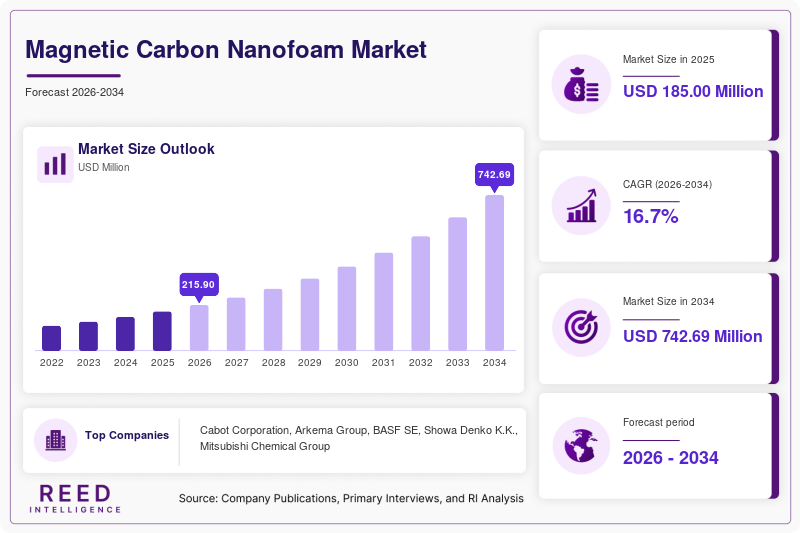
The Magnetic Carbon Nanofoam Market size was valued at approximately USD 185 million in 2025 and is projected to reach USD 742 million by 2034, expanding at a CAGR of 16.7% during 2025–2034. The market growth is being supported by the increasing demand for advanced nanomaterials with unique magnetic and structural properties across electronics, energy storage, environmental remediation, and biomedical applications. Magnetic carbon nanofoam, characterized by its low density, high surface area, and intrinsic ferromagnetic behavior, is gaining traction in high-performance and research-intensive applications.
A key global factor driving the Magnetic Carbon Nanofoam Market is the rising investment in nanotechnology and material science innovation. Governments and private institutions are increasingly funding research programs to develop multifunctional nanomaterials for next-generation technologies, thereby accelerating commercialization opportunities for magnetic carbon nanofoam.
Key Highlights
- North America dominated the market with a 36.4% share in 2025, while Asia Pacific is expected to grow at the fastest CAGR of 18.9%.
- By type, powdered nanofoam led with a 41.7% share, while composite-based nanofoam is projected to grow at a CAGR of 19.4%.
- By application, energy storage systems accounted for the largest share at 34.2%, while biomedical applications are anticipated to grow at a CAGR of 20.1%.
- The United States remained the dominant country with a market size of USD 58 million in 2025, expected to reach USD 65 million in 2026.
Market Trends
Integration in Energy Storage Technologies
Magnetic carbon nanofoam is increasingly being integrated into advanced energy storage systems such as supercapacitors and lithium-ion batteries. Its high surface area and conductivity enhance charge storage capacity and energy efficiency. The trend is further supported by the global transition toward renewable energy and electric mobility, where efficient energy storage materials are critical.
Expanding Role in Biomedical Applications
The use of magnetic carbon nanofoam in biomedical applications is gaining attention due to its biocompatibility and magnetic responsiveness. It is being explored for targeted drug delivery, imaging, and cancer treatment techniques such as hyperthermia therapy. As healthcare systems shift toward precision medicine, this material is expected to play a significant role in enabling advanced therapeutic solutions.
Market Drivers
Rising Demand for Advanced Functional Materials
Industries such as electronics, aerospace, and energy are increasingly seeking lightweight, durable, and multifunctional materials. Magnetic carbon nanofoam meets these requirements by offering a combination of structural strength and magnetic properties. This demand is significantly contributing to the expansion of the Magnetic Carbon Nanofoam Market.
Growth in Environmental Remediation Applications
Magnetic carbon nanofoam is being utilized in water purification and pollutant removal due to its adsorption capacity and magnetic separability. Its ability to efficiently remove heavy metals and organic contaminants from water sources is driving adoption in environmental applications. Increasing global focus on sustainability and water management is further fueling this growth.
Market Restraint
High Production Costs and Limited Scalability
One of the major challenges in the Magnetic Carbon Nanofoam Market is the high cost associated with production and limited scalability of manufacturing processes. The synthesis of magnetic carbon nanofoam often requires advanced equipment, controlled environments, and specialized raw materials, which increase overall production costs.
Additionally, the lack of standardized production techniques and the complexity of maintaining consistent material properties hinder large-scale commercialization. Small and medium enterprises face barriers in adopting this technology due to capital-intensive requirements. These factors collectively limit widespread adoption, especially in cost-sensitive markets.
Market Opportunities
Advancements in Nanomanufacturing Techniques
Innovations in nanomanufacturing processes are expected to reduce production costs and improve scalability. Techniques such as chemical vapor deposition and templated synthesis are being optimized to enhance efficiency and output. These advancements present significant growth opportunities for market players.
Expansion into Defense and Aerospace Applications
Magnetic carbon nanofoam is emerging as a promising material for defense and aerospace applications due to its lightweight and electromagnetic properties. It can be used in stealth technology, sensors, and shielding applications. Increasing defense budgets and technological advancements are expected to create new avenues for market expansion.
Segmental Analysis
By Type
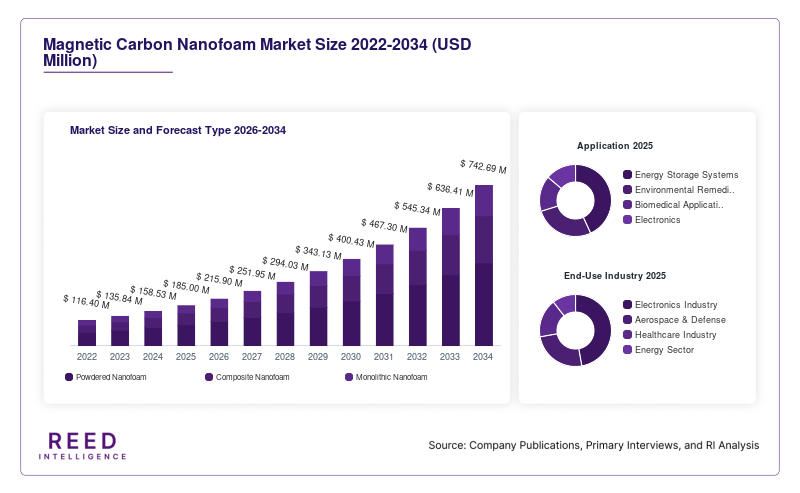
The powdered nanofoam segment dominated the Magnetic Carbon Nanofoam Market with a 41.7% share in 2025, owing to its ease of integration into various applications such as coatings and composites.
Composite-based nanofoam is expected to grow at the fastest CAGR of 19.4%, driven by its enhanced mechanical and functional properties. Its ability to combine magnetic and structural benefits makes it suitable for high-performance applications.
By Application
Energy storage systems held the largest share at 34.2% in 2025, supported by increasing demand for efficient batteries and capacitors.
Biomedical applications are projected to grow at a CAGR of 20.1%, driven by advancements in targeted therapies and diagnostic technologies.
By End-Use Industry
The electronics industry dominated with a 29.5% share in 2025, due to the growing demand for miniaturized and high-performance components.
The aerospace and defense sector is expected to grow at a CAGR of 18.7%, supported by increasing adoption of lightweight and multifunctional materials.
By Material Composition
Carbon-based nanofoam with metallic inclusions led with a 46.3% share in 2025, due to its enhanced magnetic properties.
Hybrid nanomaterials are expected to grow at a CAGR of 19.8%, driven by ongoing research in multifunctional materials.
Regional Analysis
North America
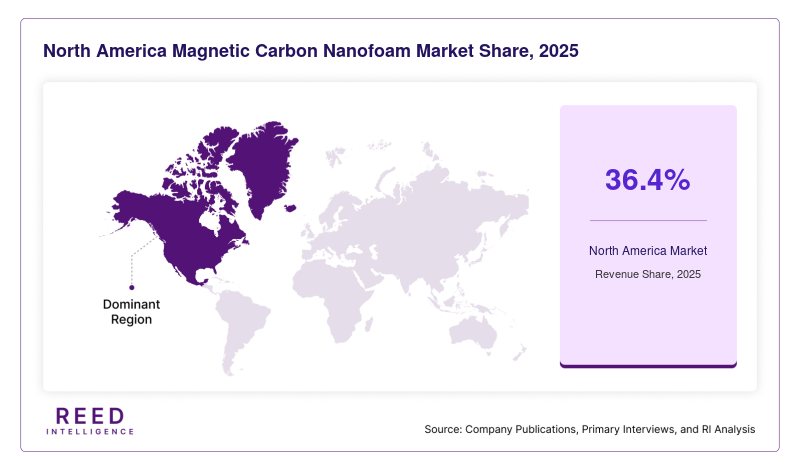
North America accounted for 36.4% of the Magnetic Carbon Nanofoam Market share in 2025 and is expected to grow at a CAGR of 15.8% during the forecast period. The region’s dominance is attributed to strong research infrastructure, high investment in nanotechnology, and the presence of leading market players.
The United States led the region due to its robust innovation ecosystem and extensive funding for advanced materials research. The country’s focus on energy storage solutions and environmental technologies has accelerated the adoption of magnetic carbon nanofoam.
Europe
Europe held a 27.1% market share in 2025 and is projected to grow at a CAGR of 15.2%. The region benefits from stringent environmental regulations and increasing demand for sustainable materials.
Germany emerged as the dominant country due to its strong industrial base and emphasis on advanced manufacturing. The country’s investments in clean energy and automotive innovation have supported the growth of nanofoam applications.
Asia Pacific
Asia Pacific accounted for 22.3% of the market in 2025 and is expected to grow at the fastest CAGR of 18.9%. Rapid industrialization and increasing R&D activities are key factors driving growth.
China dominated the region due to its expanding electronics and energy sectors. Government initiatives supporting nanotechnology development have further accelerated market growth.
Middle East & Africa
The Middle East & Africa region held a 7.2% market share in 2025 and is projected to grow at a CAGR of 14.1%. Growth is driven by increasing investments in water treatment and energy infrastructure.
The United Arab Emirates led the region due to its focus on sustainable development and adoption of advanced materials in environmental applications.
Latin America
Latin America accounted for 7.0% of the market in 2025 and is expected to grow at a CAGR of 14.5%. The region is witnessing increasing adoption of nanomaterials in industrial and environmental sectors.
Brazil dominated the region due to its growing research capabilities and demand for advanced materials in energy and environmental applications.
Competitive Landscape
The Magnetic Carbon Nanofoam Market is moderately fragmented, with several global and regional players focusing on research and product development. Companies are investing in advanced manufacturing technologies and strategic collaborations to strengthen their market position.
One of the leading players, Cabot Corporation, has been actively expanding its portfolio of advanced carbon materials. The company recently announced developments in nanofoam-based solutions for energy storage applications, highlighting its focus on innovation.
Other key players are focusing on partnerships with research institutions and expanding their production capabilities to meet growing demand. Continuous innovation and technological advancements remain key competitive strategies in this market.
Key Players List
- Cabot Corporation
- Arkema Group
- BASF SE
- Showa Denko K.K.
- Mitsubishi Chemical Group
- Nanocyl SA
- OCSiAl Group
- Hyperion Catalysis International
- Zyvex Technologies
- Thomas Swan & Co. Ltd.
- Cheap Tubes Inc.
- NanoAmor Inc.
- Graphene Laboratories Inc.
- ACS Material LLC
- Sigma-Aldrich Corporation
Recent Developments
- 2024: Cabot Corporation introduced a new nanofoam material designed for high-performance battery applications.
- 2024: BASF SE announced collaboration with research institutes to develop sustainable nanofoam production methods.
- 2023: Arkema Group expanded its nanomaterials portfolio with advanced carbon-based solutions.
- 2023: OCSiAl Group invested in scaling up production capacity for nano-enabled materials.
- 2023: Mitsubishi Chemical Group launched new R&D initiatives focusing on multifunctional nanomaterials.
Magnetic Carbon Nanofoam Market Segments
Type
- Powdered Nanofoam
- Composite Nanofoam
- Monolithic Nanofoam
Application
- Energy Storage Systems
- Environmental Remediation
- Biomedical Applications
- Electronics
End-Use Industry
- Electronics Industry
- Aerospace & Defense
- Healthcare Industry
- Energy Sector
Material Composition
- Carbon with Metallic Inclusions
- Pure Carbon Nanofoam
- Hybrid Nanomaterials
By Region
- North America
- Europe
- APAC
- Middle East and Africa
- LATAM