Magnetic Drive Pumps Market Size, Share & Trends Analysis Report By Type (Stainless Steel, Reinforced Polypropylene, Polyvinylidene Fluoride), By Product (Rotating Shaft Magnetic Drive Pumps, Stationary Shaft Magnetic Drive Pumps), By Flow Rate (Up to 80 m³/hr, 81–200 m³/hr, 201–500 m³/hr, Above 500 m³/hr), By Application (Chemical Industry, Oil and Gas, Pharmaceuticals, Aerospace and Defence, Food and Beverages) Forecasts 2026–2034
USD 3950
Magnetic Drive Pumps Market Size
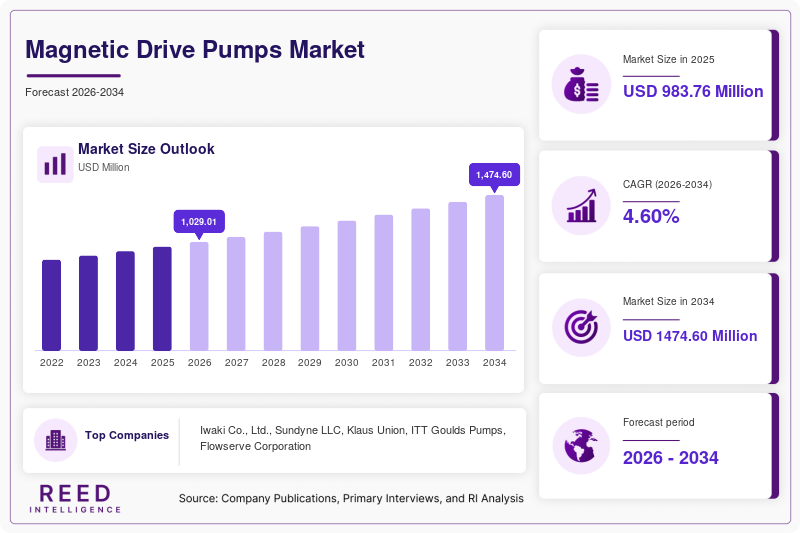
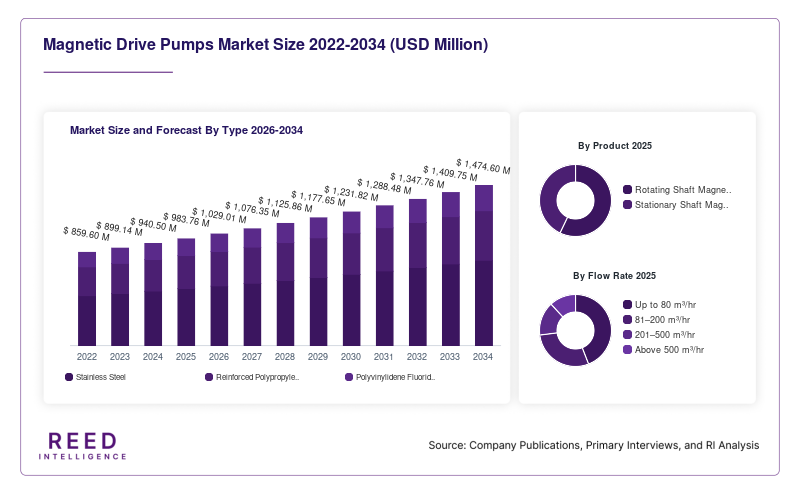
The global magnetic drive pumps market size was valued at USD 983.76 million in 2025 and is projected to grow from USD 1,029.01 million in 2026 to USD 1,474.60 million by 2034, registering a CAGR of 4.60% during the forecast period from 2026 to 2034.
The magnetic drive pumps market includes pumps that transfer mechanical power through magnetic coupling rather than a conventional shaft passing through the pump casing. This seal-less configuration helps reduce the risk of leakage and makes magnetic drive pumps suitable for selected applications involving corrosive, toxic, hazardous, and high-purity fluids.
These pumps are used across chemical processing, oil and gas, pharmaceutical manufacturing, food and beverage processing, and other industrial operations. Their value proposition includes improved fluid containment, reduced dependence on mechanical shaft seals, and the potential to lower leakage-related maintenance requirements.
Magnetic Drive Pumps Market Drivers
Increasing Demand for Leak-Resistant Pumping Systems
Magnetic drive pumps are designed to transfer power without a conventional dynamic shaft seal, reducing one potential source of leakage. This feature is valuable in applications involving hazardous, corrosive, toxic, or costly fluids. Industrial facilities may adopt these pumps to support process containment, improve workplace safety, reduce product loss, and limit the risk of environmental incidents. Demand is shaped by the fluid being handled, the consequences of leakage, and the technical suitability of the pump.
Expansion of Chemical and Pharmaceutical Manufacturing
Chemical manufacturing requires reliable equipment for transferring a broad range of process fluids, including corrosive chemicals and specialized intermediates. Pharmaceutical manufacturing also places importance on controlled fluid handling, cleanliness, and material compatibility. Magnetic drive pumps can serve suitable processes where leakage reduction is a priority. Investment in production capacity, facility modernization, and specialized manufacturing processes supports potential demand for seal-less pumping equipment.
Greater Focus on Operational Reliability and Environmental Protection
Industrial operators seek to reduce unplanned maintenance, minimize process interruptions, and manage the environmental risks associated with fluid leakage. Magnetic drive pumps can eliminate routine maintenance associated with conventional dynamic shaft seals in suitable applications. Their use may reduce certain maintenance requirements and leakage-related risks, although performance depends on installation, operating conditions, and maintenance practices.
Magnetic Drive Pumps Market Restraints
High Initial Equipment and Replacement Costs
Magnetic drive pumps can require specialized magnetic couplings, containment components, corrosion-resistant materials, and application-specific engineering. These features can increase initial acquisition costs compared with some conventional pump designs. Replacement components and specialized servicing can also affect lifecycle costs. Smaller facilities or cost-sensitive projects may therefore evaluate whether the benefits of seal-less operation justify the additional investment.
Technical Limitations and Application-Specific Requirements
Magnetic drive pumps are not suitable for all fluid-handling applications. Excessive temperatures, pressure conditions, high viscosity, abrasive solids, dry running, and chemical incompatibility can compromise performance or reliability. Magnetic coupling designs also have torque and heat-generation limitations. Selecting an unsuitable pump can lead to reduced performance or equipment damage, making technical assessment and correct installation essential.
Magnetic Drive Pumps Market Opportunities
Growing Use in Pharmaceutical and High-Purity Processes
Pharmaceutical and high-purity manufacturing offers opportunities for magnetic drive pump suppliers where process containment, fluid purity, and material compatibility are important. Manufacturers can develop configurations suited to specific production requirements and provide technical support for installation, operation, and maintenance. The opportunity depends on the relevant process specifications, cleaning requirements, and suitability of magnetic drive technology for each fluid-transfer stage.
Advances in Materials and Pump Engineering
Developments in corrosion-resistant materials, magnetic coupling technology, containment design, and hydraulic efficiency can help manufacturers address more demanding industrial requirements. Application-specific designs may support the transfer of aggressive chemicals and other challenging fluids while helping operators manage reliability and maintenance. Suppliers can also pursue retrofit opportunities where existing pumping equipment presents leakage or maintenance challenges, provided the operating conditions are compatible with magnetic drive technology.
Magnetic Drive Pumps Market Segmental Analysis
By Type
Stainless steel is identified as the dominant material segment, supported by its mechanical strength, durability, and suitability for a range of industrial fluid-handling environments. Stainless steel magnetic drive pumps can be used in chemical processing, oil and gas, and other applications requiring robust equipment. The appropriate grade must be selected according to the fluid's chemical properties, temperature, pressure, and corrosion potential.
Reinforced polypropylene pumps are used in applications where chemical resistance, low weight, and cost considerations are important. They can support selected corrosive-fluid handling requirements in chemical processing and water treatment. Their suitability depends on operating temperature, pressure, fluid compatibility, and the mechanical demands of the system.
PVDF is used in applications that require resistance to a range of aggressive chemicals and reliable performance in specialized industrial environments. PVDF magnetic drive pumps can be considered for chemical processing and selected high-purity applications. Adoption depends on fluid composition, temperature, pressure, and the compatibility of all wetted components.
By Product
Rotating shaft magnetic drive pumps serve industrial fluid-transfer applications requiring appropriate flow characteristics, reliable operation, and compatibility with existing process systems. Demand is associated with their use in established industrial processes. Purchasing decisions depend on hydraulic performance, the nature of the fluid, maintenance requirements, and operating conditions.
Stationary shaft magnetic drive pumps are a specialized product category for selected seal-less fluid-handling applications. Their potential benefits include reduced leakage risk and fewer maintenance requirements associated with conventional dynamic shaft seals. Demand depends on the configuration's ability to meet the required flow, pressure, temperature, and fluid-compatibility specifications.
Fastest-growing product segment: A reliably verified segment-specific CAGR is not established here. Growth should not be attributed to either product category without comparable, market-specific evidence.
By Flow Rate
The up-to-80 m³/hr category serves small- and medium-capacity processes where controlled fluid transfer and compact equipment are required. Applications can include chemical processing, water treatment, and selected pharmaceutical and food-processing operations. Demand depends on required flow, process layout, fluid properties, and installation costs.
The 81–200 m³/hr segment serves medium-capacity industrial operations that require greater throughput than smaller systems. Applications can include chemical manufacturing and general process industries. Pump selection is influenced by hydraulic performance, fluid characteristics, operating pressure, and reliability requirements.
Pumps in the 201–500 m³/hr category serve higher-throughput industrial processes. Buyers assess flow stability, operating efficiency, material durability, and the need to limit leakage when handling challenging fluids. Suitability depends on pump engineering, system design, and lifecycle operating requirements.
The above-500 m³/hr category addresses high-volume fluid-transfer requirements in selected industrial applications. Equipment selection requires careful assessment of flow, pressure, temperature, fluid properties, energy use, and magnetic coupling limitations. Not every high-volume application is suitable for magnetic drive technology.
By Application
The chemical industry is a key application area because manufacturing facilities handle corrosive, hazardous, and reactive liquids. Magnetic drive pumps can support process containment by eliminating a conventional dynamic shaft seal. Demand is influenced by chemical production, plant modernization, environmental and workplace safety requirements, and the need for compatible wetted materials.
Oil and gas operations require pumping systems capable of handling process fluids under demanding conditions. Magnetic drive pumps can be used in suitable applications where containment, corrosion resistance, and reliability are important. Their adoption depends on pressure, temperature, fluid composition, safety specifications, and the operating requirements of the installation.
Pharmaceutical manufacturing requires controlled fluid handling, material compatibility, and appropriate contamination-control practices. Magnetic drive pumps may be used in suitable processes where leakage reduction is important. Equipment selection depends on cleanability, validation requirements, product-contact materials, and the characteristics of the fluid being transferred.
Fastest-growing application segment: A reliable application-specific CAGR has not been established for this report. Pharmaceutical applications present potential opportunities, but this does not by itself verify that they are the fastest-growing segment.
Aerospace and defence applications may require specialized fluid-handling equipment for manufacturing, testing, and support operations. Pump requirements can include reliability, precise flow control, material compatibility, and operation within defined environmental limits. Market demand is application-specific and depends on the suitability of magnetic drive pumps for the fluids and conditions involved.
Food and beverage manufacturers require equipment that meets relevant hygiene, cleaning, and product-contact requirements. Magnetic drive pumps may be suitable for selected fluid-transfer applications where containment is important. Adoption depends on sanitary design, cleaning procedures, material certifications, and the properties of the product being transferred.
Magnetic Drive Pumps Market Regional Analysis
Asia Pacific Magnetic Drive Pumps Market
Europe Magnetic Drive Pumps Market
Europe's market is supported by chemical manufacturing, pharmaceutical production, food processing, and wastewater treatment. Industrial operators may adopt magnetic drive pumps where containment, corrosion resistance, and maintenance requirements influence equipment selection. A verified regional market-share percentage and comparable regional CAGR are not established here.
Germany's industrial and chemical manufacturing base supports demand for specialized pumping equipment. The United Kingdom and other European markets have applications in pharmaceuticals, process manufacturing, and water treatment. Demand is shaped by industrial modernization, environmental requirements, equipment performance, and the availability of suitable technical support.
North America Magnetic Drive Pumps Market
North America is an important market for magnetic drive pumps because of its established chemical processing, pharmaceutical manufacturing, oil and gas, and water treatment industries. Demand is supported by industrial equipment modernization, process safety requirements, and the need to manage leakage risks. A reliable, matching source for the region's global market-share percentage and forecast CAGR has not been established for this report.
The United States represents a significant potential demand center due to its industrial manufacturing base and process industries. Canada also presents applications across resource-related industries, chemical processing, and water infrastructure. Purchasing decisions depend on pump reliability, fluid compatibility, service availability, operating efficiency, and lifecycle cost.
Latin America Magnetic Drive Pumps Market
Latin American demand is associated with chemical processing, industrial manufacturing, mining-related operations, water infrastructure, and selected oil and gas activities. Magnetic drive pumps may be considered where leakage control and resistance to aggressive fluids are important. A reliable regional share percentage and forecast CAGR have not been established for this report.
Brazil and Argentina offer industrial and resource-related applications, while other markets may generate demand through infrastructure and manufacturing investment. Adoption depends on equipment availability, acquisition costs, local servicing, spare-parts access, and the technical requirements of each process.
Middle East & Africa Magnetic Drive Pumps Market
The Middle East and Africa market includes potential demand from oil and gas, petrochemicals, desalination, water treatment, and industrial development. Magnetic drive pumps can serve suitable applications where containment and compatibility with challenging fluids are important. A matching, independently verified regional market-share percentage and forecast CAGR have not been established for this report.
In the Middle East, petrochemical facilities and water infrastructure can require specialized fluid-handling equipment. Across Africa, mining, industrial development, and water and wastewater projects provide potential applications. Demand depends on project investment, technical suitability, equipment durability, service support, and the economics of operating and maintaining the pumps.
Magnetic Drive Pumps Market Competitive Landscape
The magnetic drive pumps market includes established industrial pump manufacturers and specialized suppliers of magnetic drive and seal-less pumping systems. Competition is influenced by product reliability, magnetic coupling design, corrosion resistance, hydraulic performance, application engineering, and after-sales support.
Companies serve chemical processing, pharmaceuticals, oil and gas, water treatment, and other industrial applications. Their product portfolios vary in terms of flow capacity, materials, operating conditions, and maintenance requirements. Buyers typically assess the total cost of ownership alongside initial equipment cost and process suitability.
Key Market Players
- Iwaki Co., Ltd.
- Sundyne LLC
- Klaus Union
- ITT Goulds Pumps
- Flowserve Corporation
- Sulzer Ltd.
- KSB SE & Co. KGaA
- Dickow Pump Company
- Finish Thompson Inc.
- CDR Pumps
- March Pump
- Hermetic-Pumpen GmbH
Recent Market Developments in the Magnetic Drive Pumps Market
- December 2025 - Amarinth: Amarinth announced that it had secured £8 million in orders over the preceding 12 months for its API 685 magnetic drive pump range. The orders covered horizontal OH2, vertical VS4, and vertical in-line OH3 pump configurations for demanding oil and gas, chemical processing, and industrial applications.
-
June 2026 - GemmeCotti: GemmeCotti highlighted its HTT regenerative magnetic drive turbine pumps for handling corrosive and clean liquids. The company emphasized their seal-less design, which removes conventional mechanical-seal leak paths and can reduce maintenance requirements in industrial applications.
Magnetic Drive Pumps Market Segments
By Type
- Stainless Steel
- Reinforced Polypropylene
- Polyvinylidene Fluoride (PVDF)
By Product
- Rotating Shaft Magnetic Drive Pumps
- Stationary Shaft Magnetic Drive Pumps
By Flow Rate
- Up to 80 m³/hr
- 81–200 m³/hr
- 201–500 m³/hr
- Above 500 m³/hr
By Application
- Chemical Industry
- Oil and Gas
- Pharmaceuticals
- Aerospace and Defence
- Food and Beverages
By Region
- North America
- Europe
- APAC
- Middle East and Africa
- LATAM