Magnetic Refrigeration Market Size, Share & Demand Report By Material (Rare-Earth-Based Alloys, Transition Metal Alloys), By Application (Refrigeration Systems, Air Conditioning Systems, Heat Pumps), By End-Use Industry (Commercial, Industrial, Healthcare, Residential), By Cooling Capacity (Low Capacity, Medium Capacity, High Capacity), By Region & Segment Forecasts, 2025–2034
USD 3950
Market Overview
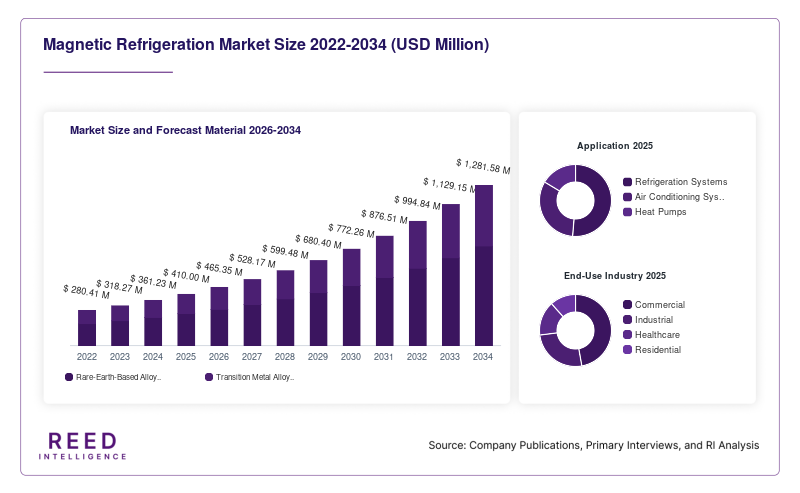
The global Magnetic Refrigeration Market size was valued at approximately USD 410 million in 2025 and is projected to reach USD 1.28 billion by 2034, expanding at a CAGR of 13.5% during the forecast period (2025–2034). Magnetic refrigeration technology, based on the magnetocaloric effect, is emerging as an alternative to conventional vapor-compression cooling systems due to its potential for higher energy efficiency and reduced environmental impact.
A key global factor supporting market growth is the increasing regulatory pressure to phase out hydrofluorocarbons (HFCs) and other harmful refrigerants. Governments and international organizations are implementing strict environmental policies that encourage the adoption of sustainable cooling technologies. Magnetic refrigeration systems, which operate without greenhouse gases, are gaining traction in both commercial and industrial applications.
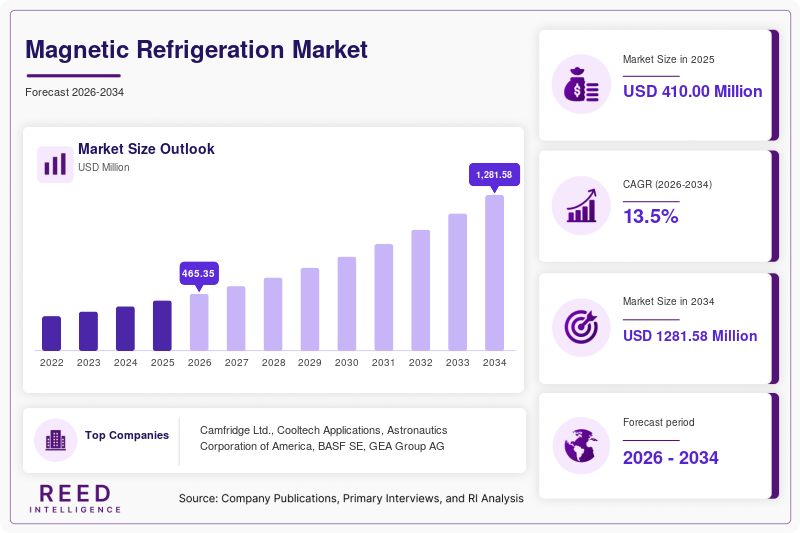
Key Highlights:
- Europe dominated the market with a share of 34.2% in 2025, while Asia Pacific is projected to grow at the fastest CAGR of 15.1% during the forecast period
- By material, rare-earth-based alloys accounted for the leading share of 62.5%, whereas transition metal alloys are expected to grow at a CAGR of 14.8%
- By application, refrigeration systems held the dominant share, while air conditioning applications are projected to grow at a CAGR of 14.3%
- Germany remained the dominant country, with market values of USD 68 million in 2024 and USD 74 million in 2025
Market Trends
Increasing Adoption of Eco-Friendly Cooling Technologies
The Magnetic Refrigeration Market is witnessing a shift toward environmentally sustainable cooling solutions. Traditional refrigeration systems rely on chemical refrigerants that contribute to global warming and ozone depletion. Magnetic refrigeration, which uses solid-state cooling, eliminates the need for such substances. This trend is gaining momentum across commercial refrigeration and medical cooling applications, where sustainability compliance is becoming a priority.
Advancements in Magnetocaloric Materials
Continuous research in advanced materials is shaping the future of the Magnetic Refrigeration Market. Innovations in rare-earth alloys and alternative materials are improving thermal efficiency and reducing operational costs. Manufacturers are focusing on developing materials with enhanced magnetocaloric properties at room temperature, which is crucial for large-scale adoption. These advancements are expected to expand the application scope and improve system reliability over the forecast period.
Market Drivers
Stringent Environmental Regulations
The implementation of global climate agreements and national regulations targeting emissions reduction is a major driver of the Magnetic Refrigeration Market. Regulatory frameworks are encouraging industries to adopt cleaner technologies, pushing manufacturers to explore alternatives to conventional refrigeration systems. Magnetic refrigeration aligns with these goals by offering a zero-emission cooling solution.
Rising Demand for Energy-Efficient Systems
Growing awareness regarding energy consumption and operational efficiency is accelerating demand for advanced cooling technologies. Magnetic refrigeration systems offer higher energy efficiency compared to traditional systems, particularly in applications requiring precise temperature control. Industries such as food processing, healthcare, and electronics are increasingly adopting energy-efficient solutions, thereby supporting market growth.
Market Restraint
High Initial Investment and Limited Commercialization
One of the major challenges in the Magnetic Refrigeration Market is the high upfront cost associated with system development and installation. The technology is still in the early stages of commercialization, leading to limited availability and higher production costs. Additionally, the reliance on rare-earth materials increases overall system expenses and supply chain risks.
The lack of widespread infrastructure and limited awareness among end users further restricts adoption. Many industries continue to rely on established cooling technologies due to familiarity and lower initial costs. Overcoming these barriers will require advancements in cost reduction, material innovation, and large-scale manufacturing capabilities.
Market Opportunities
Expansion in Medical and Pharmaceutical Cooling
The Magnetic Refrigeration Market presents significant opportunities in the healthcare sector. Magnetic refrigeration systems provide precise temperature control, making them suitable for medical storage applications such as vaccines, biological samples, and pharmaceuticals. The increasing demand for reliable and sustainable cooling in healthcare facilities is expected to drive adoption.
Integration with Smart and IoT-Based Systems
The integration of magnetic refrigeration systems with smart technologies and IoT platforms offers promising growth prospects. Smart cooling solutions enable real-time monitoring, predictive maintenance, and optimized energy usage. As industries move toward automation and digitalization, the adoption of intelligent magnetic refrigeration systems is expected to increase, creating new revenue streams for market players.
Segmental Analysis
By Material
Rare-earth-based alloys dominated the Magnetic Refrigeration Market, accounting for 62.5% of the share in 2024. These materials offer superior magnetocaloric properties, making them highly effective for cooling applications. Their ability to operate efficiently near room temperature has made them the preferred choice for commercial systems.
Transition metal alloys are projected to be the fastest-growing subsegment, with a CAGR of 14.8% during the forecast period. These materials will gain traction due to their lower cost and reduced dependency on rare-earth elements. Ongoing research aimed at enhancing their performance will further drive adoption.
By Application
Refrigeration systems held the dominant share of the Magnetic Refrigeration Market in 2024, accounting for 48.3%. These systems are widely used in commercial refrigeration, food storage, and industrial cooling applications. Their ability to deliver consistent cooling without harmful refrigerants has supported their dominance.
Air conditioning applications are expected to grow at the fastest CAGR of 14.3% during the forecast period. The increasing demand for energy-efficient HVAC systems will drive this segment. Magnetic air conditioning systems are anticipated to gain popularity due to their environmental benefits and improved performance.
By End-Use Industry
The commercial sector dominated the market in 2024, capturing 44.7% of the share. Retail chains, supermarkets, and hospitality establishments have been early adopters of magnetic refrigeration systems due to their sustainability advantages.
The healthcare sector is projected to be the fastest-growing segment, with a CAGR of 14.6%. The need for precise and reliable cooling solutions in medical applications will drive growth. Magnetic refrigeration systems will be increasingly used in laboratories and pharmaceutical storage.
By Cooling Capacity
Medium-capacity systems dominated the market with a share of 46.1% in 2024. These systems are widely used in commercial applications due to their balanced performance and cost efficiency.
High-capacity systems are expected to grow at the fastest CAGR of 14.9% during the forecast period. Industrial applications requiring large-scale cooling will drive demand for these systems. Advancements in system design will enable improved scalability and efficiency.
Regional Analysis
North America
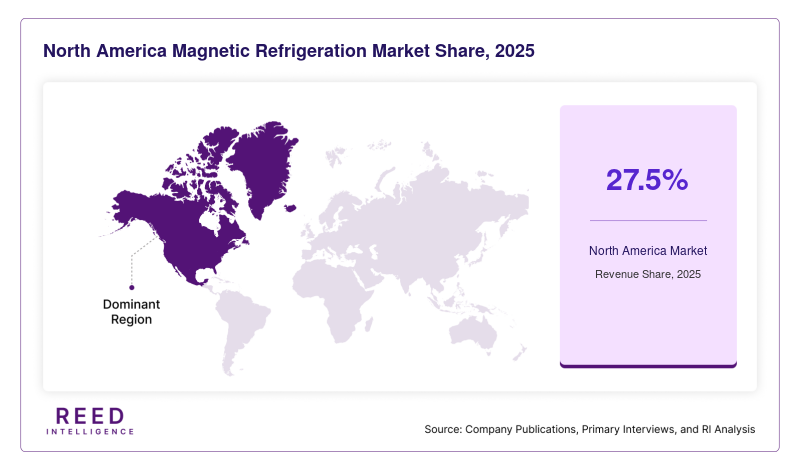
North America accounted for approximately 27.5% of the Magnetic Refrigeration Market share in 2025 and is expected to grow at a CAGR of 12.8% during the forecast period. The region demonstrated steady adoption due to increasing investments in sustainable technologies and innovation-driven industries.
The United States dominated the regional market, supported by strong research and development activities in advanced cooling technologies. The presence of leading research institutions and government funding initiatives has accelerated the development of magnetocaloric systems. Additionally, the growing demand for energy-efficient refrigeration in commercial sectors is contributing to regional growth.
Europe
Europe held the largest share of 34.2% in 2025 and is projected to grow at a CAGR of 13.2% over the forecast period. The region’s leadership is attributed to strict environmental regulations and early adoption of eco-friendly technologies.
Germany emerged as the dominant country, driven by its strong manufacturing base and emphasis on sustainability. The country’s focus on reducing carbon emissions and promoting green technologies has encouraged the adoption of magnetic refrigeration systems. Industrial applications and automotive thermal management are key areas driving demand in the region.
Asia Pacific
Asia Pacific represented 22.8% of the market share in 2025 and is expected to register the fastest CAGR of 15.1% during the forecast period. Rapid industrialization and increasing energy demand are key factors supporting market expansion.
China led the regional market due to its growing electronics manufacturing sector and increasing focus on energy efficiency. Government initiatives promoting green technologies and investments in research infrastructure are accelerating adoption. The expanding middle-class population and rising demand for advanced appliances further support market growth.
Middle East & Africa
The Middle East & Africa accounted for 8.6% of the Magnetic Refrigeration Market share in 2025 and is projected to grow at a CAGR of 11.9%. The region is gradually adopting advanced cooling technologies to address extreme climatic conditions.
The United Arab Emirates dominated the regional market, driven by increasing investments in sustainable infrastructure. The demand for efficient cooling systems in commercial buildings and hospitality sectors is contributing to growth. Government initiatives promoting energy conservation are further supporting market development.
Latin America
Latin America held a share of 6.9% in 2025 and is expected to grow at a CAGR of 12.1% during the forecast period. The region is witnessing gradual adoption of magnetic refrigeration technology due to increasing awareness of environmental sustainability.
Brazil led the market, supported by the expansion of the food and beverage industry. The need for efficient refrigeration solutions in food storage and transportation is driving demand. Additionally, government efforts to promote energy-efficient technologies are contributing to market growth.
Competitive Landscape
The Magnetic Refrigeration Market is characterized by the presence of emerging technology developers and established industrial players. Companies are focusing on research and development, strategic partnerships, and product innovation to strengthen their market position.
Camfridge Ltd. is recognized as a market leader, driven by its advanced magnetic cooling technology and strong focus on commercialization. The company recently introduced a prototype magnetic refrigeration system designed for commercial use, marking a significant step toward large-scale adoption.
Other key players are investing in material innovation and system integration to enhance performance and reduce costs. Collaborative efforts between industry participants and research institutions are expected to accelerate technological advancements and expand the market.
Key Players List
- Camfridge Ltd.
- Cooltech Applications
- Astronautics Corporation of America
- BASF SE
- GEA Group AG
- Haier Group Corporation
- Whirlpool Corporation
- Samsung Electronics Co., Ltd.
- Toshiba Corporation
- Panasonic Holdings Corporation
- LG Electronics Inc.
- Hitachi Ltd.
- Danfoss A/S
- Siemens AG
- Mitsubishi Electric Corporation
Recent Developments
- 2025: Camfridge Ltd. launched a new commercial-scale magnetic refrigeration prototype for retail applications
- 2024: Cooltech Applications expanded its production facility to increase manufacturing capacity
- 2024: BASF SE invested in research for advanced magnetocaloric materials
- 2025: GEA Group AG partnered with a technology firm to develop sustainable cooling systems
- 2024: Haier Group Corporation initiated pilot projects integrating magnetic refrigeration in smart appliances
Magnetic Refrigeration Market Segments
Material
- Rare-Earth-Based Alloys
- Transition Metal Alloys
Application
- Refrigeration Systems
- Air Conditioning Systems
- Heat Pumps
End-Use Industry
- Commercial
- Industrial
- Healthcare
- Residential
Cooling Capacity
- Low Capacity
- Medium Capacity
- High Capacity
Distribution Channel
- Direct Sales (B2B)
- OEM Partnerships
- Online Channels
- Specialty Equipment Distributors
By Region
- North America
- Europe
- APAC
- Middle East and Africa
- LATAM