Makeup Foundation Market Size, Share & Trends Analysis Report By Type (Liquid, Powder, Cream, Stick), By Application (Personal, Professional) and By Region (North America, Europe, Asia Pacific, Latin America, Middle East & Africa) Forecasts, 2026–2034
USD 3950
Makeup Foundation Market Size
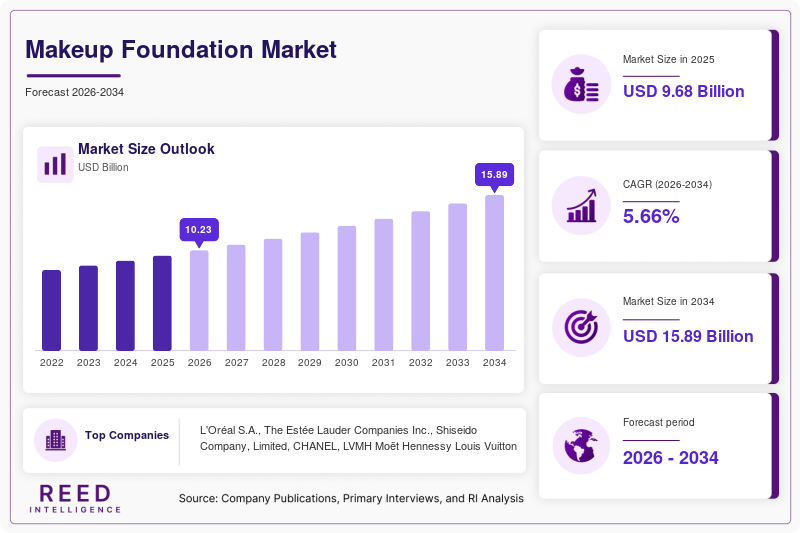
The global makeup foundation market size was valued at USD 9.68 billion in 2025 and is projected to grow from USD 10.23 billion in 2026 to USD 15.89 billion by 2034, registering a CAGR of 5.66% during the forecast period from 2026 to 2034.
The makeup foundation market is developing around a more skin-focused interpretation of complexion makeup. Consumers increasingly seek products that provide coverage while maintaining a natural appearance and comfortable skin feel. This has encouraged brands to develop serum foundations, hydrating foundations, lightweight matte formulas, buildable coverage and formulations incorporating ingredients commonly associated with skincare.
Product innovation is also becoming more segmented by skin type, climate, finish and occasion. L'Oréal Paris, for example, markets Infallible 24H Matte Cover around long-lasting, sweat-, heat-, transfer- and waterproof performance while retaining a lightweight formulation.
Makeup Foundation Market Drivers
Skincare-Makeup Convergence Is Reshaping Foundation Formulation
Foundation is increasingly positioned as a complexion product with skincare-oriented benefits. Hydration, barrier support, SPF, niacinamide, hyaluronic acid and other skin-compatible ingredients are being incorporated into formulations to address consumers who want makeup without compromising perceived skin comfort.
The commercial mechanism is a widening value proposition. Instead of competing only on pigmentation and coverage, brands can address multiple purchase criteria through one product. Estée Lauder's reformulated Double Wear, for example, emphasizes a more breathable and adaptable finish while maintaining long-wear performance, demonstrating how established products are being adjusted to changing complexion expectations.
This trend also creates opportunities for brands positioned between conventional makeup and skincare. However, formulation complexity can increase development costs and may create regulatory or substantiation requirements when products make specific skincare or protection claims.
Demand for Long-Wear and Climate-Resistant Formulas
Consumers increasingly expect foundation to maintain appearance through extended workdays, travel, heat, humidity and active lifestyles. This is supporting formulations emphasizing transfer resistance, sweat resistance, shine control and extended wear.
L'Oréal Paris's Infallible 24H Matte Cover illustrates this product strategy, combining high coverage with claims around 24-hour matte wear, shine resistance and resistance to sweat, heat, transfer and water.
Long-wear performance expands foundation's relevance across more occasions, including professional settings, events and travel. At the same time, consumers increasingly expect long-wear products to remain lightweight and comfortable, making the balance between durability and skin feel an important formulation challenge.
Digital Shade Matching and Virtual Try-On Are Reducing Selection Friction
Foundation has historically faced a significant purchase barrier because consumers need to identify an appropriate shade, undertone and finish before committing to a product. Digital shade-matching technologies and virtual try-on tools reduce this friction by allowing consumers to visualize products before purchase.
L'Oréal's June 2026 collaboration with OpenAI includes Maybelline Makeup Virtual Try-On through ModiFace, allowing users to explore makeup looks conversationally.
Restraints
Consumer Shift Toward Lightweight Alternatives
Traditional foundation faces competition from skin tints, complexion balms, tinted moisturizers, serum-based products and other lightweight complexion formats. Consumers seeking a natural skin appearance may reduce the frequency with which they use conventional high-coverage foundation.
This creates a category substitution effect rather than simply reducing overall complexion-product consumption. Foundation manufacturers therefore need to respond with lighter textures and buildable coverage. Recent foundation reformulations increasingly emphasize breathable, flexible finishes alongside traditional coverage and wear characteristics.
Shade Complexity and Product Development Costs
Foundation requires substantial shade development because consumers differ across skin tone, undertone and depth. Expanding shade ranges increases formulation, inventory, testing, packaging and distribution complexity.
The commercial challenge is particularly significant for smaller brands because each additional shade can create incremental production and inventory requirements. Larger companies can spread these costs across broader distribution networks, while digital shade matching can improve inventory efficiency and consumer selection. Nevertheless, maintaining availability across numerous shades remains an operational challenge.
Makeup Foundation Market Opportunities
Skin-First and Hybrid Foundation Products
The movement toward skincare-makeup convergence provides opportunities for foundations that combine complexion correction with hydration, sun protection, barrier-support positioning and other skin-focused attributes.
Premium and mass-market brands are already using this approach. Estée Lauder's portfolio includes skincare-oriented complexion products, while its reformulated Double Wear focuses on balancing long wear with a more breathable and adaptable experience.
The opportunity is particularly relevant for consumers who want to simplify beauty routines. A foundation capable of providing coverage, hydration and other functional benefits can increase the perceived value of a single product. The main adoption barrier remains the need to demonstrate that skincare claims do not compromise coverage, wear or finish.
AI-Powered Beauty Commerce and Personalized Shade Selection
AI-enabled beauty discovery creates an opportunity to make foundation purchasing more personalized. Virtual try-on, conversational product recommendations and digital shade matching can connect consumers with products based on skin tone, desired finish, coverage and occasion.
L'Oréal's 2026 collaboration with OpenAI demonstrates the direction of this development, with Maybelline's Makeup Virtual Try-On being integrated into ChatGPT.
For foundation brands, the commercial value extends beyond visualization. Better digital matching can support conversion, improve discovery of broader shade portfolios and help brands collect insights about consumer preferences. Accuracy, privacy expectations and the quality of shade recommendations remain important adoption considerations.
Segmental Analysis
By Type
Liquid Foundation Is the Largest Segment
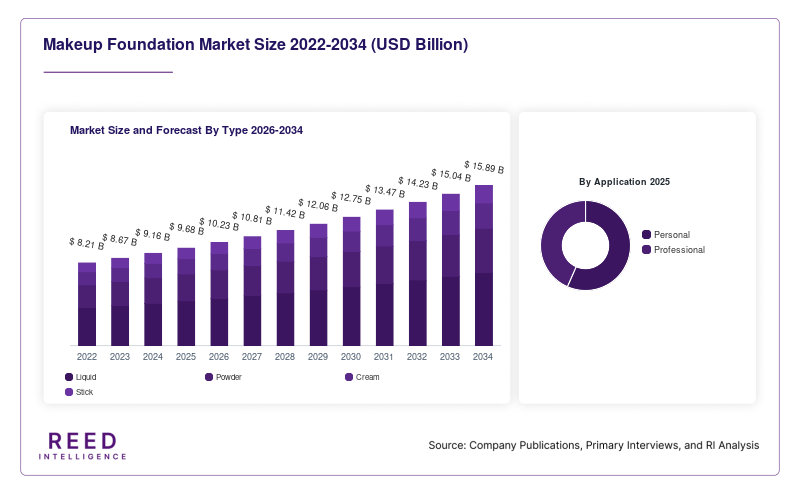
Liquid foundation accounts for approximately 54.0% market share, making it the dominant product type. Its position is supported by formulation flexibility, broad coverage options, extensive shade availability and compatibility with different skin types and finishes.
Liquid formats can be engineered for matte, natural, radiant, hydrating or high-coverage performance, allowing brands to address multiple consumer groups using the same basic delivery format. They are also well suited to hybrid formulations incorporating skincare-oriented ingredients.
Major brands continue to use liquid foundations as platforms for reformulation and innovation. Estée Lauder's 2026 Double Wear update and L'Oréal Paris's long-wear Infallible products demonstrate how liquid formats can accommodate both durability and evolving demands for comfort and skin-like appearance.
The segment is nevertheless exposed to substitution from complexion balms, skin tints and serum-based products. Maintaining dominance therefore depends on improving texture, wearability, shade precision and multifunctional performance.
Stick Foundation Is Expanding Faster Because Consumers Seek Convenience
Stick foundation is projected to record the fastest growth among major types, with a 7.2% CAGR during 2026–2034. Its compact format supports portability, targeted application and quick touch-ups, making it suitable for travel, professional makeup kits and consumers seeking simplified application.
The format also supports higher precision because users can apply product directly to areas requiring additional coverage before blending. This makes stick foundation relevant to consumers who prefer customizable rather than uniform coverage.
Powder foundation accounts for approximately 21.0% market share and is projected to grow at a 4.8% CAGR, supported by oil-control and convenience benefits. Cream foundation represents approximately 13.0% share and is projected to grow at a 5.9% CAGR, benefiting from demand for richer, moisturizing complexion textures.
By Application
Personal Application Is the Largest Segment
Personal application accounts for approximately 76.0% market share, reflecting the large consumer base purchasing foundation for daily wear, social occasions, work and personal beauty routines.
The segment is increasingly influenced by social media, digital tutorials, virtual try-on and beauty-commerce platforms. Consumers can compare finishes, shades and application methods before purchasing, while brands use digital content to explain product benefits and demonstrate results.
Personal use is also increasingly fragmented by occasion. Consumers may choose sheer coverage for everyday use, high coverage for events and long-wear formulas for work or travel. This creates demand for broader product portfolios rather than a single foundation formulation.
Professional Application Is Expanding Faster Because Makeup Services Are Becoming More Specialized
Professional application is projected to record a 6.6% CAGR, making it the faster-growing application segment. Makeup artists, salons, photographers, film and television productions and event professionals require products that deliver predictable coverage, shade flexibility, durability and camera-compatible finishes.
Professional users can influence consumer adoption because products used by makeup artists often receive visibility through editorial content, social media and beauty tutorials. Professional demand also supports premium foundation formats with specialized finishes and high-performance formulations.
Regional Analysis
North America
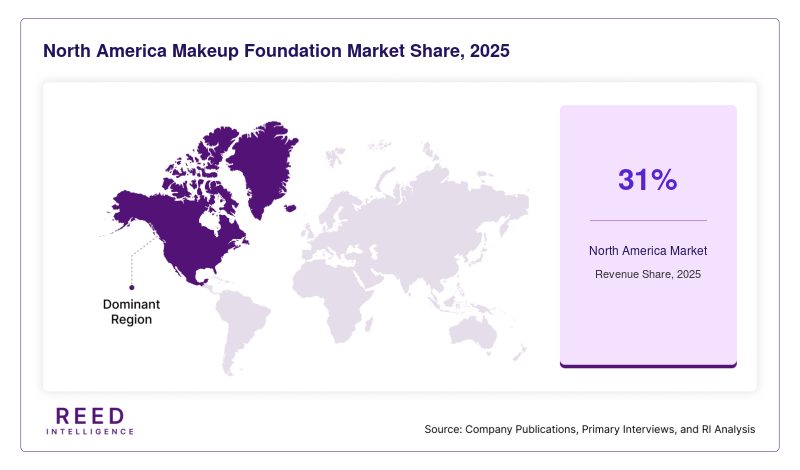
North America represents the dominant regional market with approximately 31.0% market share. The region benefits from high beauty-product penetration, extensive specialty retail networks, strong e-commerce infrastructure and the presence of major global cosmetics companies.
The United States remains the principal demand center, supported by premium and mass-market beauty brands and high consumer exposure to new product launches. Product innovation increasingly centers on skin compatibility, long wear, shade inclusivity and digital discovery.
Digital commerce is particularly important because foundation is a product where consumers historically benefit from physical shade testing. Virtual try-on and AI-supported discovery can reduce this barrier. L'Oréal's 2026 integration of Maybelline virtual try-on into ChatGPT illustrates how digital beauty discovery is moving closer to conversational commerce.
The region faces competitive pressure from complexion hybrids and changing consumer preferences toward lighter makeup. Brands are responding by expanding flexible-coverage products and reformulating established franchises.
Europe
Europe is projected to record an 5.4% CAGR during 2026–2034. The region combines established premium beauty markets such as France, the United Kingdom, Germany and Italy with strong specialty-retail and pharmacy channels.
European consumers increasingly evaluate foundation through skin feel, formulation composition, finish and multifunctionality. The region's regulatory environment also encourages manufacturers to maintain close control over ingredients, product claims and formulation compliance.
Premium brands continue to refresh complexion portfolios while mass-market companies compete through shade availability and long-wear performance. The major constraint is the mature nature of several Western European markets, where growth depends heavily on premiumization, product replacement and innovation rather than large increases in first-time category penetration.
Asia Pacific
Asia Pacific is projected to be the fastest-growing region, with a 7.1% CAGR during 2026–2034. The region benefits from expanding beauty consumption, rising disposable income in several markets, digital commerce and the influence of Korean and Japanese beauty trends.
China, Japan, South Korea and India represent important demand centers, while Southeast Asia provides additional growth through younger consumers and expanding digital beauty retail.
India is becoming particularly significant for global beauty companies. Estée Lauder's July 2026 BEAUTY&YOU India program continued its focus on identifying and supporting Indian beauty entrepreneurs, while the company has also expanded its strategic commitment to the Indian beauty market. L'Oréal separately announced an agreement in June 2026 to acquire a majority stake in Indian digital-first personal-care company Innovist, reinforcing its broader expansion strategy in the country.
The main challenge is market fragmentation across income levels, languages, skin tones and beauty preferences, requiring localized formulations, pricing and shade portfolios.
Middle East and Africa
The Middle East and Africa region is projected to grow at a 6.4% CAGR during 2026–2034. Demand is supported by premium beauty consumption, urbanization, expanding organized retail and increasing digital access to international cosmetic brands.
Foundation requirements vary substantially across the region because of climate, skin tones and consumer preferences. Long-wear, heat-resistant, humidity-resistant and transfer-resistant formulations therefore have particular commercial relevance.
The region also provides opportunities for brands that expand shade ranges and formulate products around diverse undertones. However, distribution fragmentation and differences in purchasing power can make regional expansion more complex than in mature Western beauty markets.
Latin America
Latin America is projected to record a 6.8% CAGR during the forecast period. Brazil and Mexico represent major regional demand centers, supported by established cosmetics industries, strong beauty culture and extensive mass-market distribution.
Foundation consumption is influenced by climate, complexion needs, affordability and product performance. Long-wear and humidity-resistant formulations can address practical requirements in tropical and subtropical markets, while digital commerce is broadening access to international and specialty brands.
Local beauty companies compete alongside multinational manufacturers, creating a market structure in which localization, price architecture and shade suitability remain important. Economic volatility and currency movements can nevertheless influence premium-product purchasing and imported cosmetics.
Competitive Landscape
The makeup foundation market is highly competitive, with multinational beauty groups, specialist makeup companies and digitally native brands competing through formulation innovation, shade breadth, brand positioning, distribution and consumer engagement.
L'Oréal maintains a broad complexion portfolio through brands including L'Oréal Paris, Maybelline New York, Lancôme, Giorgio Armani Beauty and other professional and prestige businesses. Its strategy combines mass-market reach with premium innovation and increasingly digitalized beauty discovery. Its 2026 AI collaboration with OpenAI demonstrates the company's effort to integrate technology directly into the consumer journey.
Key Market Players
- L'Oréal S.A.
- The Estée Lauder Companies Inc.
- Shiseido Company, Limited
- CHANEL
- LVMH Moët Hennessy Louis Vuitton
- Coty Inc.
- Revlon, Inc.
- KIKO MILANO
- Fenty Beauty
- Rare Beauty
- e.l.f. Cosmetics, Inc.
- Amorepacific Corporation
Recent Market Development
February 2026- Estée Lauder launched the next-generation Double Wear Stay-in-Place Longwear Matte Foundation. The reformulation retained the franchise's long-wear positioning while introducing a more breathable and flexible complexion experience. Estée Lauder subsequently reported double-digit growth for the Estée Lauder brand in fiscal 2026, with the foundation launch identified as a major contributor.
June 2026- L'Oréal and OpenAI announced a collaboration that includes Maybelline New York Makeup Virtual Try-On, powered by L'Oréal's ModiFace technology. The integration enables consumers to discover and virtually try makeup looks through an AI-powered conversational experience, strengthening digital shade discovery and beauty-commerce capabilities.
Makeup Foundation Market Segments
By Type
- Liquid
- Powder
- Cream
- Stick
By Application
- Personal
- Professional
By Region
- North America
- Europe
- APAC
- Middle East and Africa
- LATAM