Malonic Acid Market Size, Share & Demand Report By Type (Industrial Grade, Pharmaceutical Grade, Reagent Grade), By Application (Pharmaceutical Intermediates, Agrochemical Intermediates, Flavor & Fragrance Synthesis, Polymer & Resin Production), By End-Use Industry (Pharmaceutical Industry, Chemical Industry, Agriculture, Research & Laboratories), By Region & Segment Forecasts, 2022–2034
USD 3950
Market Overview
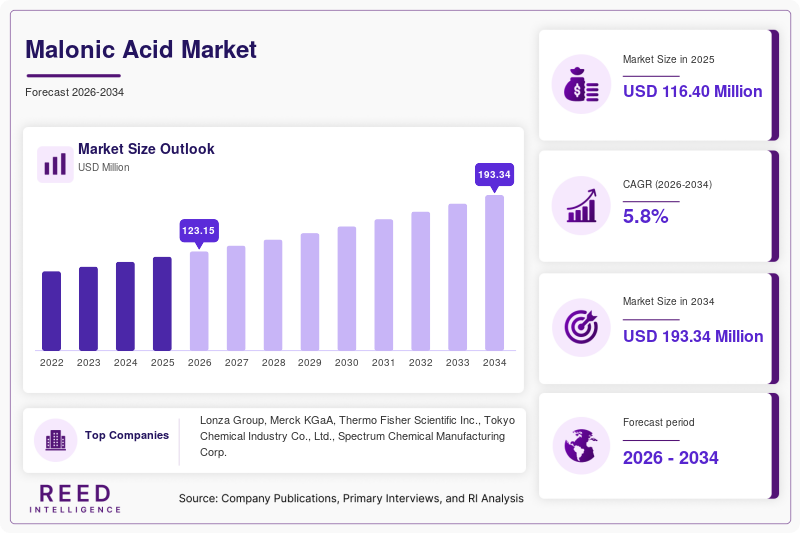
The Malonic Acid Market size was valued at USD 116.4 million in 2024 and is projected to reach USD 192.7 million by 2033, expanding at a CAGR of 5.8% during the forecast period (2025–2033). Malonic acid, a dicarboxylic acid widely used as an intermediate in organic synthesis, has gained commercial importance due to its applications in pharmaceuticals, agrochemicals, flavors, fragrances, and specialty chemicals. The compound plays a critical role in producing barbiturates, vitamins, and advanced chemical intermediates, which continues to support its demand across multiple industries.
A major global factor supporting the growth of the Malonic Acid Market has been the increasing use of specialty intermediates in pharmaceutical manufacturing. Pharmaceutical companies rely on malonic acid derivatives for synthesizing active pharmaceutical ingredients (APIs) and complex molecules used in therapeutic drugs. As pharmaceutical R&D investments continue to rise globally, demand for reliable chemical intermediates such as malonic acid is strengthening. In addition, chemical manufacturers are expanding production capacity to cater to pharmaceutical and agrochemical industries, further strengthening market expansion.
Key Highlights
- Asia Pacific dominated the Malonic Acid Market with 41.6% share in 2025, while Latin America is projected to register the fastest CAGR of 6.5% during 2025–2033.
- Pharmaceutical intermediates were the leading application segment in 2024 with 38.2% share, while agrochemical intermediates are expected to grow at a CAGR of 6.7%.
- Industrial grade malonic acid held the largest type share at 46.5% in 2024, while pharmaceutical grade is projected to grow at 6.6% CAGR.
- China remained the dominant country, with a 2024 market value of USD 24.3 million, expected to reach USD 25.7 million in 2025.
Market Trends
Increasing Adoption of High-Purity Chemical Intermediates
One of the key trends shaping the Malonic Acid Market is the growing demand for high-purity chemical intermediates used in pharmaceutical and biotechnology research. Drug manufacturers increasingly require compounds with controlled impurity levels to ensure consistent quality in drug formulation. High-purity malonic acid is used as a precursor in synthesizing pharmaceutical compounds, vitamins, and diagnostic chemicals.
As pharmaceutical production expands globally, chemical manufacturers are investing in advanced purification technologies to produce higher-grade malonic acid. This trend is also supported by regulatory compliance requirements that emphasize traceability and purity of chemical ingredients used in pharmaceutical manufacturing.
Expansion of Specialty Chemical Applications
Another significant trend in the Malonic Acid Market involves the increasing use of malonic acid in specialty chemical applications. The compound is used as a building block in the synthesis of polymers, coatings, dyes, and flavor compounds. Specialty chemical manufacturers are utilizing malonic acid derivatives to develop advanced materials with enhanced stability and functional properties.
In addition, innovation in chemical synthesis is enabling the development of new derivatives with broader industrial applications. The expansion of specialty chemical manufacturing in emerging economies is contributing to the long-term growth outlook of the Malonic Acid Market, particularly in industries requiring tailored chemical intermediates.
Market Drivers
Rising Pharmaceutical Manufacturing Activities
The expansion of pharmaceutical production globally has emerged as a key driver of the Malonic Acid Market. Malonic acid serves as a critical intermediate in synthesizing several pharmaceutical compounds, including sedatives, vitamins, and therapeutic agents. Pharmaceutical companies are increasing investments in research and development, which requires a consistent supply of specialty intermediates.
As healthcare demand increases across developed and developing economies, pharmaceutical production capacity is expanding. This development is strengthening demand for malonic acid, especially pharmaceutical-grade variants that meet strict purity standards required for drug synthesis.
Growing Agrochemical Production
Another important factor supporting the Malonic Acid Market growth is the expansion of agrochemical manufacturing. Malonic acid derivatives are used in the production of herbicides and crop protection chemicals. Rising agricultural productivity requirements have increased the use of advanced agrochemicals designed to improve crop yields and pest control efficiency.
The agricultural sector continues to adopt chemical formulations that enhance crop protection and soil productivity. As agrochemical manufacturers expand their product portfolios, the demand for chemical intermediates such as malonic acid is expected to grow steadily.
Market Restraint
Fluctuations in Raw Material Availability
One of the primary restraints affecting the Malonic Acid Market is the fluctuation in raw material availability and pricing. Malonic acid production involves chemical synthesis processes that rely on feedstocks derived from petrochemical intermediates. Variations in petrochemical supply chains and price volatility can influence production costs for malonic acid manufacturers.
Rising energy costs and environmental regulations associated with chemical manufacturing may also affect production economics. These factors can lead to pricing fluctuations in the Malonic Acid Market, potentially affecting profit margins for producers and procurement costs for downstream industries.
Market Opportunities
Expansion of Biotechnology Research
The increasing focus on biotechnology research is creating new opportunities for the Malonic Acid Market. Research institutions and biotechnology companies use malonic acid as a reagent in organic synthesis and biochemical experiments. Growing investments in life sciences research are expanding the demand for laboratory-grade chemical reagents.
As biotechnology applications expand in areas such as drug discovery, metabolic engineering, and synthetic biology, demand for high-quality reagents will continue to increase. This development is expected to create additional growth opportunities for suppliers of high-purity malonic acid.
Emerging Demand from Polymer and Material Science Industries
Another emerging opportunity in the Malonic Acid Market lies in its potential use in polymer and advanced material synthesis. Researchers are exploring malonic acid derivatives for producing functional polymers with improved chemical stability and performance characteristics.
These polymers can be used in coatings, adhesives, and specialty plastics. As material science innovation continues to evolve, the demand for chemical intermediates used in polymer synthesis is expected to increase, supporting the long-term outlook of the Malonic Acid Market.
Segmental Analysis
By Type
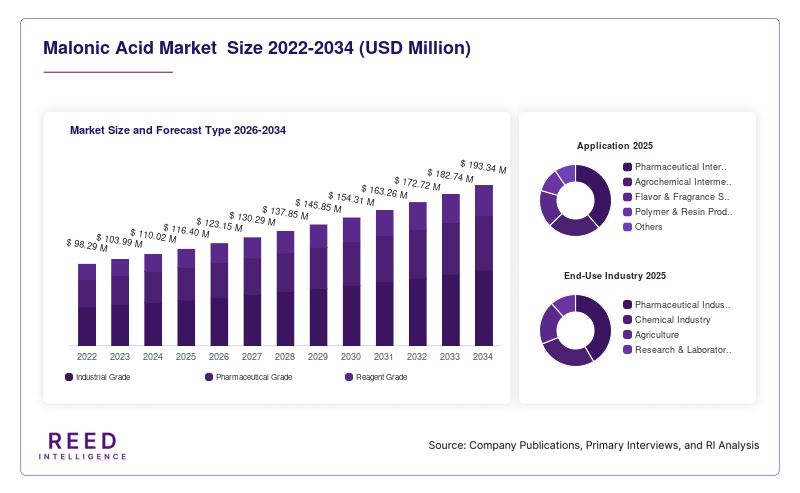
Industrial grade malonic acid dominated the Malonic Acid Market with a 46.5% share in 2024. This segment held the largest share due to its widespread use in manufacturing dyes, coatings, specialty chemicals, and polymer intermediates. Industrial-grade variants are produced at scale and are widely used in chemical processing industries that require bulk chemical intermediates.
Pharmaceutical grade malonic acid is expected to be the fastest-growing segment with a CAGR of 6.6% during the forecast period. Growth will be supported by the increasing demand for high-purity intermediates used in drug synthesis. Pharmaceutical manufacturers will increasingly rely on refined malonic acid for producing active pharmaceutical ingredients and therapeutic compounds.
By Application
Pharmaceutical intermediates represented the largest application segment with 38.2% share in 2024. The compound’s role as a precursor in synthesizing barbiturates, vitamins, and therapeutic molecules contributed to its widespread use in pharmaceutical production processes.
Agrochemical intermediates are projected to grow at a CAGR of 6.7% during the forecast period. Growth will be supported by increasing development of crop protection chemicals. Agrochemical manufacturers will use malonic acid derivatives in producing herbicides and specialty formulations designed to improve agricultural productivity.
By End-Use Industry
The pharmaceutical industry dominated the Malonic Acid Market share with 34.9% in 2024. Pharmaceutical companies utilize malonic acid in synthesizing complex organic molecules used in drug manufacturing and research activities.
The specialty chemicals industry will grow at a CAGR of 6.3% during the forecast period. This growth will be associated with increasing development of advanced materials, dyes, and coatings. Specialty chemical manufacturers will incorporate malonic acid derivatives in developing innovative chemical formulations.
Regional Analysis
North America
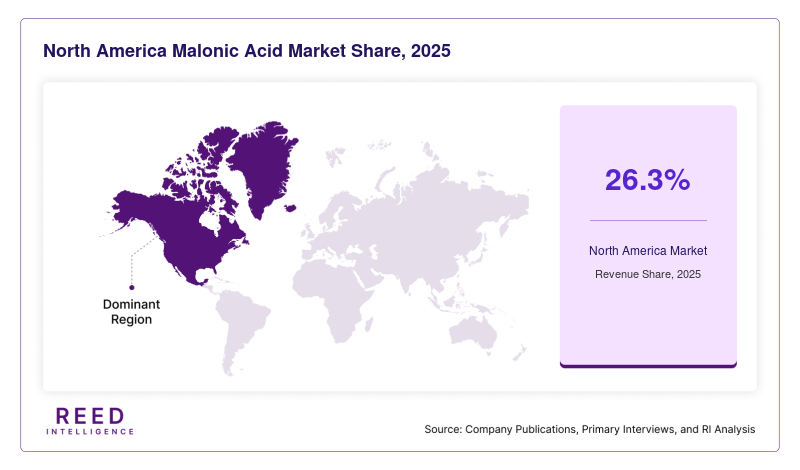
North America accounted for 26.3% of the Malonic Acid Market share in 2025 and will expand at a CAGR of 5.2% during 2025–2033. The region’s market growth is associated with the presence of established pharmaceutical manufacturing infrastructure and chemical research institutions. Pharmaceutical companies in the region rely on specialty chemical intermediates for developing therapeutic formulations and research compounds.
The United States remained the dominant country in the region due to its strong chemical research ecosystem and high pharmaceutical R&D expenditure. Academic research institutions and biotechnology firms continue to utilize malonic acid as a reagent in organic synthesis experiments. The presence of large-scale contract research organizations also supports demand for laboratory chemicals.
Europe
Europe represented 23.7% of the Malonic Acid Market in 2025 and is projected to grow at a CAGR of 5.1% through 2033. The regional market has been influenced by established specialty chemical manufacturing sectors and a strong regulatory framework supporting chemical quality standards.
Germany dominated the European market due to its advanced chemical manufacturing industry and strong presence of pharmaceutical companies. German chemical producers are involved in manufacturing specialty intermediates used in pharmaceutical synthesis and industrial applications. Continuous innovation in chemical production technologies and adherence to quality regulations contribute to market stability in the region.
Asia Pacific
Asia Pacific held the largest share of 41.6% in the Malonic Acid Market in 2025 and will expand at a CAGR of 6.2% during the forecast period. The region’s growth has been associated with expanding chemical manufacturing infrastructure and increasing production of pharmaceutical and agrochemical intermediates.
China remained the leading country in the Asia Pacific market due to its large-scale chemical manufacturing capacity and export-oriented chemical industry. Chinese chemical manufacturers produce malonic acid for domestic consumption as well as international supply chains. The country’s integrated chemical production facilities and strong industrial ecosystem support consistent production of chemical intermediates.
Middle East & Africa
The Middle East & Africa accounted for 4.9% of the Malonic Acid Market share in 2025 and will grow at a CAGR of 4.7% through 2033. Market expansion in this region is influenced by the development of chemical processing industries and increased investments in industrial diversification.
Saudi Arabia dominated the regional market due to its petrochemical infrastructure and investments in downstream chemical production. Chemical manufacturing companies in the country are expanding production capacities for specialty chemicals derived from petrochemical feedstocks. This industrial diversification supports gradual growth in demand for malonic acid.
Latin America
Latin America represented 3.5% of the Malonic Acid Market share in 2025 and will grow at the fastest CAGR of 6.5% during the forecast period. Market development in the region has been associated with increasing chemical processing activities and expansion of agricultural chemical manufacturing.
Brazil remained the dominant country due to its growing chemical manufacturing sector and agricultural industry. The country’s agrochemical production facilities require chemical intermediates used in herbicide and pesticide formulations. As agricultural productivity initiatives expand, demand for specialty chemical intermediates such as malonic acid will increase.
Competitive Landscape
The Malonic Acid Market is moderately consolidated with several global and regional chemical manufacturers involved in production and distribution. Market participants focus on improving product purity, expanding production capacity, and developing new chemical derivatives to address evolving industrial requirements.
Lonza Group remains one of the leading companies due to its strong presence in pharmaceutical chemical manufacturing and specialty intermediates. The company recently expanded its chemical intermediate production capabilities to support pharmaceutical synthesis applications.
Other major companies are strengthening their market positions by investing in research collaborations and expanding distribution networks to reach emerging markets. Strategic partnerships between chemical producers and pharmaceutical companies are also shaping the competitive landscape.
Key Players
- Lonza Group
- Tokyo Chemical Industry Co., Ltd.
- Merck KGaA
- Thermo Fisher Scientific
- Alfa Aesar
- Spectrum Chemical Manufacturing Corp.
- Sigma-Aldrich Corporation
- Anhui Jinhe Industrial Co., Ltd.
- Jiangsu Zhonglan Chemical Co., Ltd.
- Henan Tianfu Chemical Co., Ltd.
Recent Developments
- In 2024, Lonza Group expanded production capacity for specialty chemical intermediates used in pharmaceutical synthesis.
- In 2023, Tokyo Chemical Industry introduced high-purity malonic acid reagents designed for laboratory research applications.
- In 2024, Merck KGaA strengthened its specialty chemical portfolio by expanding reagent-grade organic intermediates.
- In 2023, Spectrum Chemical enhanced its supply chain capabilities for distributing specialty chemical intermediates globally.
- In 2024, Anhui Jinhe Industrial increased production output of organic acid intermediates to support export demand.
Malonic Acid Market Segments
Type
- Industrial Grade
- Pharmaceutical Grade
- Reagent Grade
Application
- Pharmaceutical Intermediates
- Agrochemical Intermediates
- Flavor & Fragrance Synthesis
- Polymer & Resin Production
- Others
End-Use Industry
- Pharmaceutical Industry
- Chemical Industry
- Agriculture
- Research & Laboratories
By Region
- North America
- Europe
- APAC
- Middle East and Africa
- LATAM