Mammalian Polyclonal Igg Antibody Market Size, Share & Demand Report By Source Animal (Rabbit, Goat, Sheep, Mouse, Others), By Application (Research and Academic Use, Diagnostic Testing, Therapeutic Development, Proteomics and Genomics, Others), By End Use (Pharmaceutical and Biotechnology Companies, Academic and Research Institutes, Contract Research Organizations, Diagnostic Laboratories, Others), By Region & Segment Forecasts, 2026–2034
USD 3950
Market Overview
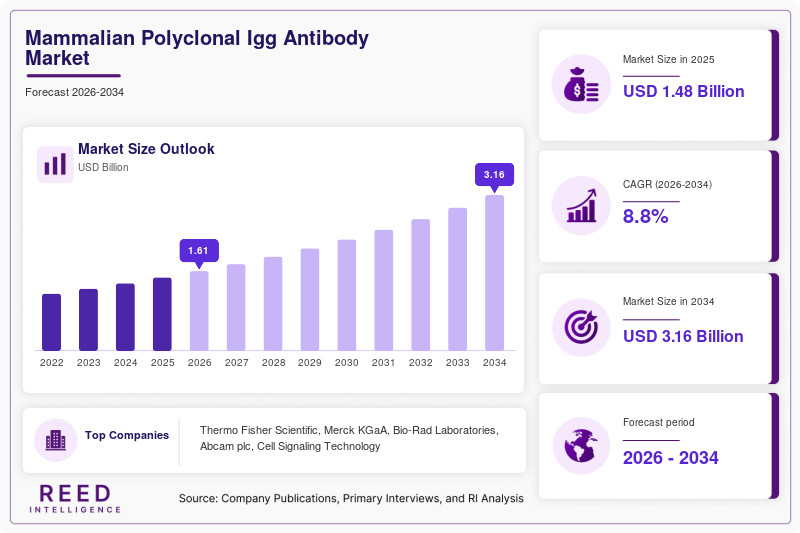
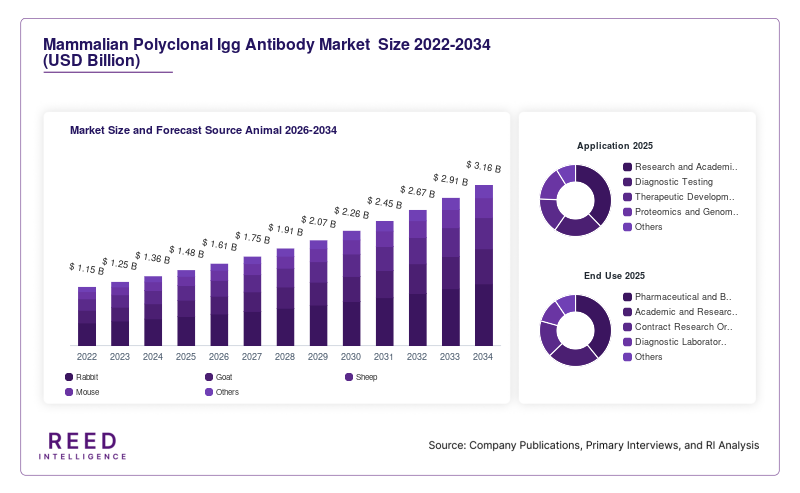
The global Mammalian Polyclonal Igg Antibody Market size was valued at USD 1.48 billion in 2026 and is projected to reach USD 2.91 billion by 2034, expanding at a CAGR of 8.8% during the forecast period from 2026 to 2034. The market continues to gain traction across pharmaceutical research, diagnostic testing, immunotherapy development, and biotechnology manufacturing activities. Mammalian polyclonal IgG antibodies are widely used because they recognize multiple epitopes, improve assay sensitivity, and provide reliable immune response detection in both clinical and research settings. The increasing focus on biologics development and infectious disease surveillance has strengthened demand for advanced antibody products across healthcare systems worldwide.
A major global factor supporting market growth is the rising investment in life science research infrastructure. Governments, academic institutions, and biotechnology firms are increasing spending on antibody-based research programs for oncology, autoimmune disorders, and rare diseases. This has accelerated the adoption of mammalian polyclonal IgG antibodies in western blotting, ELISA testing, immunohistochemistry, and therapeutic discovery applications. The expansion of personalized medicine programs and growing collaboration between contract research organizations and pharmaceutical companies are also contributing to long-term market expansion.
Key Highlights
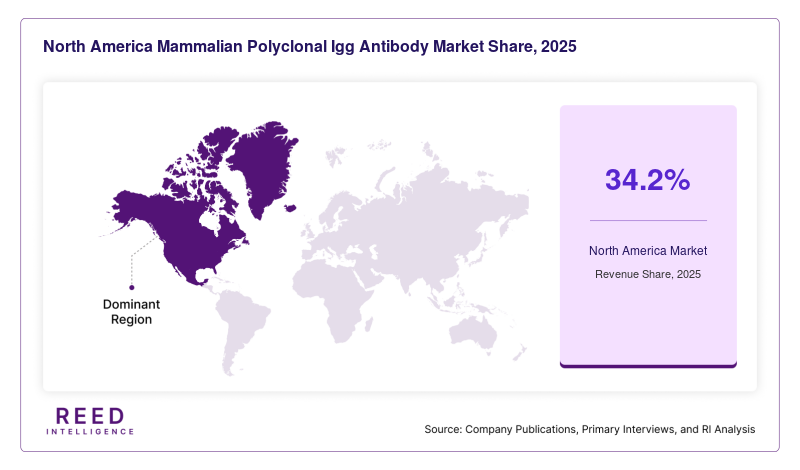
- North America dominated the market with a 34.2% share in 2025.
- Asia Pacific is expected to grow at the fastest CAGR of 10.9% during 2026–2034. By source animal, rabbit-derived antibodies accounted for the largest share of 39.4%, while goat-derived antibodies are projected to grow at a CAGR of 10.8%.
- By application, research and academic use led with a 44.1% share, whereas diagnostic testing is expected to expand at a CAGR of 11.2%.
- By end use, pharmaceutical and biotechnology companies held the largest share of 46.3%, while contract research organizations are projected to grow at a CAGR of 11.5%. The United States remained the dominant country, with market values of USD 420 million in 2024 and USD 462 million in 2025.
Market Trends
Expansion of Multiplex Diagnostic Platforms
The growing adoption of multiplex diagnostic platforms is creating strong momentum for the Mammalian Polyclonal Igg Antibody Market. Clinical laboratories and diagnostic manufacturers are increasingly integrating polyclonal antibodies into high-throughput testing systems because these antibodies can bind multiple antigenic sites and improve detection sensitivity. Healthcare providers are demanding faster and more reliable diagnostic solutions for infectious diseases, autoimmune disorders, and chronic inflammatory conditions. This trend has encouraged suppliers to develop advanced mammalian polyclonal IgG antibody panels for multiplex immunoassays. The use of automated laboratory systems in hospitals and research institutions is further supporting product demand. In addition, the rise in zoonotic disease monitoring programs and public health surveillance initiatives has strengthened the requirement for flexible antibody-based detection tools across global healthcare systems.
Increased Use in Biopharmaceutical Discovery Programs
Biopharmaceutical companies are expanding the use of mammalian polyclonal IgG antibodies in drug discovery and translational research activities. These antibodies are widely used during target validation, biomarker identification, and protein expression analysis because they provide broad antigen recognition and reliable experimental outcomes. The rapid growth of biologics and biosimilars development pipelines has increased demand for research-grade antibodies with enhanced specificity and stability. Academic laboratories and contract research organizations are also investing in antibody-based assays to support oncology, neurology, and immunology research projects. In addition, advancements in recombinant protein technologies and cell culture systems are encouraging the development of customized polyclonal antibody products for specialized applications. This trend is expected to support continuous innovation and revenue growth within the global market.
Market Drivers
Rising Prevalence of Chronic and Infectious Diseases
The increasing burden of chronic diseases and infectious disorders is a major growth driver for the Mammalian Polyclonal Igg Antibody Market. Healthcare systems worldwide are investing in early disease detection and advanced diagnostic capabilities to improve patient outcomes and reduce treatment costs. Mammalian polyclonal IgG antibodies are commonly used in immunodiagnostic procedures because they improve assay sensitivity and detect low-abundance biomarkers effectively. The growing prevalence of cancer, autoimmune diseases, viral infections, and metabolic disorders has accelerated the use of antibody-based testing across hospitals and clinical laboratories. Governments are also strengthening pandemic preparedness programs and expanding laboratory testing infrastructure. These developments are increasing demand for antibody reagents in research and clinical applications. In addition, biotechnology firms are introducing innovative immunoassay kits that rely heavily on mammalian polyclonal antibody technology.
Growth in Research Funding and Biotech Investments
Expanding public and private investment in biotechnology and life sciences research is contributing significantly to market growth. Research institutions and pharmaceutical companies are increasing spending on proteomics, genomics, and cell biology studies that require highly reliable antibody reagents. Mammalian polyclonal IgG antibodies remain important tools for protein detection and immune response analysis because they offer broad epitope recognition. Funding support for precision medicine and immunotherapy development is further driving the need for advanced research antibodies. In addition, venture capital investment in biotechnology startups has accelerated innovation in antibody production technologies and purification systems. Several companies are establishing strategic partnerships with universities and clinical laboratories to expand product development capabilities. These initiatives are strengthening global research ecosystems and supporting long-term demand for mammalian polyclonal IgG antibody products.
Market Restraint
Variability in Antibody Production and Ethical Concerns
One of the major restraints affecting the Mammalian Polyclonal Igg Antibody Market is the variability associated with antibody production processes and the growing ethical concerns regarding animal-based research methods. Mammalian polyclonal antibodies are produced by immunizing animals such as rabbits, goats, sheep, and mice, which can lead to batch-to-batch inconsistencies in antibody specificity and affinity. Variations in animal immune response often affect experimental reproducibility, creating challenges for pharmaceutical companies and research institutions that require highly standardized products. This issue becomes particularly important in diagnostic testing and therapeutic development applications where consistent assay performance is critical.
In addition, regulatory authorities and animal welfare organizations are encouraging the adoption of alternative antibody production technologies, including recombinant antibodies and synthetic affinity reagents. Several academic institutions and biotechnology firms are reducing dependence on animal-derived products due to evolving ethical guidelines and sustainability initiatives. Compliance with animal care regulations also increases operational costs for manufacturers. Smaller antibody suppliers may face difficulties in maintaining large-scale production facilities while meeting quality control requirements. These factors could slow market expansion in regions with strict regulatory oversight and increase pressure on companies to invest in advanced production alternatives.
Market Opportunities
Emerging Demand for Personalized Medicine Applications
The expansion of personalized medicine programs is creating substantial opportunities for the Mammalian Polyclonal Igg Antibody Market. Healthcare providers are increasingly adopting biomarker-based treatment strategies that require accurate protein detection and immune profiling technologies. Mammalian polyclonal IgG antibodies are widely used in biomarker validation studies because they recognize multiple epitopes and improve sensitivity in complex biological samples. Pharmaceutical companies are investing heavily in targeted therapies for oncology, autoimmune diseases, and rare genetic disorders, which is increasing the need for customized antibody solutions. In addition, advancements in molecular diagnostics and companion diagnostic assays are encouraging the development of disease-specific antibody products. The growing integration of precision medicine into mainstream healthcare systems is expected to create long-term revenue opportunities for antibody manufacturers and research organizations.
Expansion of Contract Research and Manufacturing Services
The rapid expansion of contract research organizations and contract manufacturing services is opening new growth avenues for the Mammalian Polyclonal Igg Antibody Market. Pharmaceutical and biotechnology companies are outsourcing research, assay development, and antibody production activities to improve operational efficiency and reduce costs. Contract service providers are investing in advanced laboratory automation systems and large-scale purification technologies to meet increasing global demand for research antibodies. Emerging biotechnology hubs in Asia Pacific and Latin America are also attracting international investment due to lower operational costs and skilled scientific talent availability. Furthermore, rising collaboration between academic institutions and commercial antibody suppliers is accelerating the commercialization of novel diagnostic and therapeutic solutions. These developments are expected to support capacity expansion and improve accessibility of mammalian polyclonal IgG antibody products across global markets.
Segmental Analysis
By Source Animal
Rabbit-derived antibodies accounted for the largest share of the Mammalian Polyclonal Igg Antibody Market in 2024, representing 39.4% of total revenue. These antibodies are widely preferred in research and diagnostic applications because rabbits produce high-affinity antibodies with strong antigen recognition capabilities. Pharmaceutical companies and academic institutions frequently use rabbit-derived polyclonal antibodies in western blotting, immunohistochemistry, ELISA testing, and flow cytometry procedures. Their ability to generate robust immune responses against small or poorly immunogenic antigens has made them highly valuable in life science research. Manufacturers are also investing in advanced rabbit immunization and purification technologies to improve antibody specificity and reduce background interference. The broad adoption of rabbit-derived antibodies across proteomics and translational medicine studies continues to support their dominant market position.
By Application
Research and academic use represented the largest application segment in the Mammalian Polyclonal Igg Antibody Market in 2024, accounting for 44.1% of global revenue. Universities, biotechnology laboratories, and pharmaceutical research centers extensively utilize mammalian polyclonal antibodies for protein analysis, antigen detection, and biomarker discovery activities. The expansion of immunology, oncology, and neuroscience research has significantly increased the need for high-performance antibody reagents. Researchers prefer polyclonal IgG antibodies because they recognize multiple epitopes and improve detection sensitivity in complex biological samples. Increasing government grants for biomedical research and collaborative scientific programs are further driving segment growth. Moreover, the rise of personalized medicine and translational research initiatives has strengthened the importance of antibody-based experimental tools across academic and commercial laboratories worldwide.
By End Use
Pharmaceutical and biotechnology companies held the largest share of the Mammalian Polyclonal Igg Antibody Market in 2024, contributing 46.3% of total revenue. These organizations rely heavily on mammalian polyclonal antibodies for drug discovery, biomarker validation, preclinical research, and quality control testing. The rapid growth of biologics and biosimilar development programs has significantly increased the use of antibody reagents in pharmaceutical research pipelines. Companies are investing in advanced immunoassay technologies and high-throughput screening systems that require reliable polyclonal antibody solutions. In addition, strategic partnerships between pharmaceutical firms and antibody suppliers are supporting product innovation and improving access to customized antibody products. The increasing focus on precision therapeutics and immunotherapy research is expected to maintain strong demand from this end-use segment.
Regional Analysis
North America
North America accounted for 34.2% of the global Mammalian Polyclonal Igg Antibody Market in 2025 and is projected to maintain a stable growth trajectory with a CAGR of 8.4% during the forecast period. The region benefits from a highly developed biotechnology ecosystem, strong pharmaceutical research capabilities, and advanced diagnostic infrastructure. Increasing investment in cancer immunotherapy and infectious disease research continues to strengthen demand for mammalian polyclonal IgG antibodies. Research universities and life science companies across the region are actively expanding antibody-based drug discovery and molecular diagnostics programs.
The United States remains the dominant country within the North American market due to strong federal funding for biomedical research and widespread adoption of advanced laboratory technologies. Pharmaceutical manufacturers and academic research centers are increasing their use of polyclonal antibodies in proteomics and translational medicine studies. Another important growth factor is the presence of leading biotechnology firms engaged in large-scale antibody manufacturing and clinical research collaborations. The expansion of precision medicine initiatives and biomarker discovery projects is expected to support sustained market demand across the country.
Europe
Europe represented 27.1% of the global Mammalian Polyclonal Igg Antibody Market in 2025 and is anticipated to grow at a CAGR of 8.1% through 2034. The region has a strong foundation in biomedical research, supported by extensive government funding and collaborative research networks. Increasing demand for antibody-based diagnostic kits and immunoassays is driving market expansion across major European healthcare systems. Biotechnology companies in the region are focusing on the development of high-quality antibody reagents for clinical research and pharmaceutical manufacturing applications.
Germany emerged as the leading country in the European market due to its advanced biotechnology infrastructure and growing pharmaceutical production activities. Research institutes and healthcare laboratories in Germany are expanding the use of mammalian polyclonal antibodies for oncology and infectious disease studies. A unique growth factor supporting the country’s market position is the strong integration between industrial biotechnology firms and university research centers. This collaboration model encourages innovation in antibody purification technologies and accelerates commercialization of new diagnostic products.
Asia Pacific
Asia Pacific held 23.8% of the global Mammalian Polyclonal Igg Antibody Market in 2025 and is forecast to expand at the fastest CAGR of 10.9% during the study period. Rapid growth in healthcare infrastructure, biotechnology investments, and pharmaceutical manufacturing activities is driving regional market expansion. Countries across the region are increasing funding for life science research and strengthening local diagnostic production capabilities. The growing prevalence of infectious diseases and chronic conditions has increased demand for antibody-based testing solutions in hospitals and research institutions.
China remains the dominant country in the Asia Pacific market due to extensive government support for biotechnology innovation and expanding biopharmaceutical manufacturing capacity. Domestic companies are increasing production of research-grade and diagnostic-grade mammalian polyclonal IgG antibodies to meet rising local demand. A major growth factor is the rapid development of contract research and contract manufacturing organizations that support global pharmaceutical companies. This expansion is improving access to cost-effective antibody production services and strengthening regional supply chain capabilities.
Middle East & Africa
The Middle East & Africa accounted for 7.2% of the global Mammalian Polyclonal Igg Antibody Market in 2025 and is projected to grow at a CAGR of 7.5% through 2034. The market is gradually expanding due to improving healthcare infrastructure and rising awareness regarding advanced diagnostic technologies. Governments in several countries are increasing healthcare spending and supporting laboratory modernization initiatives. Demand for mammalian polyclonal IgG antibodies is also rising in infectious disease surveillance programs and academic research projects focused on regional public health challenges.
Saudi Arabia continues to dominate the regional market due to expanding healthcare investments and strong focus on biotechnology development. Hospitals and diagnostic laboratories in the country are increasing adoption of immunodiagnostic technologies to improve disease detection capabilities. One unique growth factor is the expansion of national healthcare transformation programs aimed at strengthening domestic pharmaceutical and biotechnology production. These initiatives are encouraging partnerships with international life science companies and increasing access to advanced antibody products.
Latin America
Latin America captured 7.7% of the global Mammalian Polyclonal Igg Antibody Market in 2025 and is expected to register a CAGR of 7.9% during the forecast period. The region is witnessing growing investment in healthcare research and diagnostic testing infrastructure. Public health agencies are increasingly adopting antibody-based assays for infectious disease management and epidemiological studies. Pharmaceutical and biotechnology companies are also expanding regional operations to address increasing demand for laboratory reagents and immunoassay products.
Brazil remained the dominant country within the Latin American market because of its expanding pharmaceutical industry and active biomedical research environment. Research laboratories and academic institutions in Brazil are increasing utilization of mammalian polyclonal antibodies in molecular biology and immunology applications. A key growth factor is the country’s strong focus on vaccine development and infectious disease monitoring programs. Government-supported healthcare research initiatives are expected to strengthen local production capabilities and improve market accessibility over the coming years.
Competitive Landscape
The Mammalian Polyclonal Igg Antibody Market is moderately consolidated, with global biotechnology companies competing through product innovation, research partnerships, and geographic expansion strategies. Leading manufacturers are focusing on high-purity antibody production, improved validation protocols, and customized antibody development services to strengthen market positioning. Companies are also investing in automation technologies and advanced purification systems to enhance production scalability and maintain consistent product quality.
Thermo Fisher Scientific remains one of the leading participants in the market due to its extensive antibody portfolio, strong distribution network, and active investment in life science research solutions. The company recently expanded its antibody manufacturing capabilities to support increasing demand from pharmaceutical and diagnostic laboratories. Other major players such as Merck KGaA, Bio-Rad Laboratories, Abcam, and Cell Signaling Technology are focusing on strategic collaborations and product launches to improve market competitiveness.
Key Players
- Thermo Fisher Scientific
- Merck KGaA
- Bio-Rad Laboratories
- Abcam plc
- Cell Signaling Technology
- GenScript Biotech Corporation
- Rockland Immunochemicals
- Jackson ImmunoResearch Laboratories
- Santa Cruz Biotechnology
- Proteintech Group
- Boster Biological Technology
- Sino Biological Inc.
- BioLegend Inc.
- Creative Diagnostics
- Novus Biologicals
Recent Developments
- Thermo Fisher Scientific expanded its antibody production facility in North America in 2025 to improve supply chain efficiency for research-grade mammalian polyclonal IgG antibodies.
- Abcam plc introduced a new portfolio of high-sensitivity polyclonal antibody reagents designed for multiplex diagnostic applications in oncology research during 2025.
- Bio-Rad Laboratories announced a strategic collaboration with a biotechnology research institute in Europe to develop advanced antibody validation technologies for immunoassay platforms.
- Merck KGaA increased investment in automated antibody purification systems to strengthen large-scale manufacturing capabilities for global pharmaceutical customers.
- GenScript Biotech Corporation expanded customized antibody development services in Asia Pacific to support growing demand from biotechnology startups and contract research organizations.
Mammalian Polyclonal Igg Antibody Market Segments
Source Animal
- Rabbit
- Goat
- Sheep
- Mouse
- Others
Application
- Research and Academic Use
- Diagnostic Testing
- Therapeutic Development
- Proteomics and Genomics
- Others
End Use
- Pharmaceutical and Biotechnology Companies
- Academic and Research Institutes
- Contract Research Organizations
- Diagnostic Laboratories
- Others
By Region
- North America
- Europe
- APAC
- Middle East and Africa
- LATAM