Managed Services Providers (MSP) Market Size, Share & Demand Report By Type (Managed IT Services, Managed Security Services, Managed Network Services, Cloud Managed Services), By Application (SMEs, Large Enterprises, Government & Public Sector) By Region & Segment Forecasts, 2026–2034
USD 3950
Managed Services Providers (MSP) Market Size
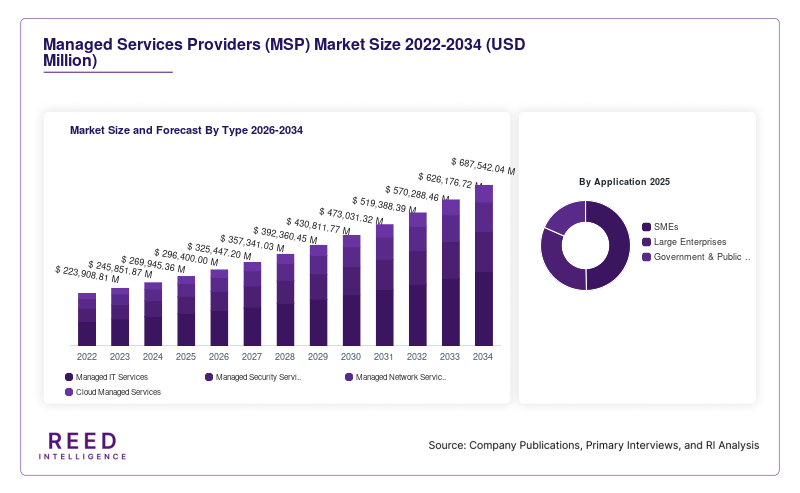
The managed services providers market size is projected at USD 325,400.0 million in 2026 and is expected to hit USD 687,542.04 million by 2034 with a CAGR of 9.8% during the forecast period. The increasing complexity of IT infrastructure, the growing demand for cost-effective and scalable IT solutions, and the rising focus on cybersecurity and compliance underpin market expansion. This report delivers a comprehensive analysis of the managed services providers market, including segmentation by type and application, competitive dynamics, and regional growth patterns, equipping stakeholders with critical intelligence to navigate this rapidly evolving IT services landscape.
Managed Services Providers Market Key Takeaways
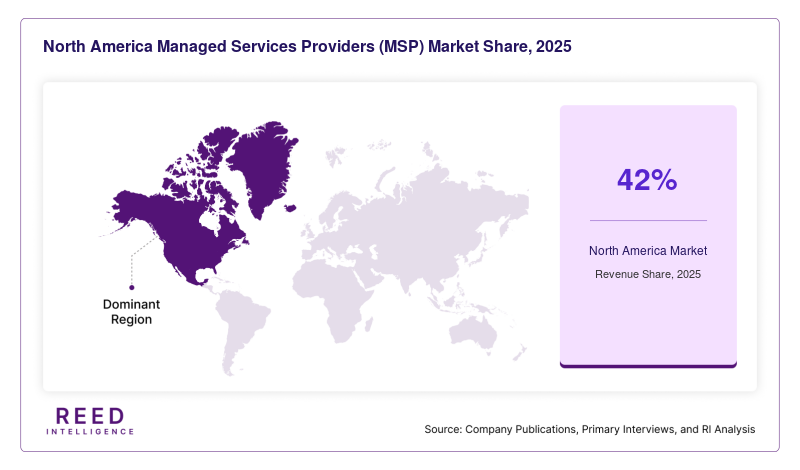
- Dominant Region: North America leads the MSP market with a 42% share, while Asia-Pacific is the fastest-growing region with a projected CAGR of 12.5% through 2034.
- Dominant Segment: The Managed IT Services type dominates the market with a 38% share, while the Large Enterprises application is the leading segment with a 45% share.
- Emerging Country: India is projected to reach USD 28,500.0 million by 2034, expanding at a CAGR of 15.2%.
- Key Drivers: The increasing IT complexity, the growing demand for cybersecurity, and the rising adoption of cloud services are driving market growth.
The managed services providers market encompasses a range of outsourced IT services delivered on a subscription or contract basis, including managed IT, security, network, and cloud services. These services enable organizations to offload the management of their IT infrastructure and operations to specialized providers, allowing them to focus on core business activities while ensuring reliable, secure, and efficient IT operations. Globally, the MSP market has grown substantially, with an estimated 150,000 MSPs operating worldwide in 2025, serving millions of businesses across all sectors. In terms of revenue, Managed IT Services accounted for roughly 38% of the total market share, driven by the fundamental need for IT support and management, while Managed Security Services followed with 28% share, particularly driven by the increasing frequency and sophistication of cyber threats. The market is further characterized by a penetration rate exceeding 65% among SMEs in developed economies, whereas large enterprises represent a significant and growing market for comprehensive managed services. The Managed Network Services and Cloud Managed Services segments, representing 20% and 14% of the market respectively, are gaining traction as organizations modernize their infrastructure and migrate to the cloud.
-market-8039.png)
Managed Services Providers Market Trends
Integration of AI and Automation for Service Delivery
The MSP market is witnessing a significant trend toward the integration of Artificial Intelligence (AI) and automation to enhance service delivery, efficiency, and scalability. This shift is driven by the need to manage increasingly complex IT environments, reduce manual effort, and deliver proactive support. MSPs are deploying AI-powered tools for predictive maintenance, automated ticket resolution, and intelligent monitoring. The adoption of AI and automation in MSP service delivery has increased by 40% year-over-year, with over 55% of MSPs now using some form of automation in their operations. This MSP market trend is supported by the growing availability of AI-powered IT management platforms and the increasing customer expectation for faster, more reliable service.
Growing Demand for Co-Managed and Customized Services
The increasing demand for co-managed and customized services is a major trend shaping the MSP market. The development of flexible engagement models that allow customers to retain control over certain IT functions while outsourcing others is gaining traction, driven by the need for tailored solutions that align with specific business requirements. The emergence of industry-specific MSP offerings for sectors such as healthcare, finance, and legal is particularly prominent. This MSP market growth is supported by the growing recognition that a one-size-fits-all approach to managed services is insufficient and that customers value flexibility and customization. The integration of customer portals and self-service options is also enhancing the co-managed experience.
Managed Services Providers Market Drivers
The MSP market's expansion is primarily driven by the increasing complexity of IT infrastructure, with organizations facing challenges in managing diverse technologies, applications, and cloud environments. The growing demand for cost-effective and scalable IT solutions has been a major driver, with MSPs offering predictable monthly costs and access to specialized expertise. The rising focus on cybersecurity and compliance has further fueled market demand, with organizations seeking specialized managed security services to protect against evolving threats and meet regulatory requirements. The increasing adoption of cloud services has also supported market growth, with MSPs providing cloud migration, management, and optimization services. Additionally, the growing shortage of skilled IT talent has expanded the market opportunity for MSPs, as organizations seek to augment their internal capabilities.
Managed Services Providers Market Restraints
Despite favorable growth prospects, the MSP market faces significant constraints, primarily related to the concerns about data security and privacy when outsourcing IT functions to third parties. The market's growth is further tempered by the potential loss of control over critical IT systems and the perceived risks of vendor lock-in. Additionally, the complexity of integrating MSP services with existing systems and the need for effective governance and oversight can create challenges for organizations. The competition from in-house IT teams and the availability of alternative solutions can also limit market growth in some segments.
Managed Services Providers Market Opportunities
The MSP market presents significant opportunities in the rapidly expanding segment of managed security services, driven by the increasing frequency and sophistication of cyberattacks. The development of specialized MSP offerings for emerging technologies such as AI, IoT, and edge computing represents another promising avenue. Emerging opportunities also exist in the application of MSP services for digital transformation initiatives and business process automation. Furthermore, the untapped potential in emerging markets, driven by increasing digitalization and the growth of SMEs, offers a fertile ground for market expansion.
Challenges in Managed Services Providers Market
The MSP market grapples with persistent challenges related to the need for continuous investment in technology, talent, and processes to keep pace with evolving customer needs and technological advancements. The complexity of managing diverse customer environments and ensuring consistent service quality presents ongoing operational challenges. The market is also contending with the challenge of recruiting and retaining skilled IT professionals in a competitive labor market. Moreover, the need for effective cybersecurity and compliance management across multiple customer environments poses significant challenges for MSPs.
Managed Services Providers Market Segmentation Analysis
The MSP market is segmented by Type and Application to provide a comprehensive market perspective. By Type, Managed IT Services dominate with a 38% market share, driven by the fundamental need for IT support. The Application segment is led by Large Enterprises, which accounts for 45% of the market, followed by SMEs at 38%, and Government & Public Sector at 17%.
By Type
Managed IT Services represent the largest segment in the MSP market, commanding a 38% share, with revenue exceeding USD 123,652 million in 2025. These services include helpdesk support, endpoint management, server management, and IT strategy. Technical specifications include service level agreements, response times, and support scope. The market's Managed IT Services segment is driven by the fundamental need for reliable IT operations and access to specialized expertise.
Managed Security Services capture a 28% share of the MSP market, with revenue of USD 91,112 million in 2025. These services include threat detection, incident response, vulnerability management, and compliance. Technical specifications include security operations center (SOC) capabilities, threat intelligence, and response times. The market's Managed Security Services segment is driven by the increasing need to protect against cyber threats and meet regulatory requirements.
Managed Network Services represent 20% of the market, with revenue of USD 65,080 million in 2025, characterized by network monitoring, management, and optimization services. Technical specifications include network uptime, performance metrics, and equipment management. The market's Managed Network Services segment is driven by the need for reliable, high-performance network infrastructure.
Cloud Managed Services account for 14% of the market, with revenue of USD 45,556 million in 2025, involving cloud migration, management, and optimization services. Technical specifications include cloud platform expertise, cost optimization, and security. The market's Cloud Managed Services segment is driven by the increasing adoption of cloud services and the need for specialized cloud expertise.
By Application
Large Enterprises dominate the MSP market, accounting for 45% of sales, representing USD 146,430 million in 2025. This segment includes organizations with complex IT environments and significant IT budgets. Usage penetration exceeds 75% among large enterprises in developed markets. The market's Large Enterprises segment is characterized by its focus on comprehensive services, customization, and integration with existing systems.
SMEs account for 38% of the MSP market, with revenue of USD 123,652 million in 2025. This segment encompasses small and medium-sized businesses seeking cost-effective IT solutions and access to expertise. The segment is growing at a significant rate, driven by the increasing digitalization of SMEs. The market's SMEs segment is characterized by its focus on affordability, scalability, and ease of use.
Government & Public Sector represent 17% of the market, with revenue of USD 55,318 million in 2025, involving government agencies and public institutions seeking managed services for IT operations, security, and compliance. The market's Government & Public Sector segment is driven by the need for secure, reliable, and compliant IT services.
Managed Services Providers Market Regional Analysis
North America Managed Services Providers Market
Leads the MSP market, commanding a 42% share, with revenue of USD 136,668 million in 2025. The United States is the primary driver, accounting for 88% of regional demand, driven by the large number of MSPs, high IT spending, and advanced digital infrastructure. The North American market is characterized by its focus on innovation, comprehensive services, and cybersecurity.
Europe Managed Services Providers Market
Represents the second-largest market, capturing a 30% share with revenue of USD 97,620 million in 2025. The United Kingdom, Germany, and France are the primary drivers, together accounting for 58% of regional demand, driven by well-established IT infrastructure and increasing focus on cybersecurity and compliance. The European market is projected to grow at a steady CAGR, supported by continuous innovation and regulatory drivers.
Asia-Pacific Managed Services Providers Market
Accounts for 20% of the global MSP market, with revenue of USD 65,080 million in 2025. China, India, and Japan are the primary drivers, accounting for 70% of regional demand, fueled by the rapidly growing digital economy, increasing IT spending, and the expansion of SMEs. The Asia-Pacific market is projected to grow at the fastest CAGR of 12.5% through 2034, driven by digital transformation and economic growth.
Latin America and Middle East & Africa Managed Services Providers Market
Together account for the remaining 8% of the MSP market, with Brazil and the UAE leading their respective regions. Both regions are projected to grow at CAGRs exceeding 11%, driven by increasing digitalization and growing IT investment.
Top players in Managed Services Providers Market
- Accenture plc
- IBM Corporation
- DXC Technology Company
- Atos SE
- Capgemini SE
- Cognizant Technology Solutions
- Infosys Limited
- Wipro Limited
- Tata Consultancy Services
- HCL Technologies
- Fujitsu Limited
- NTT Data Corporation
- Unisys Corporation
- CDW Corporation
- Presidio, Inc.
Recent Developments in Managed Services Providers Market
- April 2026 – Accenture plc launched a new AI-powered managed services platform for predictive IT operations and automated incident resolution.
- June 2025 – IBM Corporation introduced a new managed security services offering with integrated threat intelligence and AI-driven analytics.
- August 2025 – DXC Technology Company announced a new cloud managed services portfolio for hybrid and multi-cloud environments.
- February 2026 – Infosys Limited launched a new co-managed IT services model for SMEs, offering flexible engagement options.
- October 2025 – Tata Consultancy Services introduced a new managed network services solution with SD-WAN and edge computing capabilities.
Managed Services Providers (MSP) Market Segments
By Type
- Managed IT Services
- Managed Security Services
- Managed Network Services
- Cloud Managed Services
By Application
- SMEs
- Large Enterprises
- Government & Public Sector
By Region
- North America
- Europe
- APAC
- Middle East and Africa
- LATAM