Mannan Oligosaccharide Market Size, Share & Demand Report By Type (Dry, Liquid), By Source (Yeast-Based, Plant-Based), By Application (Feed, Aquaculture, Pet Nutrition), By Livestock (Poultry, Swine, Ruminants, Aquaculture) By Region & Segment Forecasts, 2025–2034
USD 3950
Market Overview
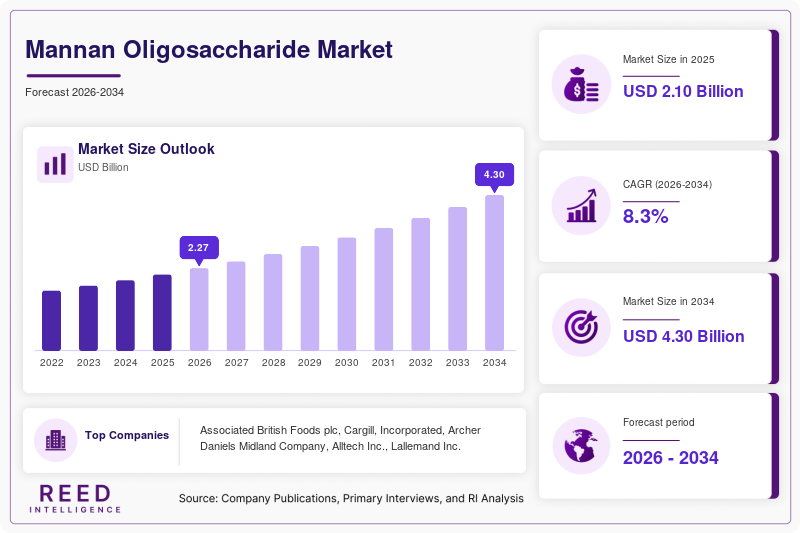
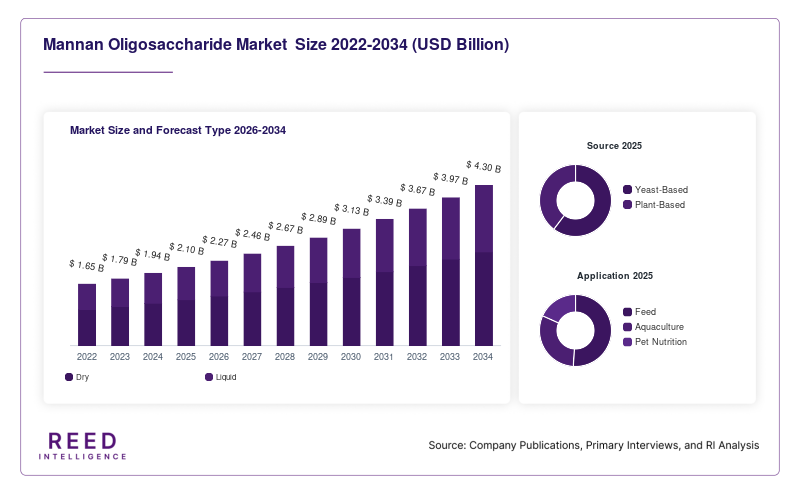
The global Mannan Oligosaccharide Market size was valued at approximately USD 2.1 billion in 2025 and is projected to reach USD 4.3 billion by 2034, expanding at a CAGR of 8.3% during the forecast period (2026–2034). The market is witnessing consistent expansion due to the increasing adoption of functional feed additives across livestock and aquaculture industries. Mannan oligosaccharides (MOS), derived primarily from yeast cell walls, are widely used as prebiotic ingredients that support gut health and immunity in animals.
A significant global factor supporting market growth is the rising emphasis on reducing antibiotic usage in animal nutrition. Regulatory shifts and consumer demand for antibiotic-free animal products have driven livestock producers to adopt natural growth promoters such as MOS. This transition has accelerated the integration of MOS into feed formulations, especially in developed markets.
Key Highlights:
- North America dominated the market with a share of 34.2% in 2025, while Asia Pacific is expected to register the fastest CAGR of 9.6% during the forecast period
- The feed application segment led with a 62.5% share, while aquaculture is projected to grow at a CAGR of 10.1%
- Dry form MOS accounted for the largest share, whereas liquid MOS is anticipated to grow at a CAGR of 8.9%
- The U.S. market was valued at USD 620 million in 2024 and reached USD 665 million in 2025
Market Trends
Rising Adoption of Functional Feed Additives
The Mannan Oligosaccharide Market is increasingly shaped by the growing use of functional feed additives that enhance animal productivity and health. Livestock producers are shifting toward scientifically formulated feed solutions that improve gut microbiota balance and nutrient absorption. MOS has emerged as a preferred prebiotic additive due to its ability to bind harmful pathogens and improve immune responses. This trend is particularly visible in poultry and swine industries, where feed efficiency directly impacts profitability.
Expansion in Aquaculture Applications
Another notable trend is the increasing application of MOS in aquaculture. As global seafood consumption rises, aquaculture producers are focusing on improving fish health and survival rates. MOS is being incorporated into fish and shrimp feed to reduce disease outbreaks and enhance growth performance. The expansion of sustainable aquaculture practices has further supported the integration of MOS as a natural and eco-friendly feed additive.
Market Drivers
Shift Toward Antibiotic-Free Animal Nutrition
The global transition toward antibiotic-free livestock production is a primary driver of the Mannan Oligosaccharide Market. Regulatory authorities in several regions have imposed restrictions on antibiotic growth promoters, encouraging the use of alternatives such as MOS. These compounds provide similar benefits in terms of growth enhancement and disease prevention without contributing to antimicrobial resistance.
Increasing Demand for High-Quality Animal Protein
Rising global population and income levels have led to increased consumption of meat, dairy, and seafood products. To meet this demand, producers are focusing on improving feed efficiency and animal health. MOS plays a critical role in enhancing nutrient absorption and gut health, thereby supporting higher productivity. This demand for high-quality animal protein continues to drive the adoption of MOS across various livestock segments.
Market Restraint
High Production and Processing Costs
One of the key challenges in the Mannan Oligosaccharide Market is the relatively high cost associated with production and extraction processes. MOS is primarily derived from yeast cell walls, requiring specialized fermentation and processing techniques. These processes increase overall manufacturing costs, making MOS-based feed additives more expensive compared to conventional alternatives.
Additionally, price sensitivity among small-scale livestock producers can limit the widespread adoption of MOS, particularly in developing regions. While large-scale commercial farms are more likely to invest in premium feed additives, smaller operators may prioritize cost-effective solutions. This pricing barrier can restrict market penetration and slow down growth in certain regions.
Market Opportunities
Growth in Pet Nutrition Industry
The expanding pet care industry presents a significant opportunity for the Mannan Oligosaccharide Market. Pet owners are increasingly seeking premium and functional pet food products that promote digestive health and immunity. MOS is gaining traction as a key ingredient in pet nutrition formulations, offering similar benefits as in livestock feed. This trend is expected to create new revenue streams for market participants.
Technological Advancements in Production
Advances in biotechnology and fermentation processes are opening new opportunities for cost optimization and product innovation. Improved production techniques can enhance yield, reduce costs, and enable the development of customized MOS formulations for specific applications. These advancements are likely to expand the application scope of MOS beyond traditional feed segments.
Segmental Analysis
By Type
The dry MOS segment dominated the Mannan Oligosaccharide Market with a share of 68.3% in 2024. This dominance was attributed to its ease of handling, longer shelf life, and compatibility with various feed formulations. Dry MOS products have been widely used in poultry and swine feed due to their stability and effectiveness.
The liquid MOS segment is expected to grow at a CAGR of 8.9% during the forecast period. This growth will be driven by its improved solubility and ease of mixing in liquid feed systems. Increasing adoption in aquaculture and specialized feed applications will support its expansion.
By Source
Yeast-derived MOS held the largest share of 74.6% in 2024, driven by its high efficacy and widespread availability. The use of yeast cell walls as a primary source has been well-established in the industry.
Plant-based MOS is projected to grow at a CAGR of 9.2% during the forecast period. This growth will be supported by increasing demand for alternative and sustainable sources, particularly in regions focusing on plant-based feed solutions.
By Application
The feed segment accounted for 62.5% of the Mannan Oligosaccharide Market share in 2024. The extensive use of MOS in livestock feed to improve gut health and performance has driven this dominance.
The aquaculture segment is expected to grow at a CAGR of 10.1% during the forecast period. Rising seafood demand and the need for disease-resistant aquatic species will drive the adoption of MOS in this segment.
By Livestock
The poultry segment dominated the market with a share of 45.7% in 2024. The high consumption of poultry products and the need for efficient feed solutions have supported this segment.
The aquaculture livestock segment is projected to grow at a CAGR of 10.3% during the forecast period. The increasing focus on sustainable fish farming practices will drive growth.
Regional Analysis
North America
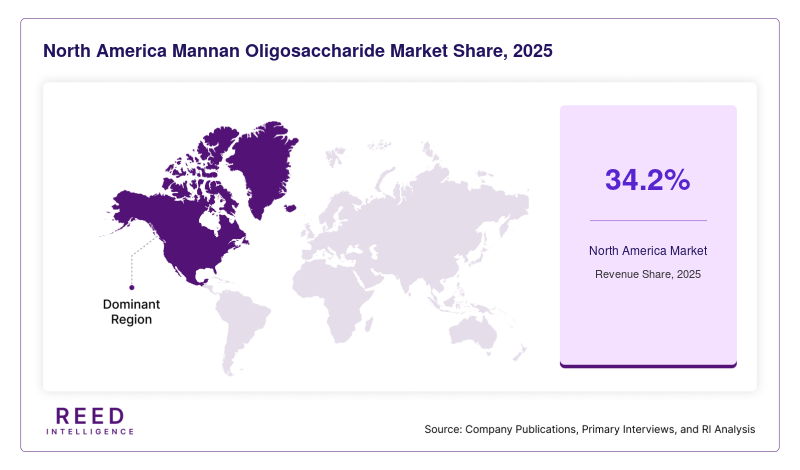
North America accounted for 34.2% of the global Mannan Oligosaccharide Market share in 2025 and is expected to grow at a CAGR of 7.8% during the forecast period. The region had a well-established livestock industry supported by advanced feed technologies and regulatory frameworks promoting antibiotic alternatives. The presence of major feed manufacturers and high awareness regarding animal nutrition contributed to market dominance.
The United States led the regional market due to its strong poultry and swine production sectors. The adoption of natural feed additives has been driven by stringent regulations and consumer preference for antibiotic-free products. Continuous investment in research and development further supports market growth in the country.
Europe
Europe held a 27.5% share of the Mannan Oligosaccharide Market in 2025 and is projected to grow at a CAGR of 7.5% through 2034. The region had a mature market characterized by strict regulations on antibiotic usage in animal feed. This regulatory environment encouraged the adoption of MOS as a natural alternative.
Germany emerged as the dominant country in the region, supported by its advanced livestock farming practices and focus on sustainable agriculture. The integration of MOS into feed formulations has been influenced by strong regulatory compliance and growing consumer demand for organic and natural products.
Asia Pacific
Asia Pacific captured 23.8% of the global Mannan Oligosaccharide Market in 2025 and is expected to register the fastest CAGR of 9.6% during the forecast period. The region has been experiencing rapid growth due to expanding livestock and aquaculture industries. Increasing awareness of feed quality and animal health has supported market expansion.
China dominated the regional market due to its large-scale livestock production and growing aquaculture sector. The country’s focus on improving feed efficiency and reducing disease outbreaks has accelerated the adoption of MOS-based additives.
Middle East & Africa
The Middle East & Africa accounted for 8.1% of the Mannan Oligosaccharide Market share in 2025 and is projected to grow at a CAGR of 8.2% during the forecast period. The market in this region has been driven by the gradual modernization of livestock farming practices and increasing demand for high-quality animal products.
South Africa led the regional market due to its relatively developed agricultural sector. The adoption of MOS has been supported by efforts to improve feed quality and enhance livestock productivity in the country.
Latin America
Latin America held a 6.4% share of the global Mannan Oligosaccharide Market in 2025 and is expected to grow at a CAGR of 8.5% during the forecast period. The region has been witnessing steady growth due to its strong poultry and beef production industries.
Brazil dominated the market in Latin America, driven by its large-scale livestock production and export-oriented meat industry. The use of MOS in feed formulations has been influenced by the need to improve animal health and meet international quality standards.
Competitive Landscape
The Mannan Oligosaccharide Market is moderately fragmented, with several global and regional players competing based on product quality, pricing, and innovation. Companies are focusing on expanding their product portfolios and enhancing production capabilities.
Associated British Foods plc emerged as a leading player due to its extensive range of feed additives and strong global presence. The company recently introduced an advanced MOS formulation aimed at improving feed efficiency and animal health.
Other key players are investing in research and development to create customized solutions for different livestock segments. Strategic partnerships and acquisitions are also being pursued to strengthen market positioning and expand geographic reach.
Key Players
- Associated British Foods plc
- Cargill, Incorporated
- Archer Daniels Midland Company
- Alltech Inc.
- Biofeed Technology Inc.
- Lallemand Inc.
- Lesaffre Group
- Nutreco N.V.
- DuPont de Nemours, Inc.
- Kemin Industries, Inc.
- Novus International, Inc.
- Phileo by Lesaffre
- Adisseo France SAS
- Royal DSM
- Zinpro Corporation
Recent Developments
- In 2024, Associated British Foods plc launched a next-generation MOS product with enhanced pathogen-binding capabilities
- In 2023, Cargill expanded its feed additive production facility to increase MOS output
- In 2024, Alltech introduced a new MOS-based solution targeting aquaculture applications
- In 2023, Lallemand Inc. invested in advanced fermentation technology for improved yield
- In 2024, Nutreco N.V. partnered with regional distributors to expand MOS availability in Asia Pacific
Mannan Oligosaccharide Market Segments
Type
- Dry
- Liquid
Source
- Yeast-Based
- Plant-Based
Application
- Feed
- Aquaculture
- Pet Nutrition
Livestock
- Poultry
- Swine
- Ruminants
- Aquaculture
Distribution Channel
- Direct Sales
- Distributors & Dealers
- Online Channels
By Region
- North America
- Europe
- APAC
- Middle East and Africa
- LATAM