Marine Deck Machinery Market Size, Share & Demand Report By Machinery Type (Winches, Cranes, Windlasses, Capstans, Steering Gear, Hatch Covers, Electric Deck Machinery, Hydraulic Deck Machinery), By Application (Commercial Shipping, Offshore Support Vessels, Naval Vessels, Fishing Vessels, Passenger Ferries, Research and Survey Vessels), By End Use (Commercial Vessel Operators, Offshore Energy Operators, Defense and Coast Guard Authorities, Shipbuilding Companies, Marine Service Providers), By R
USD 3950
Market Overview
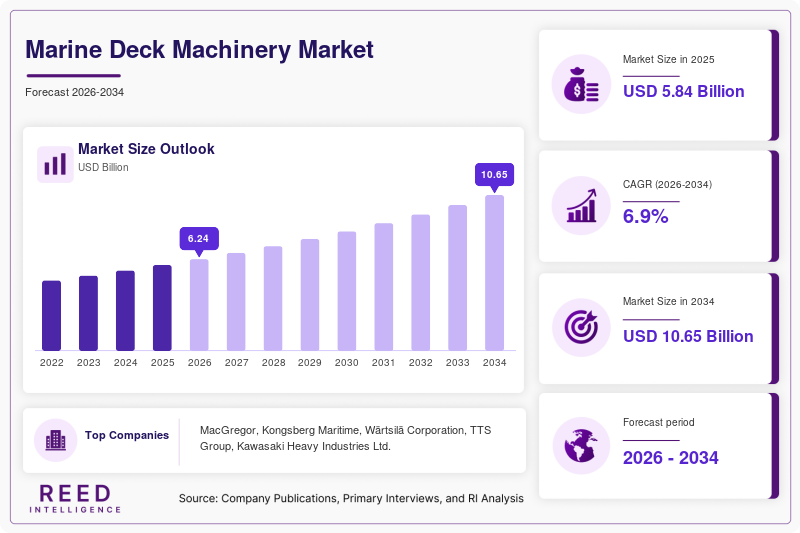
The global Marine Deck Machinery Market size was valued at USD 5.84 billion in 2026 and is projected to reach USD 9.96 billion by 2034, expanding at a CAGR of 6.9% during the forecast period. Marine deck machinery includes a wide range of systems such as winches, cranes, windlasses, capstans, hatch covers, steering gear, and mooring equipment used across commercial vessels, offshore platforms, naval fleets, and specialized marine operations. Rising seaborne trade activity, fleet modernization programs, and increasing investments in offshore energy infrastructure continue to strengthen market demand across developed and emerging maritime economies.
The growth of international shipping activity has remained one of the primary factors supporting market expansion. Governments and private operators are investing in technologically advanced vessels equipped with automated deck systems to improve cargo handling efficiency, crew safety, and operational reliability. In addition, environmental regulations focused on fuel optimization and vessel efficiency are encouraging shipowners to replace traditional hydraulic systems with electric and hybrid marine deck machinery. Shipyards are also integrating smart monitoring systems that enable predictive maintenance and reduce vessel downtime.
Key Highlights
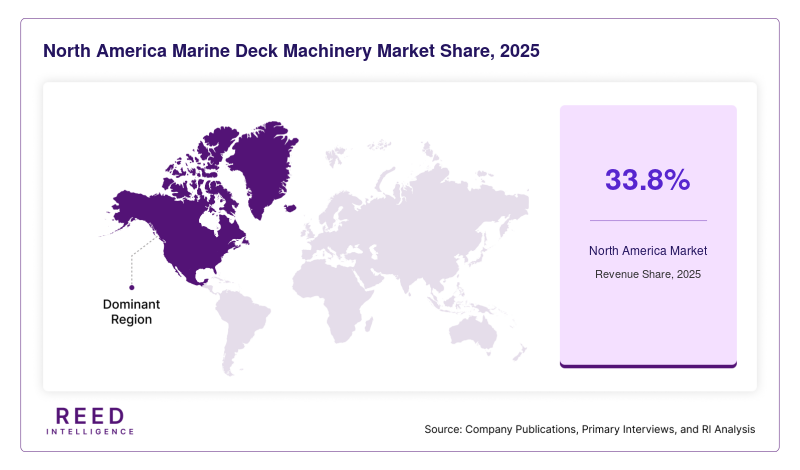
- North America dominated the market with a 33.8% share in 2025.
- Asia Pacific is expected to grow at the fastest CAGR of 8.4% during 2026–2034.
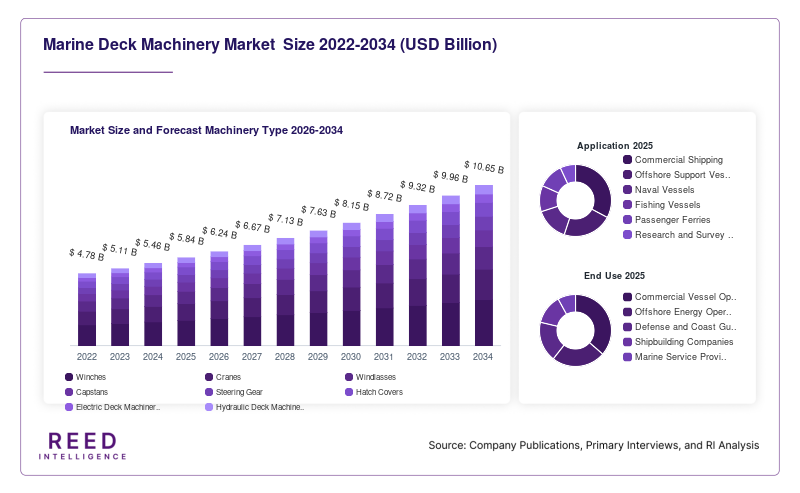
- By machinery type, winches accounted for the largest share of 31.6%, while electric deck machinery is projected to grow at a CAGR of 8.9%.
- By application, commercial shipping led with a 46.3% share, whereas offshore support vessels are expected to expand at a CAGR of 8.7%.
- The United States remained the dominant country, with market values of USD 1.08 billion in 2024 and USD 1.15 billion in 2025.
Market Trends
Integration of Smart and Automated Deck Machinery
The increasing adoption of automation across maritime operations is shaping the evolution of the Marine Deck Machinery Market. Ship operators are deploying intelligent winches, automated mooring systems, and digitally controlled cranes to improve vessel productivity and reduce operational risks. Advanced systems equipped with sensors and real-time monitoring software help crews detect equipment wear, analyze load conditions, and optimize maintenance schedules. These technologies support lower downtime and improve fuel efficiency during vessel operations. Automated deck machinery is becoming particularly important for commercial shipping fleets operating under strict delivery timelines and labor efficiency targets.
The growing use of connected maritime technologies is also encouraging integration between deck equipment and vessel management platforms. Operators can monitor deck machinery performance remotely through centralized ship control systems. This trend is gaining traction in container ships, LNG carriers, and offshore support vessels where equipment reliability is critical. Manufacturers are responding by developing electric and hybrid deck systems that offer lower emissions and quieter operations. The transition toward smart shipping practices is expected to create long-term opportunities for suppliers focused on automation-compatible marine machinery solutions.
Expansion of Offshore Renewable Energy Projects
Offshore renewable energy investments are creating sustained demand for advanced marine deck machinery across installation and maintenance vessels. Offshore wind farms require specialized cranes, anchor handling systems, towing winches, and cable-laying machinery capable of operating under harsh marine conditions. Governments in Europe and Asia Pacific are increasing investments in offshore renewable infrastructure to diversify energy sources and reduce carbon emissions. This transition is supporting the procurement of modern vessels equipped with high-capacity and digitally controlled deck systems.
Marine contractors are increasingly demanding customized deck machinery designed for heavy lifting and precision handling applications. Offshore support vessels used for turbine installation and maintenance require reliable equipment capable of operating continuously in challenging environments. The growth of floating offshore wind farms is also generating demand for dynamic positioning-compatible deck machinery systems. Manufacturers are focusing on corrosion-resistant materials, energy-efficient motors, and compact system designs to address changing customer requirements. As offshore renewable projects expand into deeper waters, demand for technologically advanced marine deck equipment is expected to rise steadily.
Market Drivers
Growth in Global Maritime Trade and Fleet Expansion
The expansion of global maritime trade continues to support demand within the Marine Deck Machinery Market. International shipping remains one of the most cost-effective transportation methods for bulk commodities, energy products, and manufactured goods. Rising cargo volumes are encouraging shipping companies to expand fleets and modernize existing vessels with advanced deck equipment. Ports and logistics operators are also emphasizing faster loading and unloading operations, increasing the need for efficient winches, cranes, and mooring systems.
Developing economies across Asia Pacific, the Middle East, and Latin America are investing heavily in port infrastructure and maritime connectivity. These investments are stimulating procurement of commercial vessels equipped with improved deck machinery systems. Fleet operators are focusing on operational efficiency, worker safety, and maintenance reduction, leading to greater adoption of automated and electric systems. In addition, stricter maritime safety regulations are encouraging shipowners to replace aging equipment with modern machinery that offers enhanced reliability and compliance capabilities.
Rising Investments in Naval Modernization Programs
Defense modernization initiatives are significantly contributing to the expansion of the Marine Deck Machinery Market. Naval fleets require advanced deck machinery systems for operations such as cargo handling, towing, replenishment, and amphibious support. Governments in the United States, China, India, and several European countries are increasing defense budgets to strengthen maritime security capabilities. This trend is supporting demand for technologically advanced machinery systems designed for military-grade durability and operational precision.
Modern naval vessels are increasingly equipped with automated deck handling systems that improve mission efficiency and reduce crew workload. Manufacturers are introducing compact and lightweight systems capable of operating under extreme environmental conditions. The demand for stealth-compatible and low-noise machinery is also increasing within naval applications. Additionally, rising geopolitical tensions and growing investments in coast guard fleets are creating procurement opportunities for marine equipment suppliers. Long-term naval fleet expansion programs are expected to maintain steady demand for specialized deck machinery throughout the forecast period.
Market Restraint
High Installation and Maintenance Costs Associated with Advanced Systems
The high cost of advanced marine deck machinery remains a major challenge for market growth, particularly among small and mid-sized vessel operators. Automated and electric deck systems involve substantial upfront investment due to the integration of sensors, control software, high-performance motors, and corrosion-resistant materials. Installation costs can increase further when shipowners retrofit older vessels with modern equipment. Many shipping companies operating in cost-sensitive markets delay machinery upgrades because of budget limitations and uncertain freight market conditions.
Maintenance complexity also affects purchasing decisions across the Marine Deck Machinery Market. Advanced systems require skilled technicians, specialized spare parts, and regular inspection procedures to ensure operational safety. Offshore vessels operating in harsh environments often experience accelerated wear, increasing maintenance expenses and operational downtime. Smaller shipyards and regional operators may face difficulties accessing technical support and replacement components in remote locations. In addition, fluctuations in steel prices and supply chain disruptions can increase manufacturing costs for deck machinery suppliers. These financial and operational challenges may slow the adoption rate of technologically advanced marine machinery systems in certain developing maritime markets.
Market Opportunities
Development of Electric and Hybrid Marine Deck Systems
The increasing focus on sustainable shipping operations is creating opportunities for electric and hybrid marine deck machinery solutions. Shipowners are under growing pressure to reduce fuel consumption and comply with international environmental regulations targeting emissions from maritime operations. Electric deck machinery systems offer lower energy consumption, reduced hydraulic oil leakage risks, and improved operational efficiency compared to conventional hydraulic systems. As a result, vessel operators are investing in cleaner and quieter deck equipment technologies.
Manufacturers are developing compact electric winches, cranes, and steering systems designed for commercial and offshore vessels. Battery-supported and hybrid systems are gaining attention in passenger ferries and coastal vessels where energy efficiency remains a priority. These systems also support lower maintenance costs due to reduced mechanical complexity. Increasing investments in green shipping corridors and low-emission ports are expected to encourage broader adoption of electric marine deck machinery. Suppliers capable of providing energy-efficient and digitally integrated solutions are likely to gain competitive advantages during the forecast period.
Expansion of Arctic and Deep-Sea Marine Operations
The growth of Arctic shipping routes and deep-sea exploration projects is opening new opportunities within the Marine Deck Machinery Market. Melting ice conditions and increasing interest in alternative maritime trade routes are encouraging investment in vessels capable of operating in extreme marine environments. Arctic cargo ships, research vessels, and offshore support ships require specialized deck machinery designed to withstand low temperatures, ice exposure, and high mechanical stress.
Deep-sea oil exploration and subsea infrastructure projects are also supporting demand for advanced anchor handling systems, towing winches, and heavy-duty cranes. Offshore energy operators require equipment capable of handling large loads with high precision under severe environmental conditions. Manufacturers are focusing on durable coatings, corrosion-resistant materials, and intelligent load management systems to improve equipment reliability. In addition, rising government investments in maritime research and polar exploration programs are expected to create demand for technologically advanced marine deck machinery across specialized vessel categories.
Segmental Analysis
By Machinery Type
Winches accounted for the largest share of the Marine Deck Machinery Market in 2024, representing approximately 31.6% of global revenue. These systems are widely used across commercial ships, offshore support vessels, fishing boats, and naval fleets for anchoring, towing, cargo handling, and mooring operations. Their broad operational functionality and critical role in vessel safety continue to support high adoption rates. Hydraulic winches remain common across heavy-duty marine applications because of their strong load-handling capability and operational durability in harsh marine environments.
The dominance of winches is also supported by rising global shipping activity and increasing offshore infrastructure projects. Manufacturers are developing automated winch systems integrated with digital control technologies that improve load accuracy and operational efficiency. Shipowners are increasingly prioritizing machinery capable of minimizing manual intervention and reducing crew fatigue during marine operations. In addition, demand for customized winch configurations is increasing across specialized vessels used in subsea construction and offshore renewable energy projects.
By Application
Commercial shipping represented the dominant application segment in the Marine Deck Machinery Market and accounted for 46.3% of global revenue in 2024. Cargo ships, bulk carriers, container vessels, and tanker fleets require reliable deck machinery systems for efficient loading, unloading, anchoring, and mooring operations. Rising international trade volumes and growing demand for maritime logistics continue to support vessel procurement and fleet modernization activities. Commercial shipping operators are increasingly investing in advanced deck equipment to improve turnaround times and reduce maintenance-related operational disruptions.
The segment also benefits from increasing investments in smart shipping technologies and digital fleet management systems. Automated deck machinery integrated with vessel monitoring platforms helps shipping companies optimize operational performance and improve safety standards. In addition, the growth of LNG shipping and specialized cargo transportation is encouraging the use of technologically advanced cranes and winches. The expansion of global port infrastructure and container handling capacity is expected to sustain long-term demand within the commercial shipping application segment.
By End Use
Commercial vessel operators accounted for the largest share of the Marine Deck Machinery Market in 2024, contributing approximately 52.1% of total revenue. Shipping companies continue to invest in modern deck machinery systems to improve vessel productivity, operational safety, and compliance with international maritime regulations. Increasing global cargo transportation volumes and fleet expansion programs are supporting procurement of advanced winches, cranes, and mooring systems across commercial fleets.
Commercial operators are increasingly prioritizing automation and energy-efficient technologies to reduce operational costs and maintenance requirements. Retrofitting projects are also contributing to market demand as older vessels undergo modernization upgrades to improve performance and extend operational lifespan. In addition, shipping companies are adopting predictive maintenance solutions that help minimize equipment failure and reduce unexpected downtime. The expansion of global trade routes and container shipping activity is expected to maintain strong demand from commercial vessel operators.
Regional Analysis
North America
North America accounted for 33.8% of the global Marine Deck Machinery Market in 2025 and is expected to maintain stable growth throughout the forecast period. The regional market is projected to expand at a CAGR of 5.9% during 2026–2034 due to continuous investments in commercial shipping, offshore energy infrastructure, and naval modernization programs. The presence of established shipbuilding companies and advanced maritime technology providers supports market development across the region. Growing demand for automated deck handling systems and electric machinery solutions is also encouraging technological innovation among manufacturers.
The United States remained the dominant country in the regional market due to its large naval fleet and strong offshore energy sector. Increasing investments in offshore wind installations along the Atlantic coast are generating demand for advanced cranes, winches, and anchor handling systems. In addition, modernization of aging commercial fleets is supporting procurement of digitally integrated deck machinery. Ship operators in the country are increasingly adopting predictive maintenance technologies to improve equipment efficiency and reduce operational downtime.
Europe
Europe represented a significant share of the Marine Deck Machinery Market in 2025, supported by strong maritime trade activity and offshore renewable energy development. The regional market is anticipated to grow at a CAGR of 6.3% during the forecast period as governments continue to encourage sustainable shipping practices. European shipyards are focusing on technologically advanced and energy-efficient vessels equipped with automated deck systems. The adoption of electric and hybrid deck machinery is particularly increasing among passenger ferries, offshore vessels, and specialized research ships.
Norway remained the leading country within the European market due to its established offshore marine industry and advanced shipbuilding capabilities. The country has invested heavily in offshore wind projects and autonomous vessel technologies, creating demand for intelligent marine deck systems. Norwegian maritime operators are also emphasizing low-emission shipping operations, encouraging suppliers to develop energy-efficient machinery. The presence of strong marine engineering expertise continues to support innovation across regional deck machinery manufacturing.
Asia Pacific
Asia Pacific is expected to register the fastest growth in the Marine Deck Machinery Market with a projected CAGR of 8.4% during 2026–2034. The region benefits from extensive shipbuilding activity, expanding seaborne trade, and rising investments in port infrastructure. Countries such as China, South Korea, and Japan remain global leaders in commercial vessel production, supporting consistent demand for deck machinery systems. Rapid industrialization and growing export activity across Southeast Asia are also contributing to increased maritime transportation requirements.
China dominated the regional market due to its large shipbuilding industry and expanding naval modernization initiatives. The country continues to invest in container ships, LNG carriers, offshore support vessels, and naval fleets equipped with advanced deck machinery systems. Increasing government support for smart ship technologies is encouraging adoption of automated cranes, electric winches, and digital monitoring systems. Chinese manufacturers are also strengthening domestic production capabilities to reduce dependency on imported marine equipment.
Middle East & Africa
The Middle East & Africa region is experiencing steady growth in the Marine Deck Machinery Market driven by offshore oil and gas activities and maritime infrastructure development. The regional market is forecast to expand at a CAGR of 6.1% during 2026–2034. Offshore support vessels operating in the Persian Gulf require durable deck machinery capable of handling heavy loads and continuous marine operations. Investments in port modernization projects and regional shipping connectivity are further supporting demand for advanced marine equipment.
Saudi Arabia emerged as the dominant country in the regional market due to expanding offshore energy projects and maritime diversification initiatives. The country is investing in large-scale port developments and ship repair facilities to strengthen regional logistics capabilities. Growing demand for offshore support vessels and heavy-lift ships is encouraging procurement of high-capacity cranes and mooring systems. In addition, government-backed industrial development programs are supporting local marine equipment manufacturing and maintenance services.
Latin America
Latin America accounted for a moderate share of the Marine Deck Machinery Market in 2025 and is projected to grow at a CAGR of 5.7% during the forecast period. Regional growth is supported by offshore energy exploration, fishing industry expansion, and modernization of regional commercial fleets. Several countries are investing in port development projects to improve international trade efficiency. The increasing use of specialized support vessels for offshore oil operations is creating demand for towing winches, anchor handling systems, and hydraulic cranes.
Brazil remained the leading country within the regional market due to its extensive offshore oil production activities and shipbuilding investments. The country continues to expand offshore exploration projects in deep-water reserves, requiring technologically advanced marine support vessels. Demand for corrosion-resistant deck machinery is rising because of challenging offshore operating conditions. Brazilian shipyards are also focusing on modernization projects aimed at improving vessel efficiency and operational safety across commercial and offshore fleets.
Competitive Landscape
The Marine Deck Machinery Market remains moderately consolidated with several international manufacturers competing through product innovation, strategic partnerships, and regional expansion initiatives. Leading companies are focusing on automation, digital monitoring technologies, and energy-efficient equipment to strengthen their market positions. Competition is influenced by vessel modernization programs, offshore renewable energy investments, and increasing demand for electric deck systems.
MacGregor remained one of the leading companies in the market due to its broad portfolio of marine cargo handling and deck equipment solutions. The company expanded its digital service capabilities in 2025 by introducing predictive maintenance software for offshore crane systems. Other major participants including Kongsberg Maritime, Wärtsilä, TTS Group, and Kawasaki Heavy Industries are investing in smart marine technologies and advanced vessel integration solutions.
Key Players
- MacGregor
- Kongsberg Maritime
- Wärtsilä Corporation
- TTS Group
- Kawasaki Heavy Industries Ltd.
- Rolls-Royce Marine
- Huisman Equipment
- Mitsubishi Heavy Industries Ltd.
- DMT Marine Equipment
- PALFINGER AG
- Liebherr Group
- Damen Shipyards Group
- Allied Marine Crane
- Markey Machinery Co.
- Ingersoll Rand
Recent Developments
- In March 2026, MacGregor launched a next-generation electric winch system designed for offshore wind installation vessels with integrated remote monitoring capabilities.
- In October 2025, Kongsberg Maritime partnered with a European shipyard to develop automated deck handling systems for hybrid-powered cargo vessels.
- In July 2025, Wärtsilä introduced a predictive maintenance platform for marine deck machinery aimed at reducing unplanned vessel downtime.
- In January 2026, PALFINGER AG expanded its marine crane manufacturing facility in Asia Pacific to support increasing offshore infrastructure demand.
- In August 2025, Kawasaki Heavy Industries Ltd. announced the development of lightweight hydraulic deck machinery for next-generation naval support vessels.
Marine Deck Machinery Market Segments
Machinery Type
- Winches
- Cranes
- Windlasses
- Capstans
- Steering Gear
- Hatch Covers
- Electric Deck Machinery
- Hydraulic Deck Machinery
Application
- Commercial Shipping
- Offshore Support Vessels
- Naval Vessels
- Fishing Vessels
- Passenger Ferries
- Research and Survey Vessels
End Use
- Commercial Vessel Operators
- Offshore Energy Operators
- Defense and Coast Guard Authorities
- Shipbuilding Companies
- Marine Service Providers
By Region
- North America
- Europe
- APAC
- Middle East and Africa
- LATAM