Marine Grease Market Size, Share, Growth Demand Report By Product Type (Calcium Sulfonate Grease, Lithium-Based Grease, Aluminum Complex Grease), By Base Oil Type (Mineral Oil-Based Grease, Synthetic Oil-Based Grease), By Application (Engine Components, Deck Equipment, Propeller Shafts, Offshore Equipment), By End User (Commercial Shipping, Naval Defense, Offshore Oil & Gas), By Region & Segment Forecasts, 2026–2034
USD 3950
Market Overview
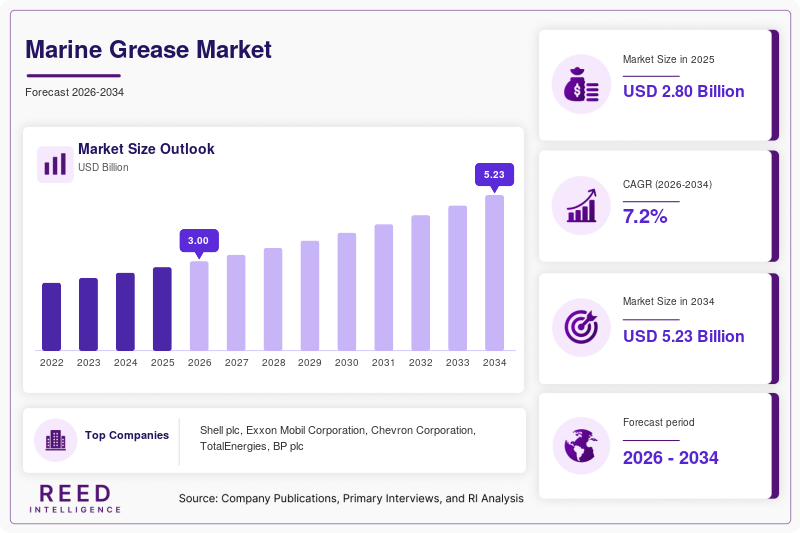
The Marine Grease Market was valued at approximately USD 2.8 billion in 2026 and is projected to reach USD 4.9 billion by 2034, expanding at a CAGR of 7.2% during the forecast period (2026–2034). The market is experiencing stable growth due to increasing maritime trade activities, rising shipbuilding operations, and growing demand for high-performance lubricants capable of operating under harsh marine conditions. Marine grease is widely used in ship engines, deck equipment, propeller shafts, bearings, winches, cranes, and offshore machinery to provide corrosion protection, water resistance, and equipment durability. Increasing investments in commercial shipping fleets, naval modernization programs, and offshore energy projects are further supporting the growth of the market globally.
A major global factor supporting the expansion of the Marine Grease Market size is the continued growth of international seaborne trade and logistics activities. Marine transportation remains one of the most efficient methods for global cargo movement, resulting in increasing vessel utilization and maintenance requirements. Rising demand for reliable lubrication systems in cargo ships, fishing vessels, offshore platforms, and port handling equipment is encouraging manufacturers to develop advanced marine grease formulations with improved thermal stability, corrosion resistance, and environmental compatibility.
Key Highlights
- Dominant Region (2025): Asia Pacific held 39% share, supported by expanding shipbuilding activities and strong maritime trade infrastructure
- Fastest-Growing Region: Middle East & Africa is projected to grow at 8.4% CAGR (2026–2034)
- Leading Subsegment (Product Type): Calcium sulfonate grease accounted for 34% share in 2025
- Fastest-Growing Subsegment (Application): Offshore equipment lubrication is projected to grow at 8.8% CAGR
- Dominant Country (2024): China accounted for approximately USD 0.56 billion
- Dominant Country (2025): China increased to USD 0.62 billion, supported by expanding port operations and rising vessel manufacturing capacity
Market Trends
Increasing Adoption of Environmentally Acceptable Lubricants
The Marine Grease Market is witnessing growing demand for environmentally acceptable lubricants due to stricter marine environmental regulations and rising sustainability initiatives across the shipping industry. Vessel operators and offshore companies are increasingly adopting biodegradable and low-toxicity grease formulations to reduce environmental impact and comply with international marine pollution standards. Manufacturers are developing bio-based marine grease products capable of delivering strong lubrication performance while minimizing ecological risks in sensitive marine environments.
Rising Development of High-Performance Synthetic Marine Grease
Another important trend shaping the Marine Grease Market is the increasing use of synthetic grease formulations designed for extreme operating conditions. Synthetic marine grease products provide enhanced resistance against saltwater exposure, oxidation, high temperatures, and heavy mechanical loads. Ship operators are increasingly preferring advanced synthetic lubricants because they help extend equipment life, reduce maintenance frequency, and improve operational efficiency across marine engines and deck machinery.
Market Drivers
Growth in Global Shipbuilding and Maritime Trade
The expansion of commercial shipping fleets and rising international maritime trade activities are major drivers for the Marine Grease Market. Increasing transportation of raw materials, energy products, industrial equipment, and consumer goods through marine logistics channels is supporting vessel production and maintenance demand. Shipbuilding companies and fleet operators require high-quality marine lubrication solutions to ensure smooth mechanical performance and reduce equipment wear under continuous operational conditions.
Increasing Offshore Oil and Gas Exploration Activities
Rising offshore exploration and production activities are significantly contributing to market growth. Offshore drilling platforms, subsea equipment, and marine support vessels require specialized grease products capable of operating under high-pressure and corrosive environments. Growing investments in offshore energy infrastructure are creating strong demand for durable marine lubrication systems with enhanced water resistance and mechanical stability.
Market Restraint
Volatility in Raw Material Prices
The Marine Grease Market faces challenges due to fluctuations in the prices of base oils, additives, and thickening agents used in grease manufacturing. Variations in crude oil prices and supply chain disruptions can increase production costs and impact profitability for lubricant manufacturers and distributors.
Market Opportunities
Expansion of Green Shipping Initiatives
The growing focus on sustainable marine transportation and low-emission shipping technologies is creating opportunities for environmentally friendly marine grease products. Manufacturers are increasingly investing in bio-based formulations and low-toxicity lubricants that align with evolving maritime sustainability standards and environmental compliance requirements.
Rising Demand from Port and Harbor Infrastructure
Increasing investments in port modernization and cargo handling infrastructure are generating growth opportunities for the Marine Grease Market. Cranes, conveyor systems, loading equipment, and dock machinery require reliable lubrication solutions capable of operating in humid and corrosive coastal environments.
Segmental Analysis
By Product Type
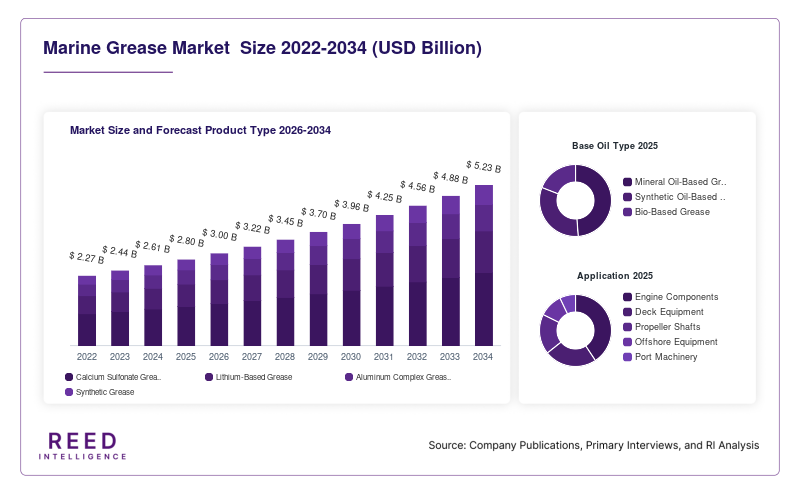
The Marine Grease Market is segmented into calcium sulfonate grease, lithium-based grease, aluminum complex grease, and synthetic grease. Calcium sulfonate grease dominated with 34% share in 2025 due to its superior corrosion resistance, water tolerance, and mechanical stability in marine environments. Synthetic grease is projected to grow at a 8.5% CAGR, supported by increasing demand for extended lubrication intervals and high-temperature operational performance across commercial and offshore vessels.
By Base Oil Type
Based on base oil type, the market includes mineral oil-based grease, synthetic oil-based grease, and bio-based grease. Mineral oil-based grease accounted for 49% share in 2025 because of its cost-effectiveness and wide usage across standard marine maintenance applications. Bio-based grease is expected to grow at a 8.9% CAGR, driven by environmental regulations and increasing demand for sustainable marine lubricant solutions.
By Application
The market is segmented into engine components, deck equipment, propeller shafts, offshore equipment, and port machinery. Engine component lubrication dominated with 31% share in 2025 due to continuous engine operation requirements and increasing commercial vessel utilization. Offshore equipment lubrication is projected to grow at a 8.8% CAGR, supported by rising offshore drilling activities and increasing deployment of subsea machinery in harsh marine conditions.
By End User
End users include commercial shipping, naval defense, offshore oil & gas, fishing vessels, and port operations. Commercial shipping accounted for 42% share in 2025 because of increasing international cargo transportation and vessel fleet expansion. Offshore oil & gas is projected to grow at a 8.3% CAGR, supported by increasing deepwater exploration activities and growing offshore production investments.
Regional Analysis
Asia Pacific
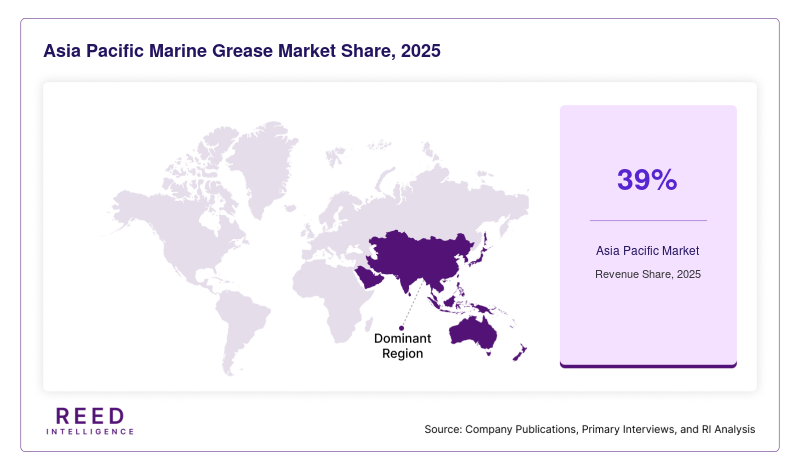
Asia Pacific accounted for 39% share of the Marine Grease Market in 2025 and is projected to grow at a 7.6% CAGR (2026–2034). The region benefits from strong shipbuilding capacity, expanding marine transportation activities, and increasing offshore industrial operations. China dominates the regional market due to large-scale commercial ship manufacturing, rising maritime trade volumes, and extensive port infrastructure development.
North America
North America held 26% share in 2025 and is expected to grow at a 6.8% CAGR (2026–2034). Growth in the region is supported by increasing offshore oil and gas activities, naval fleet maintenance, and rising investments in marine logistics infrastructure. The United States remains the leading market due to strong maritime defense spending and growing demand for synthetic marine lubricants.
Europe
Europe accounted for 22% share in 2025 and is projected to grow at a 6.9% CAGR (2026–2034). The region is witnessing increasing adoption of environmentally acceptable lubricants and sustainable marine operations. Germany leads the regional market because of advanced marine engineering capabilities and rising demand for high-performance industrial lubrication products.
Middle East & Africa
Middle East & Africa held 8% share in 2025 and is expected to grow at a 8.4% CAGR (2026–2034). Expansion of offshore energy projects and increasing maritime trade routes are contributing to regional market growth. Saudi Arabia dominates the region due to rising investments in port development and offshore petroleum infrastructure.
Latin America
Latin America accounted for 5% share in 2025 and is projected to grow at a 6.7% CAGR (2026–2034). Brazil remains the dominant market due to increasing offshore oil exploration activities and growing marine transportation operations. Expanding coastal infrastructure projects are also supporting regional lubricant demand.
Competitive Landscape
The Marine Grease Market is moderately competitive, with major lubricant manufacturers focusing on product innovation, environmentally acceptable formulations, and synthetic lubrication technologies. Companies are increasingly investing in advanced additive technologies and sustainable marine lubricant development to strengthen their market presence.
Shell plc remains one of the leading participants in the market due to its extensive marine lubricant portfolio and strong global distribution network. The company recently expanded its environmentally acceptable marine grease product line to support sustainable shipping operations and offshore industrial applications.
Exxon Mobil Corporation continues to strengthen its marine lubrication technologies through synthetic grease innovations, while Chevron Corporation focuses on corrosion-resistant grease formulations for offshore equipment. TotalEnergies and BP plc are increasing investments in bio-based lubricant technologies and marine sustainability initiatives.
Key Players List
- Shell plc
- Exxon Mobil Corporation
- Chevron Corporation
- TotalEnergies
- BP plc
- FUCHS Petrolub SE
- SKF Group
- Klüber Lubrication
- Castrol Limited
- Phillips 66 Company
- Petro-Canada Lubricants
- Sinopec Corporation
- Idemitsu Kosan Co., Ltd.
- Valvoline Inc.
- Lubmarine
Marine Grease Market Segments
Product Type
- Calcium Sulfonate Grease
- Lithium-Based Grease
- Aluminum Complex Grease
- Synthetic Grease
Base Oil Type
- Mineral Oil-Based Grease
- Synthetic Oil-Based Grease
- Bio-Based Grease
Application
- Engine Components
- Deck Equipment
- Propeller Shafts
- Offshore Equipment
- Port Machinery
End User
- Commercial Shipping
- Naval Defense
- Offshore Oil & Gas
- Fishing Vessels
- Port Operations
By Region
- North America
- Europe
- APAC
- Middle East and Africa
- LATAM