Marine Incinerator Market Size, Share, Demand Report By Type (Waste Oil Incinerators, Sludge Incinerators, General Waste Incinerators), By Application (Cargo Ships, Cruise Ships, Naval Ships, Offshore Platforms), By End-Use (Commercial Shipping, Defense, Offshore Energy, Others) By Region & Segment Forecasts, 2026–2034
USD 3950
Market Overview
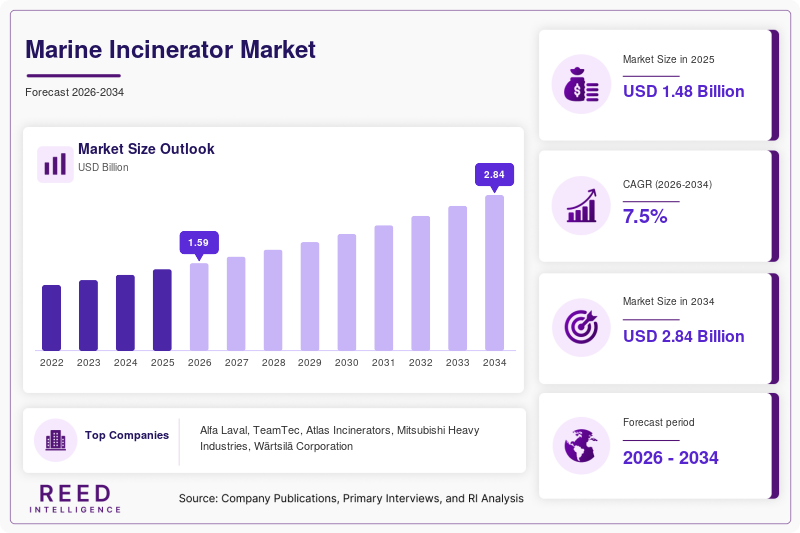
The global Marine Incinerator Market is valued at approximately USD 1.48 billion in 2026 and is projected to reach USD 2.68 billion by 2034, expanding at a CAGR of 7.5% during the forecast period (2026–2034). Growth in the market is primarily supported by increasing international maritime trade, stricter environmental regulations governing marine waste disposal, and the rising need for onboard waste management systems that comply with MARPOL Annex V standards. Shipping operators are increasingly adopting advanced incineration technologies to minimize offshore waste discharge and ensure regulatory compliance across global shipping routes.
A key global factor supporting market expansion is the modernization of commercial fleets, especially in emerging economies where shipping infrastructure is being upgraded with eco-efficient systems. Additionally, rising cruise tourism and offshore oil exploration activities are accelerating demand for compact, automated, and low-emission incineration systems onboard vessels.
Key Highlights
- North America holds 32% market share in 2025, while Asia Pacific is expected to register the fastest CAGR of 9.0%.
- By type, waste oil incinerators dominate, while sludge incinerators represent the fastest-growing subsegment with 9.1% CAGR.
- By application, cargo ships lead the market, whereas cruise ships are the fastest-growing segment (8.8% CAGR).
- By end-use, commercial shipping dominates, while defense applications are expanding fastest at 8.5% CAGR.
- United States market size: USD 0.42 billion (2024) and USD 0.45 billion (2025).
Market Trends
Integration of Automated and Smart Incineration Systems
One of the major trends shaping the Marine Incinerator Market is the increasing integration of automation and digital monitoring technologies in onboard incineration systems. Modern marine incinerators are being equipped with IoT-enabled sensors, real-time temperature monitoring, and automated fuel optimization systems that improve combustion efficiency while reducing emissions. Shipping companies are adopting these systems to ensure compliance with tightening environmental standards and reduce operational costs associated with manual waste handling. Additionally, predictive maintenance capabilities are being incorporated to minimize downtime and extend equipment lifespan. This trend is particularly strong in large cargo fleets and cruise liners, where continuous operation efficiency is critical. The shift toward smart marine systems is expected to redefine onboard waste management practices over the forecast period.
Rising Demand for Low-Emission and Eco-Compliant Systems
Another key trend is the rising demand for low-emission marine incinerators designed to meet global environmental compliance requirements. Regulatory frameworks such as IMO emissions guidelines are pushing ship operators to replace traditional incineration units with cleaner, energy-efficient alternatives. Manufacturers are focusing on developing systems with advanced filtration, reduced particulate emissions, and improved fuel efficiency. Hybrid incinerators capable of handling multiple waste streams including sludge, oil residues, and general ship waste are gaining popularity. This trend is further supported by increasing environmental awareness among shipping operators and port authorities. As global shipping continues to expand, the demand for eco-compliant incineration solutions is expected to grow steadily.
Market Drivers
Expansion of Global Maritime Trade and Fleet Size
The continuous expansion of global maritime trade is a significant driver for the Marine Incinerator Market. As international trade volumes increase, shipping fleets are expanding, leading to a higher generation of onboard waste that requires efficient disposal systems. Cargo vessels, tankers, and bulk carriers operate across long distances, making onboard waste management essential for operational efficiency and environmental compliance. Additionally, increasing investments in shipbuilding activities, particularly in Asia Pacific, are contributing to rising demand for advanced incineration systems. Fleet modernization programs are further accelerating adoption, as older vessels are retrofitted with modern waste treatment technologies to comply with international maritime regulations.
Stringent Environmental Regulations and MARPOL Compliance
Strict environmental regulations governing marine pollution are another major growth driver. The International Maritime Organization (IMO) has implemented stringent guidelines under MARPOL Annex V, restricting the discharge of waste into oceans. This has significantly increased the adoption of onboard incinerators as a compliant waste disposal solution. Shipping companies are investing in advanced systems that reduce emissions and ensure adherence to international environmental standards. Ports and coastal authorities are also enforcing stricter waste handling requirements, pushing operators toward compliant technologies. These regulatory pressures are expected to continue driving long-term demand for marine incineration systems.
Market Restraint
High Installation and Maintenance Costs of Marine Incinerators
A key restraint in the Marine Incinerator Market is the high installation and maintenance cost associated with advanced incineration systems. Modern marine incinerators require sophisticated combustion chambers, emission control systems, and automated monitoring units, which significantly increase upfront investment costs for ship operators. Additionally, ongoing maintenance, fuel consumption, and periodic system upgrades add to operational expenses. Small and medium-sized shipping companies often face budget constraints, limiting their ability to adopt high-end incineration technologies. In older vessels, retrofitting costs can be particularly high due to structural modifications required for installation. Moreover, skilled labor is needed for system operation and maintenance, further increasing operational expenditure. These cost-related challenges may slow down adoption rates, especially in price-sensitive markets and developing regions. Despite long-term environmental and regulatory benefits, the initial financial burden remains a key barrier to widespread market penetration.
Market Opportunities
Growth in Cruise and Passenger Vessel Industry
The expanding cruise and passenger vessel industry presents a significant opportunity for the Marine Incinerator Market. Rising global tourism and increasing demand for luxury cruise experiences are driving the construction of new cruise ships equipped with advanced onboard waste management systems. Cruise operators require highly efficient incinerators capable of handling large volumes of waste generated by passengers and crew. Additionally, stringent environmental expectations from tourists and regulatory authorities are encouraging adoption of eco-friendly systems. Manufacturers have an opportunity to develop compact, energy-efficient incinerators tailored for passenger vessels with reduced emissions and enhanced automation features.
Adoption of Hybrid Waste Management Systems in Offshore Platforms
Another major opportunity lies in the adoption of hybrid waste management systems in offshore oil and gas platforms. These installations operate in remote marine environments where waste disposal is highly restricted. Marine incinerators capable of handling multiple waste streams such as sludge, oil residues, and industrial waste are increasingly in demand. Offshore operators are investing in integrated waste treatment systems that combine incineration with recycling and energy recovery technologies. This creates opportunities for manufacturers to develop multifunctional systems with improved fuel efficiency and lower environmental impact.
Segmental Analysis
By Type
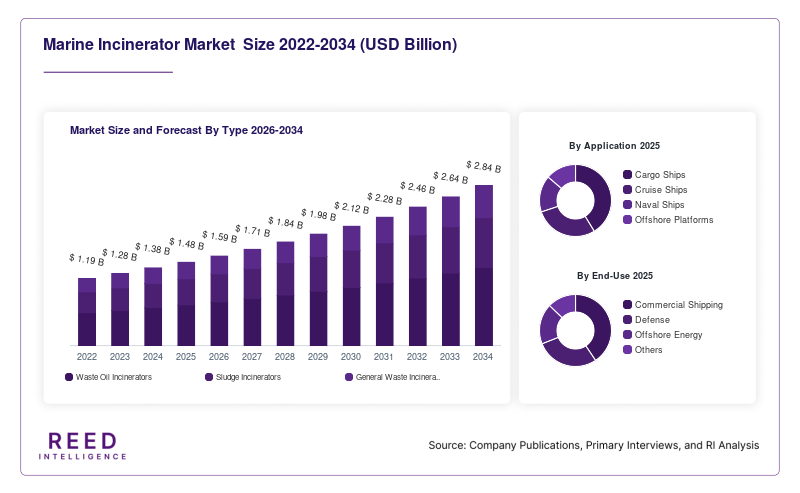
Waste oil incinerators dominate the segment with approximately 41% market share in 2024, driven by their widespread use in commercial shipping vessels for efficient disposal of oil residues. These systems are preferred due to their ability to handle continuous waste streams generated during long voyages. Their reliability and compatibility with large cargo ships further support dominance.
Sludge incinerators are the fastest-growing subsegment, projected to expand at a CAGR of 9.1% due to increasing regulatory pressure on sludge disposal from ship engines. Rising environmental compliance requirements and the need for compact, energy-efficient systems are accelerating adoption.
By Application
Cargo ships account for the dominant share of 46% in 2024, as they represent the largest segment of global maritime transport. These vessels generate substantial onboard waste requiring efficient incineration systems for long-distance operations.
Cruise ships are the fastest-growing application segment with a CAGR of 8.8%, driven by increasing global tourism and demand for luxury maritime experiences. Enhanced passenger expectations and strict environmental norms are encouraging adoption of advanced systems.
By End-Use
Commercial shipping dominates with a 52% share in 2024, supported by global trade expansion and fleet modernization programs. These vessels require continuous waste management solutions for operational efficiency.
Defense applications are the fastest-growing segment at a CAGR of 8.5%, driven by naval modernization programs and increasing focus on onboard sustainability in military fleets.
Regional Analysis
North America
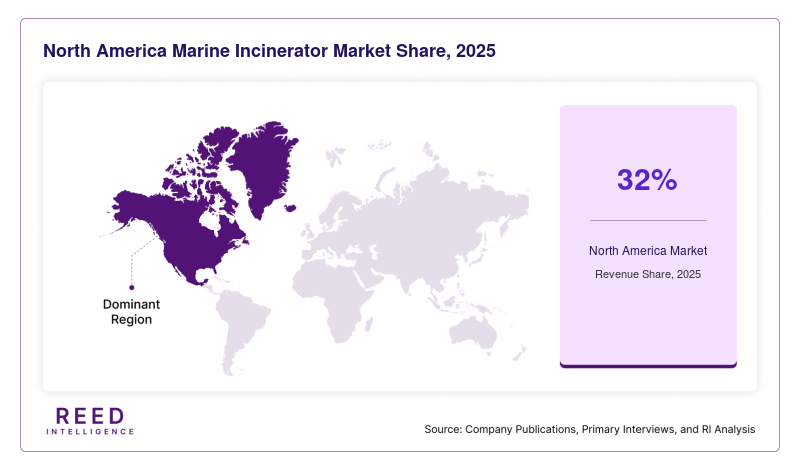
North America accounts for approximately 32% market share in 2025, with the Marine Incinerator Market expected to grow at a CAGR of 7.2% through 2034. The region benefits from strong maritime infrastructure, advanced shipping fleets, and strict environmental compliance regulations. Demand is primarily driven by commercial shipping and offshore energy operations requiring efficient onboard waste management solutions.
The United States dominates the regional market, supported by extensive coastal trade activities and modernization of naval fleets. A key growth factor is the increasing adoption of eco-compliant marine technologies across defense and commercial sectors. Canada also contributes through offshore oil exploration activities and Arctic shipping route expansion.
Europe
Europe holds a significant share of around 28% in 2025, with a projected CAGR of 6.9% through 2034. The region’s growth is driven by strict EU maritime environmental policies and strong cruise tourism activities.
Norway leads the European market due to its advanced shipping industry and strong focus on sustainable maritime operations. A major growth factor is the rapid adoption of green shipping technologies across Scandinavian fleets.
Asia Pacific
Asia Pacific accounts for nearly 24% market share in 2025, with the fastest CAGR of 9.0%. Growth is supported by shipbuilding dominance in China, South Korea, and Japan.
China is the leading country due to its massive shipbuilding industry and expanding maritime trade routes. Rising export-import activities and port infrastructure development are key growth drivers.
Middle East & Africa
The region holds around 10% share in 2025, growing at a CAGR of 7.8%. Growth is driven by offshore oil exploration and increasing maritime logistics activities.
Saudi Arabia leads the region, supported by investments in offshore energy projects and port modernization under economic diversification programs.
Latin America
Latin America represents about 6% market share in 2025, with a CAGR of 7.1%. Growth is driven by expanding maritime trade routes and offshore drilling activities.
Brazil dominates the region due to strong offshore oil production and growing commercial shipping operations along its coastline.
Competitive Landscape
The Marine Incinerator Market is moderately consolidated with the presence of several global and regional manufacturers focusing on technological innovation and regulatory compliance. Key companies include Alfa Laval, TeamTec, Atlas Incinerators, Eagle Environmental Products, and Japan Marine United Corporation. These players compete based on product efficiency, emission control capabilities, and system durability.
Alfa Laval is considered a leading player due to its advanced waste heat recovery and incineration systems integrated with maritime solutions. The company has recently expanded its product portfolio to include low-emission incinerators designed for next-generation eco-friendly vessels. Continuous investment in R&D and strategic collaborations with shipbuilders have strengthened its market position.
Key Players
- Alfa Laval
- TeamTec
- Atlas Incinerators
- Mitsubishi Heavy Industries
- Wärtsilä
- JFE Engineering
- Saacke GmbH
- Hyundai Heavy Industries
- Kawasaki Heavy Industries
- Hanjin Heavy Industries
- Delitek AS
- Schutte & Koerting
- Kadant Inc.
- EVAC Group
- Navalimpianti Group
Recent Development
- In 2025, Alfa Laval introduced a new low-emission marine incinerator series designed to reduce particulate emissions by improving combustion efficiency.
- In 2024, TeamTec expanded its manufacturing facility in Europe to meet rising demand for compact shipboard waste treatment systems.
- In 2026, several Asian shipbuilders integrated hybrid incineration units into new LNG carrier designs to improve environmental compliance and operational efficiency.
Marine Incinerator Market Segments
By Type
- Waste Oil Incinerators
- Sludge Incinerators
- General Waste Incinerators
By Application
- Cargo Ships
- Cruise Ships
- Naval Ships
- Offshore Platforms
By End-Use
- Commercial Shipping
- Defense
- Offshore Energy
- Others
By Region
- North America
- Europe
- APAC
- Middle East and Africa
- LATAM