Marine Life Raft Market Size, Share & Demand Report By Type (Inflatable Life Rafts, Rigid Life Rafts, Throw-overboard Life Rafts), By Capacity (Up to 5 Persons, 6–15 Persons, 16–25 Persons, Above 25 Persons), By Application (Commercial Shipping, Offshore, Defense, Recreational), By End-Use (Commercial, Recreational), By Region & Segment Forecasts, 2025–2034
USD 3950
Market Overview
The Marine Life Raft Market was valued at approximately USD 1.85 billion in 2025 and is projected to reach USD 3.12 billion by 2034, expanding at a compound annual growth rate (CAGR) of 6.0% from 2025 to 2034. The market growth is primarily supported by the increasing global maritime trade volume, which has significantly driven the demand for advanced onboard safety equipment across commercial and recreational vessels.
A key global factor contributing to the expansion of the Marine Life Raft Market is the tightening of international maritime safety regulations, particularly those aligned with Safety of Life at Sea (SOLAS) compliance. Governments and maritime authorities are emphasizing mandatory installation and periodic inspection of life-saving appliances, thereby creating a stable demand pipeline for life rafts across fleets.
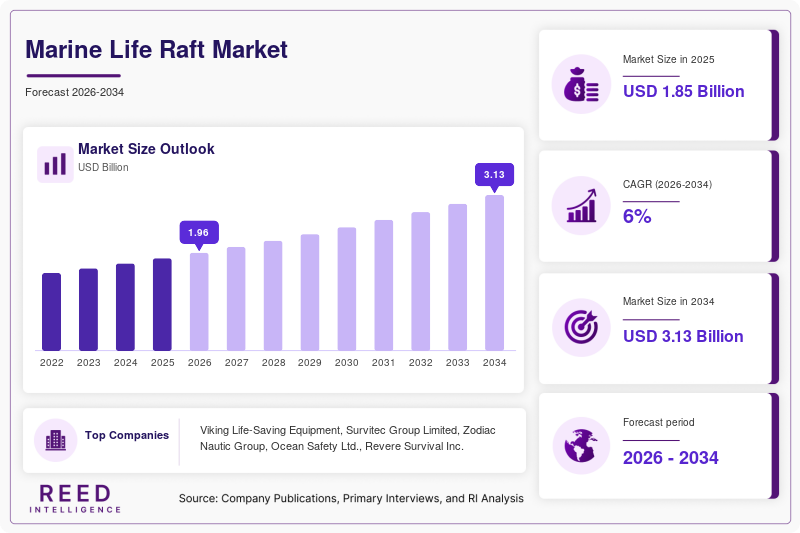
Key Highlights
- North America dominated the market with a 34% share in 2025, while Asia Pacific is projected to register the fastest CAGR of 7.4% during the forecast period.
- Inflatable life rafts emerged as the leading type segment with 68% share, while offshore applications are expected to grow fastest at a CAGR of 7.1%.
- The United States led the market with USD 540 million in 2025, rising to USD 565 million in 2026.
Market Trends
Integration of Smart Safety Technologies
The Marine Life Raft Market is witnessing a shift toward the integration of smart technologies such as GPS beacons, automated distress signaling systems, and IoT-enabled condition monitoring. These advancements enhance survivability by enabling faster rescue operations and real-time tracking. Manufacturers are increasingly focusing on embedding Emergency Position Indicating Radio Beacons (EPIRBs) and hydrostatic release units within raft systems, improving compliance and operational readiness.
Rising Demand for Compact and Lightweight Designs
There is a growing preference for compact, lightweight life rafts that reduce storage constraints and improve ease of deployment. Modern vessels, especially leisure boats and small commercial ships, require space-efficient solutions without compromising safety standards. This trend has encouraged manufacturers to innovate using high-strength synthetic fabrics and modular designs, enabling easier maintenance and transportation while maintaining durability in extreme marine conditions.
Market Drivers
Expansion of Global Maritime Trade
The steady increase in global seaborne trade has significantly boosted demand for safety equipment, including life rafts. As shipping fleets expand to accommodate trade growth, vessel operators are investing in updated safety systems to comply with international standards. This expansion is particularly evident in container shipping and bulk cargo transportation, directly influencing the Marine Life Raft Market.
Growth in Marine Tourism and Recreational Boating
The surge in marine tourism activities such as cruises, яхting, and water sports has driven the need for reliable safety solutions. Increasing disposable incomes and changing consumer preferences toward experiential travel have led to a rise in recreational vessel ownership. This trend has contributed to higher adoption of compact and user-friendly life rafts, especially in developed economies.
Market Restraint
High Maintenance and Inspection Costs
One of the major challenges in the Marine Life Raft Market is the high cost associated with regular maintenance, servicing, and compliance inspections. Life rafts require periodic testing, repacking, and certification to meet safety standards, which can impose a financial burden on vessel operators, especially small-scale owners.
Additionally, strict regulatory requirements mandate servicing at authorized stations, increasing operational downtime and logistical complexity. The need for specialized technicians and equipment further adds to the cost structure. For older fleets, retrofitting modern life raft systems can be expensive, discouraging timely upgrades.
These cost-related barriers can limit adoption rates in price-sensitive regions and among smaller operators, thereby restraining overall market growth despite strong regulatory support.
Market Opportunities
Growth in Offshore Energy Projects
The expansion of offshore oil & gas and renewable energy projects presents significant growth opportunities for the Marine Life Raft Market. Offshore platforms require advanced safety solutions due to remote operations and higher risk exposure. Increasing investments in offshore wind farms and deep-water exploration are expected to drive demand for high-capacity, durable life rafts.
Emerging Markets and Fleet Modernization
Developing economies are increasingly investing in maritime infrastructure and fleet modernization programs. Countries in Asia, Africa, and Latin America are upgrading aging vessels to meet international safety standards. This creates opportunities for manufacturers to introduce cost-effective and compliant life raft solutions tailored to regional requirements.
Segmental Analysis
By Type
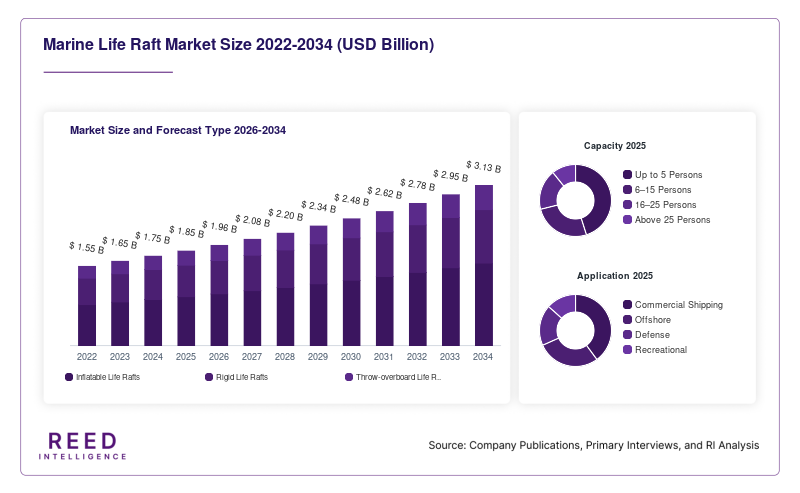
Inflatable life rafts dominated the Marine Life Raft Market, accounting for 68% of the share in 2025. Their widespread adoption is attributed to ease of storage, rapid deployment, and compliance with international safety standards. These rafts are commonly used across commercial vessels and recreational boats due to their versatility and reliability.
Throwable and rigid life rafts are expected to witness steady growth; however, throw-overboard inflatable rafts are projected to grow at the fastest CAGR of 6.8%. Their ease of manual deployment and suitability for smaller vessels will drive demand, especially in recreational boating and small-scale maritime operations.
By Capacity
Life rafts with a capacity of 6–15 persons held the dominant share of 45% in 2025, driven by their extensive use in mid-sized commercial vessels and offshore platforms. These rafts offer a balance between capacity and storage efficiency, making them suitable for various applications.
Large-capacity life rafts (above 25 persons) are expected to grow at a CAGR of 7.0%, supported by increasing cruise ship operations and large vessel deployments. The rising focus on passenger safety in large-scale maritime operations will contribute to this segment’s growth.
By Application
Commercial shipping dominated the market with a 52% share in 2025, reflecting the high demand for safety equipment across cargo vessels, tankers, and container ships. Strict regulatory compliance requirements have driven adoption in this segment.
Offshore applications are projected to grow at the fastest CAGR of 7.1%, driven by expanding offshore energy projects and the need for enhanced safety measures in remote environments. The higher risk associated with offshore operations necessitates advanced and durable life raft systems.
By End-Use
The commercial sector accounted for 60% of the market share in 2025, supported by large fleet sizes and regulatory mandates. This segment includes shipping companies, offshore operators, and government vessels.
The recreational segment is expected to grow at a CAGR of 6.9%, fueled by increasing яхting and boating activities. Rising consumer awareness of safety and regulatory enforcement in leisure boating will drive demand for compact and user-friendly life rafts.
Regional Analysis
North America
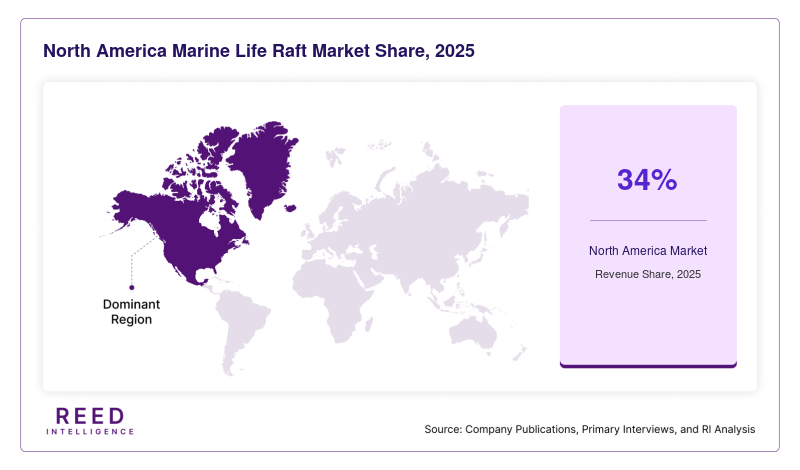
North America accounted for 34% of the Marine Life Raft Market share in 2025 and is expected to grow at a CAGR of 5.5% through 2034. The region’s established maritime infrastructure and strict enforcement of safety regulations have contributed to consistent demand for advanced life-saving equipment. The presence of a large commercial shipping fleet and a strong recreational boating culture further supports market growth.
The United States dominated the regional market due to its extensive coastline and high volume of maritime activities. A key growth factor is the increasing adoption of technologically advanced safety systems across both commercial and leisure vessels. Continuous upgrades in safety compliance standards have encouraged fleet operators to invest in next-generation life raft solutions.
Europe
Europe held approximately 27% market share in 2025 and is projected to expand at a CAGR of 5.8% during the forecast period. The region benefits from a well-regulated maritime sector and strong emphasis on environmental and safety standards. Countries with significant shipping industries and offshore activities contribute to steady demand.
Germany emerged as the dominant country in the region, driven by its robust shipbuilding industry and maritime engineering expertise. The focus on innovation and adherence to international safety protocols has supported the adoption of advanced life raft systems across commercial fleets.
Asia Pacific
Asia Pacific represented 22% of the market share in 2025 and is expected to grow at the fastest CAGR of 7.4% through 2034. Rapid industrialization, expanding maritime trade, and increasing investments in port infrastructure are key factors driving regional growth. The region is witnessing a surge in shipbuilding activities, further boosting demand.
China dominated the Asia Pacific market due to its position as a global shipbuilding hub. A significant growth factor is the expansion of its commercial shipping fleet, which necessitates compliance with international safety standards, thereby increasing demand for certified life raft systems.
Middle East & Africa
The Middle East & Africa accounted for 9% market share in 2025 and is projected to grow at a CAGR of 6.3%. The region’s growth is supported by increasing offshore oil & gas exploration and maritime trade activities. Investments in port development and logistics infrastructure have also contributed to demand.
The United Arab Emirates led the regional market, driven by its strategic location as a global shipping hub. The expansion of maritime logistics and offshore operations has increased the need for reliable safety equipment, including life rafts.
Latin America
Latin America held around 8% share in 2025 and is expected to grow at a CAGR of 6.0% during the forecast period. The region’s maritime sector is gradually expanding, supported by trade activities and offshore energy exploration. Governments are focusing on improving maritime safety standards, contributing to market growth.
Brazil dominated the regional market due to its extensive coastline and active offshore oil & gas sector. The need for safety compliance in offshore operations has driven the adoption of high-capacity life raft systems.
Competitive Landscape
The Marine Life Raft Market is moderately fragmented, with several global and regional players competing based on product innovation, safety compliance, and pricing strategies. Leading companies focus on expanding their product portfolios and strengthening distribution networks to maintain market presence.
Viking Life-Saving Equipment emerged as a market leader, leveraging its strong global footprint and comprehensive range of safety solutions. The company recently introduced advanced life rafts with integrated digital tracking systems, enhancing rescue efficiency and operational reliability.
Other key players are actively investing in research and development to introduce lightweight materials and improve deployment mechanisms. Strategic partnerships with shipbuilders and offshore operators are also a common approach to gain competitive advantage in the market.
Key Players List
- Viking Life-Saving Equipment
- Survitec Group Limited
- Zodiac Nautic Group
- Ocean Safety Ltd.
- Revere Survival Inc.
- Fujikura Rubber Ltd.
- Plastimo SAS
- Hammar AB
- Liferaft Systems Australia
- Datrex Inc.
- Lalizas Hellas SA
- Shanghai Youlong Rubber Products Co. Ltd.
- Ningbo Zhenhua Life-saving Equipment Co. Ltd.
- Jiangsu Huayan Marine Equipment Co. Ltd.
- Wuxi Haihong Boat Making Co. Ltd.
Recent Developments
- Viking Life-Saving Equipment launched a new smart-enabled life raft system with integrated GPS tracking in 2024.
- Survitec Group expanded its servicing network across Asia Pacific to support growing regional demand.
- Zodiac Nautic introduced lightweight inflatable life rafts designed for recreational boating applications.
- Ocean Safety Ltd. partnered with offshore operators to supply high-capacity life raft systems.
- Fujikura Rubber Ltd. invested in advanced material technology to enhance product durability and reduce weight.
Marine Life Raft Market Segments
Type
- Inflatable Life Rafts
- Rigid Life Rafts
- Throw-overboard Life Rafts
Capacity
- Up to 5 Persons
- 6–15 Persons
- 16–25 Persons
- Above 25 Persons
Application
- Commercial Shipping
- Offshore
- Defense
- Recreational
End-Use
- Commercial
- Recreational
By Region
- North America
- Europe
- APAC
- Middle East and Africa
- LATAM