Massage Chair Market Size, Share & Demand Report By Product Type (Full-Body Massage Chairs, Zero-Gravity Massage Chairs, Ottoman Massage Chairs, Recliner Massage Chairs, Portable Massage Chairs), By End User (Residential Users, Commercial Users), By Distribution Channel (Offline Retail, Online Retail), By Region & Segment Forecasts, 2026–2034
USD 3950
Market Overview
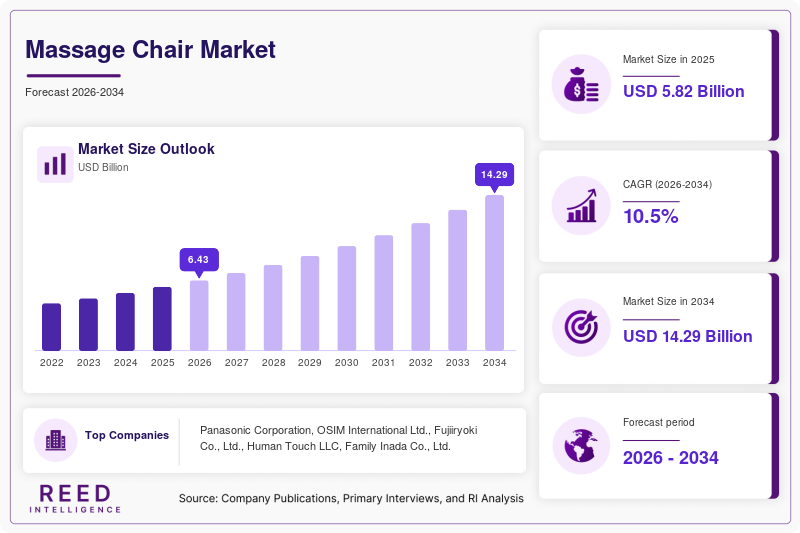
The global Massage Chair Market size was valued at USD 5.82 billion in 2026 and is projected to reach USD 12.96 billion by 2034, expanding at a CAGR of 10.5% during 2026–2034. The market is experiencing steady expansion as consumers increasingly prioritize preventive healthcare, stress management, and home-based wellness solutions. Massage chairs have evolved from luxury products into advanced wellness devices that integrate intelligent massage systems, body-scanning technology, heat therapy, and connectivity features. Growing awareness regarding musculoskeletal disorders, sedentary lifestyles, and workplace stress has further supported market adoption across residential and commercial environments.
The rise of digital health ecosystems has also contributed to market growth. Manufacturers are integrating artificial intelligence, IoT-enabled controls, customized massage programs, and mobile application connectivity to improve user experiences. These innovations are attracting a broader consumer base, including younger demographics seeking recovery and relaxation solutions. In addition, the expansion of wellness centers, luxury hotels, airports, spas, and corporate wellness programs has created sustained demand across commercial sectors.
Key Highlights
- North America dominated the market with a 35.1% share in 2025.
- while Asia Pacific is expected to grow at the fastest CAGR of 11.9% during 2026–2034.
- By product type, Full-Body Massage Chairs accounted for the largest share of 52.4%.
- while Zero-Gravity Massage Chairs are projected to grow at a CAGR of 12.8%.
- By end user, Residential Users led with a 64.7% share.
- whereas Commercial Users are expected to expand at a CAGR of 11.6%.
- By distribution channel, Offline Retail accounted for the largest share of 58.3%.
- while Online Retail is projected to grow at a CAGR of 13.2%.
- The United States remained the dominant country, with market values of USD 1.58 billion in 2024 and USD 1.73 billion in 2025.
Market Trends
Integration of Artificial Intelligence and Personalized Wellness Features
A significant trend shaping the Massage Chair Market is the growing integration of artificial intelligence and personalized wellness technologies. Modern massage chairs now feature advanced body-scanning systems that analyze user height, posture, shoulder position, and pressure points before initiating massage sessions. These capabilities allow chairs to deliver customized treatments tailored to individual needs. AI-powered systems can also store user preferences, track usage patterns, and recommend massage programs based on recovery requirements. As consumers increasingly seek personalized wellness experiences, manufacturers are investing heavily in intelligent software and adaptive massage technologies. This trend is transforming massage chairs from traditional relaxation products into sophisticated wellness platforms that provide targeted therapeutic benefits and improve customer satisfaction.
Expansion of Smart Home Wellness Ecosystems
The growing popularity of smart homes is influencing product development across the Massage Chair Market. Consumers increasingly prefer wellness devices that seamlessly integrate with connected home environments. Manufacturers are responding by introducing massage chairs with voice control compatibility, mobile application management, wireless connectivity, and cloud-based software updates. These features enable users to customize massage routines remotely and synchronize wellness activities with broader health-monitoring systems. The trend is particularly visible among technologically engaged consumers seeking convenience and automation. As smart home adoption accelerates globally, massage chair manufacturers are expected to develop increasingly connected and intelligent solutions that enhance user engagement while supporting the broader digital wellness ecosystem.
Market Drivers
Growing Prevalence of Stress and Musculoskeletal Disorders
The increasing incidence of stress-related health concerns and musculoskeletal conditions is a major factor driving the Massage Chair Market. Modern lifestyles often involve prolonged sitting, repetitive work activities, and limited physical movement, contributing to neck pain, back pain, muscle stiffness, and fatigue. Massage chairs provide convenient access to relaxation and therapeutic relief within residential environments. Consumers are increasingly viewing massage chairs as long-term wellness investments rather than luxury products. Healthcare professionals and wellness experts also emphasize the importance of muscle recovery and stress reduction, encouraging wider adoption. As awareness of preventive health management continues to increase, demand for advanced massage chairs is expected to remain strong across both developed and developing economies.
Rising Disposable Income and Consumer Spending on Wellness
Increasing disposable income levels and changing consumer spending priorities are contributing significantly to market growth. Consumers are allocating larger portions of household budgets toward wellness, fitness, and preventive healthcare solutions. Massage chairs align well with this trend by offering relaxation, convenience, and therapeutic benefits without requiring repeated visits to wellness centers or spas. The growing middle-class population in emerging economies has expanded the addressable market for massage chair manufacturers. In addition, financing options, subscription-based ownership models, and installment payment programs are making premium products more accessible. As wellness spending continues to grow globally, massage chairs are increasingly becoming an important component of personal health and lifestyle investments.
Market Restraint
High Initial Purchase Cost Limiting Mass Adoption
Despite strong growth prospects, the relatively high upfront cost of advanced massage chairs remains a notable challenge for the Massage Chair Market. Premium models equipped with artificial intelligence, zero-gravity positioning, body-scanning technology, and multiple therapeutic functions often carry substantial price tags. This limits adoption among price-sensitive consumers, particularly in developing markets where discretionary spending remains constrained. The high cost can also extend purchasing decision cycles and reduce replacement frequency.
The impact of this restraint is particularly evident in regions where consumers prioritize essential household expenditures over wellness-focused products. While financing programs have improved accessibility, affordability concerns continue to influence market penetration rates. For example, many consumers may choose lower-cost alternatives such as portable massagers or occasional professional massage services instead of investing in a premium chair. Manufacturers therefore face the challenge of balancing technological innovation with cost optimization. Expanding product portfolios across multiple price segments and improving manufacturing efficiency will remain important strategies for overcoming this market limitation.
Market Opportunities
Growing Commercial Adoption Across Hospitality and Corporate Sectors
An emerging opportunity within the Massage Chair Market is the increasing adoption of massage chairs across commercial environments. Hotels, airports, shopping centers, corporate offices, healthcare facilities, and wellness centers are integrating massage chairs to enhance customer experiences and employee well-being. Organizations are recognizing the benefits of workplace wellness initiatives aimed at reducing stress and improving productivity. Massage chairs offer a practical solution that requires minimal staffing and maintenance compared with traditional wellness services. As commercial establishments seek innovative ways to differentiate their offerings and improve user satisfaction, demand for commercial-grade massage chairs is expected to increase substantially during the forecast period.
Expansion in Emerging Economies Through Affordable Product Innovation
Emerging economies present significant growth opportunities for massage chair manufacturers. Rising urbanization, expanding middle-class populations, and growing awareness of health and wellness are creating favorable conditions for market penetration. Manufacturers are increasingly developing affordable models that retain essential therapeutic features while reducing production costs. Localized manufacturing, regional distribution partnerships, and e-commerce expansion are supporting accessibility in developing markets. Furthermore, younger consumers are showing greater interest in wellness technologies and smart lifestyle products. As affordability improves and awareness continues to increase, emerging economies are expected to become major contributors to future market revenue growth, creating substantial opportunities for both global and regional industry participants.
Segmental Analysis
By Product Type
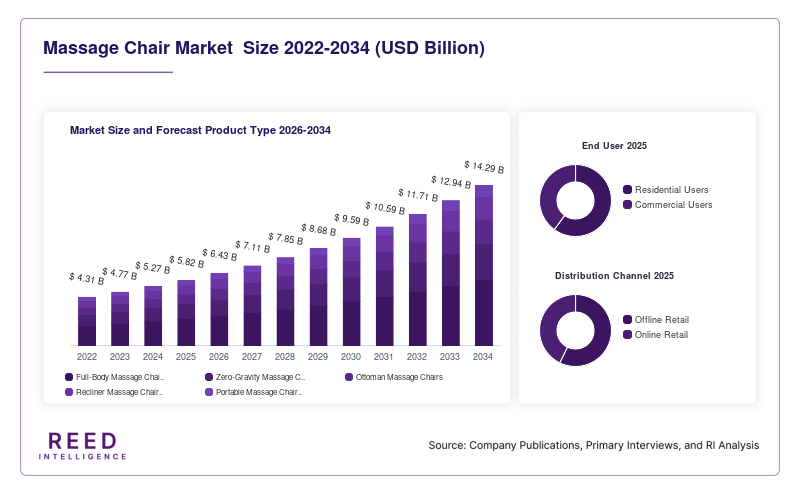
Full-Body Massage Chairs represented the dominant subsegment and accounted for approximately 52.4% of market share in 2024. These products provide comprehensive therapeutic coverage across the neck, shoulders, back, arms, hips, and legs, making them highly attractive to consumers seeking complete relaxation experiences. Their popularity is supported by increasing awareness regarding muscle recovery, stress reduction, and preventive wellness practices. Advanced features such as body scanning, heat therapy, air compression systems, and multiple massage techniques have strengthened consumer demand. Residential users particularly favor full-body models due to their ability to address multiple wellness needs within a single device. Continuous product innovation and broader availability across retail channels have further reinforced their market leadership.
Zero-Gravity Massage Chairs are expected to be the fastest-growing product category, registering a CAGR of 12.8% through 2034. Growth is driven by increasing consumer awareness of ergonomic health benefits associated with zero-gravity positioning. These chairs distribute body weight more evenly, reducing spinal pressure and enhancing massage effectiveness. Manufacturers are incorporating advanced recline mechanisms, AI-driven massage programs, and enhanced comfort features to improve user experiences. Premium consumers increasingly view zero-gravity models as comprehensive wellness solutions rather than simple relaxation products. Rising demand for luxury home wellness equipment and technological advancements in chair design are expected to support sustained expansion throughout the forecast period.
By End User
Residential Users accounted for the largest share of approximately 64.7% in 2024. Growing adoption of home-based wellness solutions and increasing interest in preventive healthcare have significantly contributed to this dominance. Consumers appreciate the convenience of accessing massage therapy without recurring appointments or travel requirements. The shift toward remote and hybrid work arrangements has further increased awareness regarding posture-related discomfort and stress management. Manufacturers continue to introduce compact, aesthetically appealing models designed specifically for residential settings. Enhanced affordability through financing options and installment plans has also encouraged broader household adoption. These factors collectively position residential users as the primary revenue-generating segment within the Massage Chair Market.
Commercial Users are projected to witness the fastest expansion, with a CAGR of 11.6% during the forecast period. Demand is increasing across airports, hotels, wellness centers, healthcare facilities, and corporate offices seeking to improve customer satisfaction and employee wellness. Businesses increasingly recognize the value of stress reduction and relaxation services as part of broader wellness initiatives. Commercial operators favor massage chairs because they offer scalable wellness solutions with relatively low operating requirements. The growing wellness tourism industry and expansion of premium hospitality services are also driving adoption. As organizations continue investing in user experience enhancement and workplace wellness programs, commercial demand is expected to grow steadily.
By Distribution Channel
Offline Retail remained the dominant distribution channel and captured approximately 58.3% of market share in 2024. Consumers often prefer physical retail environments when purchasing high-value wellness products because they can evaluate comfort, functionality, and build quality before making purchasing decisions. Specialty wellness stores, consumer electronics retailers, furniture outlets, and branded showrooms continue to play important roles in customer acquisition. Demonstration opportunities and personalized consultations help consumers better understand product features and benefits. Additionally, many premium massage chair manufacturers maintain dedicated retail networks to strengthen brand visibility and customer engagement. These factors contribute significantly to the continued leadership of offline retail channels.
Online Retail is anticipated to record the fastest CAGR of 13.2% through 2034. The rapid growth of digital commerce platforms has transformed purchasing behavior across numerous consumer product categories, including wellness equipment. Online channels provide extensive product information, customer reviews, financing options, and convenient home delivery services. Manufacturers increasingly utilize direct-to-consumer strategies to expand market reach and improve profitability. Enhanced virtual product demonstrations and digital marketing campaigns are also influencing purchasing decisions. As internet penetration continues to increase and consumers become more comfortable purchasing premium products online, e-commerce channels are expected to represent a growing share of total market revenues.
Regional Analysis
North America
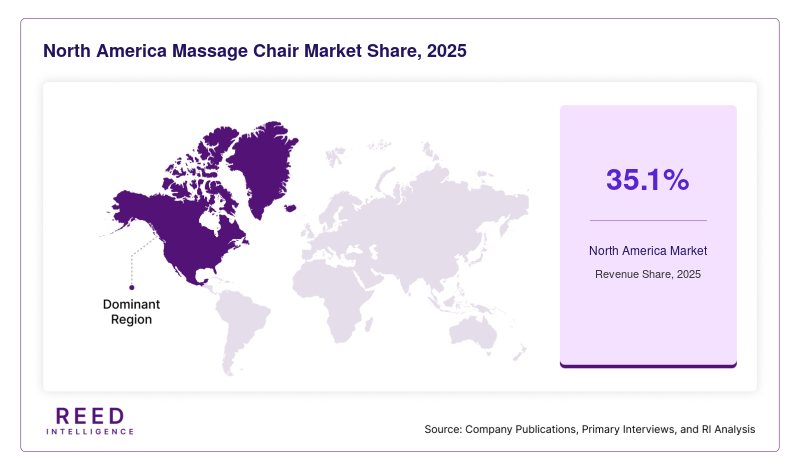
North America accounted for approximately 35.1% of the global Massage Chair Market in 2025, making it the leading regional market. The region is expected to maintain strong momentum with a forecast CAGR of 9.8% through 2034. High consumer awareness regarding preventive healthcare, stress management, and wellness technologies continues to support product demand. The presence of established manufacturers, advanced retail infrastructure, and widespread adoption of premium consumer electronics further contributes to market growth. Growing interest in home-based wellness solutions is also strengthening demand across residential applications.
The United States remains the dominant country within the region. A key growth factor is the increasing prevalence of sedentary work environments and associated musculoskeletal health concerns. Corporate wellness initiatives and growing consumer expenditure on wellness technologies are encouraging product adoption. Additionally, strong e-commerce penetration and flexible financing options have improved accessibility for a broader consumer base, supporting continued market expansion.
Europe
Europe represented approximately 27.4% of the global market in 2025 and is anticipated to grow at a CAGR of 9.4% during the forecast period. The region benefits from strong wellness awareness, aging demographics, and growing demand for non-invasive relaxation solutions. Consumers increasingly seek products that support physical recovery and long-term well-being. Market growth is also supported by technological advancements and rising demand for premium home wellness equipment across several European countries.
Germany remains the dominant market within Europe. A unique growth factor is the country's emphasis on ergonomic health and workplace wellness. Businesses and institutions increasingly invest in employee well-being initiatives, creating demand for therapeutic wellness products. Additionally, German consumers demonstrate a strong preference for technologically advanced and durable products, encouraging manufacturers to introduce premium massage chair models with enhanced functionality.
Asia Pacific
Asia Pacific held approximately 24.6% market share in 2025 and is projected to record the fastest CAGR of 11.9% through 2034. Rapid urbanization, increasing disposable incomes, and growing health awareness are driving market expansion. The region benefits from a large consumer base and rising demand for smart wellness technologies. Increasing online retail penetration and local manufacturing capabilities further support affordability and accessibility across emerging economies.
China dominates the regional market due to its large population and expanding middle-class consumer segment. A distinctive growth factor is the country's strong manufacturing ecosystem, which enables competitive pricing and rapid innovation. Chinese consumers increasingly embrace smart home technologies and wellness products, creating favorable conditions for market expansion. The growing popularity of connected healthcare devices is also contributing to demand.
Middle East & Africa
The Middle East & Africa accounted for approximately 6.4% of the global market in 2025 and is forecast to expand at a CAGR of 8.7% through 2034. Rising investments in healthcare infrastructure and increasing awareness of wellness solutions are supporting regional growth. Luxury hospitality developments and expanding wellness tourism activities are generating additional demand for massage chairs within commercial environments. Consumer interest in premium lifestyle products is also increasing across major urban centers.
The United Arab Emirates represents the leading market in the region. A key growth factor is the expansion of luxury hospitality and tourism industries. Hotels, resorts, spas, and wellness centers increasingly adopt advanced massage chairs to enhance guest experiences. The country's high disposable income levels and preference for innovative lifestyle products further support market development and create opportunities for premium manufacturers.
Latin America
Latin America captured approximately 6.5% market share in 2025 and is expected to register a CAGR of 9.1% during the forecast period. Increasing urbanization and growing awareness of preventive healthcare are encouraging adoption across residential and commercial applications. Expanding retail networks and improving digital commerce infrastructure are making massage chairs more accessible to consumers. Market participants are also introducing affordable product variants to address regional purchasing preferences.
Brazil remains the dominant country in Latin America. An important growth factor is the increasing popularity of home wellness and fitness solutions. Consumers are becoming more proactive about managing stress and improving overall well-being. The growth of online retail channels and installment-based purchasing options has improved product accessibility, helping expand the customer base and supporting regional market growth.
Competitive Landscape
The Massage Chair Market is characterized by continuous innovation, product differentiation, and expanding distribution networks. Leading manufacturers focus on integrating artificial intelligence, advanced body-scanning capabilities, and personalized wellness features to strengthen their competitive positions. Strategic partnerships, regional expansion initiatives, and product portfolio diversification remain common growth strategies.
Panasonic Corporation continues to maintain a strong leadership position due to its extensive technological expertise and established global presence. The company has focused on enhancing intelligent massage technologies and ergonomic designs to address evolving consumer requirements. Other significant competitors include OSIM International, Fujiiryoki, Human Touch, and Family Inada, each emphasizing innovation and premium product offerings.
A recent industry development involved several leading manufacturers introducing AI-enabled massage chairs capable of generating personalized wellness recommendations based on user behavior and body condition assessments. Such advancements highlight the industry's focus on delivering more customized and connected wellness experiences. Increasing competition is expected to encourage further technological innovation and product accessibility throughout the forecast period.
Key Players
- Panasonic Corporation
- OSIM International Ltd.
- Fujiiryoki Co., Ltd.
- Human Touch LLC
- Family Inada Co., Ltd.
- BODYFRIEND Co., Ltd.
- Johnson Health Tech Co., Ltd.
- Cozzia USA
- Infinity Massage Chairs
- Ogawa World USA
- Luraco Technologies
- Daito Denki Industry Co., Ltd.
- Titan World LLC
- Kahuna Chair
Recent Developments
- Panasonic Corporation introduced an advanced AI-powered massage chair platform featuring enhanced body-scanning capabilities and personalized wellness programs.
- OSIM International expanded its smart wellness product portfolio with new mobile application integration and cloud-based customization features.
- Fujiiryoki launched an upgraded zero-gravity massage chair series designed to improve spinal alignment and therapeutic effectiveness.
- BODYFRIEND invested in intelligent health-monitoring technologies aimed at integrating wellness analytics with massage chair functionality.
- Human Touch expanded its North American distribution network through strategic retail partnerships to strengthen market penetration
Massage Chair Market Segments
Product Type
- Full-Body Massage Chairs
- Zero-Gravity Massage Chairs
- Ottoman Massage Chairs
- Recliner Massage Chairs
- Portable Massage Chairs
End User
- Residential Users
- Commercial Users
Distribution Channel
- Offline Retail
- Online Retail
By Region
- North America
- Europe
- APAC
- Middle East and Africa
- LATAM