Mastocytosis Drug Market Size, Share & Demand Report By Drug Type (Tyrosine Kinase Inhibitors, Antihistamines, Corticosteroids, Biologics), By Disease Type (Cutaneous Mastocytosis, Systemic Mastocytosis), By Distribution Channel (Hospital Pharmacies, Retail Pharmacies, Online Pharmacies), By Region & Segment Forecasts, 2025–2034
USD 3950
Market Overview
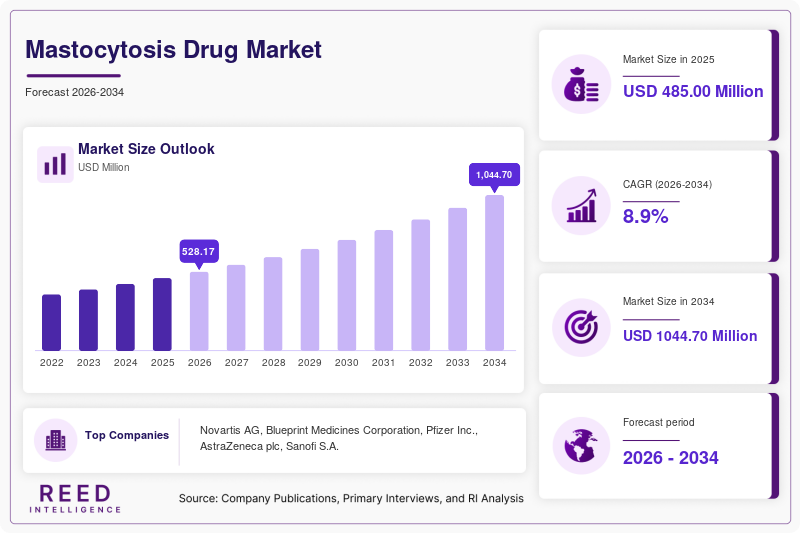
The Mastocytosis Drug Market size is estimated to reach USD 485 million, and it is projected to grow to approximately USD 525 million in 2026. By 2034, the market is forecasted to achieve a valuation of USD 1.05 billion, registering a compound annual growth rate (CAGR) of 8.9% during the forecast period (2025–2034). This growth trajectory reflects rising investments in orphan drug development and expanding therapeutic pipelines targeting mast cell disorders.
Mastocytosis, characterized by the abnormal accumulation of mast cells in tissues, presents in various forms, including cutaneous mastocytosis and systemic mastocytosis. The growing understanding of genetic mutations, particularly KIT mutations, has supported targeted therapy development, which significantly contributes to market expansion. Increasing patient diagnosis rates, driven by enhanced screening protocols and improved clinical awareness, further strengthen market demand.
Key Highlights
- Market size is projected to expand from USD 485 million in 2025 to approximately USD 1.05 billion by 2034. This steady increase reflects sustained demand for advanced therapies and growing awareness of mastocytosis globally.
- The market is expected to register a CAGR of 8.9% during the forecast period from 2025 to 2034. This growth rate indicates consistent expansion supported by innovation and increasing treatment adoption.
- Rising adoption of targeted therapies is significantly driving market expansion, as these treatments offer improved efficacy and safety. Healthcare providers are increasingly preferring precision-based approaches over conventional therapies.
- Increasing diagnosis rates are supporting demand growth, as improved diagnostic tools and awareness help identify more cases early. This leads to higher treatment uptake and better patient management outcomes.
Market Trends
Increasing Adoption of Targeted and Precision Therapies
A prominent trend in the mastocytosis drug market is the growing shift toward targeted therapies, particularly those focusing on KIT gene mutations. These therapies are designed to inhibit abnormal mast cell proliferation, offering improved treatment outcomes compared to traditional antihistamines or corticosteroids. Pharmaceutical companies are increasingly investing in precision medicine approaches that tailor treatments based on individual genetic profiles. This trend is further supported by advancements in molecular diagnostics, which allow for early detection and accurate classification of mastocytosis subtypes. As a result, healthcare providers are adopting targeted treatment protocols, improving both efficacy and safety profiles.
Expansion of Orphan Drug Development Programs
Another notable trend is the expansion of orphan drug designation programs across global regulatory bodies. Mastocytosis, being a rare disease, benefits from incentives such as extended market exclusivity, tax credits, and expedited approval processes. These benefits have encouraged both established pharmaceutical companies and emerging biotech firms to invest in research and development activities. The increasing number of clinical trials focused on mastocytosis therapies highlights this trend. Additionally, patient advocacy groups are playing a role in raising awareness and supporting drug development initiatives, which further contributes to market growth.
Market Drivers
Rising Prevalence and Improved Diagnosis of Rare Diseases
The increasing prevalence of mastocytosis, coupled with advancements in diagnostic technologies, is a key driver for the market. Historically, mastocytosis has been underdiagnosed due to limited awareness and complex symptom profiles. However, improvements in diagnostic tools, including genetic testing and bone marrow biopsy techniques, have enhanced detection rates. Healthcare professionals are now better equipped to identify the disease at earlier stages, leading to timely intervention. This increase in diagnosed cases directly contributes to the demand for effective treatment options, thereby driving market growth.
Strong Pipeline of Innovative Therapeutics
The mastocytosis drug market is significantly driven by a robust pipeline of innovative therapies under development. Pharmaceutical companies are focusing on developing next-generation tyrosine kinase inhibitors and biologics that target specific molecular pathways involved in mast cell proliferation. These therapies offer higher specificity and reduced side effects, making them more attractive to both patients and healthcare providers. Additionally, ongoing clinical trials and research collaborations are accelerating the introduction of new drugs into the market. This continuous innovation is expected to sustain long-term market growth.
Market Restraint
High Cost of Treatment and Limited Accessibility
One of the primary restraints in the mastocytosis drug market is the high cost associated with advanced therapies. Targeted treatments and biologics often come with significant price tags due to complex manufacturing processes and limited patient populations. This cost burden can restrict access, particularly in low- and middle-income countries where healthcare infrastructure and reimbursement systems are less developed. Additionally, insurance coverage for rare diseases may be limited, further exacerbating affordability issues. For example, patients requiring long-term treatment with tyrosine kinase inhibitors may face financial challenges, leading to treatment discontinuation or suboptimal care. This limitation impacts overall market penetration and slows growth in emerging regions. Furthermore, the small patient population poses challenges for large-scale clinical trials, which can delay regulatory approvals and increase development costs. These factors collectively hinder the widespread adoption of mastocytosis therapies.
Market Opportunities
Expansion in Emerging Markets
Emerging economies present significant growth opportunities for the mastocytosis drug market. Countries in Asia Pacific and Latin America are witnessing improvements in healthcare infrastructure and increased investment in rare disease management. Governments are implementing policies to enhance access to specialized treatments, including reimbursement programs and partnerships with global pharmaceutical companies. Additionally, rising awareness among healthcare professionals and patients is contributing to higher diagnosis rates. These factors create a favorable environment for market expansion, allowing companies to tap into previously underserved patient populations.
Advancements in Gene and Immunotherapy
The development of gene therapy and immunotherapy represents a promising opportunity in the mastocytosis drug market. These innovative treatment approaches aim to address the underlying causes of the disease rather than merely managing symptoms. Gene editing technologies have the potential to correct genetic mutations responsible for mast cell proliferation, offering long-term or permanent solutions. Similarly, immunotherapies are being explored to modulate immune responses and reduce disease progression. As research in these areas advances, pharmaceutical companies have the opportunity to introduce breakthrough therapies that could transform the treatment landscape and drive substantial market growth.
Segmental Analysis
By Drug Type
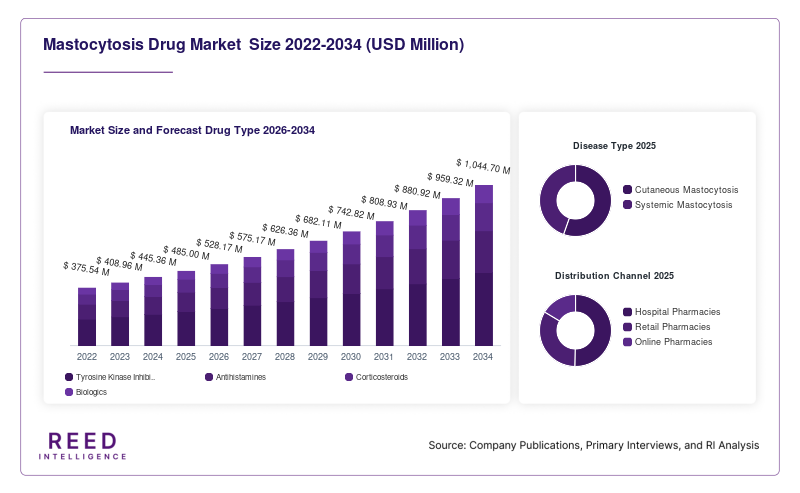
The tyrosine kinase inhibitors (TKIs) segment dominated the mastocytosis drug market in 2024, accounting for approximately 42% of the total market share. These drugs are widely used due to their ability to target specific molecular pathways associated with mast cell proliferation. The effectiveness of TKIs in managing systemic mastocytosis has made them a preferred choice among healthcare providers. Additionally, continuous research and development efforts have led to the introduction of next-generation TKIs with improved efficacy and safety profiles. The growing adoption of these therapies is further supported by favorable regulatory approvals and increasing physician awareness.
The biologics segment is expected to be the fastest-growing, with a projected CAGR of 9.6% during the forecast period. Biologics offer targeted treatment options with fewer side effects, making them increasingly popular among patients. The growth of this segment is driven by advancements in biotechnology and the development of novel monoclonal antibodies. Additionally, increasing investment in research and development activities is expected to accelerate the introduction of new biologic therapies, further driving market growth.
By Disease Type
Systemic mastocytosis dominated the market in 2024, holding around 65% of the total share. This dominance is attributed to the higher severity and prevalence of systemic forms compared to cutaneous mastocytosis. Patients with systemic mastocytosis often require long-term treatment, which increases the demand for effective therapies. Additionally, advancements in diagnostic techniques have improved the identification of systemic cases, further supporting segment growth.
Cutaneous mastocytosis is expected to be the fastest-growing segment, with a CAGR of 8.7% during the forecast period. This growth is driven by increasing awareness and improved diagnosis, particularly in pediatric populations. The development of targeted topical therapies and improved treatment protocols is also contributing to segment expansion. As healthcare providers gain a better understanding of the disease, the demand for effective treatments is expected to rise.
By Distribution Channel
Hospital pharmacies accounted for the largest market share in 2024, contributing approximately 48% of total revenue. This dominance is due to the complex nature of mastocytosis treatment, which often requires specialized care and monitoring. Hospital settings provide access to advanced diagnostic tools and experienced healthcare professionals, making them the primary distribution channel for mastocytosis drugs. Additionally, the availability of reimbursement options in hospital settings supports segment growth.
Online pharmacies are projected to be the fastest-growing segment, with a CAGR of 10.2% during the forecast period. The increasing adoption of digital healthcare platforms and the convenience of online purchasing are driving this growth. Patients prefer online pharmacies for their accessibility and competitive pricing. Additionally, the expansion of telemedicine services is expected to further support the growth of this segment.
Regional Analysis
North America
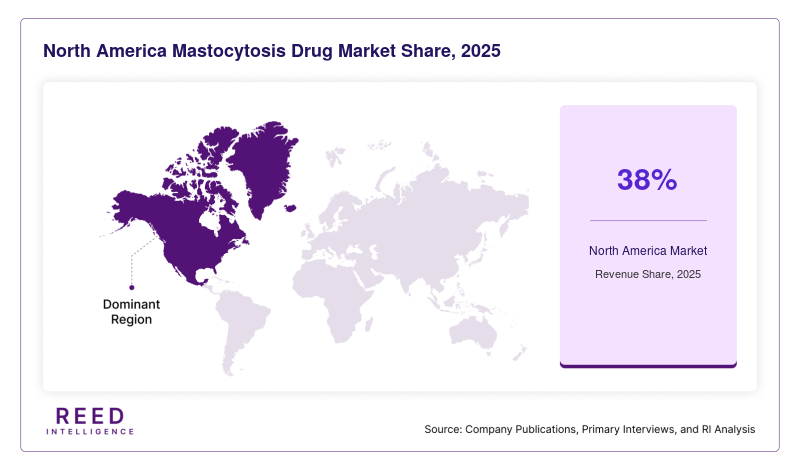
North America accounted for the largest share of the mastocytosis drug market in 2025, contributing approximately 38% of the global revenue. The region is expected to maintain its dominance, with a projected CAGR of 8.5% through 2034. This growth is driven by well-established healthcare infrastructure, high awareness levels, and strong research capabilities. The presence of leading pharmaceutical companies and active clinical trial networks further supports market expansion. Additionally, favorable reimbursement policies encourage the adoption of advanced therapies.
The United States dominates the North American market due to its advanced healthcare system and strong focus on rare disease research. A unique growth factor in this region is the extensive support from patient advocacy organizations, which promote awareness and facilitate early diagnosis. These organizations also collaborate with pharmaceutical companies to accelerate drug development and improve patient access to innovative therapies.
Europe
Europe held a significant share of around 27% in 2025 and is anticipated to grow at a CAGR of 8.2% during the forecast period. The region benefits from supportive regulatory frameworks, including orphan drug incentives provided by the European Medicines Agency. Increasing healthcare spending and growing awareness of rare diseases contribute to market growth. Additionally, the presence of established pharmaceutical companies enhances research and development activities.
Germany leads the European market due to its strong healthcare infrastructure and focus on innovation. A key growth factor in this region is government support for rare disease research programs. These initiatives provide funding for clinical trials and encourage collaboration between academic institutions and pharmaceutical companies, thereby accelerating the development of new therapies.
Asia Pacific
Asia Pacific is expected to witness the fastest growth, with a CAGR of 9.8% during the forecast period, and held approximately 18% market share in 2025. The region’s growth is driven by improving healthcare infrastructure, increasing awareness, and rising healthcare expenditure. Governments are investing in rare disease diagnosis and treatment, which supports market expansion. Additionally, the large population base presents significant growth potential.
China dominates the Asia Pacific market due to its rapidly expanding healthcare sector. A unique growth factor is the increasing adoption of advanced diagnostic technologies, which enhances disease detection rates. This improvement in diagnosis leads to higher treatment demand, driving the growth of the mastocytosis drug market in the region.
Middle East & Africa
The Middle East & Africa region accounted for around 9% of the market share in 2025 and is projected to grow at a CAGR of 7.6% through 2034. Market growth in this region is supported by improving healthcare infrastructure and increasing investment in specialized medical services. However, limited awareness and access to advanced treatments remain challenges.
Saudi Arabia leads the regional market due to its focus on healthcare modernization. A key growth factor is government investment in rare disease treatment centers, which enhances access to specialized care. These initiatives are expected to improve diagnosis rates and drive demand for mastocytosis therapies in the region.
Latin America
Latin America held approximately 8% market share in 2025 and is expected to grow at a CAGR of 7.9% during the forecast period. The region is experiencing gradual improvements in healthcare systems and increasing awareness of rare diseases. Government initiatives to expand healthcare coverage are supporting market growth.
Brazil dominates the Latin American market due to its large population and improving healthcare infrastructure. A unique growth factor is the increasing collaboration between public and private sectors to improve access to advanced treatments. These partnerships are expected to enhance the availability of mastocytosis drugs and support market expansion.
Competitive Landscape
The mastocytosis drug market is moderately consolidated, with a mix of established pharmaceutical companies and emerging biotech firms competing for market share. Leading companies are focusing on research and development to introduce innovative therapies and strengthen their product portfolios. Strategic collaborations, mergers, and acquisitions are common strategies used to enhance market presence.
One of the leading players in the market is Novartis AG, which has a strong portfolio of targeted therapies and a robust pipeline. The company recently announced advancements in its clinical trials for next-generation tyrosine kinase inhibitors, aiming to improve treatment outcomes for systemic mastocytosis patients. Other key players are also investing heavily in research and expanding their global footprint to capture emerging market opportunities.
Key Players
- Novartis AG
- Blueprint Medicines Corporation
- Pfizer Inc.
- AstraZeneca plc
- Sanofi S.A.
- Bristol-Myers Squibb Company
- Eli Lilly and Company
- GlaxoSmithKline plc
- Takeda Pharmaceutical Company Limited
- Bayer AG
- Amgen Inc.
- AbbVie Inc.
- Merck & Co., Inc.
- Teva Pharmaceutical Industries Ltd.
- Johnson & Johnson
Recent Developments
- Blueprint Medicines announced positive clinical trial results for a novel KIT inhibitor targeting advanced systemic mastocytosis, showing improved patient response rates.
- Novartis expanded its research collaboration with a biotechnology firm to accelerate the development of targeted therapies for rare hematologic disorders.
- Pfizer initiated a phase II clinical trial for a new biologic therapy aimed at reducing mast cell activity in patients with severe mastocytosis.
Mastocytosis Drug Market Segments
Drug Type
- Tyrosine Kinase Inhibitors
- Antihistamines
- Corticosteroids
- Biologics
Disease Type
- Cutaneous Mastocytosis
- Systemic Mastocytosis
Distribution Channel
- Hospital Pharmacies
- Retail Pharmacies
- Online Pharmacies
By Region
- North America
- Europe
- APAC
- Middle East and Africa
- LATAM