Mayonnaise Market Size, Share & Trends Analysis Report By Product Type (Regular Mayonnaise, Reduced-Fat & Low-Calorie Mayonnaise, Vegan & Egg-Free Mayonnaise, Flavored & Specialty Mayonnaise), By Application (Household Consumption, Foodservice & Restaurants, Food Processing), By Distribution Channel (Supermarkets & Hypermarkets, Convenience Stores, Specialty & Grocery Stores, Online Retail), By End User (Households, Restaurants & Foodservice Operators, Food Manufacturers) and By Region (North Am
USD 3950
Mayonnaise Market Size
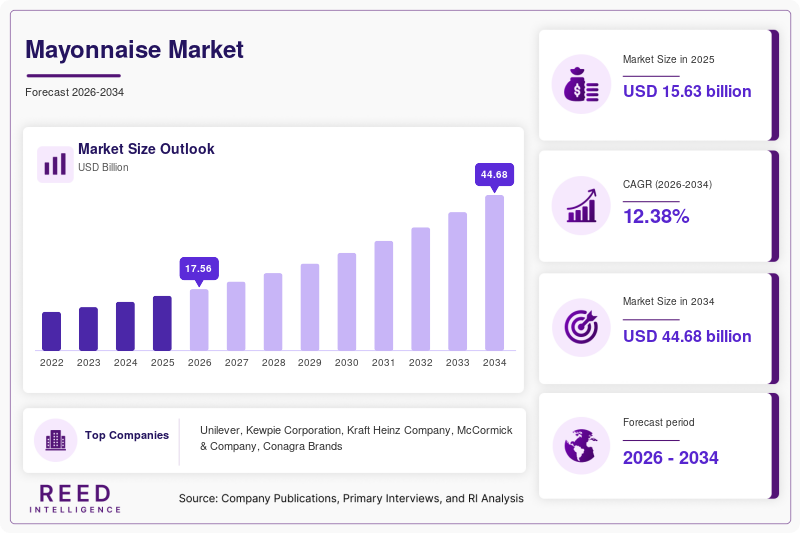
The global Mayonnaise Market size was valued at USD 15.63 billion in 2025 and is projected to grow from USD 17.57 billion in 2026 to USD 44.68 billion by 2034, registering a CAGR of 12.38% during the forecast period from 2026 to 2034.
The Mayonnaise Market is moving beyond the traditional egg-and-oil condiment category toward a broader sauce platform built around flavor variety, convenience, healthier formulations and foodservice applications. Unilever reported that Hellmann's delivered mid-single-digit, volume-led growth in 2025, with its flavored mayonnaise range scaled across more than 30 markets and becoming a €100 million platform. The company has also identified premiumization through squeeze formats and flavored mayonnaise as a core growth route.
Kewpie is pursuing a similar geographic and product-expansion strategy. The company distributes products across 79 countries and regions and identifies Kewpie Mayonnaise as a global strategic product, with localized product development and marketing used to expand international consumption.
Demand also benefits from the continuing scale of foodservice. U.S. food-away-from-home spending reached USD 1.41 trillion in 2025 in inflation-adjusted terms, while limited-service restaurants generated USD 516.1 billion and full-service restaurants USD 488.4 billion.
At the product level, manufacturers are addressing health and dietary preferences through reduced-calorie, vegan, egg-free and functional variants. Kewpie launched a 50%-lower-calorie mayonnaise-type product in 2026 and introduced a mayonnaise-type functional food containing its GK-1 ingredient.
Mayonnaise Market Drivers
Flavor Innovation Is Expanding Mayonnaise Beyond a Traditional Condiment
Mayonnaise is increasingly being used as a base for flavored sauces, dips and meal accompaniments rather than only as a sandwich spread or salad ingredient. Unilever's 2025 results provide a direct commercial signal: Hellmann's flavored mayonnaise range achieved mid-single-digit growth and had expanded into more than 30 markets. The company previously identified flavored mayonnaise as a premiumization platform approaching €100 million in value.
Kraft Heinz has taken a similar approach. In August 2025, HEINZ launched eight mayonnaise-style sauces in Canada, including Smoky Bacon, Garlic Parmesan, Mango Habanero and Pickle. The company cited consumer demand for multiple sauces and more adventurous flavors as the rationale for expanding the range.
The mechanism is commercially important because flavored products create additional consumption occasions and allow manufacturers to charge differentiated prices. They also connect mayonnaise with burgers, fried foods, sandwiches, snacks and international cuisines. The counterbalance is increased competition from aioli, dressings, specialty dips and other sauce categories.
Health-Oriented Reformulation Is Creating New Mayonnaise Subcategories
Traditional mayonnaise is associated with relatively high fat and calorie content, creating pressure for manufacturers to provide products that fit changing dietary preferences. This has encouraged reduced-fat, low-calorie, vegan and egg-free formulations.
Kewpie substantially redesigned its Kewpie Half product in 2026, maintaining an egg-yolk formulation while delivering a 50% calorie reduction compared with its standard mayonnaise. The company also launched a mayonnaise-type functional food containing its proprietary GK-1 ingredient.
Plant-based mayonnaise is another established route. Unilever reported that Hellmann's Vegan Mayo had doubled its turnover over three years and was available in close to 40 markets.
Regulatory attention to nutrition labeling reinforces the importance of formulation. The FDA's proposed front-of-package nutrition system focuses on saturated fat, sodium and added sugars, potentially increasing the visibility of nutritional differences when consumers compare packaged foods.
Foodservice Expansion Supports High-Volume Mayonnaise Consumption
Mayonnaise is a widely used ingredient in restaurants, quick-service restaurants, sandwiches, burgers, salads, prepared foods and dipping sauces. Growth in foodservice therefore increases demand beyond household retail purchases.
USDA data show that U.S. food-away-from-home spending reached USD 1.41 trillion in 2025 in inflation-adjusted terms, with limited-service restaurants alone generating USD 516.1 billion.
The importance of this channel is also reflected in manufacturer strategies. Kewpie introduced its Maon Sauce for professional foodservice in 2025 as part of its mayonnaise centennial program, while its 2026 Kewpie Half reformulation was launched in both consumer and foodservice formats.
The commercial mechanism is higher-frequency consumption and larger pack sizes. Foodservice customers also require consistent viscosity, flavor, emulsion stability and performance in prepared foods. This creates demand for specialized formulations alongside retail mayonnaise.
Mayonnaise Market Restraints
Nutrition Perception and Reformulation Costs Can Limit Conventional Mayonnaise Demand
Traditional mayonnaise is typically energy-dense because oil is a major ingredient. Consumers seeking lower-fat or lower-calorie diets can therefore substitute reduced-fat mayonnaise, yogurt-based dressings, mustard, hummus, sauces or other spreads.
Manufacturers must balance nutritional reformulation against taste and texture. Kewpie's 2026 reformulation of Kewpie Half specifically retained egg-yolk flavor and mouthfeel while cutting calories by 50%, illustrating the technical challenge of changing nutritional characteristics without weakening the core sensory proposition.
Regulatory nutrition-labeling developments could increase consumer visibility of nutritional differences. The FDA's proposed front-of-package system would highlight saturated fat, sodium and added sugars on applicable packaged foods.
Egg, Vegetable-Oil and Packaging Costs Affect Production Economics
Mayonnaise manufacturers are exposed to fluctuations in edible oils, eggs, packaging materials, energy and logistics. Egg availability is particularly relevant for traditional formulations.
USDA notes that processed egg products are widely used as ingredients in prepared mayonnaise because they provide convenience, handling advantages and food-safety controls. FDA guidance also states that commercially manufactured mayonnaise generally uses pasteurized eggs or egg products.
The supply-chain exposure creates margin pressure when ingredient costs rise. Manufacturers can mitigate this through formulation changes, supplier diversification, packaging optimization and procurement scale, but aggressive price increases can also encourage consumers to switch between brands and private labels.
Mayonnaise Market Opportunities
Premium and Flavored Mayonnaise
Premiumization provides a route to increase value without relying solely on higher household consumption. Flavored mayonnaise can incorporate garlic, chili, truffle, herbs, smoky flavors, regional spices and other ingredients that create differentiated products.
Unilever's Hellmann's flavored mayonnaise platform has already expanded across more than 30 markets, while Kraft Heinz's 2025 Canadian launch added four new flavor profiles.
The opportunity is particularly strong in markets where consumers increasingly use mayonnaise as a dipping sauce and cooking ingredient rather than only as a sandwich spread.
Plant-Based and Functional Mayonnaise
Vegan and egg-free mayonnaise allows brands to address consumers following plant-based diets and consumers avoiding eggs. Hellmann's Vegan Mayo is already present in close to 40 markets, according to Unilever.
Functional mayonnaise is an emerging extension. Kewpie launched a functional-food mayonnaise-type product containing GK-1 in Japan in February 2026, connecting a familiar condiment format with a health-oriented proposition.
This category creates room for premium pricing, although manufacturers need to maintain taste, texture, stability and regulatory compliance.
Expansion in Emerging Markets
International category development is particularly relevant where mayonnaise penetration remains below mature-market levels. Kewpie explicitly identifies China and Southeast Asia as growth priorities and states that localized menu proposals and product development are being used to increase mayonnaise usage.
Unilever has similarly described India as a market where it is building the mayonnaise category and strengthening Hellmann's through innovation and distribution.
The commercial mechanism is not simply population growth. Local manufacturers can increase usage by connecting mayonnaise with regional foods, street food, sandwiches, snacks, restaurant menus and home cooking.
Segmental Analysis
By Product Type
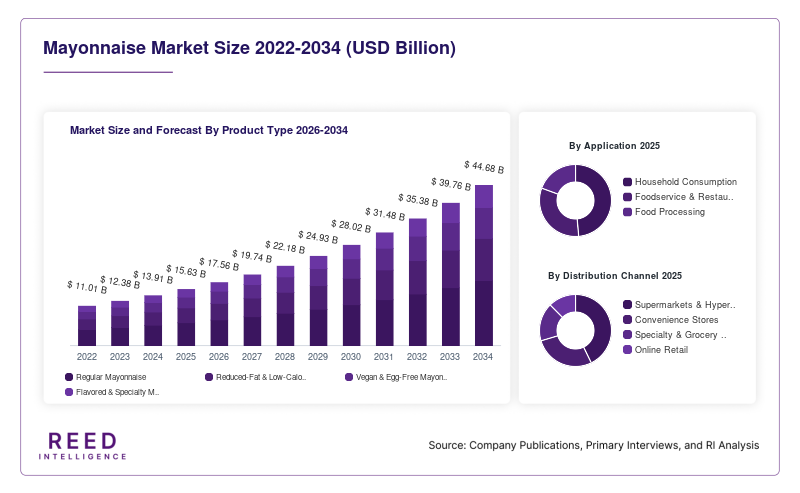
Regular Mayonnaise represents approximately 56% of the global market in 2025, making it the dominant product category. It benefits from broad household penetration, established consumer familiarity and use across sandwiches, salads, burgers, prepared foods and cooking.
Reduced-Fat & Low-Calorie Mayonnaise accounts for approximately 19%, supported by consumers seeking lower-calorie alternatives without abandoning mayonnaise-based products. Kewpie's 2026 reformulation of Kewpie Half, which reduced calories by 50%, illustrates continued product development in this segment.
Vegan & Egg-Free Mayonnaise represents approximately 11% and addresses plant-based diets and egg avoidance. Unilever's Hellmann's Vegan Mayo has expanded to close to 40 markets.
Flavored & Specialty Mayonnaise accounts for approximately 14% and is the fastest-growing product segment, with an estimated CAGR of 16.1%. Hellmann's and HEINZ are both expanding flavor-led offerings, creating additional usage occasions and premium price points.
By Application
Household Consumption represents approximately 58% of the market in 2025. Mayonnaise is a routine grocery purchase and is used in sandwiches, salads, burgers, dips, sauces and home-prepared meals.
Foodservice & Restaurants account for approximately 27%. The segment benefits from high-frequency use in limited-service restaurants, full-service restaurants, cafés, sandwich chains and catering.
Food Processing represents approximately 15%, covering prepared salads, sandwiches, sauces, ready meals and other manufactured foods.
Foodservice & Restaurants are the fastest-growing application, with an estimated 13.8% CAGR. U.S. foodservice spending reached USD 1.41 trillion in 2025 in inflation-adjusted terms, demonstrating the scale of the channel supporting commercial condiment demand.
By Distribution Channel
Supermarkets & Hypermarkets account for approximately 43% of the global market in 2025. These outlets provide broad brand and formulation selection and remain important for regular household replenishment.
Specialty & Grocery Stores represent approximately 27%, while Convenience Stores account for 16%.
Online Retail represents approximately 14% but is the fastest-growing distribution channel, with an estimated CAGR of 17.0%. Online grocery supports subscription-style replenishment, product discovery and access to imported, vegan, low-calorie and specialty mayonnaise products.
The broader retail environment supports this channel shift. USDA reports that grocery stores remained the largest U.S. food-at-home outlet in 2025, while warehouse clubs and supercenters continued to increase their share of food-at-home spending.
By End User
Households represent approximately 59% of market demand in 2025. Household use remains broad because mayonnaise serves as both a condiment and an ingredient.
Restaurants & Foodservice Operators account for approximately 27%, supported by high-volume use in burgers, sandwiches, salads, fries, dips and prepared meals.
Food Manufacturers represent approximately 14% and use mayonnaise in prepared foods, sauces, salads and ready-to-eat products.
Restaurants & Foodservice Operators are the fastest-growing end-user group, with an estimated 13.7% CAGR, reflecting continued expansion of food-away-from-home consumption and the wider use of sauces in limited-service and full-service food operations. USDA reported USD 1.41 trillion of inflation-adjusted U.S. food-away-from-home sales in 2025.
Regional Analysis
North America Mayonnaise Market
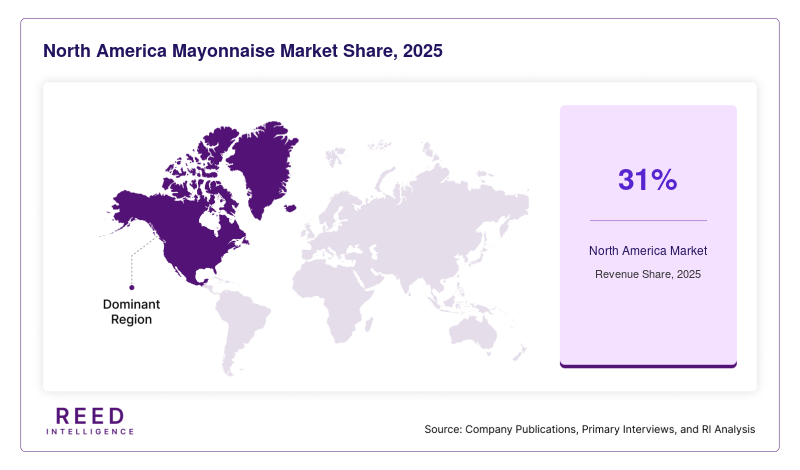
North America represents approximately 31% of the global Mayonnaise Market in 2025, supported by high household penetration, established condiment brands, large supermarket networks and substantial restaurant consumption.
The U.S. market benefits from both retail and foodservice demand. USDA reported USD 1.10 trillion in inflation-adjusted food-at-home spending and USD 1.41 trillion in food-away-from-home spending in 2025.
The region is also a major innovation market. Unilever's Hellmann's portfolio uses flavored mayonnaise and premium formats to expand the category, while Kraft Heinz launched multiple flavored mayonnaise-style sauces in Canada in 2025.
North America is projected to grow at approximately 11.1% CAGR through 2034. Demand is supported by premium sauces, restaurant applications and online grocery, while nutritional concerns and private-label competition remain counterbalances.
Food safety requirements also influence formulations. FDA guidance identifies commercial mayonnaise as generally using pasteurized eggs or egg products, while the 2026 Food Code provides requirements governing foods containing eggs.
Europe Mayonnaise Market
Europe accounts for approximately 28% of the global market in 2025. The region has established mayonnaise consumption across household and foodservice markets and supports a wide range of traditional, reduced-fat, vegan and flavored products.
The category is influenced by consumer interest in plant-based foods and product reformulation. Unilever has expanded Hellmann's Vegan Mayo into close to 40 markets, providing an established plant-based platform across Europe and other regions.
European consumers also have strong demand for convenience foods, prepared meals, sandwiches and restaurant dining, providing multiple mayonnaise applications.
Europe is expected to expand at approximately 11.8% CAGR. Premiumization and product differentiation will remain important as mature markets face competition from private labels, alternative sauces and changing nutrition preferences.
Manufacturers are also adapting packaging and formulation to sustainability requirements, including recyclable packaging, reduced material use and ingredient sourcing. The main constraint is relatively mature category penetration, which shifts growth toward premium and specialized products rather than basic mayonnaise.
APAC Mayonnaise Market
APAC represents approximately 24% of the global Mayonnaise Market in 2025 and is the fastest-growing region, with an estimated CAGR of 15.4%.
The region provides substantial room for category development because mayonnaise usage varies significantly across countries. Japan has a mature mayonnaise culture, while China, India and Southeast Asian markets offer opportunities to increase usage by linking mayonnaise with local dishes and foodservice formats.
Kewpie identifies mayonnaise as a global strategic product and distributes products across 79 countries and regions. Its international strategy specifically emphasizes localized product development and marketing.
Kewpie has also identified China and Southeast Asia as important growth areas, stating that local menu proposals and product development can increase mayonnaise usage where penetration remains comparatively low.
Unilever has separately described India as a market where it is building the mayonnaise category through Hellmann's.
APAC's growth mechanism therefore combines population scale with category creation, localization and foodservice expansion. Flavored, spicy, egg-free and reduced-calorie products provide additional opportunities.
Middle East and Africa Mayonnaise Market
Middle East and Africa represents approximately 8% of the global market in 2025 and is projected to grow at approximately 12.7% CAGR.
Demand is linked to urbanization, modern grocery retail, restaurant expansion and the popularity of sandwiches, grilled foods, fried foods and dipping sauces. Mayonnaise also fits into regional foodservice applications where consumers use multiple sauces alongside meals.
International condiment companies can expand the category by offering localized flavors rather than relying only on conventional mayonnaise. Smaller packaging can also improve affordability in price-sensitive markets.
The region's foodservice channel provides an important commercial pathway because restaurants and quick-service operators can introduce consumers to mayonnaise-based sauces before they become routine household purchases.
Key constraints include income differences between countries, imported ingredient costs and fragmented distribution. Local manufacturing and regional sourcing can therefore improve price competitiveness.
LATAM Mayonnaise Market
LATAM represents approximately 9% of the global Mayonnaise Market in 2025 and is projected to grow at approximately 13.4% CAGR.
Brazil is a major regional consumption market and is also important to global condiment companies. Unilever reported double-digit growth and share gains in Brazil during 2025, supported by premium innovations within its Foods business.
The region's demand is supported by household consumption, fast-food restaurants, prepared foods and growing interest in flavored sauces. Mayonnaise can be integrated into sandwiches, burgers, salads, snacks and local food preparations, creating multiple consumption occasions.
LATAM's growth pathway is therefore based on both established household consumption and product premiumization. Flavored products, squeeze packaging and smaller formats can broaden usage.
Currency volatility, ingredient costs and uneven retail infrastructure remain constraints, particularly for imported brands and premium products.
Competitive Landscape
The Mayonnaise Market has a combination of multinational food companies, regional specialists, private-label manufacturers and foodservice suppliers. Competition is increasingly shifting from basic mayonnaise toward flavor innovation, health positioning, premium packaging, localized formulations and foodservice penetration.
Unilever has positioned Hellmann's as a global mayonnaise platform. The company identifies Hellmann's as a nearly €3 billion brand and reported mid-single-digit growth in 2025, led by flavored mayonnaise. The range is now available in more than 30 markets.
Kewpie has a particularly strong international expansion strategy. The company distributes products across 79 countries and regions and identifies Kewpie Mayonnaise as a global strategic product. Its strategy combines manufacturing and supply-chain investment with localized products and marketing.
Key Market Players
- Unilever
- Kewpie Corporation
- Kraft Heinz Company
- McCormick & Company
- Conagra Brands
- Remia
- Ajinomoto Co.
- Nestlé
- Dr. August Oetker
- Ken's Foods
- Del Monte Foods
- Kenko Mayonnaise
- Cremica Fooxd Industries
- Veeba Foods
- American Garden
Recent Market Developments
- 2025 – Unilever expanded the Hellmann's flavored mayonnaise platform. Unilever reported that the range was available in more than 30 markets and had reached a €100 million platform, making flavor-led mayonnaise a significant part of its premiumization strategy.
- August 2025 – Kraft Heinz launched eight HEINZ Mayonnaise-Style Sauces in Canada. Four new variants Smoky Bacon, Garlic Parmesan, Mango Habanero, and Pickle expanded the company's flavored sauce portfolio.
Mayonnaise Market Segments
By Product Type
- Regular Mayonnaise
- Reduced-Fat & Low-Calorie Mayonnaise
- Vegan & Egg-Free Mayonnaise
- Flavored & Specialty Mayonnaise
By Application
- Household Consumption
- Foodservice & Restaurants
- Food Processing
By Distribution Channel
- Supermarkets & Hypermarkets
- Convenience Stores
- Specialty & Grocery Stores
- Online Retail
By End User
- Households
- Restaurants & Foodservice Operators
- Food Manufacturers
By Region
- North America
- Europe
- APAC
- Middle East and Africa
- LATAM