Meat Poultry Seafood Market Size, Share, Demand Report By Product Type (Beef, Poultry, Pork, Seafood, Others), By Form (Fresh/Chilled, Frozen, Processed & Packaged), By Distribution Channel (Supermarkets & Hypermarkets, Convenience Stores, Specialty Stores, Online Retail, Foodservice & Institutional Supply), By Region & Segment Forecasts, 2026–2034
USD 3950
Market Overview
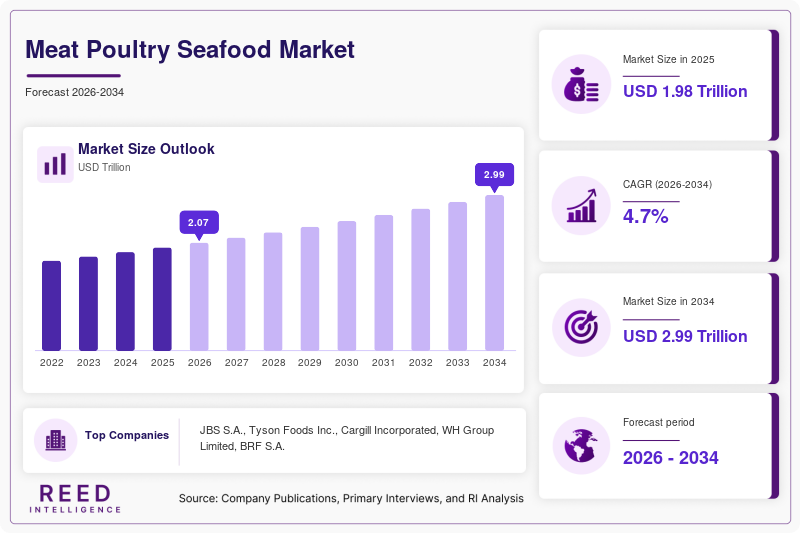
The global Meat Poultry Seafood Market size was valued at USD 1.98 trillion in 2026 and is projected to reach USD 2.86 trillion by 2034, expanding at a CAGR of 4.7% during 2026–2034. The market includes fresh, frozen, processed, and packaged meat products across retail, foodservice, and industrial channels. Rising protein consumption, urbanization, and changing dietary habits continue to support steady demand across developed and emerging economies. Consumers are increasingly purchasing convenient, ready-to-cook, portion-controlled, and value-added protein products, which is encouraging processors to expand capacity and modernize supply chains.
A major global factor supporting market growth is the expansion of cold-chain logistics. Improved refrigerated transportation, smart warehousing, and temperature-monitoring systems have reduced spoilage rates and expanded access to premium protein products in secondary cities and export markets. This has been particularly important for seafood and chilled poultry categories, where freshness and shelf life strongly influence purchasing decisions. At the same time, e-commerce grocery channels are helping branded processors reach households directly with subscription packs and customized assortments.
Key Highlights
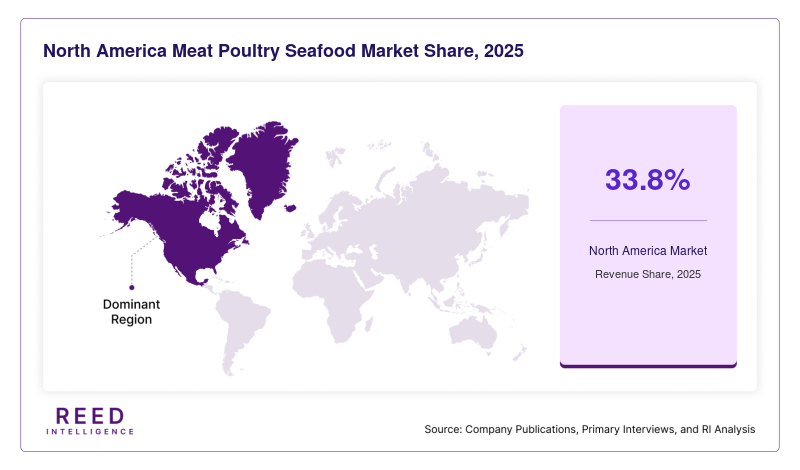
- North America dominated the market with a 33.8% share in 2025.
- Asia Pacific is expected to grow at the fastest CAGR of 6.3% during 2026–2034.
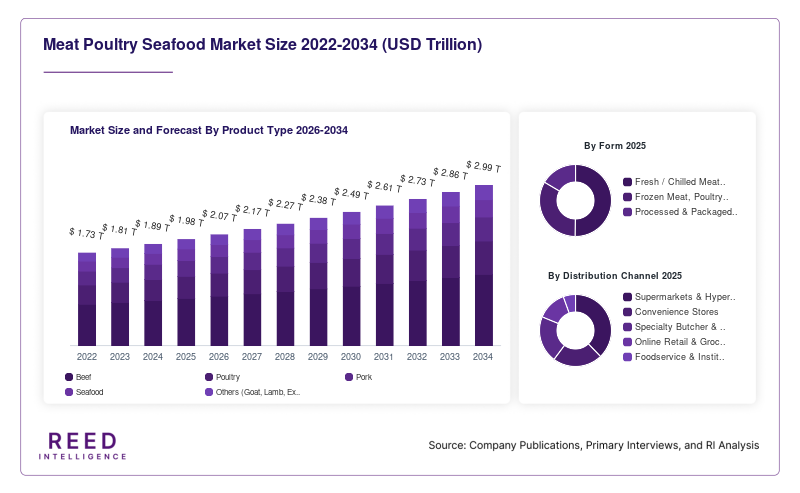
- By product type, poultry accounted for the largest share of 36.9%, while seafood is projected to grow at a CAGR of 5.8%.
- By form, fresh/chilled products led with a 48.6% share, whereas frozen products are expected to expand at a CAGR of 5.5%.
- By distribution channel, supermarkets and hypermarkets held 44.1% share, while online retail is forecast to grow at a CAGR of 8.4%.
- The United States remained the dominant country, with market values of USD 362 billion in 2024 and USD 378 billion in 2025.
Market Trends
Premiumization and clean-label protein demand
Consumers are shifting toward higher-quality meat, poultry, and seafood products that offer transparent sourcing, cleaner labels, and stronger nutritional positioning. Demand for grass-fed beef, free-range chicken, organic eggs-linked poultry packs, wild-caught seafood, and minimally processed cuts is increasing in urban markets. Retailers are dedicating more shelf space to branded premium proteins with traceability codes and farm-origin labeling. This trend is helping processors improve margins through differentiated packaging and value-added marinades. Younger consumers are also responding positively to products marketed around animal welfare, lower additives, and sustainable sourcing, creating room for premium product launches across modern retail channels.
Convenience formats and digital grocery expansion
Busy lifestyles are driving strong interest in ready-to-cook and ready-to-eat formats such as seasoned chicken fillets, portioned seafood trays, deli meats, and microwaveable meal kits. Consumers want faster preparation without sacrificing freshness or taste. E-commerce platforms are strengthening this trend by offering same-day delivery, frozen logistics, and recurring subscription bundles for family protein needs. Digital channels allow brands to personalize offers based on household size and dietary preferences. Processors are using insulated packaging and direct-to-consumer models to expand reach. As online grocery penetration rises, convenience-oriented protein formats are expected to gain additional market share.
Market Drivers
Rising global protein consumption and population growth
Population expansion, urban migration, and rising incomes are increasing protein intake across Asia, Africa, and Latin America. Many households moving into middle-income brackets add poultry, processed meats, and seafood more frequently to weekly diets. Poultry remains especially attractive because of affordability, broad cultural acceptance, and lower preparation time. Foodservice chains are also expanding menu offerings centered on chicken, burgers, seafood snacks, and prepared meat dishes. This structural increase in protein demand provides stable long-term volume growth for the Meat Poultry Seafood Market and supports investment in farming, processing, storage, and packaging infrastructure worldwide.
Processing technology and supply chain modernization
Automation in slaughterhouses, deboning lines, portioning systems, freezing tunnels, and packaging plants is improving yields while reducing labor dependency. Digital inventory management and predictive demand planning help companies balance procurement with retail orders more efficiently. Enhanced cold-chain systems reduce waste and maintain product quality during long-distance transport. These improvements allow processors to serve export markets while protecting margins. In seafood, onboard freezing and rapid grading technologies have strengthened quality consistency. As more producers adopt advanced processing methods, the industry gains better productivity, stronger food safety performance, and wider product availability across channels.
Market Restraint
Price volatility, disease outbreaks, and regulatory pressure
The market faces recurring pressure from feed cost inflation, fuel prices, weather disruptions, disease outbreaks, and changing trade regulations. Beef and poultry producers are highly sensitive to corn and soybean price movements, while seafood operators face fuel-intensive harvesting costs and quota restrictions. Disease events such as avian influenza or swine fever can quickly reduce supply, restrict exports, and alter consumer sentiment. Compliance with labeling, traceability, hygiene, and sustainability standards also increases operating costs, particularly for small processors. When prices rise sharply, consumers often trade down to cheaper proteins or reduce discretionary purchases, limiting near-term revenue growth across premium categories.
Market Opportunities
Expansion in emerging retail and foodservice markets
Modern retail growth in India, Southeast Asia, Africa, and parts of Latin America creates strong opportunities for packaged protein suppliers. Supermarkets, convenience chains, and quick-service restaurants require reliable branded meat and poultry inputs with standardized quality. As cold storage networks improve, suppliers can introduce frozen seafood, marinated poultry, and processed meats to cities previously underserved by organized retail. This enables companies to build brand recognition early in high-growth markets. Local partnerships with distributors and restaurant chains can accelerate scale while reducing route-to-market complexity for international processors entering new regions.
Sustainable seafood and value-added innovation
Consumers and institutional buyers increasingly prefer responsibly sourced seafood and lower-waste protein solutions. This creates opportunity for certified fisheries, aquaculture operators, and processors using recyclable packaging or full-animal utilization models. Value-added products such as seasoned shrimp kits, smoked salmon snacks, high-protein meat bites, and blended convenience meals can command higher margins than commodity cuts. Brands that communicate sustainability metrics and nutritional benefits are likely to gain shelf space with premium retailers. Innovation in freezing technology and shelf-life extension also enables broader geographic reach for seafood producers serving inland markets.
Segmental Analysis
By Product Type
Poultry was the dominant subsegment in 2024, accounting for 36.9% share of the global market. Chicken and turkey products benefit from lower average prices than beef and many seafood categories, making them accessible across income groups. Poultry also offers shorter production cycles, allowing suppliers to respond quickly to demand shifts. Consumers perceive chicken as a versatile protein suitable for home cooking, foodservice menus, and processed applications such as nuggets, sausages, and deli slices. Retailers favor poultry because of consistent turnover and broad household acceptance across regions.
Seafood is the fastest-growing subsegment and is projected to expand at a CAGR of 5.8% through 2034. Rising awareness of omega-3 nutrition, increasing restaurant demand, and expanding frozen seafood assortments are supporting growth. Improved aquaculture production is stabilizing supply of shrimp, salmon, tilapia, and other species. Inland consumers now access seafood through stronger cold chains and online grocery delivery. Value-added products such as seasoned shrimp packs, breaded fish fillets, and smoked salmon snacks are further increasing category appeal.
By Form
Fresh and chilled products held the leading share in 2024 at 48.6%. Many consumers continue to associate fresh meat, poultry, and seafood with higher quality, better texture, and stronger taste. Traditional retail counters, butcher shops, and wet markets remain influential in several countries. Foodservice operators also prefer chilled proteins for menu flexibility and portion control. Fresh categories command regular replenishment cycles, helping retailers drive store traffic and repeat visits while maintaining pricing visibility for shoppers.
Frozen products are expected to grow at the fastest CAGR of 5.5% during the forecast period. Freezing extends shelf life, reduces household waste, and enables bulk purchasing. Busy consumers increasingly buy frozen chicken portions, burgers, shrimp, and seafood mixes for convenience. Retailers benefit from broader assortment management and lower shrink rates. Technological improvements such as rapid freezing and moisture-retention packaging are enhancing texture and taste, reducing historical quality concerns and supporting stronger adoption worldwide.
By Distribution Channel
Supermarkets and hypermarkets were the dominant channel in 2024 with 44.1% share. These stores offer wide product assortments spanning fresh counters, chilled cabinets, frozen aisles, and private-label value packs. Consumers prefer one-stop shopping, visible promotions, and trust in food safety standards. Large chains also negotiate directly with processors, improving price competitiveness and ensuring stable inventory. In developed markets, in-store prepared meal sections further stimulate purchases of rotisserie chicken, deli meats, and seafood trays.
Online retail is the fastest-growing channel, forecast to expand at a CAGR of 8.4% through 2034. Digital grocery platforms are improving delivery speed, temperature control, and customer confidence in perishable purchases. Subscription meat boxes, app-based promotions, and personalized recommendations increase basket size. Urban consumers value convenience, while younger households are comfortable purchasing protein online. Retailers are building dark stores and micro-fulfillment centers to strengthen cold-chain efficiency and reduce delivery times.
Regional Analysis
North America
North America held 33.8% of the global Meat Poultry Seafood Market in 2025 and is expected to grow at a CAGR of 3.8% through 2034. The region benefits from large-scale industrial farming, efficient processing systems, and strong retail penetration. Consumers purchase across fresh, frozen, deli, and ready-meal categories, supporting diversified revenue streams. Premium beef and branded poultry continue to perform well, while seafood demand is rising in health-focused households.
The United States remains the dominant country due to its extensive livestock production base and integrated cold-chain network. A unique growth factor is the rapid adoption of direct-to-consumer meat subscriptions and omnichannel grocery delivery. Consumers increasingly order curated protein boxes, specialty cuts, and frozen seafood packs online, helping brands build recurring sales and stronger customer loyalty.
Europe
Europe accounted for 24.1% market share in 2025 and is projected to expand at a CAGR of 3.6% during the forecast period. The region is characterized by high quality standards, mature retail systems, and strong demand for processed meats, chilled poultry, and premium seafood. Private-label products remain important, while premium organic and welfare-certified lines are growing steadily across Western Europe.
Germany leads the regional market due to purchasing power, organized retail depth, and central logistics access. A unique growth factor is the strong consumer preference for traceable and responsibly sourced proteins. Retailers increasingly require origin labeling and welfare certifications, encouraging suppliers to modernize farms, upgrade packaging, and maintain transparent sourcing practices.
Asia Pacific
Asia Pacific represented 22.7% of global share in 2025 and is forecast to register the fastest CAGR of 6.3% through 2034. Rising disposable incomes, urbanization, and changing food habits are increasing protein intake across the region. Poultry dominates many markets because of affordability, while seafood remains essential in coastal economies. Frozen and packaged formats are expanding rapidly in urban centers.
China is the largest country market owing to its scale, consumption base, and advanced e-commerce ecosystem. A unique growth factor is the rapid modernization of domestic cold-chain logistics connecting inland cities with coastal seafood and meat supply hubs. This has widened product availability and improved freshness standards across second-tier cities.
Middle East & Africa
Middle East & Africa captured 10.2% share in 2025 and is expected to grow at a CAGR of 4.9%. Demand is supported by population growth, tourism recovery, and expanding hospitality sectors. Poultry is a core category because of price competitiveness and broad dietary acceptance. Frozen imports play an important role in balancing regional supply gaps.
Saudi Arabia leads the regional market due to strong purchasing power and large foodservice demand. A unique growth factor is investment in domestic food security programs, including poultry farms, processing plants, and strategic cold storage assets. These initiatives reduce import dependency while creating stable supply for retailers and restaurants.
Latin America
Latin America held 9.2% market share in 2025 and is anticipated to grow at a CAGR of 4.5% through 2034. The region benefits from strong livestock resources, export-oriented poultry production, and growing modern retail networks. Domestic consumers increasingly buy packaged chicken, sausages, and frozen seafood products as convenience becomes more important in urban areas.
Brazil dominates the region with its major poultry and beef production capacity. A unique growth factor is its competitive export infrastructure linking farms, processors, and ports efficiently. Strong export earnings help fund plant upgrades and support domestic availability of processed protein products sold through supermarkets and wholesalers.
Competitive Landscape
The global Meat Poultry Seafood Market is moderately consolidated, with multinational processors competing against regional specialists and vertically integrated producers. Leading companies focus on capacity expansion, feed efficiency, brand building, and export access. Product differentiation increasingly centers on premium cuts, convenience packs, traceability, and sustainable sourcing claims.
JBS S.A. remains a market leader due to its diversified protein portfolio and broad geographic footprint. A recent development includes additional investment in value-added prepared protein lines for retail and foodservice channels. Tyson Foods continues expanding branded poultry and convenience offerings. Cargill strengthens supply chain services and ingredient integration for food manufacturers. WH Group maintains scale in pork processing and packaged meats, while Maruha Nichiro advances seafood processing and cold-chain reach. Competitive intensity is expected to rise as companies pursue automation, e-commerce partnerships, and premium category expansion.
Key Players List
- JBS S.A.
- Tyson Foods Inc.
- Cargill Incorporated
- WH Group Limited
- BRF S.A.
- Marfrig Global Foods
- Hormel Foods Corporation
- Smithfield Foods
- Maruha Nichiro Corporation
- Mowi ASA
- Nippon Ham Foods Ltd.
- Charoen Pokphand Foods
- Sysco Corporation
- OSI Group
- Pilgrim’s Pride Corporation
Recent Developments
- Major processors expanded automated deboning and packaging lines to improve labor productivity and output consistency.
- Several seafood suppliers launched recyclable packaging formats for frozen shrimp and fish products in modern retail channels.
- Large grocery chains introduced same-day chilled meat delivery partnerships with online platforms in key urban markets.
Meat Poultry Seafood Market Segments
By Product Type
- Beef
- Poultry
- Pork
- Seafood
- Others (Goat, Lamb, Exotic Meats)
By Form
- Fresh / Chilled Meat, Poultry & Seafood
- Frozen Meat, Poultry & Seafood
- Processed & Packaged Products
By Distribution Channel
- Supermarkets & Hypermarkets
- Convenience Stores
- Specialty Butcher & Seafood Shops
- Online Retail & Grocery Platforms
- Foodservice & Institutional Supply
By Region
- North America
- Europe
- APAC
- Middle East and Africa
- LATAM