Meat Speciation Testing Market Size, Share & Demand Report By Technology (PCR-based Testing, Immunoassay, Next-Generation Sequencing, Other Technologies), By Application (Processed Meat Products, Raw Meat Testing), By End-Use (Food Manufacturers, Testing Laboratories, Regulatory Authorities), By Region & Segment Forecasts, 2026–2034
USD 3950
Market Overview
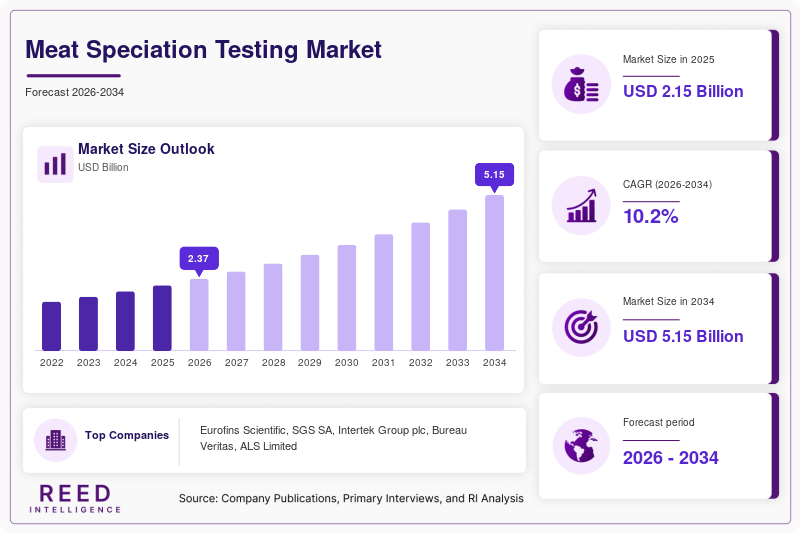
The global Meat Speciation Testing Market size was valued at USD 2.15 billion in 2026 and is projected to reach USD 4.68 billion by 2034, expanding at a CAGR of 10.2% during the forecast period (2026–2034). The market is witnessing steady expansion due to increasing concerns over food authenticity, labeling compliance, and consumer safety across developed and emerging economies. Rising incidents of food fraud and adulteration, particularly in processed meat products, have encouraged regulatory bodies and food manufacturers to adopt advanced testing solutions such as PCR-based and immunoassay technologies.
A major global factor supporting market growth is the strengthening of food safety regulations and traceability requirements. Governments and international organizations are implementing stringent guidelines to ensure transparency across the food supply chain. This has significantly increased demand for reliable meat speciation testing methods among food processors, retailers, and import-export authorities. Additionally, the globalization of the meat trade has created complex supply chains, further increasing the need for verification of species origin.
Key Highlights
- Europe accounted for a dominant market share of 34.5% in 2025, while Asia Pacific is projected to register the fastest CAGR of 12.1% during the forecast period.
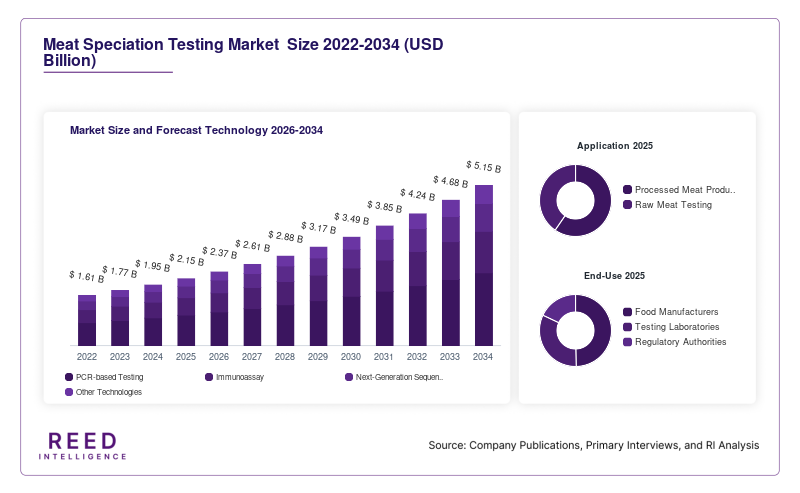
- PCR-based testing emerged as the leading subsegment in technology with a 46.8% share, while next-generation sequencing is expected to grow at the fastest CAGR of 13.4%.
- Processed meat products led the application segment with a 51.2% share, while raw meat testing is anticipated to grow at a CAGR of 11.7%.
- Germany, the dominant country, recorded market values of USD 320 million in 2024 and USD 345 million in 2025.
Market Trends
Increasing Adoption of Advanced Molecular Techniques
The Meat Speciation Testing Market is experiencing a shift toward advanced molecular diagnostic techniques, particularly polymerase chain reaction (PCR) and next-generation sequencing (NGS). These technologies offer higher accuracy, sensitivity, and the ability to detect multiple species within a single test sample. As food supply chains become more globalized and complex, traditional methods such as protein-based assays are gradually being replaced. Laboratories and food manufacturers are investing in automated and high-throughput systems that can process large sample volumes with minimal human intervention. This trend is also supported by declining costs of molecular technologies and improved accessibility in developing regions, which is enabling wider adoption.
Integration of Digital Traceability and Blockchain Solutions
Another notable trend in the market is the integration of digital traceability systems, including blockchain, with meat speciation testing processes. Companies are increasingly combining laboratory testing data with digital platforms to ensure transparency and real-time tracking of meat products. This helps build consumer trust and simplifies compliance with regulatory requirements. Blockchain-enabled systems allow stakeholders to verify species authenticity at every stage of the supply chain, from farm to retail. The growing emphasis on sustainability and ethical sourcing is further driving the adoption of such integrated solutions, making traceability a critical component of modern meat testing frameworks.
Market Drivers
Rising Incidence of Food Fraud and Adulteration
The increasing prevalence of food fraud incidents is a major driver for the Meat Speciation Testing Market. Cases involving substitution of high-value meat with lower-cost alternatives have raised serious concerns among consumers and regulatory authorities. These incidents not only affect public health but also damage brand reputation and economic stability within the food industry. As a result, food manufacturers are adopting stringent quality control measures, including routine speciation testing. Regulatory agencies are also mandating periodic testing, thereby increasing demand for advanced testing solutions across the value chain.
Stringent Government Regulations and Compliance Requirements
Government regulations related to food labeling, safety, and traceability are becoming more stringent worldwide. Authorities in regions such as Europe and North America have established strict guidelines that require accurate identification of meat species in food products. Non-compliance can result in heavy penalties, product recalls, and legal actions. This regulatory pressure is compelling food producers and processors to invest in reliable testing technologies. Additionally, the harmonization of international standards is encouraging exporters to adopt meat speciation testing to meet the requirements of multiple markets, further driving growth.
Market Restraint
High Cost of Advanced Testing Technologies
Despite significant growth potential, the Meat Speciation Testing Market faces challenges related to the high cost of advanced testing technologies. Techniques such as next-generation sequencing and real-time PCR require sophisticated equipment, skilled personnel, and continuous maintenance, which can be expensive for small and medium-sized enterprises. These cost barriers limit adoption, particularly in developing regions where budget constraints and lack of infrastructure are prevalent.
The financial burden also extends to training and certification requirements for laboratory staff, further increasing operational costs. For example, smaller food processing units may rely on third-party laboratories instead of in-house testing, leading to longer turnaround times and increased dependency. This can affect supply chain efficiency and decision-making processes. While technological advancements are gradually reducing costs, affordability remains a critical concern that may hinder market expansion in price-sensitive regions.
Market Opportunities
Expansion in Emerging Markets
Emerging economies in Asia Pacific, Latin America, and Africa present significant growth opportunities for the Meat Speciation Testing Market. Rapid urbanization, rising disposable incomes, and increasing awareness of food safety are driving demand for quality assurance solutions. Governments in these regions are also strengthening food safety regulations, creating a favorable environment for market expansion. International companies are entering these markets through partnerships and local investments, aiming to capitalize on the growing demand. The establishment of modern laboratory infrastructure further supports this opportunity.
Growth of Plant-Based and Alternative Protein Verification
The rise of plant-based and alternative protein products is creating new opportunities for meat speciation testing. Manufacturers of vegetarian and vegan products require verification to ensure the absence of animal-derived components. This has expanded the scope of testing beyond traditional meat products to include cross-contamination analysis and authenticity verification. As consumer demand for clean-label and ethical products increases, testing solutions are being adapted to meet these requirements. This diversification is expected to drive innovation and open new revenue streams for market players.
Segmental Analysis
By Technology
PCR-based testing dominated the technology segment with a 46.8% share in 2024. This method is widely used due to its high accuracy, sensitivity, and ability to detect multiple species in a single sample. PCR techniques are particularly effective in identifying trace amounts of DNA, making them suitable for detecting adulteration in processed meat products. The widespread adoption of PCR is also supported by its relatively lower cost compared to advanced sequencing methods, making it accessible to a larger number of laboratories.
Next-generation sequencing (NGS) is the fastest-growing subsegment, expected to register a CAGR of 13.4%. The growth is driven by its ability to provide comprehensive analysis and detect unknown species in complex samples. NGS is increasingly being adopted in research and high-end testing laboratories. The technology’s ability to deliver detailed genetic information is enhancing its application in food safety and authenticity testing, making it a key growth driver.
By Application
Processed meat products accounted for the largest share of 51.2% in 2024. This dominance is attributed to the high risk of adulteration in processed foods, where multiple ingredients are used. Meat speciation testing is essential in verifying product labels and ensuring compliance with regulations. Food manufacturers are increasingly adopting testing solutions to maintain brand reputation and meet consumer expectations.
Raw meat testing is the fastest-growing subsegment, with a projected CAGR of 11.7%. The growth is driven by increasing demand for fresh and unprocessed meat products. Consumers are becoming more conscious about the origin and quality of meat, which is encouraging retailers and suppliers to adopt testing solutions. Additionally, regulatory requirements for traceability are further supporting the growth of this segment.
By End-Use
Food manufacturers dominated the end-use segment with a significant share in 2024. These organizations rely on meat speciation testing to ensure product quality, maintain compliance, and prevent fraud. The increasing complexity of supply chains has made testing a critical component of quality control processes. Large manufacturers are investing in in-house testing facilities to improve efficiency and reduce dependency on third-party laboratories.
Testing laboratories are the fastest-growing subsegment, with a CAGR of 12.5%. The growth is driven by the increasing outsourcing of testing services by small and medium-sized enterprises. Laboratories offer specialized expertise and advanced technologies, making them a preferred choice for many organizations. The expansion of laboratory networks and the introduction of automated testing solutions are further contributing to the growth of this segment.
Regional Analysis
North America
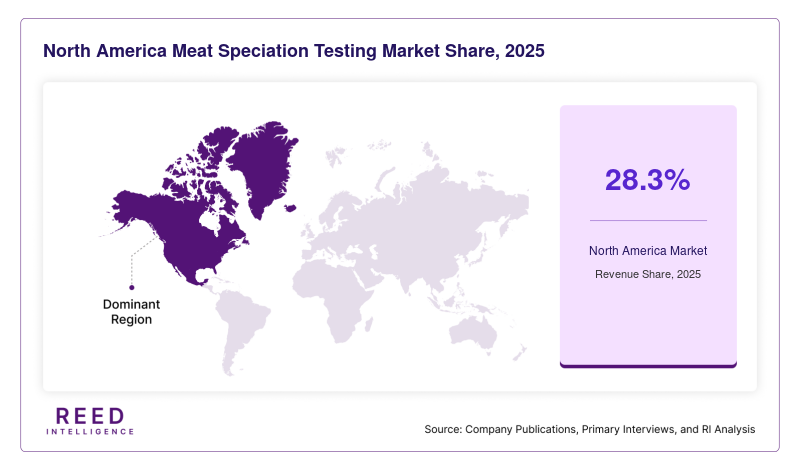
North America held a market share of approximately 28.3% in 2025 and is expected to grow at a CAGR of 9.6% during the forecast period. The region benefits from well-established food safety regulations and advanced laboratory infrastructure. High consumer awareness regarding food authenticity and labeling accuracy is driving demand for meat speciation testing. The presence of major food processing companies further supports market growth, as these organizations invest heavily in quality assurance and compliance measures.
The United States dominates the North American market due to its strong regulatory framework and technological advancements. A unique growth factor is the increasing adoption of automation in testing laboratories, which enhances efficiency and reduces human error. Additionally, collaborations between research institutions and industry players are fostering innovation in testing methodologies, contributing to market expansion.
Europe
Europe accounted for the largest market share of 34.5% in 2025 and is projected to grow at a CAGR of 9.8%. The region has stringent food safety regulations and a strong focus on traceability, which drives demand for meat speciation testing. The presence of established regulatory bodies ensures strict compliance, making testing a critical component of the food supply chain.
Germany leads the European market, supported by its advanced food processing industry and strong export activities. A unique growth factor is the region’s emphasis on sustainability and ethical sourcing, which requires accurate verification of meat origin. This has increased the adoption of advanced testing technologies across the supply chain.
Asia Pacific
Asia Pacific is expected to register the fastest CAGR of 12.1% during the forecast period, with a market share of 21.7% in 2025. Rapid urbanization and increasing consumption of processed meat products are key factors driving growth. Governments in the region are implementing stricter food safety regulations, which is encouraging the adoption of testing solutions.
China dominates the Asia Pacific market due to its large population and expanding food industry. A unique growth factor is the rising investment in food testing infrastructure, including the establishment of modern laboratories. This is enhancing the region’s capability to conduct advanced meat speciation testing.
Middle East & Africa
The Middle East & Africa region held a market share of 8.6% in 2025 and is projected to grow at a CAGR of 10.4%. The market is driven by increasing awareness of food safety and the need for halal certification. Meat speciation testing plays a critical role in verifying compliance with religious dietary requirements.
Saudi Arabia is a dominant country in this region, supported by strong demand for halal-certified products. A unique growth factor is the expansion of the food import sector, which requires strict quality checks and species verification. This is increasing the demand for testing services.
Latin America
Latin America accounted for a market share of 6.9% in 2025 and is expected to grow at a CAGR of 10.1%. The region is witnessing increased adoption of meat speciation testing due to growing export activities and regulatory improvements. Countries are focusing on enhancing food quality standards to compete in international markets.
Brazil leads the Latin American market, driven by its large meat production and export industry. A unique growth factor is the increasing demand for certified meat products in global markets, which requires compliance with international testing standards. This is boosting the adoption of advanced testing solutions.
Competitive Landscape
The Meat Speciation Testing Market is moderately fragmented, with several global and regional players competing based on technology, accuracy, and service offerings. Leading companies are focusing on product innovation, strategic partnerships, and geographic expansion to strengthen their market position.
Eurofins Scientific is a key leader in the market, offering a wide range of testing services and advanced technologies. The company has recently expanded its laboratory network to enhance its global presence and improve service capabilities. Other major players are also investing in research and development to introduce more efficient and cost-effective testing solutions.
Competition is further intensified by the entry of new players and the increasing demand for customized testing services. Companies are adopting digital platforms and automation to improve operational efficiency and reduce turnaround times, which is becoming a key differentiating factor in the market.
Key Players
- Eurofins Scientific
- SGS SA
- Intertek Group plc
- Bureau Veritas
- ALS Limited
- Merieux Nutrisciences
- Thermo Fisher Scientific
- Neogen Corporation
- Bio-Rad Laboratories
- Agilent Technologies
- PerkinElmer Inc.
- LGC Limited
- Charm Sciences
- Genetic ID
- Microbac Laboratories
Recent Developments
- In 2025, Eurofins Scientific expanded its DNA testing capabilities with new high-throughput laboratories in Asia Pacific.
- In 2024, SGS SA launched an advanced PCR-based testing solution for rapid meat speciation analysis.
- In 2025, Intertek Group introduced blockchain-integrated traceability solutions for meat supply chains.
Meat Speciation Testing Market Segments
Technology
- PCR-based Testing
- Immunoassay
- Next-Generation Sequencing
- Other Technologies
Application
- Processed Meat Products
- Raw Meat Testing
End-Use
- Food Manufacturers
- Testing Laboratories
- Regulatory Authorities
By Region
- North America
- Europe
- APAC
- Middle East and Africa
- LATAM