Medical Adherence Monitoring Caps Market Size, Share, Demand Report By Product Type (Electronic Monitoring Caps, Bluetooth-Enabled Adherence Caps), By Application (Chronic Disease Management,Home Healthcare Management), By End-Use (Hospitals & Clinics, Home Healthcare Settings, Pharmaceutical Companies, Clinical Research Organizations, Pharmacies & Retail Drug Stores), By Region & Segment Forecasts, 2026–2034
USD 3950
Market Overview
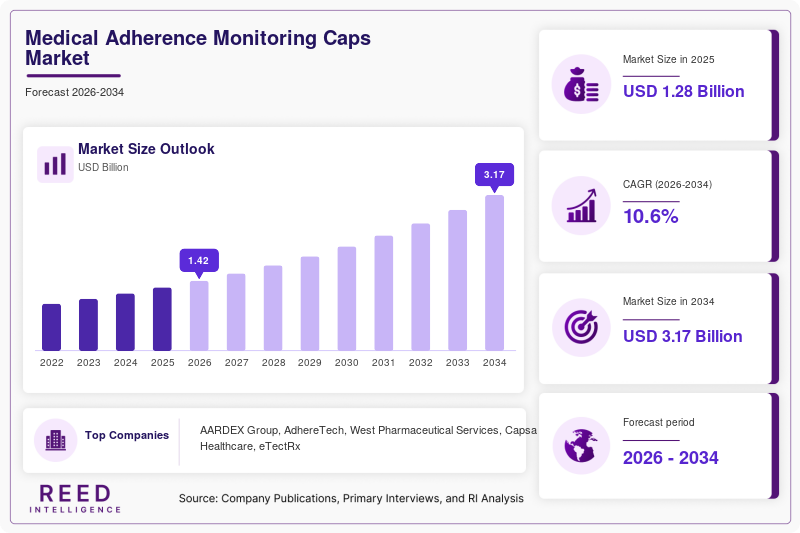
The Medical Adherence Monitoring Caps Market size is estimated at approximately USD 1.42 billion, and it is projected to reach around USD 3.18 billion by 2034, registering a CAGR of 10.6% during 2026–2034. This growth is primarily supported by increasing prevalence of chronic diseases such as diabetes, cardiovascular disorders, and respiratory conditions, which require long-term medication adherence and consistent monitoring solutions.
A major global factor supporting market growth is the rapid integration of smart healthcare technologies, including IoT-enabled pharmaceutical packaging and digital adherence tracking systems. These innovations are helping healthcare providers reduce non-adherence rates, improve treatment outcomes, and lower hospitalization costs. Pharmaceutical companies and digital health startups are increasingly investing in smart closure systems that combine sensors, wireless connectivity, and mobile app integration.
Key Highlights
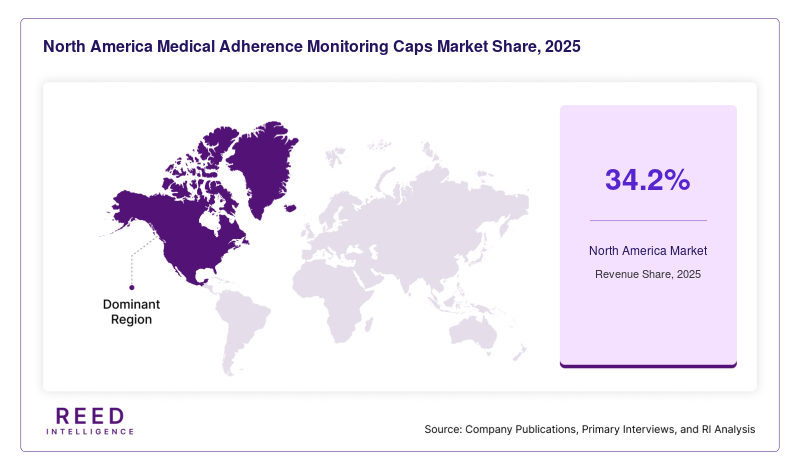
North America dominated the market with a 34.2% share in 2025.
Asia Pacific is expected to grow at the fastest CAGR of 11.4% during 2026–2034.
By product type, electronic monitoring caps accounted for the largest share of 40.1%.
while smart sensor-enabled caps are projected to grow at a CAGR of 12.6%.
By application, chronic disease management led with a 45.3% share, whereas clinical trial adherence monitoring is expected to expand at a CAGR of 11.9%.
The United States remained the dominant country, with market values of USD 620 million in 2024 and USD 690 million in 2025.
Market Trends
Integration of IoT and Connected Healthcare Ecosystems
The Medical Adherence Monitoring Caps Market is experiencing a strong shift toward IoT-enabled smart packaging systems that connect medication containers with digital healthcare platforms. These advanced caps are equipped with sensors that record dosage timing, frequency, and patient interaction data, which is transmitted to mobile applications or cloud-based dashboards. Healthcare providers are increasingly using this data to monitor patient behavior remotely and intervene when non-adherence is detected. The integration of IoT is also enabling predictive analytics, where algorithms assess adherence patterns and forecast potential risks in treatment discontinuation. This trend is particularly strong in developed healthcare systems where telemedicine adoption is high and reimbursement models support digital health integration.
Expansion of Digital Therapeutics and Remote Patient Monitoring
Another significant trend in the Medical Adherence Monitoring Caps Market is the rising adoption of digital therapeutics and remote patient monitoring systems. Pharmaceutical companies are collaborating with digital health firms to integrate smart caps into broader treatment ecosystems that include mobile health apps, AI-based reminders, and physician dashboards. These systems are designed to improve long-term medication adherence for chronic disease patients, particularly in geriatrics and oncology care. Hospitals and home healthcare providers are increasingly deploying these solutions to reduce readmission rates and improve clinical outcomes. The growing preference for home-based care is further accelerating demand for smart adherence solutions that allow continuous monitoring without physical hospital visits.
Market Drivers
Rising Prevalence of Chronic Diseases and Long-Term Therapies
The increasing global burden of chronic diseases is a major driver of the Medical Adherence Monitoring Caps Market. Conditions such as diabetes, hypertension, asthma, and cardiovascular disorders require long-term medication, making adherence a critical factor in treatment success. However, non-adherence remains a persistent issue, leading to poor clinical outcomes and increased healthcare costs. Medical adherence monitoring caps help address this challenge by providing real-time tracking of medication usage and alerting both patients and caregivers about missed doses. Governments and healthcare organizations are actively promoting adherence-enhancing technologies as part of chronic disease management programs, further driving market adoption across hospitals, pharmacies, and homecare settings.
Growth of Smart Healthcare Infrastructure and Digitalization
The expansion of smart healthcare infrastructure is significantly contributing to the growth of the Medical Adherence Monitoring Caps Market. Hospitals and healthcare systems are increasingly investing in digital transformation initiatives that integrate electronic medical records, connected devices, and cloud-based monitoring platforms. Smart caps are becoming an essential component of these ecosystems, enabling seamless data sharing between patients, pharmacists, and healthcare providers. The increasing use of smartphones and wearable devices is also supporting the adoption of adherence monitoring solutions. In addition, healthcare policies encouraging value-based care are pushing providers to adopt technologies that improve treatment efficiency and reduce avoidable hospital admissions.
Market Restraint
High Cost of Smart Monitoring Solutions and Limited Affordability
A key restraint affecting the Medical Adherence Monitoring Caps Market is the relatively high cost associated with advanced smart cap technologies. These devices often incorporate sensors, Bluetooth connectivity, and cloud integration features, which increase manufacturing and operational costs. As a result, affordability becomes a challenge in low- and middle-income regions where healthcare budgets are limited. Many patients, particularly those without comprehensive insurance coverage, may hesitate to adopt these solutions due to additional expenses. Furthermore, healthcare providers in cost-sensitive markets may prioritize basic medication packaging over advanced adherence technologies, slowing overall market penetration. Despite long-term cost benefits associated with improved adherence, the initial investment barrier continues to restrict widespread adoption.
Market Opportunities
Expansion in Emerging Healthcare Markets
Emerging economies present a significant growth opportunity for the Medical Adherence Monitoring Caps Market. Countries in Asia Pacific, Latin America, and parts of Africa are witnessing rapid improvements in healthcare infrastructure and increasing awareness of chronic disease management. Governments in these regions are investing in digital health initiatives, which creates a favorable environment for smart medical packaging solutions. Additionally, rising middle-class populations and improved access to healthcare services are driving demand for innovative adherence tools. Local pharmaceutical companies are also beginning to collaborate with global technology providers to introduce cost-effective monitoring solutions tailored for regional healthcare systems.
Advancements in AI-Driven Medication Adherence Analytics
Artificial intelligence is creating new opportunities in the Medical Adherence Monitoring Caps Market by enabling advanced data analytics and predictive modeling. AI-powered platforms can analyze adherence patterns collected from smart caps and identify patients at risk of non-compliance. This allows healthcare providers to implement early interventions and personalized treatment strategies. Integration of machine learning algorithms with adherence data is also helping pharmaceutical companies improve clinical trial accuracy by ensuring consistent medication usage among participants. As AI technologies continue to evolve, their integration with smart medical devices is expected to enhance operational efficiency and improve patient outcomes across global healthcare systems.
Segmental Analysis
Product Type
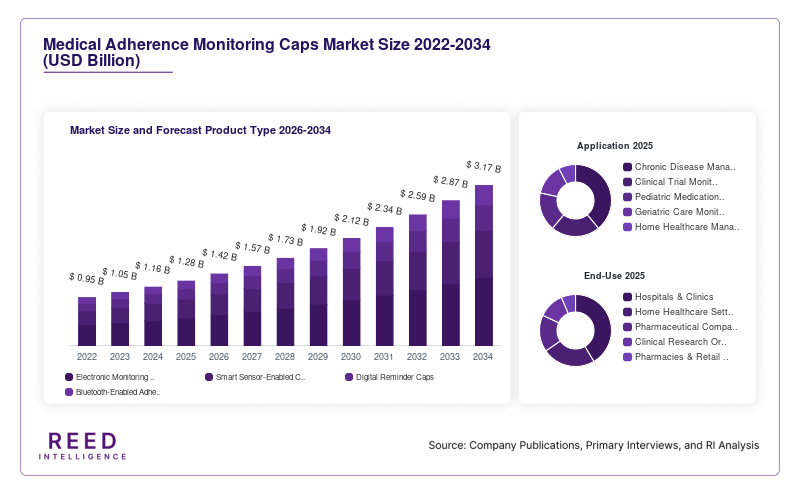
Electronic monitoring caps accounted for approximately 40.1% share in 2025, making them the dominant subsegment in the Medical Adherence Monitoring Caps Market. These devices are widely used due to their ability to record precise medication usage data and integrate with healthcare management systems. Their adoption is particularly strong in hospitals and clinical research environments where accurate adherence tracking is essential for treatment evaluation and regulatory compliance.
Smart sensor-enabled caps are projected to grow at a CAGR of 12.6% during the forecast period. Growth is supported by advancements in miniaturized sensors and wireless communication technologies. These caps provide real-time alerts and cloud-based monitoring, making them suitable for home healthcare applications. Increasing demand for personalized medicine and remote patient monitoring is accelerating adoption across both developed and emerging markets.
Application
Chronic disease management held the largest share of 45.3% in 2025. This dominance is attributed to the high global burden of long-term illnesses requiring continuous medication adherence. Healthcare providers rely on monitoring caps to reduce non-compliance and improve therapeutic outcomes, especially in diabetes and cardiovascular treatment programs.
Clinical trial adherence monitoring is expected to grow at a CAGR of 11.9%. Pharmaceutical companies are increasingly using smart caps to ensure accurate dosing during drug development studies. This helps improve data reliability and reduces trial failure rates, making it a key growth area.
End-Use
Hospitals and healthcare institutions represented 38.7% of the market share in 2025. Their dominance is driven by structured medication management systems and integration with electronic health records. These institutions use adherence caps to improve patient safety and reduce readmission rates.
Home healthcare is expected to expand at a CAGR of 12.1%, driven by increasing preference for at-home treatment and remote monitoring solutions. Aging populations and rising healthcare costs are further encouraging adoption in home-based care settings.
Regional Analysis
North America
North America accounted for approximately 34.2% market share in 2025 and is projected to grow at a CAGR of 9.8% during the forecast period. Strong healthcare infrastructure and high adoption of digital health technologies support regional dominance.
The United States leads the regional market, driven by advanced healthcare reimbursement systems and widespread use of smart medication management solutions. Increasing focus on reducing hospital readmissions is further accelerating adoption of adherence monitoring caps.
Europe
Europe held nearly 27.5% market share in 2025 and is expected to grow at a CAGR of 9.3% through 2034. The region benefits from strong regulatory support for patient safety and medication adherence programs.
Germany dominates the European market due to its advanced pharmaceutical sector and emphasis on digital healthcare transformation. Public health initiatives promoting chronic disease management also contribute to regional demand.
Asia Pacific
Asia Pacific accounted for 22.8% market share in 2025 and is projected to grow at the fastest CAGR of 11.4%. Rising healthcare investments and growing chronic disease prevalence drive expansion.
China leads the region, supported by large-scale healthcare digitization programs and increasing adoption of smart medical devices in urban hospitals.
Middle East & Africa
The region held 7.1% market share in 2025 and is expected to grow at a CAGR of 10.1%. Increasing healthcare modernization efforts are supporting growth.
Saudi Arabia dominates the regional market due to strong government healthcare investments and adoption of digital hospital infrastructure initiatives.
Latin America
Latin America accounted for 5.4% market share in 2025 and is projected to grow at a CAGR of 9.6%. Expanding healthcare access and pharmaceutical distribution networks are key growth drivers.
Brazil leads the region, driven by increasing chronic disease burden and growing adoption of remote healthcare monitoring solutions.
Competitive Landscape
The Medical Adherence Monitoring Caps Market is moderately competitive, with key players focusing on technological innovation and strategic partnerships. Companies such as AARDEX Group, AdhereTech, West Pharmaceutical Services, Capsa Healthcare, and eTectRx dominate the market. AARDEX Group leads due to its advanced electronic monitoring systems widely used in clinical trials. Recent developments include West Pharmaceutical Services expanding its smart packaging portfolio to integrate Bluetooth-enabled adherence solutions for pharmaceutical clients.
Key Players List
- AARDEX Group
- AdhereTech
- West Pharmaceutical Services
- Capsa Healthcare
- eTectRx
- Vitality Group
- Information Mediary Corporation
- RxCap
- GlowCap Technologies
- Proteus Digital Health
- Novartis AG
- Omnicell Inc.
- Becton Dickinson and Company
- Ypsomed Holding AG
- 3M Company
Recent Developments
- A leading pharmaceutical technology company introduced an upgraded smart cap system integrated with AI-based adherence analytics in early 2026. This solution enhances real-time monitoring accuracy and predictive intervention capabilities.
- A healthcare device manufacturer expanded its production facility in Asia Pacific to meet growing demand for smart adherence packaging solutions, improving regional supply chain efficiency.
- A digital health startup partnered with a global pharmaceutical firm to integrate adherence monitoring caps with mobile health platforms, enabling seamless patient engagement and remote monitoring across multiple chronic disease programs.
Medical Adherence Monitoring Caps Market Segments
Product Type
- Electronic Monitoring Caps
- Smart Sensor-Enabled Caps
- Digital Reminder Caps
- Bluetooth-Enabled Adherence Caps
Application
- Chronic Disease Management
- Clinical Trial Monitoring
- Pediatric Medication Adherence
- Geriatric Care Monitoring
- Home Healthcare Management
End-Use
- Hospitals & Clinics
- Home Healthcare Settings
- Pharmaceutical Companies
- Clinical Research Organizations
- Pharmacies & Retail Drug Stores
By Region
- North America
- Europe
- APAC
- Middle East and Africa
- LATAM