Medical Case Management Market Size, Share & Demand Report By Type (On-Site Case Management, Telephonic Case Management, Field Case Management), By Application (Workers' Compensation, Disability Management, Healthcare Navigation, Catastrophic Injury Management) By Region & Segment Forecasts, 2026–2034
USD 3950
Medical Case Management Market Size
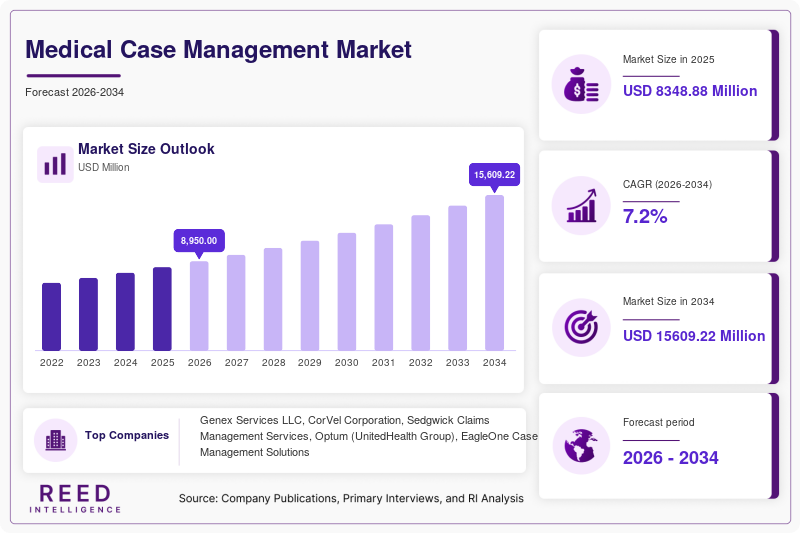
The Medical Case Management market size is projected at USD 8,950.0 million in 2026 and is expected to hit USD 15,600.0 million by 2034 with a CAGR of 7.2% during the forecast period. The increasing demand for cost-effective healthcare solutions, the growing complexity of healthcare systems, and the rising focus on patient care coordination and outcomes improvement underpin market expansion. This report delivers a comprehensive analysis of the Medical Case Management market, including segmentation by type and application, competitive dynamics, and regional growth patterns, equipping stakeholders with critical intelligence to navigate this evolving healthcare services landscape.
Key Takeaways
- Dominant Region: North America leads the Medical Case Management market with a 45% share, while Asia-Pacific is the fastest-growing region with a projected CAGR of 9.5% through 2034.
- Dominant Segment: The Telephonic Case Management type dominates the market with a 42% share, while the Workers' Compensation application is the leading segment with a 35% share.
- Emerging Country: China is projected to reach USD 1,050.0 million by 2034, expanding at a CAGR of 11.0%.
- Key Drivers: The increasing healthcare costs, the growing focus on patient-centered care, and the rising adoption of value-based care models are driving market growth.
Medical Case Management Market Trends
Integration of Digital Health and Telehealth Solutions
The Medical Case Management market is witnessing a significant trend toward the integration of digital health and telehealth solutions to enhance service delivery and patient engagement. This shift is driven by the increasing adoption of remote monitoring technologies, mobile health applications, and virtual care platforms that enable more efficient and accessible case management. Case managers are leveraging digital tools for patient communication, care plan monitoring, and real-time data sharing with healthcare providers. The development of AI-powered clinical decision support systems is enhancing case assessment and intervention planning. This trend is supported by growing acceptance of telehealth and the need for more flexible care delivery models.
Growing Focus on Value-Based Care and Outcomes Measurement
The increasing focus on value-based care models and outcomes measurement is a major trend shaping the Medical Case Management market. The development of case management programs with integrated quality metrics and outcome tracking is gaining traction, driven by the shift toward value-based reimbursement and the need to demonstrate program effectiveness. The use of analytics for identifying high-risk patients and predicting care needs is becoming increasingly prevalent. This trend is supported by growing data availability and the need for continuous quality improvement. The integration of patient-reported outcomes and satisfaction measures into case management programs is enabling more patient-centered care delivery.
Medical Case Management Market Drivers
The Medical Case Management market's expansion is primarily driven by the increasing healthcare costs globally, with healthcare expenditure expected to reach USD 10 trillion by 2030, creating demand for cost-containment solutions. The growing complexity of healthcare systems and the need for effective care coordination have been major drivers, with case management serving as an essential tool for navigating the healthcare landscape. The rising focus on patient-centered care and the shift toward value-based care models have further fueled market demand. The increasing prevalence of chronic diseases and catastrophic injuries requiring complex care management has also supported market growth. Additionally, the growing employer interest in workforce health management and disability cost control has expanded the market opportunity.
Medical Case Management Market Restraints
Despite favorable growth prospects, the Medical Case Management market faces significant constraints, primarily related to the shortage of qualified case managers and the high training requirements for effective practice. The variability in case management quality and outcomes across different providers can also limit trust and adoption. The market's growth is further tempered by the competition from self-insured employers and the availability of alternative care management solutions. Additionally, the challenges of integrating case management with existing healthcare systems and reimbursement models can create barriers to adoption.
Medical Case Management Market Opportunities
The Medical Case Management market presents significant opportunities in the rapidly expanding segment of technology-enabled case management solutions that leverage AI and data analytics for enhanced decision-making and efficiency. The development of specialized case management programs for chronic disease and complex care management represents another promising avenue. Emerging opportunities also exist in the application of case management for population health management and preventive care. Furthermore, the untapped potential in developing economies, driven by expanding healthcare systems and growing demand for quality improvement, offers a fertile ground for market expansion.
Challenges in Medical Case Management Market
The Medical Case Management market grapples with persistent challenges related to the need for continuous innovation to adapt to evolving healthcare delivery models and technological advancements. The complexity of managing diverse patient populations with varying needs and preferences presents ongoing challenges. The market is also contending with the challenge of demonstrating return on investment and program effectiveness to payers and employers. Moreover, the need for effective collaboration among multiple stakeholders in the healthcare ecosystem poses operational challenges.
Medical Case Management Market Segmentation Analysis
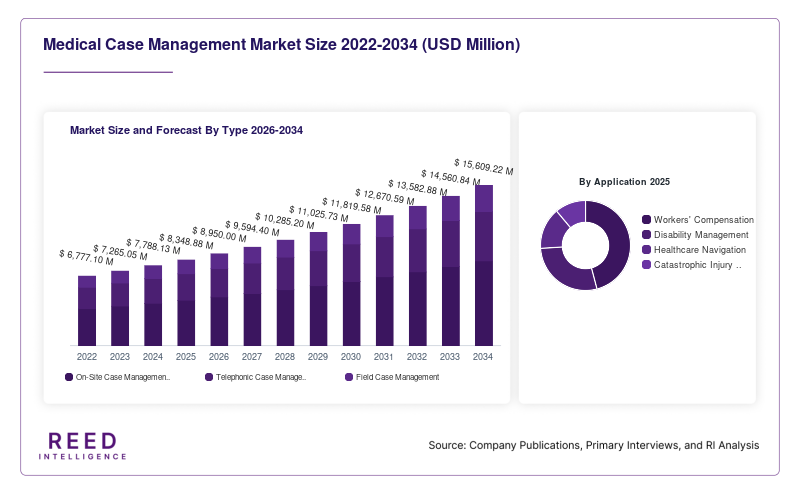
The Medical Case Management market is segmented by Type and Application to provide a comprehensive market perspective. By Type, Telephonic Case Management dominates with a 42% market share, driven by its cost-effectiveness. The Application segment is led by Workers' Compensation, which accounts for 35% of the market, followed by Disability Management at 28%, Healthcare Navigation at 22%, and Catastrophic Injury Management at 15%.
By Type
Telephonic Case Management represents the largest segment in the Medical Case Management market, commanding a 42% share, with revenue exceeding USD 3,759 million in 2025. These services involve remote case management via telephone communication. Technical specifications include communication protocols, documentation standards, and patient engagement strategies. The market's Telephonic Case Management segment is driven by its use in workers' compensation, disability management, and general healthcare navigation where remote coordination is appropriate.
On-Site Case Management captures a 35% share of the Medical Case Management market, with revenue of USD 3,132 million in 2025. These services involve in-person case management at healthcare facilities, employer sites, or patient locations. Technical specifications include direct patient interaction, coordination with healthcare providers, and on-site assessment. The market's On-Site Case Management segment is driven by its use in complex cases requiring direct intervention and field assessment.
Field Case Management represents 23% of the market, with revenue of USD 2,058 million in 2025, characterized by a hybrid approach combining on-site visits with telephonic follow-up. Technical specifications include travel coordination, field assessment protocols, and patient communication strategies. The market's Field Case Management segment is driven by its use in catastrophic injury cases and situations requiring both remote and in-person coordination.
By Application
Workers' Compensation dominates the Medical Case Management market, accounting for 35% of sales, representing USD 3,132 million in 2025. This segment includes case management for workplace injuries and occupational illnesses. Usage penetration exceeds 60% in large workers' compensation programs. The market's Workers' Compensation segment is characterized by its focus on return-to-work outcomes and cost containment.
Disability Management accounts for 28% of the Medical Case Management market, with revenue of USD 2,506 million in 2025. This segment encompasses case management for short-term and long-term disability claims. The segment is growing at a steady rate, driven by increasing disability claims and employer focus on workforce health. The market's Disability Management segment is characterized by its focus on functional recovery and vocational rehabilitation.
Healthcare Navigation represents 22% of the market, with revenue of USD 1,969 million in 2025, involving case management for patients navigating complex healthcare systems. The segment's growth is fueled by increasing healthcare complexity and patient advocacy demand. The market's Healthcare Navigation segment is characterized by its focus on care coordination and patient education.
Catastrophic Injury Management accounts for 15% of the market, with revenue of USD 1,342 million in 2025, encompassing case management for patients with severe and life-altering injuries. The market's Catastrophic Injury Management segment is driven by the need for comprehensive care coordination and long-term support for severely injured patients.
Medical Case Management Market Outlook
North America Medical Case Management Market
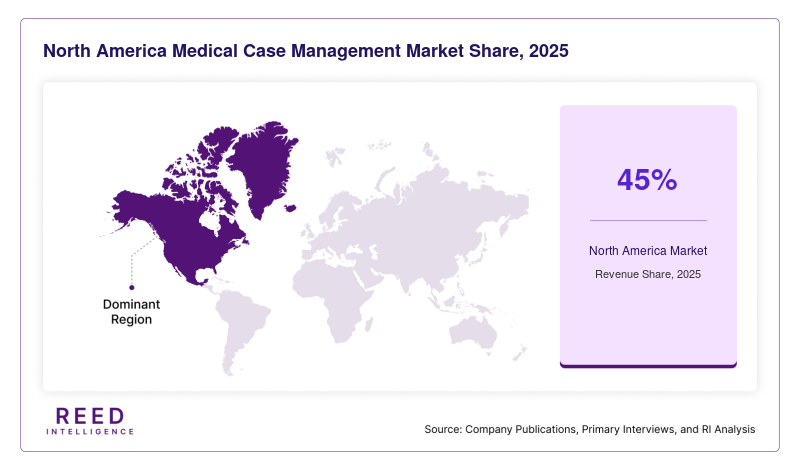
Leads the Medical Case Management market, commanding a 45% share, with revenue of USD 4,027 million in 2025. The United States is the primary driver, accounting for 88% of regional demand, driven by high healthcare costs, established workers' compensation systems, and strong employer focus on health management. The North American market is characterized by its focus on innovation and technology adoption.
Europe Medical Case Management Market
Represents the second-largest market, capturing a 28% share with revenue of USD 2,506 million in 2025. The United Kingdom, Germany, and France are the primary drivers, together accounting for 58% of regional demand, driven by well-established healthcare systems and growing focus on care coordination. The European market is projected to grow at a robust CAGR, supported by continuous innovation and healthcare reform.
Asia-Pacific Medical Case Management Market
Accounts for 20% of the global Medical Case Management market, with revenue of USD 1,790 million in 2025. China, Japan, and Australia are the primary drivers, accounting for 62% of regional demand, fueled by rapidly expanding healthcare systems, increasing healthcare complexity, and growing demand for quality improvement. The Asia-Pacific market is projected to grow at the fastest CAGR of 9.5% through 2034, driven by healthcare system development and technology adoption.
Latin America and Middle East & Africa Medical Case Management Market
Together account for the remaining 7% of the Medical Case Management market, with Brazil and South Africa leading their respective regions. Both regions are projected to grow at CAGRs exceeding 8.5%, driven by improving healthcare systems and growing demand for care coordination.
Top players in Medical Case Management Market
- Genex Services LLC
- CorVel Corporation
- Sedgwick Claims Management Services
- Optum (UnitedHealth Group)
- EagleOne Case Management Solutions
- Maxim Healthcare Services
- ExamWorks (EHC)
- Paradigm Management Services
- Concentra Inc.
- Medical Review Institute of America
- One Call Care Management
- MCMC LLC
- HealthCare Resolution Services
- Managed Care Advisors
- Align Networks
Medical Case Management Market Segments
By Type
- On-Site Case Management
- Telephonic Case Management
- Field Case Management
By Application
- Workers' Compensation
- Disability Management
- Healthcare Navigation
- Catastrophic Injury Management
By Region
- North America
- Europe
- APAC
- Middle East and Africa
- LATAM