Medical Decision Support System Sepsi Market Size, Share & Demand Report By Component (Software Solutions, Services), By Deployment Mode (On-Premise Systems, Cloud-Based Systems), By End-Use (Hospitals, ICUs, Clinics, Ambulatory Care Centers), By Application (Sepsis Early Detection, Risk Scoring Systems, Predictive Analytics), By Region & Segment Forecasts, 2026–2034
USD 3950
Market Overview
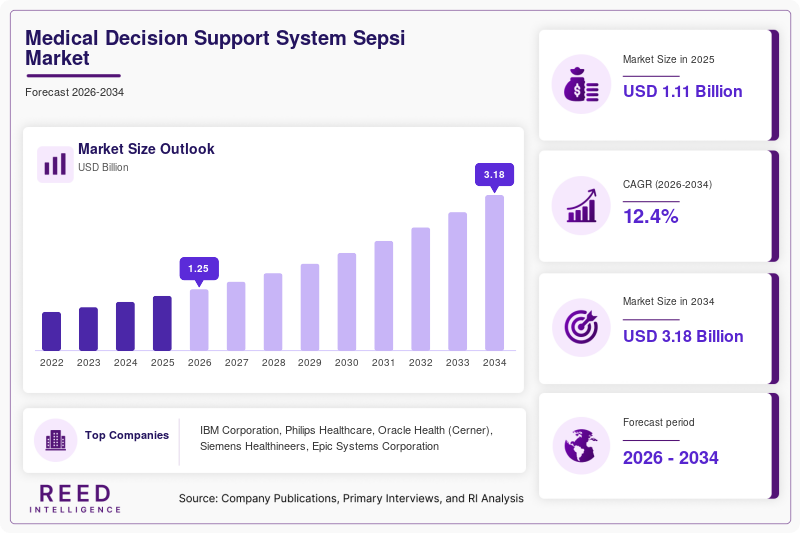
The Medical Decision Support System Sepsi Market size is estimated at USD 1.25 billion, and it is projected to reach USD 3.18 billion by 2034, expanding at a CAGR of 12.4% (2026–2034). This growth is primarily supported by the rising global burden of sepsis cases in intensive care units (ICUs) and the accelerating integration of AI-powered clinical decision support systems (CDSS) into hospital workflows.
One major global factor driving the Medical Decision Support System Sepsi Market growth is the increasing digitization of healthcare infrastructure, particularly the adoption of electronic health records (EHR) integrated with predictive analytics. This integration enables real-time sepsis risk detection, significantly reducing mortality rates and improving hospital efficiency.
Key Highlights
- Dominant Region Share (2025): North America held 38% of the global market
- Fastest-Growing Region CAGR (2026–2034): Asia Pacific at 14.2%
- Leading Subsegment (Component): Software solutions dominated with 52% share in 2025
- Fastest-Growing Subsegment (Deployment): Cloud-based systems with 15.1% CAGR
- Dominant Country (Market Value): United States – USD 420 million (2024) and USD 470 million (2025)
Market Trends
AI-Driven Predictive Sepsis Detection Systems
The Medical Decision Support System Sepsi Market is increasingly shaped by AI and machine learning algorithms capable of analyzing patient vitals, lab results, and historical EHR data in real time. These systems improve early sepsis detection accuracy, reducing ICU mortality rates and enabling proactive treatment interventions.
Integration of Cloud-Based Clinical Decision Platforms
Cloud-based deployment models are becoming central to the Medical Decision Support System Sepsi Market trends, allowing hospitals to scale analytics capabilities without heavy on-premise infrastructure investments. This shift supports interoperability across multi-hospital networks and enhances remote patient monitoring capabilities.
Market Drivers
Rising Global Incidence of Sepsis Cases
One of the primary drivers of the Medical Decision Support System Sepsi Market is the increasing incidence of sepsis globally, particularly among aging populations and patients with chronic diseases. Hospitals are adopting decision support systems to reduce diagnostic delays and improve survival outcomes through early intervention protocols.
Expansion of AI and Clinical Analytics in Healthcare
The rapid adoption of AI-powered healthcare analytics is significantly boosting the Medical Decision Support System Sepsi Market size. These systems integrate real-time monitoring and predictive modeling, allowing clinicians to identify sepsis risk before clinical symptoms fully manifest, thereby improving treatment efficiency.
Market Restraint
High Implementation Cost and Integration Complexity
A major restraint affecting the Medical Decision Support System Sepsi Market growth is the high cost of system deployment and integration with legacy hospital infrastructure. Smaller healthcare facilities often face financial and technical barriers, slowing down widespread adoption of advanced decision support platforms.
Market Opportunities
Expansion of Cloud-Based Healthcare Ecosystems
The shift toward cloud-native healthcare platforms presents a significant opportunity for the Medical Decision Support System Sepsi Market. Cloud systems enable scalable AI deployment, real-time updates, and cross-institutional data sharing, improving clinical decision accuracy and operational efficiency.
Emerging Healthcare Digitization in Developing Economies
Rapid healthcare digitization in emerging markets, particularly in Asia Pacific and Latin America, is creating new growth avenues. Governments are investing in hospital modernization programs, increasing demand for sepsis-focused decision support solutions across public healthcare systems.
Segmental Analysis
By Component
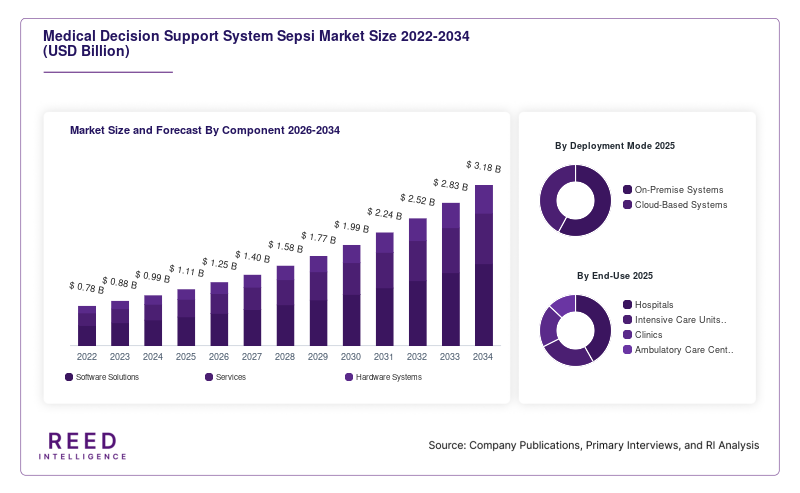
Software solutions dominated the Medical Decision Support System Sepsi Market with 52% share in 2025, driven by increasing demand for AI-powered predictive analytics platforms. These systems are widely used in ICU environments to monitor patient vitals and generate real-time alerts.
The services segment is expected to be the fastest-growing, with a projected CAGR of 13.8% (2026–2034), as hospitals increasingly rely on managed services, system integration, and analytics optimization support to enhance system performance.
By Deployment Mode
On-premise systems held 54% share in 2025, mainly due to data security requirements in large hospitals. However, cloud-based deployment is projected to grow fastest at a CAGR of 15.1%, driven by scalability, lower upfront costs, and remote accessibility.
By End-Use
Hospitals dominated the Medical Decision Support System Sepsi Market with 61% share in 2025, as they represent the primary point of care for sepsis patients.
ICUs and critical care units are expected to grow fastest at a CAGR of 14.5%, due to the high need for continuous patient monitoring and real-time clinical decision-making tools.
By Application
Sepsis early detection systems held the largest share at 48% in 2025, reflecting their critical role in reducing mortality rates.
The risk scoring and predictive analytics segment is expected to register the fastest growth at a CAGR of 14.9%, driven by increasing adoption of machine learning-based patient stratification models.
Regional Analysis
North America
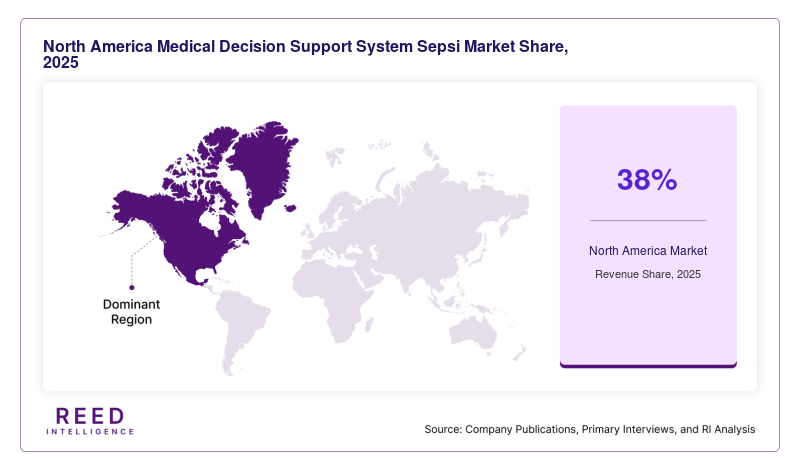
North America accounted for 38% share of the Medical Decision Support System Sepsi Market in 2025, and it is projected to grow at a CAGR of 11.8% (2026–2034). The region’s leadership is driven by advanced hospital IT infrastructure and strong adoption of AI-based clinical decision systems. The United States remains the dominant country due to high ICU admission rates and widespread EHR integration.
Europe
Europe held 28% market share in 2025 and is expected to expand at a CAGR of 11.2%. Growth is supported by government-led digital health initiatives and strong regulatory frameworks promoting patient safety and early diagnosis technologies.
Asia Pacific
Asia Pacific represented 22% share in 2025 and is projected to register the highest CAGR of 14.2% (2026–2034). Rising healthcare expenditure, increasing ICU capacity, and rapid adoption of AI healthcare solutions in countries such as China, India, and Japan are driving the Medical Decision Support System Sepsi Market expansion in the region.
Middle East & Africa
The Middle East & Africa held 7% share in 2025 and is expected to grow at a CAGR of 10.6%. Growth is driven by expanding private healthcare networks and increasing adoption of digital hospital systems in Gulf Cooperation Council (GCC) countries.
Latin America
Latin America accounted for 5% share in 2025 and is projected to grow at a CAGR of 10.9%. Brazil and Mexico are leading markets due to gradual adoption of AI-based clinical decision tools and improvements in hospital digitization infrastructure.
Competitive Landscape
The Medical Decision Support System Sepsi Market is moderately consolidated, with leading players focusing on AI integration, cloud deployment, and interoperability with hospital systems. Key companies include IBM, Philips Healthcare, Oracle Health, Siemens Healthineers, and Epic Systems.
IBM leads the market through its Watson Health analytics platform, which continues to expand predictive sepsis detection capabilities using AI-driven clinical insights. Philips Healthcare focuses on ICU monitoring integration with real-time decision support tools. Oracle Health (Cerner) strengthens its position through EHR-integrated sepsis alert systems across large hospital networks. Siemens Healthineers emphasizes advanced diagnostic and imaging integration with decision support analytics. Epic Systems continues to expand its EHR-based predictive alert frameworks.
Recent competitive strategies include cloud migration, AI algorithm enhancement, and partnerships with hospitals for large-scale deployment. The competitive intensity is expected to rise as vendors expand predictive healthcare capabilities.
Key Players List
- IBM Corporation
- Philips Healthcare
- Oracle Health (Cerner)
- Siemens Healthineers
- Epic Systems Corporation
- GE HealthCare
- SAS Institute Inc.
- Medtronic plc
- Roche Diagnostics
- Agfa HealthCare
- Allscripts Healthcare Solutions
- Aidoc Medical
- Elsevier Clinical Solutions
- Zebra Medical Vision
- Change Healthcare
Recent Developments
- In 2025, leading vendors expanded AI-based sepsis prediction modules integrated with electronic health records to improve early warning accuracy.
- Cloud-based clinical decision platforms saw increased adoption across multi-hospital networks, enhancing interoperability.
- Several companies introduced real-time ICU monitoring dashboards with automated sepsis alerts.
- Partnerships between healthcare IT firms and hospital groups accelerated deployment of predictive analytics tools.
- Investment in machine learning model refinement increased to improve false-positive reduction in sepsis alerts within clinical environments.
Medical Decision Support System Sepsi Market Segments
By Component
- Software Solutions
- Services
- Hardware Systems
By Deployment Mode
- On-Premise Systems
- Cloud-Based Systems
By End-Use
- Hospitals
- Intensive Care Units (ICUs)
- Clinics
- Ambulatory Care Centers
By Application
- Sepsis Early Detection
- Risk Scoring Systems
- Predictive Analytics
- Patient Monitoring & Alert Systems
By Region
- North America
- Europe
- APAC
- Middle East and Africa
- LATAM