Medical Grade Collagen Market Size, Share & Demand Report By Type (Bovine Collagen, Marine Collagen, Porcine Collagen, Others), By Application (Wound Care, Orthopedics, Tissue Engineering, Cosmetic Surgery), By End-Use (Hospitals, Specialty Clinics, Research Institutes), By Region & Segment Forecasts, 2025–2034
USD 3950
Market Overview
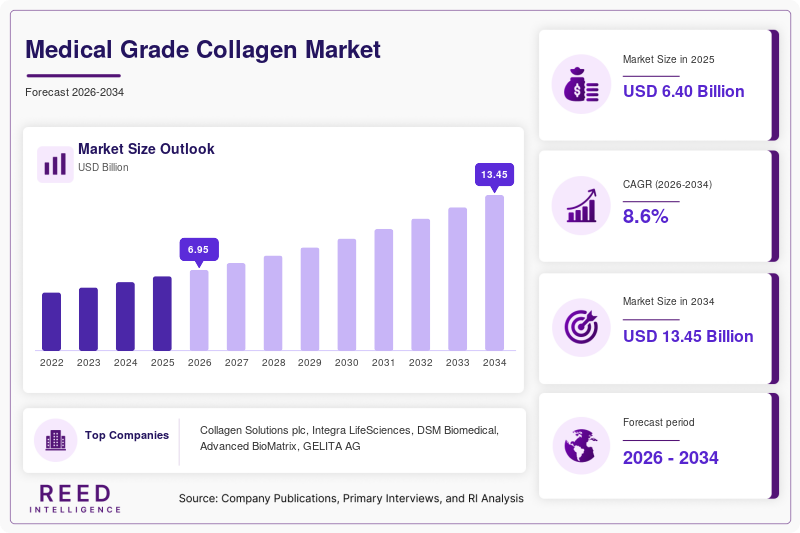
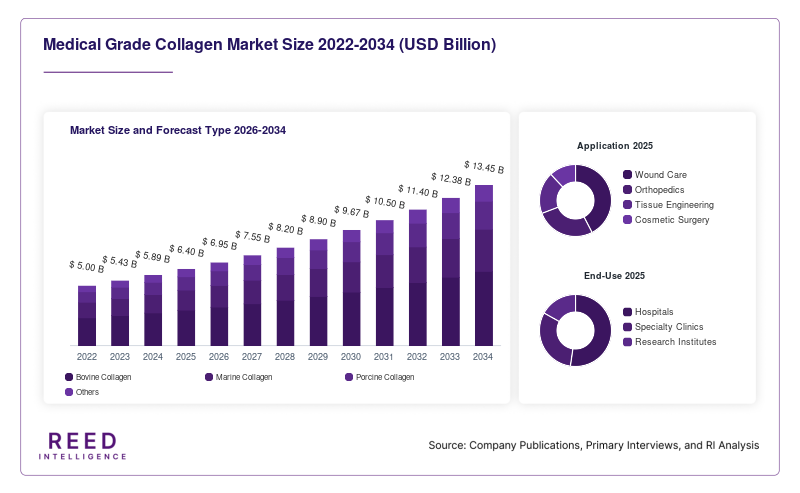
The Medical Grade Collagen Market size is witnessing steady expansion, driven by increasing applications across wound care, orthopedics, cosmetic surgery, and tissue engineering. In 2025, the global market size is estimated at approximately USD 6.4 billion, with a projected increase to USD 7.1 billion in 2026. The market is forecast to reach nearly USD 14.8 billion by 2034, registering a compound annual growth rate (CAGR) of 8.6% from 2025 to 2034. This growth reflects rising demand for biocompatible materials in clinical settings and the expanding adoption of regenerative medicine technologies.
Medical grade collagen is widely used due to its superior biocompatibility, low immunogenicity, and structural similarity to human tissues. The rising prevalence of chronic wounds, such as diabetic ulcers and pressure sores, is contributing significantly to market growth. Additionally, the aging population worldwide is increasing the demand for reconstructive and aesthetic procedures, where collagen-based biomaterials are frequently utilized.
Key Highlights
- Market size projected to grow from USD 6.4 billion in 2025 to USD 14.8 billion by 2034
- CAGR of 8.6% during the forecast period (2025–2034)
- Rising demand in wound care and regenerative medicine applications
- Increasing adoption in aesthetic and reconstructive procedures
Market Trends
Increasing Adoption of Collagen in Regenerative Medicine
One of the prominent trends in the Medical Grade Collagen Market is the growing use of collagen in regenerative medicine applications. Collagen serves as a key structural protein in the human body, making it highly suitable for developing scaffolds that support cell growth and tissue regeneration. Healthcare providers are increasingly utilizing collagen-based biomaterials in stem cell therapy, tissue repair, and organ regeneration. This trend is particularly strong in developed economies where advanced healthcare infrastructure supports innovative treatments. Research institutions and biotechnology firms are also investing in collagen-based solutions, leading to new product developments and expanded clinical applications.
Expansion of Cosmetic and Aesthetic Applications
Another notable trend is the rising use of medical grade collagen in cosmetic and aesthetic procedures. With growing consumer awareness and demand for minimally invasive treatments, collagen-based fillers and implants are gaining traction. These products are widely used for skin rejuvenation, wrinkle reduction, and facial contouring. The trend is further supported by increasing disposable income and the influence of social media on personal appearance. Manufacturers are focusing on developing high-purity collagen products with enhanced safety profiles to meet the evolving needs of cosmetic clinics and dermatology practices.
Market Drivers
Rising Prevalence of Chronic Wounds and Surgical Procedures
The increasing incidence of chronic wounds and surgical interventions is a major driver for the Medical Grade Collagen Market. Conditions such as diabetes, obesity, and vascular diseases are contributing to a higher number of patients requiring advanced wound care solutions. Collagen-based dressings and matrices are widely used due to their ability to promote faster healing and tissue regeneration. Hospitals and clinics are adopting these products to improve patient outcomes and reduce recovery times. Additionally, the growing number of surgical procedures globally is increasing the demand for collagen-based implants and sutures, further driving market growth.
Advancements in Biotechnology and Biomaterials
Technological advancements in biotechnology and biomaterials are significantly contributing to market expansion. Innovations in collagen extraction, purification, and cross-linking techniques are improving product performance and durability. These advancements enable the development of customized collagen-based solutions for specific medical applications. Furthermore, increased funding for research and development is encouraging the exploration of new uses for collagen in drug delivery systems and tissue engineering. As a result, the market is witnessing the introduction of advanced products that offer enhanced functionality and clinical benefits.
Market Restraint
High Production Costs and Regulatory Challenges
One of the key restraints affecting the Medical Grade Collagen Market is the high cost associated with production and regulatory compliance. Manufacturing medical grade collagen requires stringent quality control processes, including purification, sterilization, and validation to ensure safety and efficacy. These processes increase production costs, making the final products relatively expensive. Additionally, regulatory requirements for medical biomaterials are rigorous, particularly in developed regions. Obtaining approvals from regulatory authorities can be time-consuming and costly, delaying product launches. For example, companies entering the U.S. or European markets must adhere to strict guidelines, which may limit the participation of smaller manufacturers and slow overall market growth.
Market Opportunities
Growing Demand in Emerging Markets
Emerging economies present significant growth opportunities for the Medical Grade Collagen Market. Countries in Asia Pacific and Latin America are experiencing rapid improvements in healthcare infrastructure and increasing healthcare spending. This is enabling greater access to advanced medical treatments, including collagen-based products. Additionally, rising awareness about wound care and aesthetic procedures is driving demand. Local manufacturers are also entering the market, offering cost-effective solutions that cater to regional needs. This trend is expected to create new revenue streams for global players and expand the market footprint.
Development of Novel Collagen-Based Applications
The development of new applications for collagen in areas such as drug delivery and bioengineering offers promising opportunities. Researchers are exploring the use of collagen as a carrier for targeted drug delivery, which can improve treatment efficacy and reduce side effects. Additionally, collagen is being used in the development of 3D bioprinting technologies for creating artificial tissues and organs. These innovations are expected to open new avenues for market growth. Companies investing in research and development are likely to gain a competitive advantage by introducing advanced and differentiated products.
Segmental Analysis
By Type
The bovine collagen segment dominates the Medical Grade Collagen Market, accounting for approximately 48% of the market share in 2024. Bovine collagen is widely used due to its availability, cost-effectiveness, and structural similarity to human collagen. It is commonly utilized in wound care products, orthopedic implants, and cosmetic applications. The segment benefits from well-established extraction processes and a strong supply chain. Additionally, regulatory approvals for bovine-derived products are relatively streamlined compared to other sources, further supporting its dominance in the market.
Marine collagen is expected to be the fastest-growing segment, with a projected CAGR of 9.5% during the forecast period. This growth is driven by increasing demand for alternative sources of collagen that are considered safer and more sustainable. Marine collagen is gaining popularity in cosmetic and biomedical applications due to its high bioavailability and lower risk of disease transmission. The rising preference for non-mammalian sources, particularly among certain consumer groups, is further contributing to the segment’s growth.
By Application
Wound care is the leading application segment, holding a market share of approximately 36% in 2024. Collagen-based wound dressings are widely used for treating chronic wounds, burns, and surgical incisions. These products promote faster healing by providing a supportive matrix for cell growth and tissue regeneration. The increasing prevalence of chronic conditions such as diabetes is driving the demand for advanced wound care solutions. Healthcare providers are increasingly adopting collagen-based products to improve treatment outcomes and reduce hospital stays.
Tissue engineering is the fastest-growing application segment, with a CAGR of 10.2%. The growth is driven by advancements in regenerative medicine and the increasing use of collagen scaffolds for developing artificial tissues. Research institutions and biotechnology companies are investing heavily in this area, leading to the development of innovative products. The ability of collagen to mimic the natural extracellular matrix makes it an ideal material for tissue engineering applications, supporting rapid growth in this segment.
By End-Use
Hospitals are the dominant end-use segment, accounting for approximately 52% of the market share in 2024. Hospitals are the primary consumers of medical grade collagen products due to the high volume of surgical procedures and wound care treatments performed in these settings. The availability of advanced healthcare infrastructure and skilled professionals further supports the adoption of collagen-based products. Additionally, hospitals often have the financial resources to invest in high-quality medical materials, reinforcing their dominance.
Specialty clinics are expected to be the fastest-growing segment, with a CAGR of 9.1%. This growth is driven by the increasing number of cosmetic and dermatology clinics offering collagen-based treatments. The rising demand for minimally invasive procedures and aesthetic enhancements is contributing to the expansion of this segment. Clinics are adopting advanced collagen products to meet patient expectations for safe and effective treatments, driving market growth.
Regional Analysis
North America
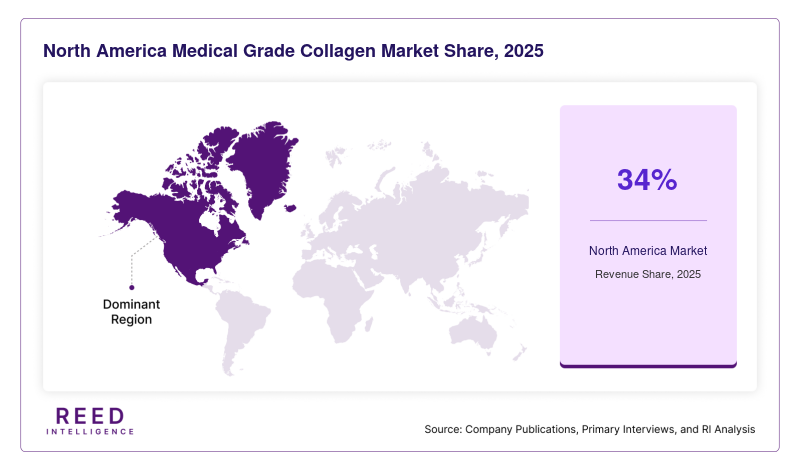
North America holds a significant share of the Medical Grade Collagen Market, accounting for approximately 34% in 2025, with a projected CAGR of 7.9% during the forecast period. The region benefits from advanced healthcare infrastructure and high adoption of innovative medical technologies. The presence of leading biotechnology companies and strong investment in research and development further supports market growth. Increasing demand for aesthetic procedures and wound care solutions is also contributing to the region’s dominance.
The United States is the leading country in this region, driven by a high prevalence of chronic diseases and a well-established healthcare system. A key growth factor is the strong focus on regenerative medicine and tissue engineering. Research institutions and private companies are actively developing collagen-based products for advanced medical applications, which is expected to sustain market expansion.
Europe
Europe represents a substantial share of the market, contributing around 27% in 2025, with a CAGR of 7.6% through 2034. The region’s growth is supported by increasing healthcare expenditure and a rising aging population. Countries across Europe are adopting advanced wound care products, including collagen-based dressings, to improve patient outcomes. Regulatory frameworks, although stringent, ensure high product quality and safety.
Germany dominates the European market due to its strong medical device industry and robust healthcare infrastructure. A unique growth factor in this region is the increasing emphasis on sustainable and ethically sourced collagen. Manufacturers are focusing on alternative sources and environmentally friendly production methods, which is influencing purchasing decisions.
Asia Pacific
Asia Pacific is expected to witness the fastest growth, with a CAGR of 9.8% and a market share of 22% in 2025. Rapid urbanization, increasing healthcare investments, and growing awareness about advanced medical treatments are driving market expansion. The region is also benefiting from a large patient population and rising demand for cosmetic procedures.
China leads the Asia Pacific market, supported by government initiatives to improve healthcare access and infrastructure. A key growth factor is the expansion of domestic manufacturing capabilities. Local companies are producing cost-effective collagen products, making them more accessible to a wider population and accelerating market growth.
Middle East & Africa
The Middle East & Africa region accounts for approximately 9% of the market in 2025, with a projected CAGR of 7.2%. Growth in this region is driven by improving healthcare infrastructure and increasing investments in medical facilities. The adoption of advanced wound care solutions is gradually increasing, particularly in urban areas.
Saudi Arabia is a dominant country in this region, supported by government initiatives to modernize healthcare systems. A unique growth factor is the rising demand for aesthetic treatments. The growing popularity of cosmetic procedures is driving the use of collagen-based products in dermatology and plastic surgery.
Latin America
Latin America holds around 8% of the market share in 2025 and is expected to grow at a CAGR of 7.4%. The region is experiencing steady growth due to improving healthcare access and increasing awareness about advanced treatment options. Governments are investing in healthcare infrastructure, which is supporting the adoption of collagen-based medical products.
Brazil is the leading country in Latin America, driven by a strong demand for cosmetic and reconstructive procedures. A key growth factor is the growing medical tourism industry. Patients from other regions are seeking affordable treatments in Brazil, boosting the demand for medical grade collagen products.
Competitive Landscape
The Medical Grade Collagen Market is moderately fragmented, with several global and regional players competing based on product quality, innovation, and pricing. Key companies are focusing on expanding their product portfolios and strengthening their distribution networks. Strategic collaborations, mergers, and acquisitions are common strategies adopted to enhance market presence.
A leading player in the market is Collagen Solutions plc, known for its strong focus on research and development. The company has recently introduced advanced collagen-based biomaterials designed for tissue engineering applications. Other major players are investing in innovative technologies to improve product performance and meet evolving clinical needs. The competitive landscape is expected to intensify as new entrants bring cost-effective solutions to the market.
Key Players
- Collagen Solutions plc
- Integra LifeSciences
- DSM Biomedical
- Advanced BioMatrix
- GELITA AG
- Nitta Gelatin Inc.
- Symatese Group
- Koken Co., Ltd.
- CollPlant Biotechnologies
- Medtronic plc
- Zimmer Biomet
- Smith & Nephew
- Stryker Corporation
- Baxter International Inc.
- Rousselot
Recent Developments
- In 2024, CollPlant Biotechnologies launched a recombinant human collagen product designed for 3D bioprinting applications.
- In 2025, GELITA AG expanded its production capacity to meet increasing global demand for medical grade collagen.
- In 2024, Integra LifeSciences introduced a new collagen-based wound care product aimed at improving healing outcomes in chronic wounds.
Medical Grade Collagen Market Segments
Type
- Bovine Collagen
- Marine Collagen
- Porcine Collagen
- Others
Application
- Wound Care
- Orthopedics
- Tissue Engineering
- Cosmetic Surgery
End-Use
- Hospitals
- Specialty Clinics
- Research Institutes
Region
- North America
- Europe
- Asia Pacific
- Middle East & Africa
- Latin America
By Region
- North America
- Europe
- APAC
- Middle East and Africa
- LATAM