Medical Grade Liquid Crystal Polymer Market Size, Share & Demand Report By Product Type (Thermotropic LCP, Lyotropic LCP), By Application (Medical Devices, Diagnostic Equipment, Surgical Instruments), By Processing Method (Injection Molding, Extrusion, Others), By End-Use (Hospitals, Ambulatory Surgical Centers, Clinics), By Region & Segment Forecasts, 2025–2034
USD 3950
Market Overview
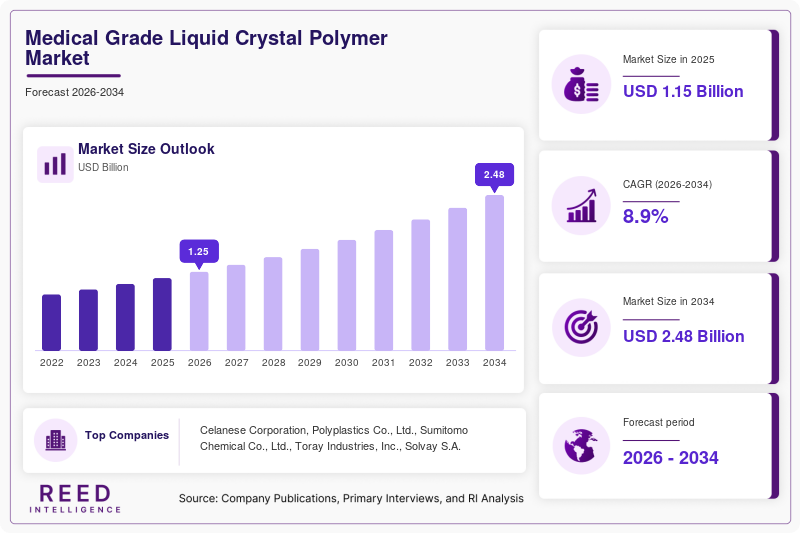
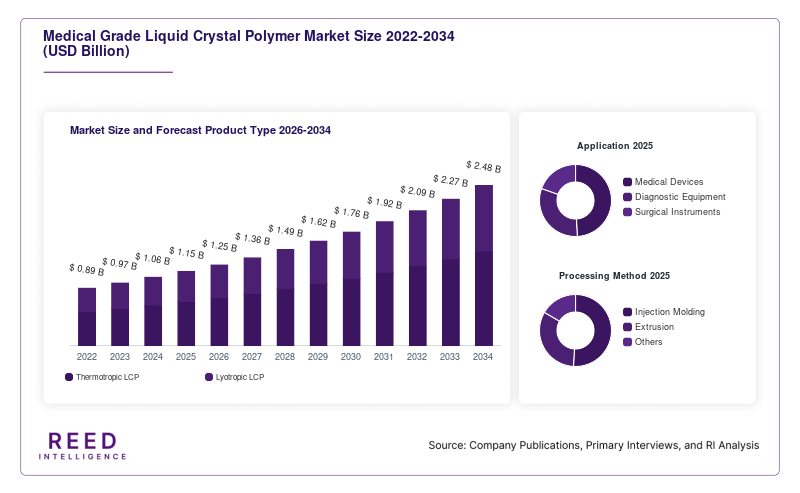
The Medical Grade Liquid Crystal Polymer Market size was valued at approximately USD 1.15 billion in 2025 and is projected to reach USD 2.48 billion by 2034, expanding at a CAGR of 8.9% during the forecast period (2025–2034). The market has witnessed steady growth due to the increasing demand for high-performance polymers in critical medical applications, including minimally invasive devices, implantable components, and diagnostic equipment. Medical-grade liquid crystal polymers (LCPs) offer superior properties such as chemical resistance, biocompatibility, dimensional stability, and excellent electrical insulation, making them suitable for advanced healthcare solutions.
A key global factor supporting the growth of the Medical Grade Liquid Crystal Polymer Market is the rising adoption of miniaturized medical devices. As healthcare systems worldwide prioritize precision and portability, manufacturers are increasingly incorporating LCP materials into micro-scale components used in catheters, surgical instruments, and wearable health monitoring devices. This shift has significantly boosted the market outlook.
Key Highlights:
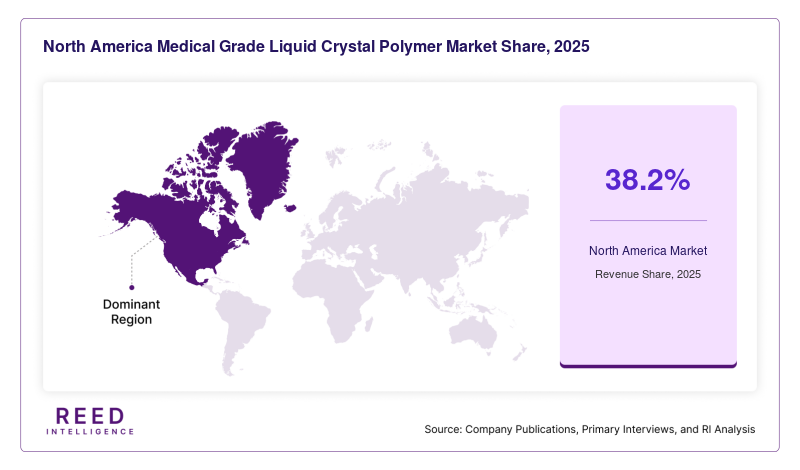
- North America dominated the market with a 38.2% share in 2025, while Asia Pacific is expected to register the fastest CAGR of 10.2% during the forecast period.
- Injection molding emerged as the leading processing segment with a 46.5% share, while extrusion is projected to grow at a CAGR of 9.6%.
- Medical device applications accounted for the largest share at 52.7%, while diagnostic equipment is expected to grow fastest at 9.8% CAGR.
- The United States led the market, valued at USD 410 million in 2024 and USD 445 million in 2025.
Market Trends
Increasing Use in Miniaturized and Wearable Medical Devices
The Medical Grade Liquid Crystal Polymer Market is experiencing strong momentum due to the growing integration of LCP materials in compact and wearable healthcare devices. These polymers provide high precision molding capabilities and maintain structural integrity even at micro dimensions. As wearable health monitoring devices and implantable electronics gain traction, manufacturers are shifting toward materials that offer flexibility, reliability, and electrical performance. LCP’s low moisture absorption and thermal stability further enhance its suitability for long-term use in such devices.
Rising Adoption in Advanced Diagnostic Systems
Another significant trend shaping the Medical Grade Liquid Crystal Polymer Market is the increasing use of LCP in diagnostic equipment. Modern diagnostic systems demand materials with high dielectric strength and chemical resistance to ensure accurate and consistent performance. LCP is being widely used in connectors, sensors, and housings for diagnostic devices. This trend is further supported by advancements in medical imaging and laboratory automation technologies, which require high-performance polymers to meet stringent regulatory standards and operational demands.
Market Drivers
Growth in Minimally Invasive Surgical Procedures
The rise in minimally invasive surgical procedures is a major driver of the Medical Grade Liquid Crystal Polymer Market. These procedures require precision-engineered components that are lightweight, durable, and resistant to sterilization processes. LCP materials meet these requirements effectively, making them a preferred choice for manufacturing surgical tools, catheters, and endoscopic devices. The increasing patient preference for minimally invasive treatments is further accelerating demand.
Increasing Demand for High-Performance Biocompatible Materials
The healthcare industry’s growing focus on patient safety and device reliability has led to increased demand for biocompatible materials. Medical-grade LCP offers excellent biocompatibility along with resistance to chemicals and high temperatures. This makes it suitable for use in implantable devices and long-term medical applications. As regulatory standards become more stringent, manufacturers are adopting LCP to ensure compliance and enhance product performance.
Market Restraint
High Material and Processing Costs
One of the primary challenges faced by the Medical Grade Liquid Crystal Polymer Market is the high cost associated with raw materials and processing techniques. LCP materials require specialized manufacturing processes such as precision injection molding and extrusion, which increase production costs. Additionally, the cost of medical-grade certification and compliance with regulatory standards adds to the overall expense.
These high costs can limit the adoption of LCP materials, particularly among small and medium-sized manufacturers. In price-sensitive markets, alternative materials such as polypropylene or polyethylene are often preferred despite offering lower performance. Furthermore, the need for skilled labor and advanced equipment for processing LCP materials creates additional barriers for new entrants.
While the long-term benefits of LCP, such as durability and reliability, may offset initial costs, the high upfront investment remains a significant restraint impacting the overall growth trajectory of the Medical Grade Liquid Crystal Polymer Market.
Market Opportunities
Expansion in Implantable Medical Devices
The increasing demand for implantable medical devices presents a significant growth opportunity for the Medical Grade Liquid Crystal Polymer Market. LCP materials offer excellent biocompatibility, chemical resistance, and mechanical strength, making them ideal for long-term implantation. As the prevalence of chronic diseases rises globally, the demand for implants such as pacemakers, neurostimulators, and drug delivery systems is expected to increase. This trend will create new avenues for market expansion.
Growth in Emerging Healthcare Markets
Emerging economies are investing heavily in healthcare infrastructure, creating opportunities for advanced medical materials. The Medical Grade Liquid Crystal Polymer Market is poised to benefit from this trend as manufacturers expand their presence in regions such as Asia Pacific, Latin America, and the Middle East. Increasing healthcare expenditure, improving access to medical technologies, and rising awareness about advanced treatment options are driving demand for high-performance materials like LCP in these regions.
Segmental Analysis
By Processing Method
Injection molding dominated the Medical Grade Liquid Crystal Polymer Market with a 46.5% share in 2024. This method is widely used due to its ability to produce complex and precise components required in medical devices. The high dimensional accuracy and consistency offered by injection molding make it suitable for mass production.
Extrusion is expected to be the fastest-growing segment, with a projected CAGR of 9.6% during the forecast period. The growth is driven by increasing demand for continuous profiles such as tubes and fibers used in catheters and surgical instruments. The ability to produce long, uniform structures will support its adoption.
By Application
Medical devices accounted for the largest share of 52.7% in 2024. The extensive use of LCP in surgical instruments, catheters, and implantable devices has driven this segment. The material’s strength and resistance to sterilization processes make it ideal for such applications.
Diagnostic equipment is anticipated to grow at the fastest CAGR of 9.8%. The increasing demand for accurate and reliable diagnostic systems will drive this segment. LCP’s electrical insulation properties make it suitable for sensors and connectors used in diagnostic devices.
By Product Type
Thermotropic LCP dominated the market with a 61.3% share in 2024 due to its superior mechanical properties and ease of processing. It is widely used in medical applications requiring high precision and stability.
Lyotropic LCP is expected to grow at a CAGR of 8.7% due to its unique properties such as high tensile strength and flexibility. Its increasing use in specialized medical applications will drive growth.
By End-Use
Hospitals held the largest share of 48.9% in 2024. The high demand for advanced medical devices in hospital settings has driven this segment. The need for reliable and durable materials in critical healthcare environments supports the use of LCP.
Ambulatory surgical centers are expected to grow at a CAGR of 9.3%. The increasing number of outpatient procedures and the demand for cost-effective solutions will drive this segment.
Regional Analysis
North America
North America accounted for 38.2% of the Medical Grade Liquid Crystal Polymer Market share in 2025 and is expected to grow at a CAGR of 7.8% during the forecast period. The region has a well-established healthcare infrastructure and a strong presence of medical device manufacturers. The demand for advanced materials in surgical instruments and diagnostic equipment has driven market growth.
The United States remained the dominant country due to its focus on technological innovation in healthcare. The increasing adoption of advanced surgical techniques and the presence of leading medical device companies have significantly contributed to market expansion. Additionally, regulatory support for high-quality materials has further strengthened the market.
Europe
Europe held a 26.5% share of the Medical Grade Liquid Crystal Polymer Market in 2025 and is projected to grow at a CAGR of 7.5% through 2034. The region has a strong emphasis on quality and safety standards in medical devices, which has driven the adoption of LCP materials.
Germany emerged as the leading country due to its advanced manufacturing capabilities and focus on precision engineering. The country’s strong medical device industry and investments in research and development have supported market growth.
Asia Pacific
Asia Pacific captured 22.8% of the Medical Grade Liquid Crystal Polymer Market in 2025 and is expected to witness the fastest CAGR of 10.2% during the forecast period. Rapid industrialization, increasing healthcare investments, and growing demand for advanced medical devices have fueled market growth.
China dominated the region due to its expanding healthcare infrastructure and manufacturing capabilities. The country’s focus on domestic production of medical devices and increasing export activities have contributed to the growth of the market.
Middle East & Africa
The Middle East & Africa region accounted for 6.3% of the Medical Grade Liquid Crystal Polymer Market in 2025 and is projected to grow at a CAGR of 8.1%. The region is witnessing gradual improvements in healthcare infrastructure and increased adoption of advanced medical technologies.
Saudi Arabia led the market due to its investments in healthcare modernization and increasing demand for high-quality medical devices. Government initiatives aimed at improving healthcare services have supported market growth.
Latin America
Latin America held a 6.2% share of the Medical Grade Liquid Crystal Polymer Market in 2025 and is expected to grow at a CAGR of 8.4% during the forecast period. The region is experiencing steady growth due to rising healthcare expenditure and increasing awareness about advanced medical treatments.
Brazil emerged as the dominant country, driven by its growing medical device industry and improving healthcare infrastructure. The demand for high-performance materials in diagnostic and surgical applications has contributed to market expansion.
Competitive Landscape
The Medical Grade Liquid Crystal Polymer Market is moderately consolidated, with key players focusing on product innovation and strategic collaborations. Leading companies are investing in research and development to enhance material properties and expand application areas.
Celanese Corporation emerged as a market leader due to its strong product portfolio and continuous innovation in high-performance polymers. The company recently introduced advanced medical-grade LCP materials designed for miniaturized medical devices, strengthening its market position.
Other major players are adopting strategies such as mergers, acquisitions, and partnerships to expand their global presence. The competitive environment is characterized by technological advancements and a focus on meeting regulatory standards, which play a crucial role in maintaining market competitiveness.
Key Players List
- Celanese Corporation
- Polyplastics Co., Ltd.
- Sumitomo Chemical Co., Ltd.
- Toray Industries, Inc.
- Solvay S.A.
- RTP Company
- Ueno Fine Chemicals Industry, Ltd.
- Kuraray Co., Ltd.
- Shanghai PRET Composites Co., Ltd.
- Kingfa Sci. & Tech. Co., Ltd.
- Mitsubishi Engineering-Plastics Corporation
- SABIC
- Ensinger GmbH
- Quadrant AG
- DIC Corporation
Recent Developments
- In 2025, Celanese Corporation launched a new range of medical-grade LCP materials for micro-electronic medical devices.
- Polyplastics Co., Ltd. expanded its production capacity to meet rising global demand.
- Toray Industries introduced enhanced LCP grades with improved thermal stability.
- SABIC announced a strategic collaboration with medical device manufacturers to develop advanced polymer solutions.
- Solvay S.A. invested in research initiatives focused on sustainable and recyclable LCP materials.
Medical Grade Liquid Crystal Polymer Market Segments
Product Type
- Thermotropic LCP
- Lyotropic LCP
Application
- Medical Devices
- Diagnostic Equipment
- Surgical Instruments
Processing Method
- Injection Molding
- Extrusion
- Others
End-Use
- Hospitals
- Ambulatory Surgical Centers
- Clinics
By Region
- North America
- Europe
- APAC
- Middle East and Africa
- LATAM