Medical Holographic Display Market Size, Share Demand Report By Component (Hardware, Software, Services), By Application (Medical Imaging, Surgical Planning, Medical Education, Others), By End-Use (Hospitals, Academic & Research Institutes, Diagnostic Centers) By Region & Segment Forecasts, 2026–2034
USD 3950
Market Overview
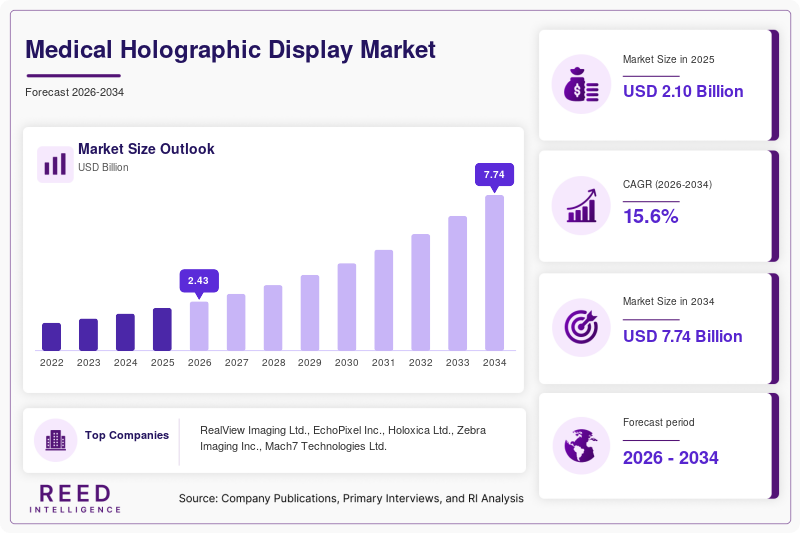
The Medical Holographic Display Market size was valued at approximately USD 2.1 billion in 2026 and is projected to reach USD 6.8 billion by 2034, expanding at a compound annual growth rate (CAGR) of 15.6% during 2026–2034. The market is gaining traction due to increasing demand for advanced visualization technologies in healthcare, particularly in surgical planning, diagnostics, and medical education. Holographic displays offer three-dimensional visualization without the need for special eyewear, which enhances precision in complex procedures and improves clinical outcomes.
A key global factor driving market expansion is the rising adoption of digital healthcare infrastructure across both developed and emerging economies. Governments and private healthcare providers are investing in advanced imaging technologies to improve patient outcomes and reduce procedural errors. The integration of holographic visualization with artificial intelligence and augmented reality is also contributing to improved diagnostic accuracy and workflow efficiency.
Key Highlights
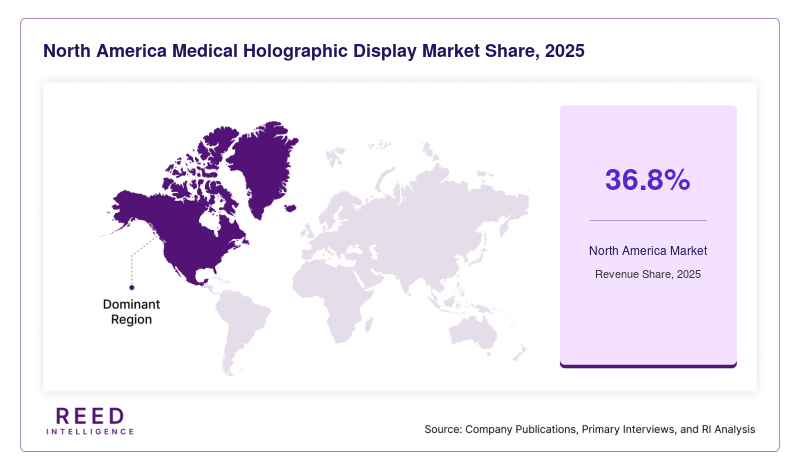
- North America dominated the market with a 36.8% share in 2025.
- Asia Pacific is expected to grow at the fastest CAGR of 17.3% during 2026–2034.
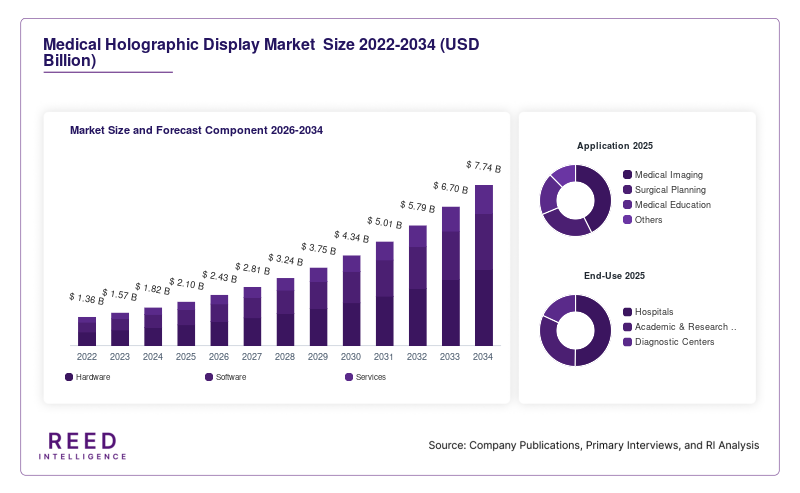
- By component, hardware accounted for the largest share of 44.1%, while software solutions are projected to grow at a CAGR of 16.8%.
- By application, medical imaging led with a 39.5% share, whereas surgical planning is expected to expand at a CAGR of 17.1%.
- The United States remained the dominant country, with market values of USD 680 million in 2024 and USD 745 million in 2025.
Market Trends
Rising integration of artificial intelligence in holographic imaging
The integration of artificial intelligence (AI) with holographic display systems is emerging as a significant trend in the market. AI algorithms enhance the processing of complex medical imaging data, enabling real-time rendering of high-resolution holographic visuals. This development supports clinicians in interpreting intricate anatomical structures with improved clarity and accuracy. Hospitals are increasingly adopting AI-powered holographic solutions to streamline workflows, reduce diagnosis time, and enhance patient outcomes. Additionally, machine learning models are being trained to recognize patterns within holographic data, further improving diagnostic reliability. As healthcare providers seek to reduce human error and increase efficiency, AI-enabled holographic systems are expected to witness sustained adoption across diagnostic centers and surgical units.
Expansion of holographic displays in medical education and training
Medical education institutions are rapidly adopting holographic displays to transform traditional teaching methodologies. These systems allow students to visualize human anatomy in three dimensions, improving understanding compared to conventional textbooks or two-dimensional imaging. Interactive holographic simulations enable learners to practice surgical procedures in a controlled environment, reducing reliance on cadavers and enhancing skill development. Furthermore, remote learning capabilities have been strengthened through holographic technologies, allowing instructors to conduct immersive virtual training sessions. As medical schools continue to modernize their curricula, the demand for advanced visualization tools is expected to grow steadily, supporting the expansion of the medical holographic display market.
Market Drivers
Increasing demand for advanced diagnostic and imaging technologies
The growing need for precise diagnostic tools is a major factor driving the adoption of medical holographic displays. Traditional imaging methods often lack depth perception, which can limit the accuracy of diagnosis in complex cases. Holographic displays provide detailed three-dimensional representations of anatomical structures, enabling clinicians to identify abnormalities with greater precision. This capability is particularly valuable in oncology, cardiology, and neurology, where accurate visualization is critical for treatment planning. Additionally, healthcare providers are focusing on improving patient outcomes and reducing procedural complications, further encouraging the use of advanced imaging technologies. As a result, investments in holographic display systems are increasing across hospitals and diagnostic centers worldwide.
Growing adoption of minimally invasive surgical procedures
The rise in minimally invasive surgeries is another key driver influencing market growth. These procedures require precise visualization of internal organs and tissues to ensure successful outcomes. Medical holographic displays enable surgeons to view detailed 3D images during operations, improving accuracy and reducing the risk of complications. The ability to overlay holographic visuals onto the patient’s body enhances spatial awareness and supports better decision-making during surgery. Furthermore, advancements in surgical robotics are complementing the use of holographic displays, creating a more integrated and efficient surgical environment. As healthcare systems continue to prioritize minimally invasive techniques, the demand for holographic visualization solutions is expected to increase significantly.
Market Restraint
High implementation costs and limited accessibility
One of the primary challenges limiting the growth of the medical holographic display market is the high cost associated with these systems. The development and deployment of holographic display technologies require significant investment in hardware, software, and infrastructure. Many healthcare facilities, particularly in developing regions, face budget constraints that hinder the adoption of such advanced technologies. Additionally, the maintenance and training costs associated with holographic systems further add to the financial burden. Smaller hospitals and clinics may find it difficult to justify these expenses, especially when traditional imaging methods are still widely used. This limitation impacts the overall market penetration, as the adoption remains concentrated in well-funded healthcare institutions. Addressing cost barriers through technological advancements and economies of scale will be crucial for expanding accessibility and driving market growth in the long term.
Market Opportunities
Increasing investments in digital healthcare infrastructure
The ongoing digital transformation of the healthcare sector presents significant opportunities for the medical holographic display market. Governments and private organizations are investing heavily in upgrading healthcare infrastructure, including the adoption of advanced visualization technologies. These investments are aimed at improving patient care, enhancing diagnostic accuracy, and reducing operational inefficiencies. Holographic displays are becoming an integral part of modern healthcare systems, particularly in smart hospitals and research institutions. Additionally, funding for research and development activities is accelerating innovation in holographic technologies, leading to the introduction of more cost-effective and efficient solutions. As digital healthcare continues to evolve, the demand for advanced visualization tools is expected to grow substantially.
Expansion in emerging markets with improving healthcare facilities
Emerging economies are witnessing rapid improvements in healthcare infrastructure, creating new growth opportunities for market players. Countries in Asia Pacific, Latin America, and the Middle East are investing in modern medical facilities and adopting advanced technologies to meet the growing demand for quality healthcare services. The increasing prevalence of chronic diseases and rising healthcare expenditure are further driving the need for innovative diagnostic and treatment solutions. Medical holographic displays are gaining attention in these regions due to their ability to enhance clinical outcomes and support medical training. As awareness and affordability improve, the adoption of holographic technologies is expected to expand significantly in emerging markets.
Segmental Analysis
By Component
The hardware segment dominated the market in 2024, accounting for approximately 44.1% of the total share. This segment includes holographic display devices, projection systems, and imaging equipment used in medical applications. The high share is attributed to the increasing adoption of advanced display technologies in hospitals and diagnostic centers. Healthcare providers are investing in high-quality hardware to ensure accurate visualization of medical data, which is essential for diagnosis and treatment planning. Additionally, continuous advancements in display technology are improving image quality and resolution, further driving demand for hardware components.
The software segment is expected to be the fastest-growing, with a CAGR of 16.8% during the forecast period. The growth is driven by the increasing integration of artificial intelligence and machine learning in holographic imaging systems. Software solutions enable real-time processing and visualization of complex medical data, enhancing the functionality of holographic displays. Moreover, the development of user-friendly interfaces and advanced analytics tools is supporting the adoption of software solutions across healthcare facilities.
By Application
Medical imaging was the dominant application segment in 2024, holding a share of approximately 39.5%. This segment includes the use of holographic displays for visualizing medical images such as CT scans, MRI scans, and ultrasound data. The high share is attributed to the growing demand for accurate and detailed imaging solutions in healthcare. Holographic displays provide a more comprehensive view of anatomical structures, enabling clinicians to make informed decisions. The increasing prevalence of chronic diseases is further driving the demand for advanced imaging technologies.
Surgical planning is projected to be the fastest-growing application segment, with a CAGR of 17.1%. The growth is driven by the increasing adoption of minimally invasive surgical procedures and the need for precise preoperative planning. Holographic displays enable surgeons to visualize patient-specific anatomy in three dimensions, improving surgical outcomes. Additionally, advancements in surgical robotics and navigation systems are supporting the integration of holographic visualization in surgical procedures.
By End-Use
Hospitals accounted for the largest share in 2024, representing approximately 48.3% of the market. The dominance of this segment is due to the high adoption of advanced medical technologies in hospital settings. Hospitals require accurate diagnostic and visualization tools to provide effective patient care, which is driving the demand for holographic displays. Furthermore, the increasing number of complex surgical procedures is supporting the adoption of these technologies in hospitals.
Academic and research institutes are expected to witness the fastest growth, with a CAGR of 16.5% during the forecast period. The growth is driven by the increasing use of holographic displays in medical education and research. These institutions are adopting advanced visualization tools to enhance learning experiences and support research activities. The growing focus on innovation and technological advancement in the healthcare sector is further contributing to the growth of this segment.
Regional Analysis
North America
North America accounted for a significant share of approximately 36.8% in 2025 and is expected to maintain steady growth with a CAGR of 14.2% during the forecast period. The region’s dominance is attributed to the presence of advanced healthcare infrastructure, high adoption of innovative technologies, and strong investment in research and development. Additionally, the increasing prevalence of chronic diseases and the growing demand for precise diagnostic tools are supporting market expansion.
The United States remains the dominant country in this region, driven by substantial healthcare spending and technological advancements. A key growth factor is the strong collaboration between technology companies and healthcare providers, which is fostering innovation in holographic imaging solutions. These partnerships are enabling the development of more efficient and user-friendly systems, further boosting market growth.
Europe
Europe held a market share of around 27.4% in 2025 and is projected to grow at a CAGR of 13.8% during 2026–2034. The region is characterized by well-established healthcare systems and increasing adoption of advanced medical technologies. Government initiatives aimed at improving healthcare quality and patient outcomes are also contributing to market growth.
Germany is the leading country in the European market, supported by its strong medical technology sector and focus on innovation. A unique growth factor is the increasing emphasis on medical training and education, where holographic displays are being used to enhance learning experiences. This trend is driving demand across academic and research institutions.
Asia Pacific
Asia Pacific is expected to register the fastest growth, with a CAGR of 17.3% during the forecast period, while holding a 21.6% share in 2025. The region’s rapid growth is driven by increasing healthcare investments, rising population, and growing awareness of advanced medical technologies.
China dominates the Asia Pacific market, benefiting from large-scale healthcare infrastructure development. A key growth factor is the government’s focus on digital healthcare transformation, which is encouraging the adoption of innovative technologies such as holographic displays. This initiative is expected to significantly boost market growth in the region.
Middle East & Africa
The Middle East & Africa region accounted for a smaller share of approximately 7.2% in 2025 but is expected to grow at a CAGR of 12.6% during the forecast period. The market is gradually expanding due to improving healthcare infrastructure and increasing investments in advanced medical technologies.
The United Arab Emirates is a leading country in this region, driven by its focus on becoming a hub for advanced healthcare services. A unique growth factor is the adoption of smart hospital initiatives, which incorporate cutting-edge technologies such as holographic displays to enhance patient care and operational efficiency.
Latin America
Latin America held a market share of around 7.0% in 2025 and is projected to grow at a CAGR of 13.1% during 2026–2034. The region is experiencing steady growth due to increasing healthcare expenditure and rising demand for advanced diagnostic solutions.
Brazil is the dominant country in the Latin American market, supported by its expanding healthcare sector. A key growth factor is the increasing adoption of digital health technologies, which is driving the demand for innovative visualization tools such as holographic displays.
Competitive Landscape
The medical holographic display market is characterized by the presence of several global and regional players focusing on innovation and strategic collaborations. Companies are investing in research and development to enhance the capabilities of holographic display systems and expand their application areas. The competitive environment is marked by partnerships between technology firms and healthcare providers, aimed at developing integrated solutions for medical imaging and surgical planning.
A leading player in the market is RealView Imaging Ltd., known for its advanced holographic display systems used in clinical applications. The company has recently introduced an upgraded holographic imaging platform that enables real-time interaction with 3D medical images, enhancing diagnostic and surgical precision. Other key players are also focusing on product launches, mergers, and acquisitions to strengthen their market position and expand their global presence.
Key Players
- RealView Imaging Ltd.
- EchoPixel Inc.
- Holoxica Ltd.
- Zebra Imaging Inc.
- Mach7 Technologies Ltd.
- Leia Inc.
- NanoLive SA
- Lyncee Tec SA
- Eon Reality Inc.
- Microsoft Corporation
- Philips Healthcare
- Siemens Healthineers
- GE HealthCare
- Canon Medical Systems
- Konica Minolta Inc.
Recent Developments
- RealView Imaging Ltd. launched an advanced real-time holographic visualization system for interventional cardiology applications in 2025.
- EchoPixel Inc. expanded its product portfolio with AI-integrated holographic imaging software to improve diagnostic accuracy in 2024.
- Siemens Healthineers introduced a new holographic imaging solution integrated with its existing diagnostic platforms to enhance clinical workflows in 2025.
Medical Holographic Display Market Segments
Component
- Hardware
- Software
- Services
Application
- Medical Imaging
- Surgical Planning
- Medical Education
- Others
End-Use
- Hospitals
- Academic & Research Institutes
- Diagnostic Centers
By Region
- North America
- Europe
- APAC
- Middle East and Africa
- LATAM