Medical Humidifier Market Size, Share & Demand Report By Type (Heated Humidifiers, Bubble Humidifiers, Passover Humidifiers), By Application (Respiratory Therapy, Sleep Therapy, Others), By End-Use (Hospitals, Home Healthcare, Ambulatory Surgical Centers), By Distribution Channel (Direct Sales, Distributors, Online Channels), By Region & Segment Forecasts, 2025–2034
USD 3950
Market Overview
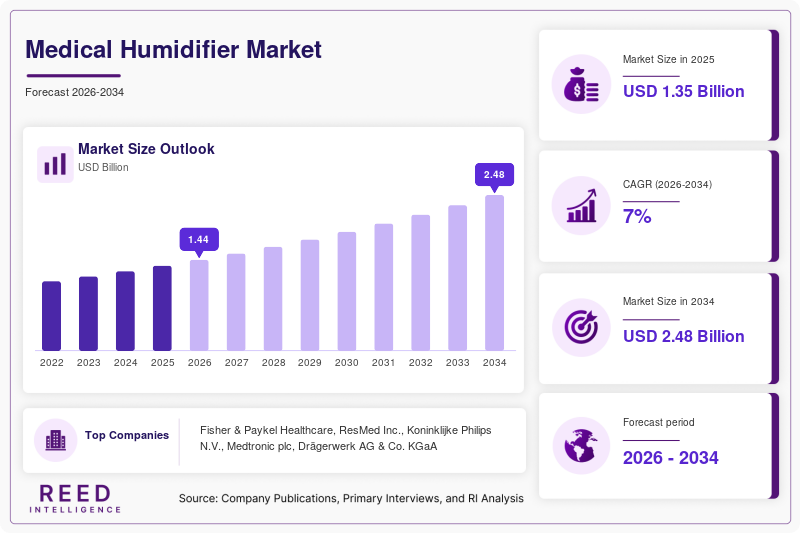
The Medical Humidifier Market size was valued at approximately USD 1.35 billion in 2025 and is projected to reach USD 2.48 billion by 2034, expanding at a CAGR of 7.0% during 2025–2034. The market growth reflects the increasing integration of respiratory care technologies across hospitals, home healthcare, and ambulatory settings.
One major global factor supporting market expansion is the rising burden of chronic respiratory conditions such as asthma, chronic obstructive pulmonary disease (COPD), and sleep apnea. These conditions require effective airway management, where medical humidifiers play a vital role in improving patient comfort and treatment outcomes by maintaining optimal moisture levels in inhaled air.
Key Highlights:
- North America dominated the market with 38.5% share in 2025, while Asia Pacific is projected to grow at the fastest CAGR of 8.5%.
- Heated humidifiers led the type segment with 61.2% share, while bubble humidifiers are expected to grow at a CAGR of 7.8%.
- Hospital end-use dominated with 55.6% share, while home healthcare is anticipated to grow at a CAGR of 8.2%.
- The U.S. remained the dominant country with market values of USD 420 million in 2024 and USD 448 million in 2025.
Market Trends
Integration of Smart and Connected Devices
The Medical Humidifier Market is witnessing a shift toward smart humidification systems equipped with sensors and connectivity features. These devices enable real-time monitoring of humidity levels and integration with hospital information systems. Such advancements are improving treatment precision and patient outcomes, especially in intensive care settings. The incorporation of IoT capabilities also allows remote monitoring in home healthcare, enhancing convenience for patients and caregivers.
Growing Adoption of Home-Based Respiratory Care
The increasing preference for home healthcare is reshaping the Medical Humidifier Market. Patients with chronic respiratory disorders are opting for home-based treatments to reduce hospital visits and healthcare costs. This trend has led to rising demand for portable and user-friendly humidifiers. Manufacturers are focusing on compact designs, low maintenance requirements, and quiet operation, making devices suitable for long-term use in residential settings.
Market Drivers
Rising Prevalence of Respiratory Disorders
The growing incidence of respiratory illnesses is a primary driver of the Medical Humidifier Market. Conditions such as COPD, bronchitis, and sleep apnea require effective airway management, where humidifiers are essential. Increasing air pollution levels and aging populations further contribute to the rising patient pool, thereby driving demand for humidification devices across healthcare facilities.
Expansion of Healthcare Infrastructure
The continuous development of healthcare infrastructure globally is boosting the adoption of medical humidifiers. Investments in hospitals, intensive care units, and specialty clinics are increasing the demand for respiratory support equipment. Emerging economies are particularly focusing on improving healthcare access, which is expected to support the long-term growth of the Medical Humidifier Market.
Market Restraint
High Maintenance and Operational Costs
One significant restraint in the Medical Humidifier Market is the high maintenance and operational costs associated with these devices. Medical humidifiers require regular cleaning, sterilization, and component replacement to prevent contamination and ensure optimal performance. Failure to maintain proper hygiene can lead to infections, which increases the burden on healthcare providers.
Additionally, advanced humidification systems with heating and monitoring capabilities involve higher initial costs, limiting their adoption in low-resource settings. Smaller healthcare facilities and home users may find it challenging to afford these devices, particularly in developing regions. The need for trained personnel to handle complex systems further adds to operational costs, restricting market growth to some extent.
Market Opportunities
Emerging Demand in Home Healthcare Segment
The expanding home healthcare sector presents a strong growth opportunity for the Medical Humidifier Market. Increasing awareness of self-care and the availability of portable medical devices are encouraging patients to manage respiratory conditions at home. Manufacturers can capitalize on this trend by developing affordable, easy-to-use humidifiers tailored for residential use.
Technological Advancements in Humidification Systems
Ongoing innovation in humidification technologies is creating new opportunities in the market. The development of energy-efficient devices, advanced filtration systems, and automated humidity control features is enhancing product performance. These innovations are expected to drive adoption in both hospital and home settings, providing manufacturers with opportunities to differentiate their offerings and expand their market presence.
Segmental Analysis
By Type
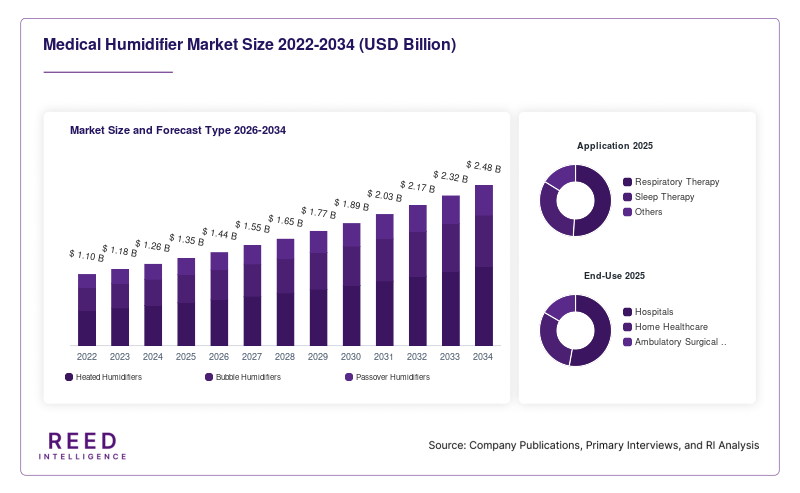
Heated humidifiers dominated the Medical Humidifier Market with a 61.2% share in 2024. These devices were widely used in hospitals and intensive care units due to their ability to deliver precise humidity levels. Their effectiveness in improving patient comfort and reducing airway complications contributed to their dominance.
Bubble humidifiers are expected to grow at the fastest CAGR of 7.8% during the forecast period. Their cost-effectiveness and ease of use make them suitable for home healthcare settings. Increasing demand for affordable respiratory care solutions is expected to drive their growth.
By Application
Respiratory therapy accounted for the largest share of 58.4% in 2024. The widespread use of humidifiers in oxygen therapy and ventilator support contributed to this dominance. The growing prevalence of respiratory diseases further supported demand in this segment.
Sleep therapy is projected to grow at a CAGR of 7.6%. The rising incidence of sleep apnea and increasing use of CPAP devices are expected to drive demand for humidifiers in this segment. Enhanced patient comfort during sleep therapy is a key growth factor.
By End-Use
Hospitals held the dominant share of 55.6% in 2024 due to the high usage of humidifiers in critical care settings. The presence of advanced medical infrastructure and trained healthcare professionals supported the widespread adoption of these devices.
Home healthcare is anticipated to grow at a CAGR of 8.2%. Increasing preference for home-based treatment and the availability of portable devices are driving growth in this segment. Patients are increasingly opting for convenient and cost-effective treatment options.
By Distribution Channel
Direct sales dominated the market with a 49.1% share in 2024, as hospitals and large healthcare facilities preferred purchasing directly from manufacturers. This channel ensured better pricing and after-sales support.
Online distribution channels are expected to grow at a CAGR of 8.0%. The increasing use of e-commerce platforms and the convenience of online purchasing are driving growth in this segment. Home healthcare users, in particular, are contributing to this trend.
Regional Analysis
North America
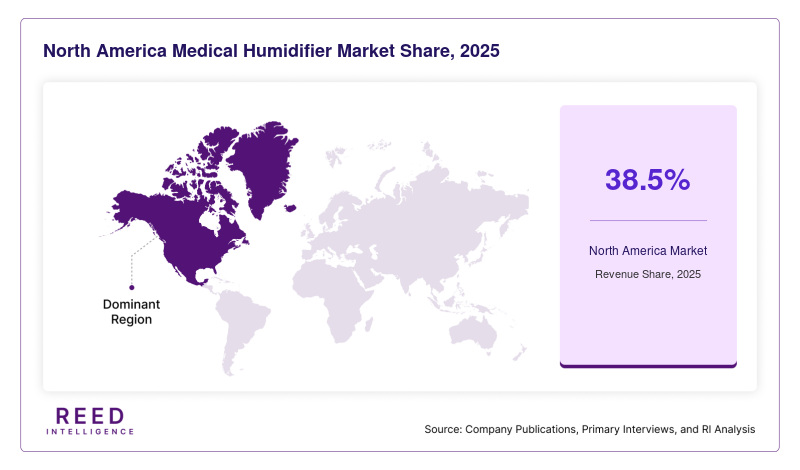
North America accounted for 38.5% of the Medical Humidifier Market share in 2025 and is expected to grow at a CAGR of 6.5% during the forecast period. The region had a well-established healthcare infrastructure and high adoption of advanced medical technologies, which supported market growth. Increasing prevalence of respiratory disorders and a strong focus on patient care further contributed to market expansion.
The United States dominated the regional market due to its advanced healthcare system and high healthcare spending. The presence of leading manufacturers and continuous technological advancements supported market growth. Additionally, the rising adoption of home healthcare devices contributed to increasing demand for medical humidifiers in the country.
Europe
Europe held a 27.3% market share in 2025 and is projected to grow at a CAGR of 6.8% through 2034. The region had a strong emphasis on healthcare quality and patient safety, which drove the adoption of medical humidifiers in hospitals and clinics. Government initiatives aimed at improving healthcare infrastructure also supported market growth.
Germany emerged as the dominant country in Europe, driven by its robust healthcare system and high investment in medical technologies. The increasing aging population and prevalence of chronic respiratory diseases further boosted demand for humidification devices in the region.
Asia Pacific
Asia Pacific captured 20.6% of the market share in 2025 and is anticipated to grow at the fastest CAGR of 8.5%. Rapid urbanization, increasing healthcare expenditure, and improving healthcare infrastructure contributed to market growth in the region.
China dominated the Asia Pacific market due to its large population and rising prevalence of respiratory disorders. Government initiatives to expand healthcare access and increasing adoption of advanced medical devices supported market expansion. Additionally, the growing awareness of home healthcare solutions further contributed to market growth.
Middle East & Africa
The Middle East & Africa region accounted for 7.2% of the market share in 2025 and is expected to grow at a CAGR of 6.9%. The market growth was supported by improving healthcare infrastructure and increasing investment in medical facilities.
Saudi Arabia emerged as the leading country in the region due to its expanding healthcare sector and government initiatives aimed at improving healthcare services. The rising prevalence of respiratory conditions and increasing demand for advanced medical devices contributed to market growth.
Latin America
Latin America held a 6.4% share of the Medical Humidifier Market in 2025 and is projected to grow at a CAGR of 7.1%. The region experienced steady growth due to improving healthcare systems and increasing awareness of respiratory care.
Brazil dominated the Latin American market, driven by its large healthcare sector and growing demand for medical devices. The increasing prevalence of respiratory diseases and expanding access to healthcare services supported market growth in the country.
Competitive Landscape
The Medical Humidifier Market is moderately competitive, with key players focusing on product innovation and strategic collaborations. Leading companies are investing in advanced technologies to enhance product efficiency and expand their market presence.
A prominent market leader is Fisher & Paykel Healthcare, known for its strong portfolio of respiratory care products. The company has recently introduced advanced humidification systems with improved temperature control and user-friendly interfaces, strengthening its position in the market.
Other major players are also focusing on expanding their product offerings and entering emerging markets to capitalize on growth opportunities. Strategic partnerships and mergers are common strategies adopted to enhance market reach and technological capabilities.
Key Players
- Fisher & Paykel Healthcare
- ResMed Inc.
- Koninklijke Philips N.V.
- Medtronic plc
- Drägerwerk AG & Co. KGaA
- Teleflex Incorporated
- Hamilton Medical AG
- GE HealthCare Technologies Inc.
- Smiths Medical
- Vapotherm, Inc.
Recent Developments
- 2024: Fisher & Paykel Healthcare launched a next-generation heated humidifier with enhanced temperature regulation.
- 2024: ResMed Inc. expanded its home healthcare product line with compact humidification systems.
- 2023: Philips introduced smart humidifiers integrated with digital monitoring platforms.
- 2023: Medtronic plc partnered with healthcare providers to expand respiratory care solutions.
- 2023: GE HealthCare enhanced its distribution network for respiratory devices in emerging markets.
Medical Humidifier Market Segments
Type
- Heated Humidifiers
- Bubble Humidifiers
- Passover Humidifiers
Application
- Respiratory Therapy
- Sleep Therapy
- Others
End-Use
- Hospitals
- Home Healthcare
- Ambulatory Surgical Centers
Distribution Channel
- Direct Sales
- Distributors
- Online Channels
By Region
- North America
- Europe
- APAC
- Middle East and Africa
- LATAM