Medical Power Supply Market Size, Share & Demand Report By Product Type (AC-DC Power Supplies, DC-DC Converters, Configurable Power Supplies, Uninterruptible Power Supplies, External Power Adapters), By Application (Diagnostic Equipment, Surgical Equipment, Patient Monitoring Devices, Home Healthcare Devices, Dental Equipment), By End Use (Hospitals, Diagnostic Centers, Ambulatory Surgical Centers, Home Care Settings, Specialty Clinics), By Region & Segment Forecasts, 2026–2034
USD 3950
Market Overview
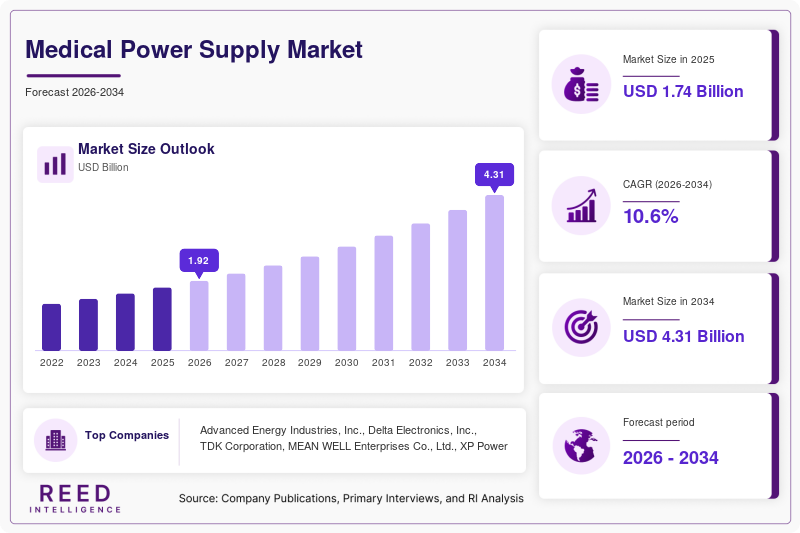
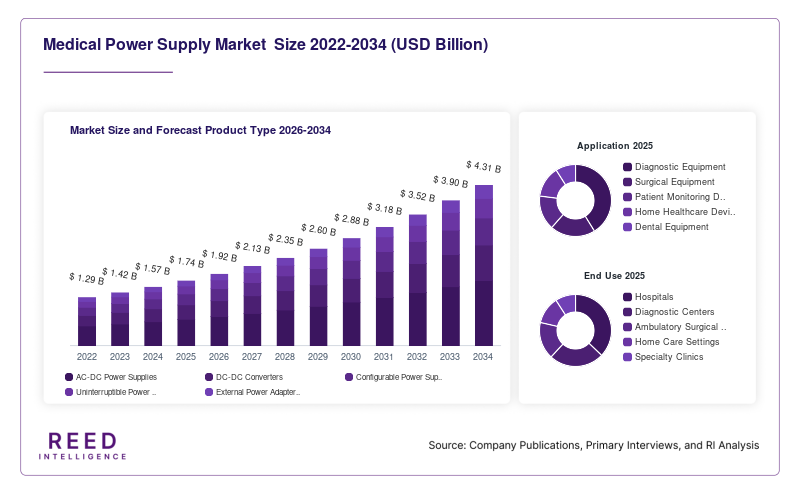
The global Medical Power Supply Market size was valued at USD 1.74 billion in 2026 and is projected to reach USD 3.91 billion by 2034, expanding at a CAGR of 10.6% during the forecast period from 2026 to 2034. The market is witnessing stable expansion due to the growing deployment of advanced medical electronics across hospitals, diagnostic centers, ambulatory facilities, and home healthcare environments. Medical power supplies are critical components used to ensure safe and uninterrupted power delivery in healthcare equipment such as patient monitoring systems, imaging devices, surgical instruments, ventilators, and laboratory analyzers. Rising demand for electrically safe and energy-efficient healthcare devices continues to support product innovation and market penetration worldwide.
One of the major global factors supporting market growth is the rapid digital transformation of healthcare infrastructure. Healthcare providers are increasingly adopting connected medical devices, portable monitoring systems, and AI-enabled diagnostic equipment that require reliable and compact power supply systems. Regulatory focus on patient safety and electromagnetic compatibility standards has also encouraged manufacturers to develop highly efficient AC-DC and DC-DC medical power solutions with low leakage current and enhanced durability. Furthermore, the expansion of telemedicine and home-based care services has accelerated the need for lightweight and compact medical power systems that can operate efficiently in remote environments.
Key Highlights
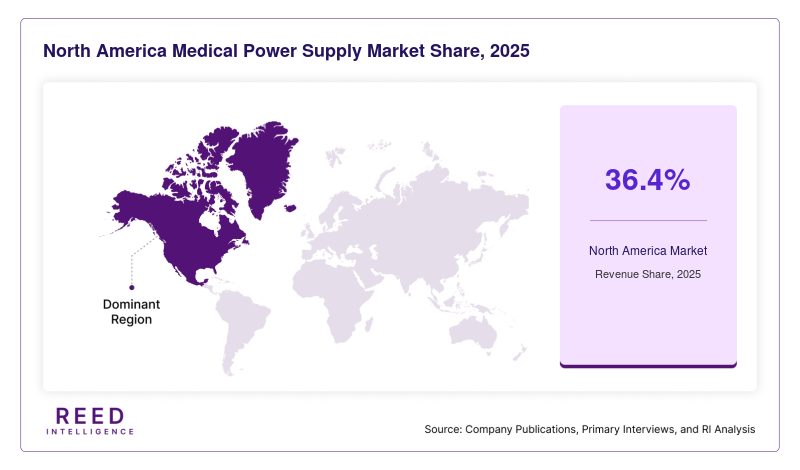
- North America dominated the market with a 36.4% share in 2025, while Asia Pacific is expected to grow at the fastest CAGR of 11.8% during 2026–2034.
- By product type, AC-DC power supplies accounted for the largest share of 42.7%, while configurable power supplies are projected to grow at a CAGR of 12.3%.
- By application, diagnostic equipment led with a 39.5% share, whereas home healthcare devices are expected to expand at a CAGR of 12.7%.
- By end use, hospitals represented the dominant share of 46.2%, while ambulatory surgical centers are anticipated to grow at a CAGR of 11.9%.
- The United States remained the dominant country, with market values of USD 540 million in 2024 and USD 598 million in 2025.
Market Trends
Growing Integration of Compact and Portable Medical Devices
Healthcare providers across developed and emerging economies are increasing the adoption of portable and compact medical devices to improve patient mobility and operational flexibility. This trend is significantly influencing demand for compact medical power supplies with higher efficiency and lower thermal output. Portable ventilators, wearable cardiac monitors, infusion pumps, and handheld imaging systems require lightweight power solutions that can operate continuously with minimal maintenance. Manufacturers are therefore focusing on miniaturized designs and higher power density technologies to meet evolving equipment requirements. The transition toward outpatient and home-based healthcare has further increased the need for mobile medical devices supported by reliable external and embedded power systems.
The growing use of battery-powered medical equipment is also encouraging advancements in modular power architectures. Medical device manufacturers are integrating intelligent power management features to improve equipment lifespan and energy utilization. As healthcare systems continue prioritizing mobility and decentralized patient care, the demand for smaller, quieter, and more energy-efficient medical power supply units is expected to remain strong throughout the forecast period.
Rising Adoption of Digital Healthcare Infrastructure
The healthcare industry is experiencing substantial investment in digital infrastructure, creating increased demand for advanced medical electronics and associated power systems. Hospitals are implementing connected patient monitoring platforms, cloud-integrated imaging systems, robotic surgery equipment, and AI-supported diagnostic devices that require highly stable and regulated power delivery. Medical power supply manufacturers are responding by introducing products with enhanced electromagnetic compatibility, remote monitoring capability, and integrated safety functions.
Another aspect of this trend is the increasing use of smart hospitals and automated clinical workflows. These environments require uninterrupted and efficient power support for multiple interconnected devices operating simultaneously. Demand for configurable and programmable medical power supplies has therefore increased among healthcare technology providers. In addition, stricter regulatory requirements regarding electrical safety and system reliability are encouraging healthcare facilities to replace outdated power units with advanced compliant systems that support digital healthcare transformation initiatives.
Market Drivers
Expanding Demand for Advanced Diagnostic Equipment
The increasing global burden of chronic diseases and aging populations has accelerated the deployment of advanced diagnostic systems across healthcare facilities. Imaging systems, laboratory analyzers, patient monitoring devices, and diagnostic scanners require stable and highly regulated medical power supplies to maintain accuracy and operational safety. Healthcare providers are expanding diagnostic capabilities to improve early disease detection and treatment efficiency, creating consistent demand for high-performance power solutions.
Technological improvements in diagnostic devices are also driving the requirement for higher power density and improved thermal management. Modern imaging systems incorporate sophisticated electronic components that require reliable voltage control and low electromagnetic interference. In response, manufacturers are introducing medical-grade power supplies with higher conversion efficiency and enhanced durability. The expansion of diagnostic centers in emerging economies and increased healthcare spending are expected to further strengthen long-term demand for medical power supply systems.
Growth of Home Healthcare and Remote Patient Monitoring
The rapid expansion of home healthcare services has become a major growth driver for the Medical Power Supply Market. Patients increasingly prefer home-based treatment and monitoring due to convenience, reduced hospitalization costs, and improved chronic disease management. This trend has significantly increased demand for compact and energy-efficient medical devices supported by reliable power supply systems.
Remote patient monitoring technologies, including wearable sensors, portable ventilators, oxygen concentrators, and telehealth equipment, require lightweight and highly efficient medical power modules. Manufacturers are focusing on silent operation, low standby power consumption, and improved safety compliance to support home healthcare applications. The rising prevalence of cardiovascular diseases, diabetes, and respiratory disorders continues to accelerate adoption of remote monitoring solutions globally. As healthcare systems shift toward decentralized care delivery models, medical power supply providers are expected to benefit from sustained product demand.
Market Restraint
High Regulatory Compliance and Product Certification Requirements
The Medical Power Supply Market faces a major restraint in the form of strict regulatory and certification requirements associated with medical electrical equipment. Medical power systems must comply with various international safety standards related to leakage current, electromagnetic compatibility, insulation protection, and thermal performance. Achieving compliance with standards such as IEC 60601 often requires extensive product testing, engineering modifications, and lengthy certification procedures, increasing development costs for manufacturers.
Smaller companies and new market entrants frequently encounter challenges related to regulatory approvals and documentation complexity. Delays in product certification can slow commercialization timelines and limit revenue generation opportunities. Additionally, healthcare institutions generally prefer certified and established suppliers due to patient safety concerns, creating barriers for emerging participants. Frequent updates in healthcare regulations also require manufacturers to continuously invest in product redesign and compliance management. These factors increase operational costs and can affect profit margins, particularly for companies operating in price-sensitive emerging markets where healthcare budgets remain constrained.
Market Opportunities
Expansion of Healthcare Infrastructure in Emerging Economies
Emerging economies across Asia Pacific, Latin America, and parts of Africa are investing heavily in healthcare infrastructure development, creating significant opportunities for medical power supply manufacturers. Governments are increasing healthcare spending to improve access to diagnostic and treatment services in urban and rural areas. New hospitals, specialty clinics, and diagnostic laboratories require reliable medical electronic equipment supported by advanced power management systems.
The modernization of healthcare facilities is also increasing demand for technologically advanced medical devices with higher power efficiency requirements. Countries such as India, China, Brazil, and Indonesia are witnessing rising procurement of imaging systems, surgical devices, and patient monitoring equipment. Medical power supply providers are therefore expanding regional manufacturing capabilities and distribution networks to address growing demand. The increasing presence of international medical device manufacturers in emerging markets is expected to create additional opportunities for component suppliers throughout the forecast period.
Rising Adoption of Modular and Configurable Power Solutions
The increasing preference for modular healthcare equipment is creating substantial opportunities for configurable medical power supplies. Healthcare equipment manufacturers are seeking flexible power systems that can support multiple device configurations while reducing development complexity. Configurable power supplies allow manufacturers to customize voltage output, power capacity, and operational features according to specific application requirements.
This trend is particularly prominent in advanced imaging systems, robotic surgical equipment, and multifunction patient monitoring devices. Modular power solutions also improve maintenance efficiency and simplify equipment upgrades in healthcare facilities. Manufacturers are investing in programmable power technologies with digital control features to enhance operational flexibility. The growing demand for scalable healthcare systems and rapid product customization is expected to support adoption of configurable medical power supply architectures across both developed and emerging markets.
Segmental Analysis
By Product Type
AC-DC power supplies accounted for the dominant share of 42.7% in 2024 due to their extensive use across hospitals, diagnostic systems, surgical equipment, and laboratory devices. These power supplies are widely preferred because they efficiently convert alternating current from standard electrical outlets into regulated direct current required by sensitive medical electronics. Their broad compatibility with imaging systems, patient monitoring devices, infusion pumps, and ventilators continues to support segment leadership. Healthcare institutions also prioritize AC-DC medical power supplies because of their stable voltage output, high operational reliability, and compliance with strict medical safety regulations. Manufacturers are increasingly focusing on higher energy efficiency and compact designs to improve system integration and reduce equipment heat generation.
Configurable power supplies are projected to register the fastest CAGR of 12.3% during the forecast period due to increasing demand for modular healthcare equipment and customized medical device configurations. These systems allow manufacturers to adjust voltage outputs, power capacity, and operational settings according to specific application requirements, improving flexibility and reducing engineering complexity. Advanced imaging systems, robotic surgical platforms, and multifunction diagnostic devices are increasingly incorporating configurable power architectures to support complex electronic operations. The ability to simplify maintenance and support future upgrades is another factor encouraging healthcare equipment manufacturers to adopt configurable power supply systems. Rising demand for adaptable and scalable healthcare technologies is expected to further accelerate segment growth.
By Application
Diagnostic equipment held the largest market share of 39.5% in 2024 owing to the widespread deployment of imaging systems, laboratory analyzers, and patient diagnostic platforms across healthcare facilities worldwide. Devices such as MRI scanners, CT systems, ultrasound equipment, and pathology analyzers require highly regulated medical power supplies to ensure operational precision and patient safety. Increasing prevalence of chronic diseases and growing emphasis on early disease detection continue to strengthen demand for advanced diagnostic technologies. Healthcare providers are also investing in modern diagnostic infrastructure to improve workflow efficiency and reduce clinical errors. As a result, manufacturers are developing power systems with enhanced electromagnetic compatibility, lower leakage current, and improved thermal management specifically designed for high-performance diagnostic equipment.
Home healthcare devices are anticipated to expand at the fastest CAGR of 12.7% during the forecast period due to the rapid transition toward decentralized patient care models. Portable ventilators, wearable monitors, oxygen concentrators, and telehealth equipment require compact and energy-efficient medical power systems suitable for non-clinical environments. The increasing aging population and rising incidence of chronic conditions are encouraging patients to adopt home-based monitoring and treatment solutions. Manufacturers are therefore focusing on lightweight, silent, and highly durable power modules that support continuous operation. Improvements in battery management technologies and wireless connectivity are also supporting growth within this segment, particularly across developed healthcare markets emphasizing remote patient care.
By End Use
Hospitals represented the dominant share of 46.2% in 2024 due to the high concentration of medical equipment and continuous expansion of healthcare infrastructure globally. Hospitals require large volumes of medical-grade power supplies to support imaging systems, surgical devices, intensive care equipment, patient monitoring systems, and laboratory technologies. The increasing adoption of advanced electronic healthcare systems and automation technologies continues to strengthen demand within this segment. Hospitals also prioritize reliable and compliant power systems to ensure uninterrupted device operation and patient safety during critical procedures. In addition, rising investments in smart hospital development and digital healthcare integration are encouraging healthcare facilities to replace conventional power units with more efficient and programmable medical power supply systems.
Ambulatory surgical centers are projected to grow at the fastest CAGR of 11.9% during the forecast period due to increasing preference for outpatient procedures and minimally invasive treatments. These facilities are rapidly adopting compact surgical devices, portable imaging systems, and monitoring equipment that require efficient and lightweight power supply solutions. Ambulatory centers focus heavily on operational efficiency, reduced equipment downtime, and lower infrastructure costs, creating demand for modular and energy-efficient medical power systems. The growing number of same-day surgical procedures and expanding private healthcare investments are also supporting segment expansion. Manufacturers are responding by introducing compact power platforms specifically designed for space-constrained outpatient healthcare environments.
Regional Analysis
North America
North America accounted for 36.4% of the global Medical Power Supply Market share in 2025 and is expected to maintain its leadership position throughout the forecast period. The region is projected to grow at a CAGR of 9.8% between 2026 and 2034 due to strong healthcare spending and widespread adoption of advanced medical technologies. Hospitals and diagnostic centers across the region continue investing in AI-enabled imaging systems, robotic surgery devices, and connected patient monitoring platforms, all of which require reliable medical-grade power supplies. Regulatory compliance standards and increasing replacement demand for aging healthcare infrastructure also contribute to regional market expansion.
The United States remains the dominant country in North America due to the presence of major healthcare equipment manufacturers and extensive healthcare infrastructure modernization programs. One important growth factor is the rapid expansion of home healthcare and remote patient monitoring services across the country. Healthcare providers are increasingly adopting portable and battery-powered medical equipment to reduce hospitalization costs and improve patient outcomes. This shift has accelerated demand for compact, high-efficiency medical power supply systems designed for continuous operation in non-clinical environments.
Europe
Europe represented 27.1% of the global Medical Power Supply Market in 2025 and is anticipated to grow at a CAGR of 9.4% during the forecast period. The region benefits from strong regulatory frameworks supporting medical device safety and energy efficiency. Healthcare facilities across Germany, France, and the United Kingdom continue upgrading diagnostic and treatment equipment, increasing demand for reliable AC-DC and DC-DC medical power solutions. The growing elderly population and rising prevalence of chronic diseases are also contributing to higher utilization of advanced healthcare electronics.
Germany emerged as the leading country within the European market due to its well-established medical technology industry and strong industrial manufacturing capabilities. A unique growth factor in the country is the increasing integration of automation and digital technologies within hospitals and diagnostic laboratories. Healthcare institutions are investing in connected medical systems and automated clinical workflows that require stable and intelligent power management solutions. This trend is encouraging manufacturers to introduce programmable and modular medical power supply platforms designed for digitally integrated healthcare environments.
Asia Pacific
Asia Pacific held a 22.6% share of the global Medical Power Supply Market in 2025 and is projected to register the fastest CAGR of 11.8% during 2026–2034. Rapid healthcare infrastructure expansion, rising healthcare expenditure, and increasing medical device production are major factors supporting market growth across the region. Countries including China, India, Japan, and South Korea are witnessing strong demand for diagnostic imaging systems, patient monitoring devices, and portable healthcare equipment. Regional manufacturers are also increasing investment in localized production to reduce import dependency and improve supply chain efficiency.
China remains the dominant country in Asia Pacific due to its large medical device manufacturing sector and expanding healthcare modernization initiatives. One distinctive growth factor is the rapid development of smart hospitals and telemedicine infrastructure across urban healthcare systems. Government initiatives promoting digital healthcare transformation are accelerating procurement of connected medical equipment requiring highly efficient and compact power supply units. Increasing domestic innovation in healthcare electronics is also strengthening regional market competitiveness and supporting long-term industry growth.
Middle East & Africa
The Middle East & Africa region accounted for 7.4% of the global Medical Power Supply Market in 2025 and is forecast to grow at a CAGR of 8.7% through 2034. Market expansion is supported by rising investment in healthcare infrastructure and increasing adoption of modern diagnostic technologies across Gulf countries and parts of Africa. Governments are prioritizing healthcare modernization programs to improve service quality and reduce dependence on overseas medical treatment. Demand for reliable medical power systems is therefore increasing across hospitals, laboratories, and specialty clinics.
Saudi Arabia represents the dominant country within the regional market due to substantial healthcare spending and ongoing hospital expansion projects. A key growth factor is the development of advanced healthcare cities and integrated medical complexes under national economic diversification programs. These facilities require sophisticated imaging systems, surgical equipment, and intensive care technologies supported by stable medical-grade power supplies. Increasing private sector participation in healthcare development is also creating additional opportunities for regional suppliers and international manufacturers.
Latin America
Latin America captured 6.5% of the global Medical Power Supply Market in 2025 and is expected to expand at a CAGR of 8.9% during the forecast period. The region is experiencing gradual healthcare infrastructure modernization supported by public and private investment. Increasing awareness regarding early disease diagnosis and preventive healthcare is driving demand for medical electronic equipment across urban healthcare centers. Hospitals and diagnostic laboratories are investing in technologically advanced systems that require compliant and energy-efficient medical power supply solutions.
Brazil remains the leading country in Latin America due to its comparatively large healthcare industry and growing medical device imports. One important growth factor is the rising expansion of private healthcare networks and outpatient treatment facilities. These institutions are increasingly adopting portable diagnostic devices, patient monitoring systems, and minimally invasive surgical equipment. As healthcare accessibility improves across the country, demand for reliable and compact medical power supply products is expected to increase steadily over the coming years.
Competitive Landscape
The Medical Power Supply Market is characterized by moderate competition with the presence of established global manufacturers and specialized regional suppliers. Companies are focusing on product innovation, regulatory compliance, and strategic partnerships to strengthen their market positions. Increasing demand for compact, programmable, and energy-efficient medical power systems is encouraging manufacturers to invest heavily in research and development activities. Market participants are also expanding manufacturing facilities and distribution networks to improve supply chain efficiency and address growing healthcare infrastructure demand across emerging economies.
Advanced Energy Industries remains one of the leading companies in the market due to its broad portfolio of medical-grade AC-DC and configurable power solutions. The company recently expanded its high-efficiency medical power product range designed for portable diagnostic equipment and home healthcare applications. Other major participants are emphasizing acquisitions and collaboration strategies to strengthen technological capabilities and regional presence. Companies are also integrating digital monitoring features and intelligent power management systems to support the growing adoption of connected healthcare devices and automated clinical environments.
Key Players
- Advanced Energy Industries, Inc.
- Delta Electronics, Inc.
- TDK Corporation
- MEAN WELL Enterprises Co., Ltd.
- XP Power
- Bel Fuse Inc.
- Murata Manufacturing Co., Ltd.
- SL Power Electronics
- Cincon Electronics Co., Ltd.
- CUI Inc.
- Astrodyne TDI
- SynQor, Inc.
- FRIWO Gerätebau GmbH
- GlobTek, Inc.
- RECOM Power GmbH
Recent Developments
- In February 2026, Advanced Energy Industries introduced a compact configurable medical power platform designed for portable imaging and monitoring systems with enhanced thermal efficiency.
- In August 2025, Delta Electronics expanded its medical power manufacturing operations in Asia Pacific to address rising demand from regional healthcare equipment manufacturers.
- In November 2025, XP Power launched a new low-leakage AC-DC medical power supply series developed for home healthcare and remote patient monitoring applications.
- In January 2026, TDK Corporation announced the development of high-density modular medical power solutions optimized for robotic surgical systems and AI-enabled healthcare equipment.
- In September 2025, MEAN WELL Enterprises introduced energy-efficient external medical adapters compliant with updated international medical safety standards.
Medical Power Supply Market Segments
Product Type
- AC-DC Power Supplies
- DC-DC Converters
- Configurable Power Supplies
- Uninterruptible Power Supplies
- External Power Adapters
Application
- Diagnostic Equipment
- Surgical Equipment
- Patient Monitoring Devices
- Home Healthcare Devices
- Dental Equipment
End Use
- Hospitals
- Diagnostic Centers
- Ambulatory Surgical Centers
- Home Care Settings
- Specialty Clinics
By Region
- North America
- Europe
- APAC
- Middle East and Africa
- LATAM