Medical Radiation Shielding Market Size, Share, Demand Report By Type (Lead-Based Shielding Products, Lead-Free Shielding Products, Composite Shielding Systems), By Material (Lead, Lead-Free Alloys, Polymer Composites), By Application (Diagnostic Imaging, Radiation Therapy, Nuclear Medicine, Dental Radiology), By End-Use (Hospitals, Diagnostic Centers, Cancer Treatment Centers) By Region & Segment Forecasts, 2026–2034
USD 3950
Market Overview
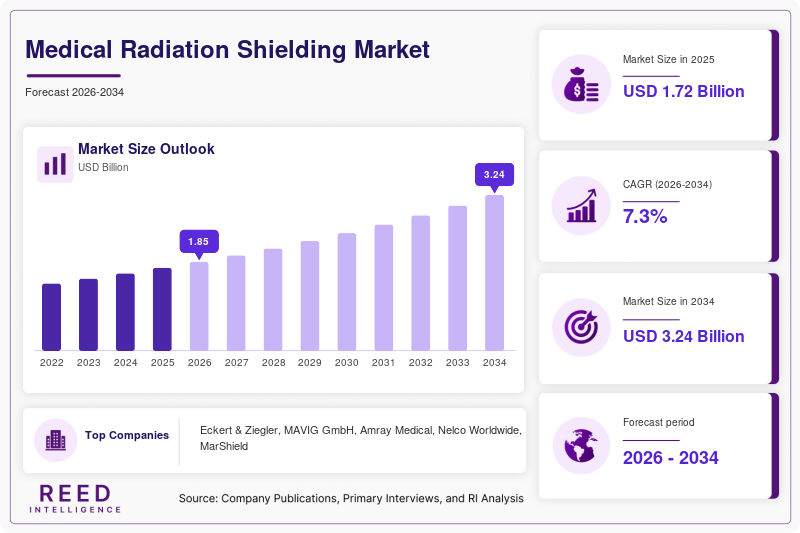
The Medical Radiation Shielding Market size is projected to reach a size of USD 1.85 billion in 2026, and is expected to attain USD 3.25 billion by 2034, expanding at a CAGR of 7.3% during the forecast period (2026–2034). The growth of the market is strongly supported by the increasing global prevalence of cancer and cardiovascular diseases, which has significantly boosted diagnostic imaging and radiation therapy procedures across healthcare facilities.
A major global factor driving the Medical Radiation Shielding Market is the rapid expansion of advanced imaging infrastructure, including CT, MRI, PET, and hybrid imaging systems, which require enhanced radiation protection solutions to ensure patient and healthcare worker safety.
Key Highlights:
- Dominant Region (2025): North America held approximately 38% market share
- Fastest-Growing Region: Asia Pacific is expected to grow at a CAGR of 8.5% (2026–2034)
- Leading Subsegment (Type): Lead-based shielding products dominated with 42% share in 2025
- Fastest-Growing Subsegment (Type): Lead-free composite shielding products, projected CAGR of 9.1%
- Leading Subsegment (Application): Diagnostic imaging accounted for 46% share in 2025
- Fastest-Growing Subsegment (Application): Radiation therapy shielding solutions, projected CAGR of 8.3%
- Dominant Country (2024): United States valued at USD 650 million
- Dominant Country (2025): United States increased to USD 690 million
Market Trends
Integration of Lead-Free and Eco-Friendly Shielding Materials
The Medical Radiation Shielding Market is witnessing a gradual shift toward environmentally safe and lightweight shielding materials. Hospitals and diagnostic centers are increasingly adopting lead-free composites due to regulatory pressure and sustainability goals. These materials reduce toxicity risks while maintaining radiation attenuation efficiency.
Expansion of Modular Radiation Shielding Systems
Modular shielding systems are gaining traction in modern healthcare infrastructure. These systems allow flexible installation in diagnostic rooms, mobile imaging units, and outpatient facilities. The trend is driven by the growing demand for cost-efficient hospital expansion and rapid deployment of imaging technologies.
Market Drivers
Rising Prevalence of Chronic Diseases and Cancer Cases
The growing incidence of cancer and chronic diseases is increasing the demand for diagnostic imaging and radiation therapy. This has directly influenced the Medical Radiation Shielding Market, as healthcare providers invest in advanced protective systems to ensure compliance with radiation safety standards.
Technological Advancements in Diagnostic Imaging Systems
The rapid adoption of high-resolution imaging systems such as PET-CT and SPECT-CT has increased radiation exposure risks. As a result, hospitals are integrating advanced shielding materials, including mobile barriers and protective glass, to enhance safety standards in imaging environments.
Market Restraint
High Installation and Material Costs
One of the primary restraints in the Medical Radiation Shielding Market is the high cost associated with lead-based shielding systems and infrastructure modifications. The installation of shielding rooms and protective barriers requires significant capital investment, which limits adoption in small and mid-sized healthcare facilities.
Market Opportunities
Expansion of Healthcare Infrastructure in Emerging Economies
Emerging economies in Asia Pacific and Latin America are investing heavily in healthcare infrastructure development. This is creating new opportunities for radiation shielding manufacturers to supply cost-effective and scalable solutions for diagnostic and oncology centers.
Innovation in Lightweight Composite Shielding Materials
Continuous research and development in nanomaterials and polymer-based composites are opening new growth avenues. These innovations offer improved flexibility, reduced weight, and enhanced safety, making them suitable for mobile imaging systems and modern hospital designs.
Segmental Analysis
By Type (Shielding Products)
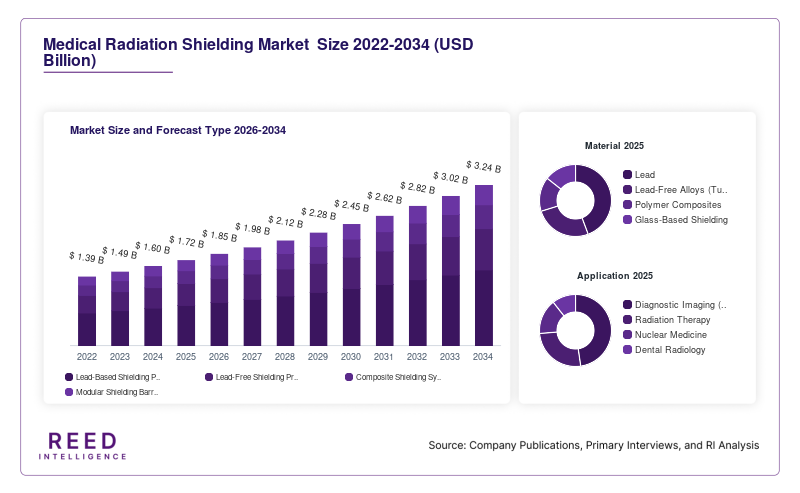
Lead-based shielding products dominated the Medical Radiation Shielding Market with 42% share in 2025, due to their high radiation absorption efficiency and long-standing use in healthcare facilities. However, lead-free shielding products are expected to grow at a CAGR of 9.1% (2026–2034), driven by increasing environmental regulations and demand for safer alternatives.
By Material
Lead material accounted for the largest share of 48% in 2025, primarily due to its cost-effectiveness and superior shielding capability. Composite materials, however, are expected to register the fastest growth with a CAGR of 8.9%, supported by advancements in polymer-based radiation protection technologies.
By Application
Diagnostic imaging held the dominant share of 46% in 2025, as hospitals increasingly rely on CT, MRI, and PET scans. Radiation therapy applications are expected to grow at a CAGR of 8.3%, driven by rising cancer treatment procedures and precision oncology advancements.
By End-Use
Hospitals dominated the segment with 52% share in 2025, due to high patient inflow and installation of advanced imaging systems. Cancer treatment centers are projected to grow at the fastest CAGR of 8.7%, supported by rising oncology infrastructure investments globally.
Regional Analysis
North America
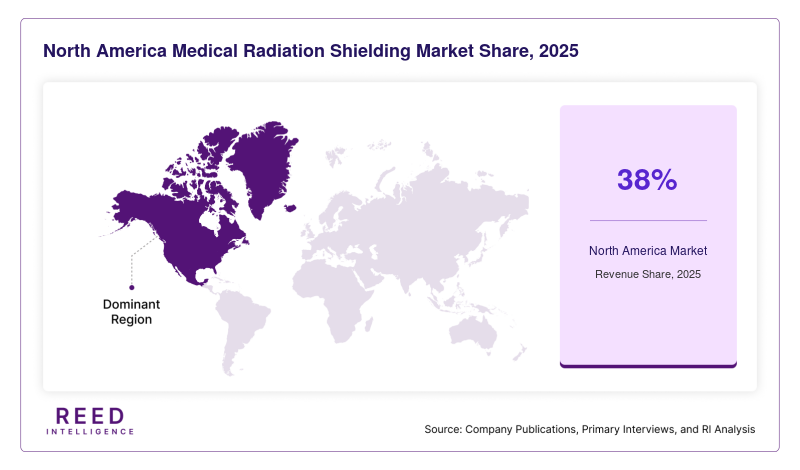
North America accounted for 38% of the global Medical Radiation Shielding Market share in 2025 and is expected to grow at a steady CAGR of 6.8% (2026–2034). The United States dominates this region due to advanced healthcare infrastructure and strict radiation safety regulations, which drive consistent demand for shielding solutions.
Europe
Europe held 28% market share in 2025 and is projected to expand at a CAGR of 6.5% (2026–2034). Germany leads the region, supported by strong adoption of advanced diagnostic imaging systems and government-backed healthcare safety standards.
Asia Pacific
Asia Pacific captured 24% market share in 2025 and is anticipated to grow at the highest CAGR of 8.5% (2026–2034). China is the dominant country, driven by large-scale hospital expansion and increasing investments in oncology treatment centers.
Middle East & Africa
The Middle East & Africa region held 6% market share in 2025 and is projected to grow at a CAGR of 7.2% (2026–2034). The UAE leads the region due to rising medical tourism and increasing installation of advanced imaging systems in private hospitals.
Latin America
Latin America accounted for 4% market share in 2025 and is expected to grow at a CAGR of 6.9% (2026–2034). Brazil remains the leading country due to expanding public healthcare infrastructure and growing cancer diagnosis rates.
Competitive Landscape
The Medical Radiation Shielding Market is moderately consolidated with key players focusing on material innovation, product expansion, and strategic partnerships. Major companies include Eckert & Ziegler, Amray Medical, Nelco Worldwide, MAVIG GmbH, and MarShield. These companies focus on delivering advanced shielding solutions such as protective barriers, lead aprons, and modular shielding systems for hospitals and diagnostic centers.
Eckert & Ziegler remains a leading player due to its strong portfolio in radiation protection materials and global distribution network. The company recently expanded its shielding product line to include lightweight composite solutions designed for modern imaging environments. Other players are investing in sustainable materials and customized shielding solutions to meet evolving healthcare safety standards. Competitive strategies are centered around product differentiation, regulatory compliance, and expansion in emerging healthcare markets.
Key Players List
- Eckert & Ziegler
- Amray Medical
- Nelco Worldwide
- MAVIG GmbH
- MarShield
- ETS-Lindgren
- Veritas Medical Solutions
- Infab Corporation
- Radiation Protection Products Inc.
- Ray-Bar Engineering Corporation
- AliMed Inc.
- Gaven Industries Inc.
- Lemer Pax
- Protech Medical
- A&L Shielding
Recent Developments
- Manufacturers have introduced advanced lead-free shielding materials using tungsten and bismuth composites, reducing reliance on traditional lead while improving environmental safety and handling efficiency in healthcare facilities.
- There is a growing shift toward modular and prefabricated radiation shielding systems, enabling faster installation in hospitals, imaging centers, and oncology units with minimal structural modifications.
- Companies are integrating digital design tools and simulation software to optimize radiation shielding layouts during the planning stage of medical facilities, improving accuracy and compliance with safety standards.
- The market is witnessing the launch of smart shielding solutions with radiation monitoring capabilities, allowing real-time tracking of exposure levels in diagnostic and treatment environments.
- Strategic collaborations between material science firms and medical equipment manufacturers are increasing, focusing on lightweight composite shielding solutions suitable for mobile imaging systems and hybrid operating rooms.
- Regulatory pressure and updated healthcare safety standards are accelerating the replacement of conventional shielding systems with safer, more sustainable alternatives across both developed and emerging markets.
Medical Radiation Shielding Market Segments
Type
- Lead-Based Shielding Products
- Lead-Free Shielding Products
- Composite Shielding Systems
- Modular Shielding Barriers
Material
- Lead
- Lead-Free Alloys (Tungsten, Bismuth)
- Polymer Composites
- Glass-Based Shielding
Application
- Diagnostic Imaging (CT, MRI, PET)
- Radiation Therapy
- Nuclear Medicine
- Dental Radiology
End-Use
- Hospitals
- Diagnostic Imaging Centers
- Cancer Treatment Centers
- Research & Academic Institutes
By Region
- North America
- Europe
- APAC
- Middle East and Africa
- LATAM