Medical Seals Market Size, Share & Demand Report By Material (Silicone, Thermoplastic Elastomers, EPDM, Nitrile Rubber), By Product Type (O-rings, Gaskets, Lip Seals, Custom Seals), By Application (Medical Devices, Pharmaceutical Packaging, Diagnostic Equipment), By End-Use (Hospitals & Clinics, Home Healthcare, Pharmaceutical Companies), By Region & Segment Forecasts, 2025–2034
USD 3950
Market Overview
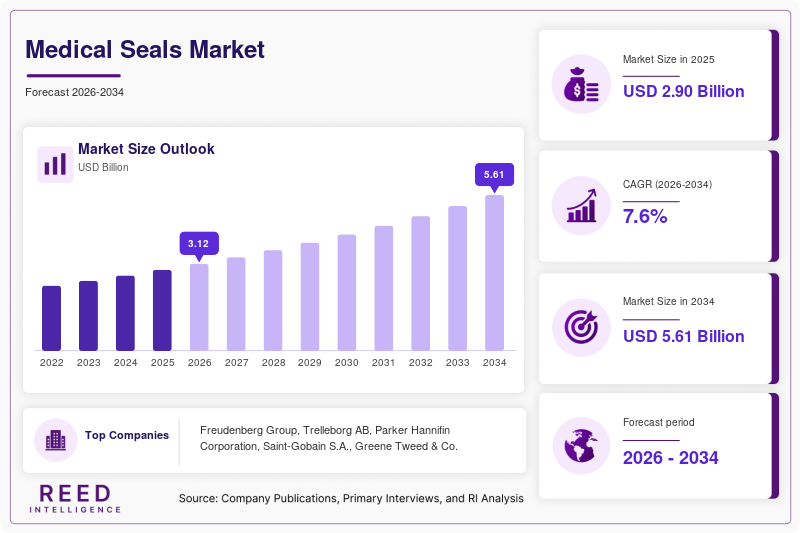
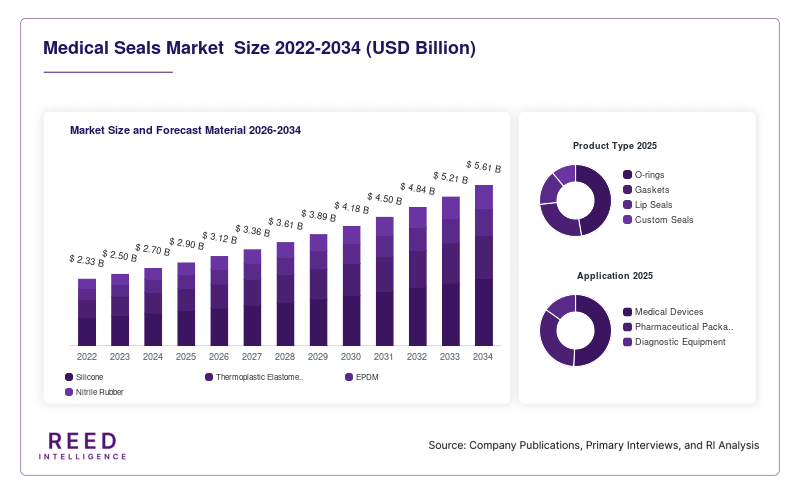
The Medical Seals Market size was valued at approximately USD 2.9 billion in 2025 and is projected to reach USD 5.6 billion by 2034, expanding at a CAGR of 7.6% during the forecast period (2025–2034). The market is witnessing steady expansion driven by the increasing demand for sterile and leak-proof medical devices, particularly in high-risk clinical environments such as surgical procedures, drug delivery systems, and diagnostic equipment.
A major global factor supporting market growth is the rising emphasis on infection prevention and patient safety across healthcare systems. Regulatory bodies and healthcare providers are prioritizing advanced sealing technologies to ensure device integrity and compliance with stringent hygiene standards. This has resulted in increased adoption of high-performance elastomers and polymer-based sealing solutions.
Key Highlights
- North America dominated the market with a 38% share in 2025, while Asia Pacific is projected to grow at the fastest CAGR of 9.1%
- Silicone-based seals led the material segment with a 42% share, while thermoplastic elastomers are expected to grow at a CAGR of 8.8%
- Equipment & device application segment accounted for the largest share at 47%, while pharmaceutical packaging seals are the fastest-growing at 8.5% CAGR
- The U.S. Medical Seals Market was valued at USD 1.05 billion in 2025 and is estimated to reach USD 1.12 billion in 2026
Market Trends
Increasing Adoption of Advanced Elastomer Materials
The Medical Seals Market is experiencing a notable shift toward advanced elastomer materials such as silicone, fluorosilicone, and thermoplastic elastomers. These materials offer superior chemical resistance, flexibility, and biocompatibility, making them suitable for demanding medical applications. Manufacturers are increasingly focusing on materials that can withstand repeated sterilization cycles without degradation. This trend is particularly evident in surgical devices and implantable equipment, where durability and performance consistency are essential. Additionally, innovations in material science are enabling the development of seals with enhanced resistance to extreme temperatures and aggressive chemicals, improving device lifespan and safety.
Growth of Miniaturized and Portable Medical Devices
Another key trend shaping the Medical Seals Market is the growing demand for miniaturized and portable medical devices. As healthcare shifts toward home-based care and wearable technologies, the need for compact, lightweight, and highly reliable sealing solutions is increasing. Miniaturized seals must maintain performance under tight tolerances and varying environmental conditions. This has driven innovation in micro-sealing technologies and precision manufacturing processes. The rise of digital health devices, including insulin pumps and portable diagnostic tools, has further accelerated this trend. Manufacturers are investing in design optimization and advanced molding techniques to meet the evolving requirements of compact medical systems.
Market Drivers
Rising Demand for Sterile Medical Environments
The growing focus on maintaining sterile environments in healthcare settings is a key driver of the Medical Seals Market. Hospitals and clinics are increasingly adopting high-quality sealing solutions to prevent contamination and ensure patient safety. Medical seals are essential in maintaining airtight and fluid-tight systems in equipment such as ventilators, infusion pumps, and diagnostic instruments. With the increasing incidence of hospital-acquired infections, healthcare providers are investing in reliable sealing technologies that meet strict regulatory standards. This demand is further reinforced by global health initiatives aimed at improving infection control practices.
Expansion of Medical Device Manufacturing Industry
The rapid expansion of the global medical device manufacturing industry is significantly driving the Medical Seals Market. The increasing production of advanced medical equipment, including imaging systems, surgical tools, and drug delivery devices, has created a strong demand for high-performance sealing components. Manufacturers are focusing on developing customized sealing solutions tailored to specific device requirements. The integration of automation and precision engineering in manufacturing processes has further enhanced the quality and consistency of medical seals. As the healthcare industry continues to evolve, the demand for innovative sealing solutions is expected to grow steadily.
Market Restraint
Stringent Regulatory Compliance and Material Approval Processes
One of the major challenges in the Medical Seals Market is the stringent regulatory framework governing medical-grade materials and components. Seals used in medical devices must comply with strict standards related to biocompatibility, chemical resistance, and sterilization compatibility. The approval process for new materials and designs can be time-consuming and costly, often delaying product development and market entry.
Manufacturers are required to conduct extensive testing and validation प्रक्रsses to ensure compliance with international standards. This increases operational costs and limits the flexibility of companies to innovate rapidly. Additionally, variations in regulatory requirements across different regions create complexities for global market players. Small and medium-sized manufacturers may face difficulties in meeting these requirements, which can restrict market participation.
The need for continuous documentation, quality assurance, and certification further adds to the burden, making it challenging for companies to scale efficiently. While regulations are essential for ensuring safety and reliability, they also act as a barrier to entry and innovation within the market.
Market Opportunities
Growth in Biopharmaceutical and Drug Delivery Applications
The expanding biopharmaceutical sector presents a significant opportunity for the Medical Seals Market. The increasing production of biologics, vaccines, and advanced drug delivery systems requires highly specialized sealing solutions. These applications demand seals that can maintain sterility, prevent leakage, and withstand exposure to sensitive compounds. As pharmaceutical companies invest in advanced manufacturing technologies, the demand for high-performance seals is expected to rise. This creates opportunities for manufacturers to develop innovative products tailored to specific pharmaceutical applications.
Emerging Markets and Healthcare Infrastructure Development
Developing regions are offering substantial growth opportunities for the Medical Seals Market due to ongoing improvements in healthcare infrastructure. Countries in Asia Pacific, Latin America, and the Middle East are investing heavily in hospitals, diagnostic centers, and medical manufacturing facilities. This expansion is driving the demand for medical devices and, consequently, sealing components. Local manufacturing initiatives and government support for healthcare development are further boosting market growth. Companies that establish a strong presence in these regions can benefit from increasing demand and favorable economic conditions.
Regional Analysis
North America
North America accounted for approximately 38% of the Medical Seals Market share in 2025 and is expected to grow at a CAGR of 6.8% during the forecast period. The region had a well-established healthcare infrastructure and a strong presence of leading medical device manufacturers. High healthcare expenditure and advanced technological adoption contributed to market dominance.
The United States remained the dominant country due to its robust medical device industry and continuous investment in research and development. The presence of major manufacturers and increasing demand for advanced surgical equipment supported market growth. Additionally, the focus on quality standards and innovation in healthcare technologies drove the adoption of high-performance sealing solutions.
Europe
Europe held a 27% share of the Medical Seals Market in 2025 and is projected to grow at a CAGR of 6.5%. The region had a strong regulatory framework and a well-developed healthcare system, which supported the demand for high-quality medical components.
Germany emerged as the leading country due to its advanced manufacturing capabilities and strong presence in the medical technology sector. The country’s focus on precision engineering and innovation in medical devices contributed to the increased adoption of specialized sealing solutions.
Asia Pacific
Asia Pacific accounted for 22% of the Medical Seals Market in 2025 and is expected to register the fastest CAGR of 9.1%. Rapid industrialization and increasing healthcare investments supported market expansion in the region.
China dominated the regional market due to its large-scale manufacturing capabilities and growing healthcare infrastructure. The country’s increasing focus on domestic medical device production and export activities created strong demand for medical seals. Government initiatives to improve healthcare access further contributed to market growth.
Middle East & Africa
The Middle East & Africa region held a 7% share of the Medical Seals Market in 2025 and is projected to grow at a CAGR of 7.2%. The region experienced gradual growth due to improving healthcare infrastructure and increasing investments in medical facilities.
Saudi Arabia emerged as a key country, driven by government initiatives to modernize healthcare systems. The expansion of hospitals and diagnostic centers increased the demand for medical devices and sealing components.
Latin America
Latin America accounted for 6% of the Medical Seals Market in 2025 and is expected to grow at a CAGR of 7.0%. The region showed steady growth supported by rising healthcare awareness and infrastructure development.
Brazil led the regional market due to its expanding healthcare sector and increasing investment in medical technology. The growing demand for medical devices and improved access to healthcare services contributed to the adoption of advanced sealing solutions.
Segmental Analysis
By Material
Silicone seals dominated the Medical Seals Market in 2025, accounting for approximately 42% of the total share. Their widespread use was attributed to excellent biocompatibility, flexibility, and resistance to extreme temperatures. Silicone materials were extensively used in medical devices requiring repeated sterilization and long-term durability.
Thermoplastic elastomers are expected to be the fastest-growing subsegment, with a projected CAGR of 8.8% during the forecast period. Their recyclability, cost-effectiveness, and ease of processing will drive adoption. These materials will gain popularity in disposable medical devices and cost-sensitive applications.
By Product Type
O-rings held the largest share in 2025 at 36%, owing to their versatility and widespread use in sealing applications across various medical devices. Their simple design and effectiveness in preventing leakage made them a preferred choice.
Lip seals are anticipated to grow at the fastest CAGR of 8.2%, driven by their ability to provide superior sealing performance in dynamic applications. Increasing use in rotating equipment and fluid handling systems will support their growth.
By Application
Medical equipment and devices represented the dominant application segment with a 47% share in 2025. The extensive use of seals in diagnostic machines, surgical tools, and monitoring equipment contributed to this dominance.
Pharmaceutical packaging is expected to be the fastest-growing application, with a CAGR of 8.5%. The increasing demand for sterile packaging solutions and the growth of the pharmaceutical industry will drive this segment.
By End-Use
Hospitals and clinics accounted for the largest share of 44% in 2025, driven by high usage of medical devices and equipment requiring reliable sealing solutions.
Home healthcare is projected to grow at the fastest CAGR of 9.0%, supported by the rising adoption of portable medical devices and home-based treatment solutions.
Regional Analysis
North America
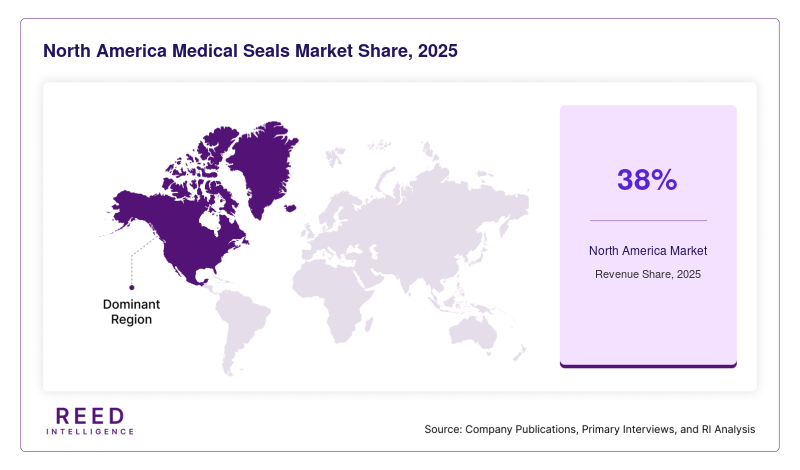
North America accounted for approximately 38% of the Medical Seals Market share in 2025 and is expected to grow at a CAGR of 6.8% during the forecast period. The region had a well-established healthcare infrastructure and a strong presence of leading medical device manufacturers. High healthcare expenditure and advanced technological adoption contributed to market dominance.
The United States remained the dominant country due to its robust medical device industry and continuous investment in research and development. The presence of major manufacturers and increasing demand for advanced surgical equipment supported market growth. Additionally, the focus on quality standards and innovation in healthcare technologies drove the adoption of high-performance sealing solutions.
Europe
Europe held a 27% share of the Medical Seals Market in 2025 and is projected to grow at a CAGR of 6.5%. The region had a strong regulatory framework and a well-developed healthcare system, which supported the demand for high-quality medical components.
Germany emerged as the leading country due to its advanced manufacturing capabilities and strong presence in the medical technology sector. The country’s focus on precision engineering and innovation in medical devices contributed to the increased adoption of specialized sealing solutions.
Asia Pacific
Asia Pacific accounted for 22% of the Medical Seals Market in 2025 and is expected to register the fastest CAGR of 9.1%. Rapid industrialization and increasing healthcare investments supported market expansion in the region.
China dominated the regional market due to its large-scale manufacturing capabilities and growing healthcare infrastructure. The country’s increasing focus on domestic medical device production and export activities created strong demand for medical seals. Government initiatives to improve healthcare access further contributed to market growth.
Middle East & Africa
The Middle East & Africa region held a 7% share of the Medical Seals Market in 2025 and is projected to grow at a CAGR of 7.2%. The region experienced gradual growth due to improving healthcare infrastructure and increasing investments in medical facilities.
Saudi Arabia emerged as a key country, driven by government initiatives to modernize healthcare systems. The expansion of hospitals and diagnostic centers increased the demand for medical devices and sealing components.
Latin America
Latin America accounted for 6% of the Medical Seals Market in 2025 and is expected to grow at a CAGR of 7.0%. The region showed steady growth supported by rising healthcare awareness and infrastructure development.
Brazil led the regional market due to its expanding healthcare sector and increasing investment in medical technology. The growing demand for medical devices and improved access to healthcare services contributed to the adoption of advanced sealing solutions.
Competitive Landscape
The Medical Seals Market is moderately fragmented, with several global and regional players competing on product quality, innovation, and pricing. Key companies are focusing on developing advanced materials and expanding their product portfolios to meet evolving industry requirements.
Freudenberg Group is a leading player in the market, known for its extensive range of high-performance sealing solutions. The company recently introduced a new line of medical-grade elastomer seals designed for enhanced durability and sterilization resistance.
Other prominent players are investing in research and development, strategic partnerships, and geographic expansion to strengthen their market presence. The competitive environment is characterized by continuous innovation and a strong focus on compliance with regulatory standards.
Key Players
- Freudenberg Group
- Trelleborg AB
- Parker Hannifin Corporation
- Saint-Gobain S.A.
- Greene Tweed & Co.
- Minnesota Rubber & Plastics
- Apple Rubber Products Inc.
- Marco Rubber & Plastics LLC
- Precision Associates Inc.
- Techno Ad Ltd.
- Flexitallic Group
- ERIKS NV
- Hutchinson SA
- Simrit (Freudenberg division)
- Bal Seal Engineering
Recent Developments
- 2024: Freudenberg Group launched advanced medical-grade sealing materials for high-temperature sterilization
- 2024: Trelleborg expanded its healthcare sealing solutions portfolio with new elastomer technologies
- 2023: Parker Hannifin introduced precision-engineered seals for minimally invasive devices
- 2023: Saint-Gobain developed bio-compatible sealing solutions for pharmaceutical applications
- 2023: Greene Tweed enhanced its product line with chemically resistant medical seals
Medical Seals Market Segments
Material
- Silicone
- Thermoplastic Elastomers
- EPDM
- Nitrile Rubber
Product Type
- O-rings
- Gaskets
- Lip Seals
- Custom Seals
Application
- Medical Devices
- Pharmaceutical Packaging
- Diagnostic Equipment
End-Use
- Hospitals & Clinics
- Home Healthcare
- Pharmaceutical Companies
By Region
- North America
- Europe
- APAC
- Middle East and Africa
- LATAM