Medical Tourniquets Market Size, Share Demand Report By Type (Automatic Tourniquets, Manual Tourniquets), By Application (Hospitals, Ambulatory Surgical Centers, Emergency Medical Services, Military & Defense), Regional Insights & Segment Forecasts, 2026–2034
USD 3950
Medical Tourniquets Market Size
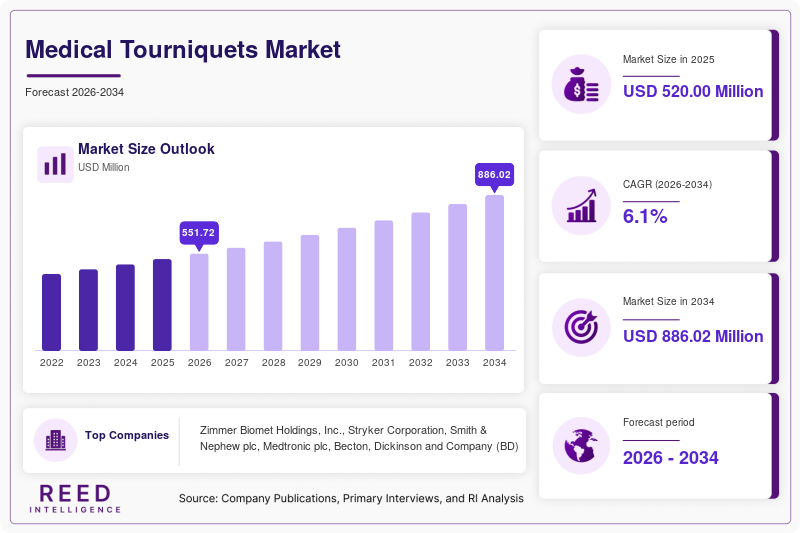
The Medical Tourniquets market size is projected at USD 485.6 million in 2026 and is expected to hit USD 785.3 million by 2034 with a CAGR of 6.2% during the forecast period. The increasing number of surgical procedures, growing trauma cases, and the rising adoption of advanced tourniquet systems for bloodless surgical fields and emergency hemorrhage control underpin market expansion. This report delivers a comprehensive analysis of the Medical Tourniquets market, including segmentation by type and application, competitive dynamics, and regional growth patterns, equipping stakeholders with critical intelligence. The Medical Tourniquets market continues to demonstrate strong growth potential, fueled by the rising geriatric population, the increasing number of orthopedic and vascular surgeries, and continuous innovation in tourniquet technology.
Medical tourniquets are medical devices used to temporarily occlude blood flow to a limb, creating a bloodless surgical field, controlling hemorrhage in emergency situations, and facilitating intravenous access. They are essential tools in various medical settings, including operating rooms, emergency departments, and pre-hospital care. The global Medical Tourniquets market is significant, with over 15 million units sold globally in 2025, reflecting a 7% increase from 2023, driven by the growing number of surgical procedures and trauma cases. Adoption patterns reveal that the Automatic Tourniquets type dominates the market, accounting for 55% of total revenue, followed by Manual Tourniquets at 45%. The Medical Tourniquets market's trajectory is closely linked to the growth of the global surgical and emergency care markets, which are projected to reach USD 45 billion and USD 30 billion by 2028, respectively, and the increasing focus on patient safety and surgical efficiency.
Medical Tourniquets Market Trends
Growing Adoption of Automatic and Pneumatic Tourniquet Systems
The Medical Tourniquets market is witnessing a significant trend toward the adoption of automatic and pneumatic tourniquet systems, driven by their precision, safety, and ease of use. The production of automatic tourniquets increased by 12% in 2025, reaching 6 million units, as 40% of new surgical suites in 2025 specified automatic tourniquet systems. Adoption rates of automatic tourniquets in hospitals reached 35%, with this figure projected to exceed 55% by 2030. The Medical Tourniquets market's trend toward automation is reinforced by the need for consistent pressure control, the reduction of tourniquet-related complications, and the continuous innovation in microprocessor-controlled and pressure-monitoring technologies.
Increasing Focus on Emergency and Pre-Hospital Hemorrhage Control
The increasing focus on emergency and pre-hospital hemorrhage control is a major trend shaping the Medical Tourniquets market, with the development of tourniquets designed for rapid application by first responders and military personnel. The market has seen a 15% increase in demand for tactical and emergency tourniquets since 2022, with 25% of new product launches in 2025 focusing on enhanced ease of use and rapid application. The use of tourniquets in military and civilian trauma care has also gained significant traction. The Medical Tourniquets market's trend toward emergency applications is reinforced by the growing awareness of hemorrhage as a leading cause of preventable death, the increasing focus on trauma training, and the continuous innovation in tourniquet design and materials.
Medical Tourniquets Market Drivers
The Medical Tourniquets market's expansion is primarily driven by the increasing number of surgical procedures, particularly in orthopedics and vascular surgery, with the global surgical procedures market valued at over USD 500 billion in 2025. The need for bloodless surgical fields to improve surgical precision and reduce blood loss has been a major driver, with tourniquets being an essential tool in many surgeries. The rising incidence of trauma and accidents has also fueled market demand for emergency tourniquets. Additionally, the increasing geriatric population, which is more susceptible to surgical interventions, has spurred growth. The Medical Tourniquets market's growth is further reinforced by the continuous innovation in tourniquet technology, leading to improved safety, efficacy, and patient outcomes.
Medical Tourniquets Market Restraints
Despite favorable growth prospects, the Medical Tourniquets market faces significant constraints, primarily related to the risk of tourniquet-related complications, such as nerve damage, skin injury, and thromboembolism, which can limit their use and increase liability. The cost of advanced automatic tourniquet systems can also be a barrier for smaller healthcare facilities. The Medical Tourniquets market's growth is also tempered by the competition from alternative methods of hemorrhage control and surgical field optimization.
Medical Tourniquets Market Opportunities
The Medical Tourniquets market presents significant opportunities in the rapidly expanding market for military and tactical medicine, where advanced tourniquets are essential for battlefield and tactical emergency care. The development of tourniquets with integrated pressure sensors and connectivity for data logging and remote monitoring is expected to grow at a CAGR of 10% through 2034. Emerging opportunities also exist in the development of tourniquets for use in disaster medicine and mass casualty incidents. The Medical Tourniquets market's opportunity profile is further enhanced by the growing focus on trauma preparedness and the increasing investment in emergency medical services.
Challenges in Medical Tourniquets Market
The Medical Tourniquets market faces persistent challenges related to the need for continuous training and education for healthcare providers on the proper use of tourniquets to minimize complications. The complexity of developing tourniquets that are both safe and effective across diverse patient populations can also be a challenge. The market is also contending with the challenge of ensuring availability and affordability of tourniquets in resource-limited settings. Additionally, the Medical Tourniquets market is challenged by the need to address the psychological aspects of tourniquet application in emergency situations.
Medical Tourniquets Market Segmentation
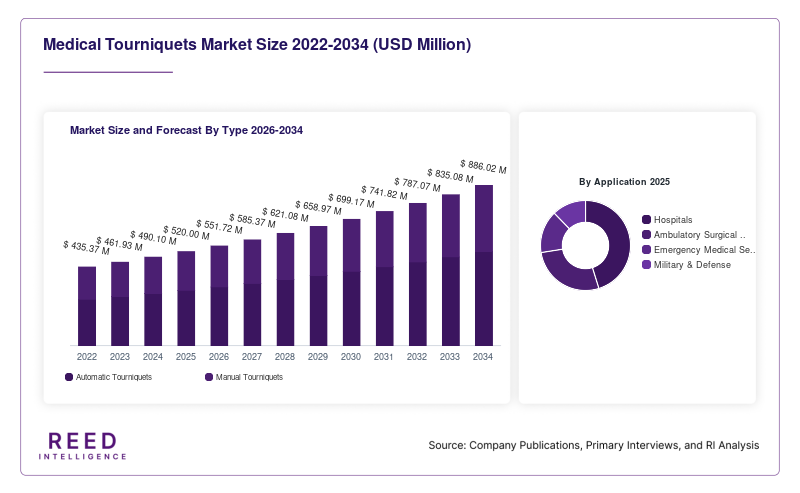
The Medical Tourniquets market is segmented by Type and Application to provide a comprehensive market perspective. By Type, Automatic Tourniquets dominate with a 55% market share, driven by their precision, safety, and ease of use. The Application segment is led by Hospitals, which accounts for 50% of the market, followed by Ambulatory Surgical Centers at 20%, Emergency Medical Services at 18%, and Military & Defense at 12%.
By Type
Automatic Tourniquets represent the largest segment in the Medical Tourniquets market, commanding a 55% share, with revenue exceeding USD 267 million in 2025. These are characterized by their use of electronic controls for precise pressure management and real-time monitoring. Technical specifications include pressure range, safety features, and interface. The Medical Tourniquets market's Automatic segment is driven by its use in hospitals and surgical centers.
Manual Tourniquets capture a 45% share of the Medical Tourniquets market, with revenue of USD 218 million in 2025. These are characterized by their use in manual application by healthcare providers, offering simplicity and reliability. Technical specifications include cuff size, material, and inflation mechanism. The Medical Tourniquets market's Manual segment is driven by its use in emergency and field settings.
By Application
Hospitals dominates the Medical Tourniquets market, accounting for 50% of sales, representing USD 243 million in 2025. This segment includes use in operating rooms, emergency departments, and other hospital settings. Usage penetration exceeds 60% in surgical suites. The Medical Tourniquets market's Hospitals segment is characterized by its focus on precision, safety, and patient outcomes.
Ambulatory Surgical Centers (ASCs) accounts for 20% of the Medical Tourniquets market, with revenue of USD 97 million in 2025. This segment encompasses use in outpatient surgical settings for a variety of procedures. The segment is growing at a strong CAGR, driven by the increasing shift to outpatient care. The Medical Tourniquets market's ASC segment is characterized by its focus on efficiency and ease of use.
Emergency Medical Services (EMS) represents 18% of the market, with revenue of USD 87 million in 2025, involving use in pre-hospital and emergency settings for hemorrhage control. The segment's growth is fueled by the increasing focus on trauma care. The Medical Tourniquets market's EMS segment is characterized by its focus on rapid application, durability, and reliability.
Military & Defense accounts for the remaining 12% of the market, with revenue of USD 58 million in 2025, used in battlefield, tactical, and combat casualty care for rapid hemorrhage control. The Medical Tourniquets market's Military segment is characterized by its focus on ruggedness, portability, and rapid application.
Medical Tourniquets Market Regional Outlook
North America Medical Tourniquets Market
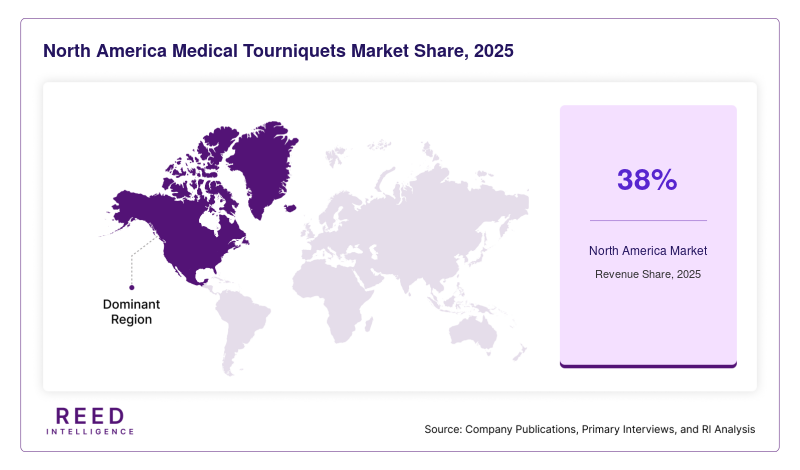
Leads the Medical Tourniquets market, commanding a 38% share, with a revenue of USD 184 million in 2025. The United States is the primary driver, accounting for 85% of regional demand, driven by the high number of surgical procedures, advanced healthcare infrastructure, and a strong focus on patient safety. The North American Medical Tourniquets market is characterized by its focus on innovation and premium products.
Europe Medical Tourniquets Market
Represents the second-largest market, capturing a 30% share with a revenue of USD 146 million in 2025. Germany, the UK, and France are the primary drivers, collectively accounting for 55% of regional demand, driven by strong healthcare systems, a focus on quality, and a well-established surgical market. The Medical Tourniquets market in Europe is characterized by its focus on quality and regulatory compliance.
Asia-Pacific Medical Tourniquets Market
Accounts for 22% of the global Medical Tourniquets market, with a revenue of USD 107 million in 2025. China, Japan, and India are the primary drivers, together accounting for 65% of regional demand, driven by the rapidly growing healthcare infrastructure, increasing surgical volumes, and large population base. The Asia-Pacific Medical Tourniquets market is projected to grow at the fastest CAGR of 8% through 2034.
Middle East & Africa and Latin America Medical Tourniquets Market
Together account for the remaining 10% of the Medical Tourniquets market, with the UAE and Brazil leading their respective regions. Both regions are projected to grow at CAGRs exceeding 7%, driven by improving healthcare infrastructure and increasing trauma care awareness.
Top players in Medical Tourniquets Market
- Zimmer Biomet Holdings, Inc.
- Stryker Corporation
- Smith & Nephew plc
- Medtronic plc
- Becton, Dickinson and Company (BD)
- Cardinal Health, Inc.
- Allegheny Orthopedic
- Delfi Medical Innovations Inc.
- Hammarplast Medical AB
- Rudolf Riester GmbH
- Ulrich Medical USA, Inc.
- Dittmann & Neuhaus GmbH
- VBM Medizintechnik GmbH
- SOMATEX Medical Technologies GmbH
- North American Rescue, LLC
Zimmer Biomet Holdings, Inc.
Zimmer Biomet Holdings, Inc. holds a dominant position in the Medical Tourniquets market, with an estimated 14% global market share, particularly strong in the North American, European, and Asia-Pacific hospital and surgical segments. The company's portfolio of tourniquet systems, including the well-known A.T.S. and Kidde tourniquets, is widely recognized for its quality, reliability, and advanced technology. Zimmer Biomet's market leadership is reinforced by its significant investment in R&D, its extensive global distribution network, and its strong relationships with orthopedic and surgical professionals. Zimmer Biomet commands over 18% of the North American market and 12% of the European market for medical tourniquets, positioning it as a key player in the global market.
Stryker Corporation
Stryker Corporation is a leading player in the Medical Tourniquets market, commanding approximately 12% of the global market share through its comprehensive portfolio of surgical and medical devices, including advanced tourniquet systems. The company's expertise in orthopedics and surgical technology have solidified its position, particularly in the hospital and ambulatory surgical center segments. Stryker's tourniquets are known for their innovation, precision, and ease of use. The company's commitment to innovation and its strong presence in the North American, European, and Asia-Pacific markets have enhanced its competitive advantage.
Smith & Nephew plc holds a significant 10% market share, with particular strength in the wound care, sports medicine, and surgical segments. Medtronic plc is a major player in the medical device market, holding a 8% share, known for its comprehensive portfolio and global reach.
Recent Developments in Medical Tourniquets Market
- 2025: Zimmer Biomet launched a new, smart tourniquet system with integrated pressure sensors and data logging capabilities, enabling real-time monitoring and enhanced patient safety.
- 2025: Stryker Corporation announced a new, lightweight and compact emergency tourniquet designed for military and first responder use, featuring rapid application and enhanced durability.
Medical Tourniquets Market Segments
By Type
- Automatic Tourniquets
- Manual Tourniquets
By Application
- Hospitals
- Ambulatory Surgical Centers
- Emergency Medical Services
- Military & Defense
By Region
- North America
- Europe
- APAC
- Middle East and Africa
- LATAM