Medical Tray Sealer Market Size, Share & Demand Report By Product Type (Automatic Tray Sealers, Semi-Automatic Tray Sealers, Manual Tray Sealers, Rotary Tray Sealers), By Application (Medical Device Packaging, Pharmaceutical Packaging, Diagnostic Product Packaging, Surgical Instrument Packaging, Laboratory Product Packaging), By End Use (Hospitals and Clinics, Pharmaceutical Companies, Medical Device Manufacturers, Contract Packaging Organizations, Diagnostic Laboratories), By Region & Segment F
USD 3950
Market Overview
The global Medical Tray Sealer Market size was valued at USD 1.42 billion in 2026 and is projected to reach USD 3.18 billion by 2034, expanding at a CAGR of 10.6% during the forecast period from 2026 to 2034. The market continues to witness stable expansion due to the increasing demand for sterile packaging systems across hospitals, pharmaceutical manufacturing facilities, and medical device production units. Medical tray sealers are widely used for packaging surgical instruments, diagnostic kits, implantable devices, and disposable healthcare products that require contamination-free handling during storage and transportation.
The increasing emphasis on infection prevention and healthcare safety standards has supported long-term demand for automated sealing technologies. Regulatory authorities across developed and emerging economies continue to implement stricter packaging validation requirements for sterile medical products. This factor has encouraged healthcare manufacturers to adopt advanced tray sealing systems with automated temperature control, pressure monitoring, and sealing verification capabilities. The growing use of single-use medical devices and rising hospital admissions have also contributed to higher packaging volumes globally.
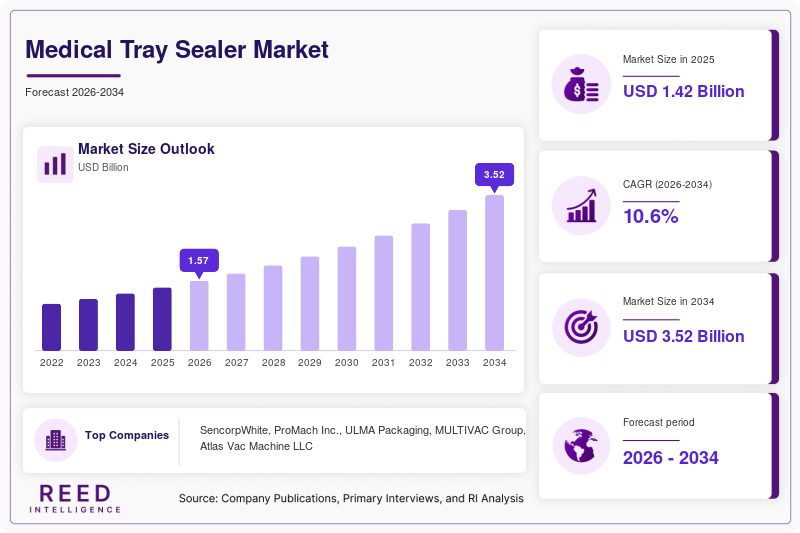
Key Highlights
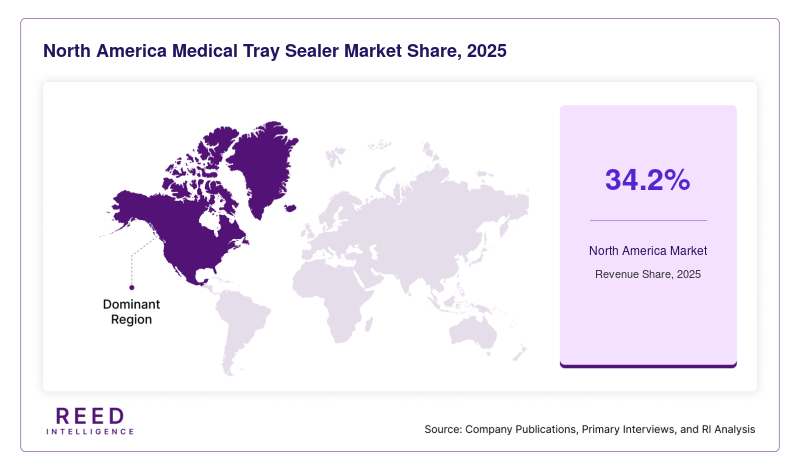
- North America dominated the market with a 34.2% share in 2025, while Asia Pacific is expected to grow at the fastest CAGR of 11.8% during 2026–2034.
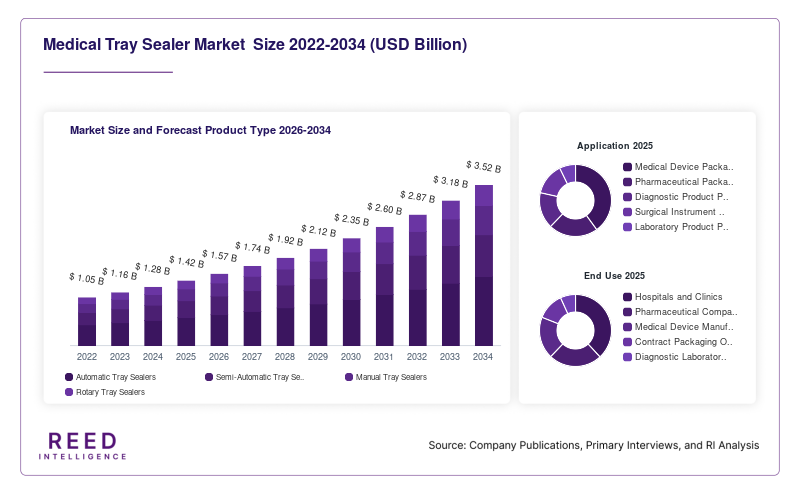
- By product type, automatic tray sealers accounted for the largest share of 46.5% in 2025, while rotary tray sealers are projected to grow at a CAGR of 12.1% during the forecast period.
- By application, medical device packaging led with a 43.9% share, whereas pharmaceutical packaging is expected to expand at a CAGR of 11.6% through 2034.
- By end use, hospitals and clinics represented the dominant share of 39.4%, while contract packaging organizations are anticipated to register a CAGR of 12.4% during the forecast period.
- The United States remained the dominant country, with market values of USD 498 million in 2024 and USD 546 million in 2025.
Market Trends
Integration of Smart Automation in Packaging Operations
Medical packaging manufacturers are increasingly integrating smart automation technologies into tray sealing operations to improve production consistency and reduce manual intervention. Automated tray sealers equipped with programmable logic controllers, touchscreen monitoring systems, and data recording software are gaining wider adoption across healthcare manufacturing facilities. These systems allow operators to monitor sealing temperature, pressure levels, dwell time, and packaging integrity in real time. Companies are adopting Industry 4.0 practices to improve traceability and compliance with regulatory requirements for sterile medical packaging.
The trend is especially visible among large-scale pharmaceutical and medical device manufacturers that require high-speed production lines. Smart automation also helps reduce product rejection rates and lowers operational downtime during packaging activities. Integration with robotic handling systems and AI-based quality inspection tools is improving production efficiency across facilities. Demand for connected sealing systems is expected to rise further as healthcare packaging companies focus on predictive maintenance and digital production management.
Rising Preference for Sustainable Packaging Materials
Healthcare manufacturers are gradually shifting toward sustainable packaging solutions to reduce environmental impact and meet changing regulatory expectations. Medical tray sealing companies are responding by developing equipment compatible with recyclable and lightweight packaging materials. Demand for sealing systems capable of handling biodegradable films, recyclable polymer trays, and low-waste packaging formats is increasing across developed economies.
Hospitals and pharmaceutical companies are also emphasizing sustainable procurement strategies, encouraging packaging suppliers to adopt environmentally responsible production practices. This trend has accelerated research activities focused on improving sealing performance while using thinner packaging substrates. Manufacturers are introducing energy-efficient sealing systems that consume lower electricity and minimize material loss during production. Sustainability initiatives in Europe and North America are expected to create continued demand for advanced medical tray sealers capable of supporting eco-friendly packaging operations without compromising sterility standards.
Market Drivers
Increasing Demand for Sterile Medical Packaging Solutions
The growing global demand for sterile healthcare products is one of the primary factors supporting the expansion of the Medical Tray Sealer Market. Hospitals, surgical centers, and diagnostic laboratories require secure packaging systems to maintain the integrity of medical instruments and disposable products during transportation and storage. Rising awareness regarding healthcare-associated infections has encouraged healthcare providers to strengthen sterilization and packaging standards.
Medical tray sealers help maintain contamination-free packaging conditions by providing airtight and reliable seals for surgical tools, implants, syringes, and diagnostic kits. Growth in minimally invasive surgical procedures and the increasing use of single-use medical products are also contributing to higher demand for sterile packaging systems. Emerging economies are witnessing increased healthcare infrastructure investments, which is further supporting packaging equipment adoption. Manufacturers are responding by introducing advanced sealing technologies that improve productivity while meeting global healthcare safety regulations.
Expansion of Pharmaceutical and Medical Device Manufacturing
The rapid growth of pharmaceutical production and medical device manufacturing facilities is significantly contributing to market growth. Global pharmaceutical companies continue to increase investments in biologics, injectable drugs, vaccines, and specialty therapies, all of which require secure sterile packaging solutions. Medical tray sealers are widely used to package high-value healthcare products that require precise sealing conditions and packaging validation.
The expansion of medical device manufacturing in countries such as China, India, Germany, and the United States has also increased demand for automated packaging systems. Contract manufacturing organizations are adopting high-speed tray sealing machines to improve operational capacity and support large-volume production requirements. Increasing exports of medical products and stricter packaging compliance standards are encouraging manufacturers to upgrade existing packaging infrastructure. This factor is expected to sustain long-term demand for technologically advanced tray sealing equipment across global healthcare industries.
Market Restraint
High Initial Investment and Validation Costs
The high capital investment associated with advanced medical tray sealing equipment remains a major challenge for small and medium-sized healthcare packaging companies. Automated tray sealing systems equipped with digital monitoring, robotic handling, and integrated inspection technologies require significant upfront expenditure. In addition to equipment costs, manufacturers must allocate resources for validation testing, regulatory documentation, operator training, and ongoing maintenance.
Healthcare packaging regulations require companies to conduct extensive seal integrity validation and process qualification procedures before commercial deployment. These compliance activities increase implementation timelines and operational expenses, particularly for smaller organizations operating with limited budgets. Companies in developing economies often delay automation investments due to cost concerns and reliance on semi-automatic packaging systems. The challenge is more evident in facilities handling low production volumes, where return on investment periods are longer. Although automation improves productivity over time, the financial burden associated with adopting advanced tray sealing technologies may restrict market penetration among price-sensitive manufacturers.
Market Opportunities
Growth Potential in Emerging Healthcare Economies
Emerging economies across Asia Pacific, Latin America, and the Middle East are creating significant growth opportunities for medical tray sealing equipment manufacturers. Governments in these regions are increasing healthcare expenditure and expanding domestic pharmaceutical production capabilities to reduce dependency on imports. New hospitals, diagnostic laboratories, and medical device manufacturing facilities require reliable sterile packaging systems to support growing healthcare demand.
Countries such as India, Brazil, Saudi Arabia, and Indonesia are witnessing rising investments in healthcare infrastructure modernization. Local pharmaceutical manufacturers are increasingly adopting automated packaging technologies to comply with international export standards. The expansion of healthcare insurance coverage and improving access to medical services are also increasing demand for packaged medical products. Global packaging equipment suppliers are strengthening regional distribution networks and establishing local manufacturing partnerships to capitalize on this opportunity.
Rising Adoption of Customized and Compact Sealing Systems
The increasing need for flexible and compact packaging equipment is opening new opportunities for manufacturers operating in the Medical Tray Sealer Market. Small healthcare facilities and specialized medical device manufacturers are seeking space-efficient sealing systems capable of handling multiple packaging formats with minimal operational complexity. This demand is encouraging companies to develop modular and customizable tray sealing equipment.
Compact sealing systems with rapid changeover capabilities are gaining attention among contract packaging companies that manage diverse product portfolios. Manufacturers are introducing user-friendly interfaces, energy-efficient designs, and portable sealing equipment suitable for low- to medium-volume packaging environments. Demand for customized sealing systems is particularly strong in specialty healthcare applications, including dental products, laboratory kits, and personalized medical devices. The ability to offer adaptable equipment configurations is expected to create additional revenue opportunities for packaging technology providers during the forecast period.
Segmental Analysis
By Product Type
Automatic tray sealers accounted for the largest market share in 2024 due to their widespread use across high-volume pharmaceutical and medical device packaging facilities. These systems are preferred for their ability to maintain consistent sealing quality while reducing labor dependency and operational errors. Automatic machines support faster packaging throughput and provide better process control through programmable sealing parameters and digital monitoring systems. Healthcare manufacturers increasingly rely on these systems to meet stringent sterility standards and improve production efficiency. The demand for automatic tray sealers is especially high in facilities producing surgical kits, diagnostic products, and disposable healthcare devices. Their compatibility with robotic handling systems and integrated quality inspection technologies has further strengthened adoption across large-scale healthcare packaging operations.
Rotary tray sealers are projected to witness the fastest CAGR of 12.1% during the forecast period due to their ability to support continuous and high-speed packaging processes. These systems are increasingly used in pharmaceutical manufacturing environments where production efficiency and packaging consistency are critical. Rotary sealing technologies reduce downtime and improve operational flexibility by handling multiple tray sizes with rapid format changeovers. The growing demand for large-scale sterile packaging solutions in emerging economies is encouraging manufacturers to invest in rotary equipment. In addition, the expansion of biologics and injectable drug production facilities is creating demand for advanced sealing systems capable of maintaining precise packaging conditions. Manufacturers are also introducing energy-efficient rotary sealers with improved automation capabilities to strengthen market competitiveness.
By Application
Medical device packaging represented the dominant application segment in 2024 and accounted for a substantial share of the global market. The increasing production of surgical tools, implants, catheters, diagnostic devices, and disposable healthcare products continues to support strong demand for tray sealing technologies. Medical device manufacturers require sterile packaging systems that provide secure sealing performance while maintaining product integrity during transportation and storage. Regulatory requirements related to medical device sterility validation are also encouraging manufacturers to adopt advanced sealing equipment with automated inspection capabilities. The growing volume of minimally invasive surgical procedures and rising healthcare expenditure are contributing to higher packaging demand globally. Large healthcare companies are increasingly investing in high-capacity packaging infrastructure to support expanding medical device production activities.
Pharmaceutical packaging is expected to expand at the fastest CAGR of 11.6% during the forecast period due to increasing global pharmaceutical manufacturing activities. Rising demand for vaccines, biologics, injectable drugs, and specialty medicines is driving the need for reliable sterile packaging systems. Pharmaceutical companies are adopting advanced tray sealing technologies to ensure packaging integrity and compliance with healthcare regulations. The increasing focus on cold-chain pharmaceuticals and personalized medicines is also creating opportunities for flexible and high-precision sealing systems. Contract pharmaceutical manufacturing organizations are rapidly upgrading packaging operations to improve production scalability and support export requirements. In addition, investments in automated pharmaceutical packaging lines are expected to increase as companies focus on operational efficiency and contamination prevention.
By End Use
Hospitals and clinics accounted for the largest share of the Medical Tray Sealer Market in 2024 due to rising demand for sterile packaged medical products across healthcare facilities. Hospitals rely on securely sealed trays for surgical instruments, diagnostic tools, disposable medical kits, and emergency healthcare supplies. The increasing number of surgeries and hospital admissions worldwide continues to support packaging consumption. Healthcare institutions are emphasizing infection prevention measures, which has increased demand for contamination-free packaging solutions. Many hospitals are also adopting in-house sterile processing operations equipped with compact tray sealing systems for improved inventory management and operational efficiency. The growing use of disposable healthcare products across emergency care, outpatient treatment, and surgical procedures is expected to maintain stable market demand from this segment.
Contract packaging organizations are projected to witness the fastest CAGR of 12.4% during the forecast period due to increasing outsourcing trends within the pharmaceutical and medical device industries. Healthcare manufacturers are partnering with specialized packaging companies to reduce operational costs and improve production flexibility. Contract packaging firms are investing in advanced tray sealing technologies capable of handling diverse product categories and packaging formats. Rising demand for scalable healthcare packaging solutions is supporting the expansion of third-party packaging operations across emerging and developed economies. These organizations also benefit from increasing regulatory requirements that encourage manufacturers to work with certified packaging specialists. The ability to provide customized packaging services and rapid production scaling continues to strengthen growth opportunities for contract packaging providers.
Regional Analysis
North America
North America accounted for 34.2% of the global Medical Tray Sealer Market in 2025 and continues to maintain a leading position due to the presence of advanced healthcare infrastructure and strong medical device manufacturing activity. The region is projected to expand at a CAGR of 9.4% during the forecast period. High adoption of automated sterile packaging systems across hospitals and pharmaceutical facilities has supported market growth. Regulatory compliance standards established by healthcare authorities continue to encourage manufacturers to invest in advanced sealing technologies with integrated quality monitoring capabilities.
The United States represents the dominant country within the regional market due to the large concentration of pharmaceutical companies and healthcare packaging facilities. One unique growth factor in the country is the increasing use of single-use surgical instruments and disposable healthcare products across hospitals. Rising investments in biologics production and sterile injectable drug manufacturing are also driving demand for high-performance tray sealing systems. Canada is witnessing stable adoption due to expanding medical research activities and growing healthcare equipment imports.
Europe
Europe held a considerable share of the Medical Tray Sealer Market in 2025 and is expected to grow at a CAGR of 9.1% through 2034. The region benefits from strong pharmaceutical manufacturing capabilities, established healthcare systems, and strict packaging regulations focused on patient safety. Medical packaging companies across Germany, France, Italy, and the United Kingdom continue to invest in energy-efficient and digitally integrated tray sealing technologies. Sustainability initiatives across the European healthcare sector are also encouraging the adoption of recyclable packaging materials compatible with advanced sealing systems.
Germany remains the dominant country within the European market due to its large medical device manufacturing industry and technological expertise in industrial automation. A unique growth factor supporting the German market is the increasing integration of smart factory technologies into pharmaceutical and healthcare packaging facilities. Companies are adopting automated production lines with real-time packaging verification systems to improve efficiency and reduce operational risks. The United Kingdom is also witnessing rising demand for sterile packaging equipment driven by expanding diagnostic and laboratory testing services.
Asia Pacific
Asia Pacific is projected to register the fastest CAGR of 11.8% during the forecast period due to rapid healthcare infrastructure development and growing pharmaceutical production capacity. The region accounted for a significant market share in 2025, supported by rising investments in medical device manufacturing across China, India, Japan, and South Korea. Increasing healthcare expenditure and population growth are generating higher demand for sterile packaged medical products. Local manufacturers are adopting automated tray sealing equipment to improve productivity and comply with international packaging standards.
China dominates the Asia Pacific market owing to its large-scale pharmaceutical and medical equipment manufacturing sector. One unique growth factor driving the Chinese market is the expansion of export-oriented healthcare production facilities. Manufacturers are increasingly investing in advanced packaging systems to meet international sterility and packaging quality requirements. India is also emerging as a major growth market due to increasing contract pharmaceutical manufacturing activities and government support for domestic healthcare production. Rising private healthcare investments continue to support regional packaging equipment demand.
Middle East & Africa
The Middle East & Africa Medical Tray Sealer Market is experiencing steady growth due to increasing healthcare modernization programs and rising investments in pharmaceutical production. The region is anticipated to grow at a CAGR of 8.7% through 2034. Countries across the Gulf region are expanding healthcare infrastructure and establishing domestic pharmaceutical manufacturing facilities to strengthen healthcare supply chains. Demand for sterile medical packaging systems is increasing among hospitals, laboratories, and healthcare distributors seeking improved packaging reliability.
Saudi Arabia represents the leading country in the regional market due to ongoing healthcare transformation initiatives and expanding pharmaceutical manufacturing activities. A unique growth factor supporting the Saudi Arabian market is the government’s focus on localizing healthcare production and reducing import dependency. New industrial healthcare zones and medical manufacturing facilities are increasing demand for automated packaging technologies. South Africa is also witnessing gradual market expansion driven by rising diagnostic testing requirements and improving healthcare access across urban healthcare centers.
Latin America
Latin America accounted for a moderate share of the global Medical Tray Sealer Market in 2025 and is expected to grow at a CAGR of 8.9% during the forecast period. Healthcare packaging demand in the region is increasing due to expanding pharmaceutical production, improving hospital infrastructure, and rising awareness regarding sterile medical packaging. Countries such as Brazil, Mexico, and Argentina are witnessing increasing investments in healthcare manufacturing and medical product distribution networks. Regional manufacturers are gradually upgrading packaging operations to improve compliance with international healthcare quality standards.
Brazil dominates the Latin American market due to its large healthcare sector and expanding pharmaceutical manufacturing industry. One unique growth factor supporting the Brazilian market is the increasing growth of domestic medical device production supported by favorable industrial policies. The expansion of private hospitals and diagnostic centers is contributing to higher consumption of sterile packaged healthcare products. Mexico is also experiencing increased demand for packaging automation due to rising medical exports and the expansion of contract healthcare manufacturing operations.
Competitive Landscape
The Medical Tray Sealer Market remains moderately consolidated, with established packaging equipment manufacturers competing through product innovation, automation integration, and geographic expansion strategies. Leading companies are investing in advanced sealing technologies with digital monitoring systems, robotic compatibility, and energy-efficient performance to strengthen their market presence. Competition is also increasing among regional manufacturers offering cost-effective solutions for emerging healthcare markets.
SencorpWhite is considered one of the leading companies in the market due to its broad portfolio of automated tray sealing systems and strong customer presence across healthcare manufacturing industries. The company recently expanded its packaging automation capabilities through the introduction of intelligent sealing systems equipped with enhanced process validation software. Other major companies are focusing on strategic partnerships, manufacturing expansion, and customized product development to improve competitiveness.
Companies are increasingly targeting pharmaceutical packaging applications and contract manufacturing organizations due to rising demand for high-speed sterile packaging systems. Technological advancements related to digital process control and sustainable packaging compatibility are expected to remain key competitive factors throughout the forecast period.
Key Players
- SencorpWhite
- ProMach Inc.
- ULMA Packaging
- MULTIVAC Group
- Atlas Vac Machine LLC
- Nelipak Corporation
- Amcor plc
- Cima-Pak Corporation
- Belco Packaging Systems
- Placon Corporation
- Orics Industries Inc.
- Sonoco Products Company
- Sealed Air Corporation
- Bosch Packaging Technology
- Paxxus Inc.
Recent Developments
- In February 2026, MULTIVAC Group introduced a next-generation medical tray sealing platform with integrated digital inspection systems designed for pharmaceutical packaging facilities.
- In September 2025, ULMA Packaging expanded its healthcare packaging operations in Europe by establishing a new automated equipment manufacturing center focused on sterile medical packaging systems.
- In June 2025, ProMach Inc. launched an upgraded rotary tray sealing system featuring advanced temperature control technology for high-speed medical device packaging applications.
- In January 2026, SencorpWhite announced the integration of AI-enabled monitoring software into its automated tray sealing equipment to improve process validation and production efficiency.
Medical Tray Sealer Market Segments
Product Type
- Automatic Tray Sealers
- Semi-Automatic Tray Sealers
- Manual Tray Sealers
- Rotary Tray Sealers
Application
- Medical Device Packaging
- Pharmaceutical Packaging
- Diagnostic Product Packaging
- Surgical Instrument Packaging
- Laboratory Product Packaging
End Use
- Hospitals and Clinics
- Pharmaceutical Companies
- Medical Device Manufacturers
- Contract Packaging Organizations
- Diagnostic Laboratories
By Region
- North America
- Europe
- APAC
- Middle East and Africa
- LATAM