Medical Tuning Fork Market Size, Share & Demand Report By Product Type (Aluminum Tuning Forks, Stainless Steel Tuning Forks), By Frequency Range (128 Hz, 256 Hz, 512 Hz), By Application (Neurological Examinations, Hearing Tests), By End-Use (Hospitals, Clinics, Medical Institutions), By Region & Segment Forecasts, 2025–2034
USD 3950
Market Overview
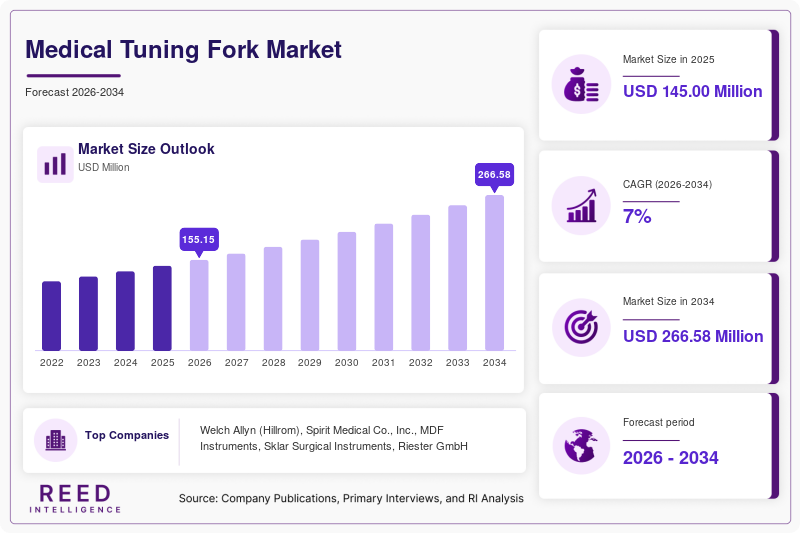
The global Medical Tuning Fork Market size was valued at approximately USD 145 million in 2025 and is projected to reach USD 268 million by 2034, expanding at a compound annual growth rate (CAGR) of 7.0% during the forecast period. The market is witnessing consistent growth due to its essential role in neurological examinations, hearing assessments, and diagnostic procedures in clinical settings.
A key global factor supporting the growth of the Medical Tuning Fork Market is the increasing emphasis on cost-effective and non-invasive diagnostic tools. Medical tuning forks are widely used for assessing hearing loss, vibration sensation, and nerve function, particularly in primary care and neurology. Their affordability, ease of use, and reliability make them indispensable in both developed and emerging healthcare systems.
Key Highlights:
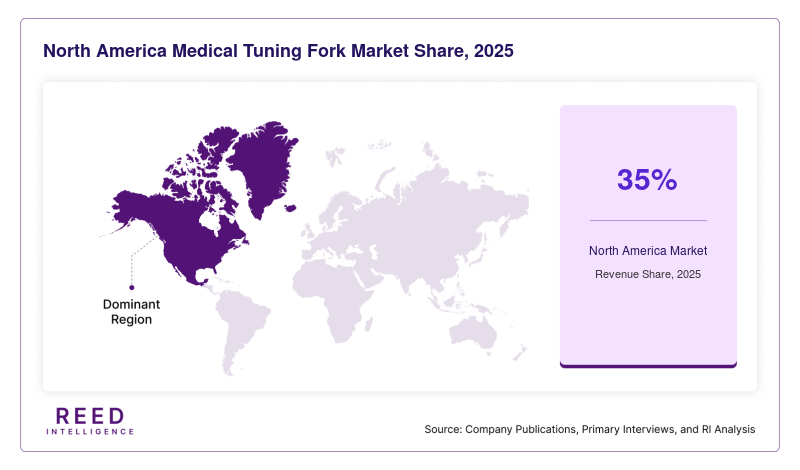
- North America dominated the Medical Tuning Fork Market with a 35% share in 2025, while Asia Pacific is expected to register the fastest CAGR of 8.3%.
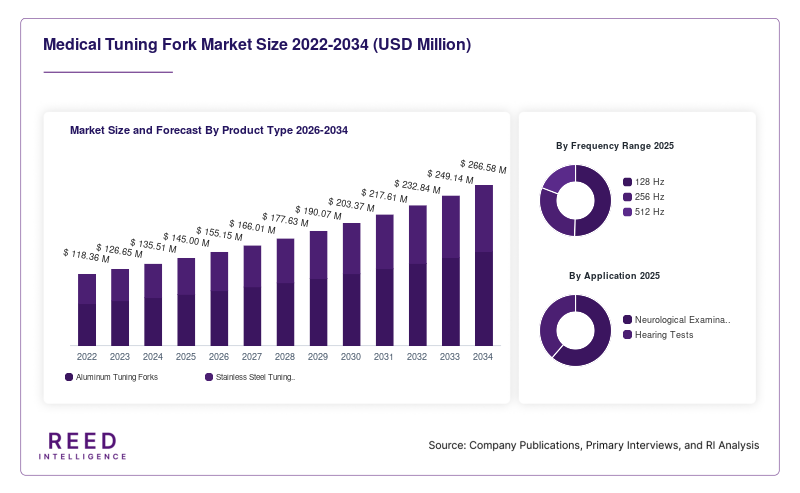
- By product type, aluminum tuning forks led with a 56% share, while stainless steel tuning forks are projected to grow at the fastest CAGR of 7.8%.
- By application, neurological examinations dominated with a 48% share, while hearing tests are expected to grow at a CAGR of 7.6%.
- The U.S. remained the dominant country with market values of USD 52 million in 2025 and USD 55 million in 2026.
Market Trends
Increasing Adoption in Primary Healthcare Settings
The Medical Tuning Fork Market is experiencing growing adoption in primary healthcare due to the rising demand for simple diagnostic tools. Tuning forks are widely used by general practitioners for quick assessments of nerve and hearing functions. Their portability and low cost make them suitable for routine examinations, particularly in resource-limited settings. This trend is expanding their usage beyond specialized healthcare facilities.
Integration with Medical Training and Education
Another notable trend is the increasing use of medical tuning forks in educational institutions. Medical schools and training centers are incorporating these tools into clinical training programs. Students are trained to perform neurological and auditory tests using tuning forks, ensuring widespread familiarity and continued demand. This trend is supporting consistent market growth.
Market Drivers
Rising Prevalence of Neurological and Hearing Disorders
The increasing incidence of neurological conditions and hearing impairments is a major driver for the Medical Tuning Fork Market. Early diagnosis is critical for effective treatment, and tuning forks play a key role in initial assessments. The growing aging population is further contributing to the rise in such conditions, boosting demand for diagnostic tools.
Cost-Effectiveness and Ease of Use
Medical tuning forks are affordable and easy to use, making them accessible to a wide range of healthcare providers. Unlike advanced diagnostic equipment, they do not require extensive training or infrastructure. This simplicity supports their adoption in both developed and developing regions, driving market growth.
Market Restraint
Availability of Advanced Diagnostic Technologies
A significant restraint in the Medical Tuning Fork Market is the increasing availability of advanced diagnostic technologies. Devices such as audiometers and imaging systems provide more detailed and accurate results compared to tuning forks. As healthcare systems adopt these technologies, reliance on traditional tools may decrease.
Additionally, the preference for digital and automated diagnostic solutions is growing among healthcare providers. These tools offer higher precision and data integration capabilities, which may limit the use of tuning forks in certain clinical settings. This shift could impact long-term market growth.
Market Opportunities
Expansion in Emerging Healthcare Markets
Emerging economies present strong growth opportunities for the Medical Tuning Fork Market. Increasing healthcare investments and expansion of primary care services are driving demand for basic diagnostic tools. Tuning forks, being cost-effective and easy to use, are well-suited for these markets.
Development of Enhanced and Durable Products
Manufacturers have the opportunity to develop improved tuning forks with enhanced durability and precision. Innovations in materials and design can increase product lifespan and accuracy, making them more appealing to healthcare providers. This can help maintain relevance in a competitive diagnostic landscape.
Segmental Analysis
By Product Type
Aluminum tuning forks dominated the Medical Tuning Fork Market with a 56% share in 2025, as they are lightweight, cost-effective, and widely used in clinical settings. Their ease of handling and consistent performance make them a preferred choice for routine examinations.
Stainless steel tuning forks are expected to grow at the fastest CAGR of 7.8%, driven by their durability and precision. Their resistance to corrosion and longer lifespan make them suitable for long-term use in healthcare facilities.
By Frequency Range
The 512 Hz tuning forks segment accounted for 42% of the Medical Tuning Fork Market in 2025, as this frequency is commonly used for hearing tests and neurological assessments. It is widely adopted due to its effectiveness in detecting sensory deficits.
The 128 Hz segment is anticipated to grow at a CAGR of 7.4%, as it is frequently used for vibration testing in neurological examinations. Increasing awareness of nerve-related disorders is supporting its growth.
By Application
Neurological examinations accounted for 48% of the market in 2025, as tuning forks are essential for assessing nerve function and vibration sensation. The increasing prevalence of neurological conditions is driving demand in this segment.
Hearing tests are expected to grow at a CAGR of 7.6%, supported by rising cases of hearing impairment and the need for early diagnosis. Tuning forks remain a reliable tool for initial hearing assessments.
By End-Use
Hospitals accounted for 51% of the Medical Tuning Fork Market in 2025, due to their comprehensive diagnostic capabilities and high patient volume. The availability of trained professionals further supports this segment.
Clinics are projected to grow at a CAGR of 7.5%, driven by the expansion of primary healthcare services. The increasing number of outpatient facilities is supporting demand for basic diagnostic tools.
Regional Analysis
North America
North America accounted for 35% of the Medical Tuning Fork Market share in 2025 and will grow at a CAGR of 6.6% through 2034. The region benefits from a well-established healthcare system and high awareness of neurological and auditory disorders. The widespread use of diagnostic tools in routine check-ups is supporting steady market growth.
The United States dominated the region due to its advanced healthcare infrastructure and strong focus on early diagnosis. The presence of medical training institutions and continuous demand for basic diagnostic tools are key factors driving growth.
Europe
Europe held 28% market share in 2025 and is projected to grow at a CAGR of 6.8%. The region has a strong emphasis on preventive healthcare and early diagnosis, which supports the use of medical tuning forks. Increasing healthcare spending and adoption of diagnostic tools are contributing to market expansion.
Germany emerged as the dominant country due to its robust healthcare system and focus on medical education. The country’s emphasis on clinical training and diagnostic accuracy is supporting demand for tuning forks.
Asia Pacific
Asia Pacific captured 20% of the Medical Tuning Fork Market in 2025 and is expected to register the fastest CAGR of 8.3%. Rapid healthcare infrastructure development and increasing awareness of neurological disorders are driving demand. The region is also witnessing growth in medical education and training programs.
China led the region due to its large population and expanding healthcare services. Government initiatives to improve primary healthcare and diagnostic capabilities are supporting market growth.
Middle East & Africa
The Middle East & Africa held 9% share in 2025 and will grow at a CAGR of 7.5%. The market is gradually expanding due to increasing healthcare investments and improving access to medical services. The demand for cost-effective diagnostic tools is supporting growth.
Saudi Arabia dominated the region due to its focus on healthcare modernization. The development of new healthcare facilities and increased adoption of diagnostic tools are driving demand.
Latin America
Latin America accounted for 8% of the Medical Tuning Fork Market in 2025 and is projected to grow at a CAGR of 7.7%. The region is experiencing steady growth due to improving healthcare infrastructure and increasing awareness of diagnostic practices.
Brazil led the region due to its expanding healthcare sector and rising demand for medical devices. The growth of public healthcare programs is supporting market expansion.
Competitive Landscape
The Medical Tuning Fork Market is moderately fragmented, with several manufacturers focusing on product quality and durability. Companies are investing in material innovation and ergonomic designs to enhance user experience.
A leading market player has recently introduced a new range of stainless steel tuning forks designed for improved accuracy and longevity. This development reflects the growing demand for durable and reliable diagnostic tools.
Other players are focusing on expanding their distribution networks and strengthening their presence in emerging markets. The competitive landscape is characterized by continuous product development and efforts to meet evolving healthcare needs.
Key Players List
- Welch Allyn (Hillrom)
- Spirit Medical Co., Inc.
- MDF Instruments
- Sklar Surgical Instruments
- Riester GmbH
- Luxamed GmbH
- American Diagnostic Corporation
- Medline Industries, Inc.
- Prestige Medical
- KaWe (Kirchner & Wilhelm GmbH)
- GIMA S.p.A.
- Timesco Healthcare Ltd.
- Narang Medical Limited
- Surgical Holdings
- Honsun Group
Recent Developments
- 2024: Introduction of durable stainless steel tuning forks with enhanced precision.
- 2024: Expansion of distribution networks in Asia Pacific and Latin America.
- 2025: Launch of ergonomic designs for improved usability in clinical settings.
- 2025: Increased focus on product innovation and quality enhancement.
Medical Tuning Fork Market Segments
By Product Type
- Aluminum Tuning Forks
- Stainless Steel Tuning Forks
By Frequency Range
- 128 Hz
- 256 Hz
- 512 Hz
By Application
- Neurological Examinations
- Hearing Tests
By End-Use
- Hospitals
- Clinics
- Medical Institutions
By Region
- North America
- Europe
- APAC
- Middle East and Africa
- LATAM