Medical Ultrasonic Cleaner Market Size, Share & Demand Report By Product Type (Bench-top Ultrasonic Cleaners, Portable Ultrasonic Cleaners), By Application (Dental Instrument Cleaning, Laboratory Equipment Cleaning, Endoscope Cleaning), By End Use (Hospitals, Dental Clinics, Ambulatory Surgical Centers), By Region & Segment Forecasts, 2026–2034
USD 3950
Market Overview
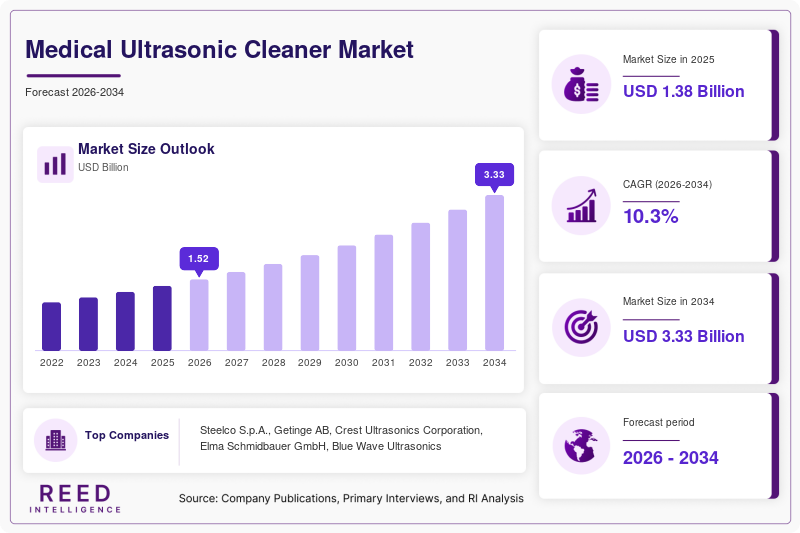
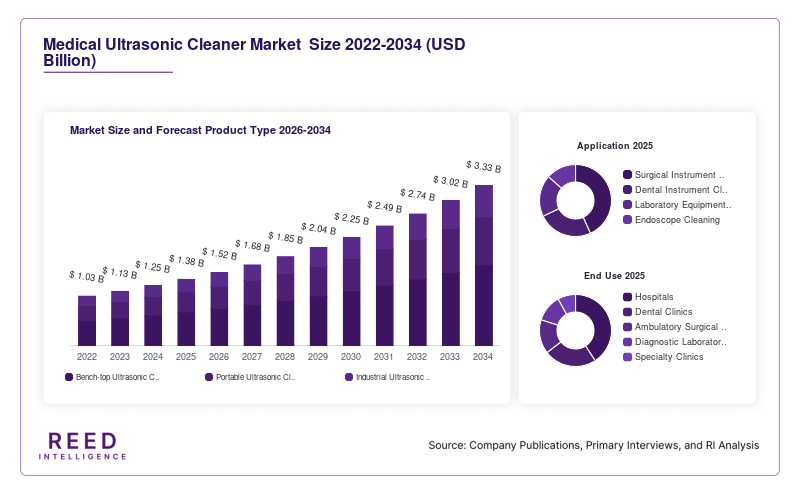
The global Medical Ultrasonic Cleaner Market size was valued at USD 1.38 billion in 2026 and is projected to reach USD 3.02 billion by 2034, expanding at a CAGR of 10.3% during the forecast period from 2026 to 2034. The market continues to gain momentum due to the increasing demand for advanced sterilization and infection prevention systems across hospitals, ambulatory surgical centers, diagnostic laboratories, and dental clinics. Medical ultrasonic cleaners are widely used for removing contaminants from surgical instruments and reusable medical devices through high-frequency sound waves, helping healthcare facilities improve hygiene compliance and operational efficiency.
The growing number of surgical procedures worldwide has become a major factor supporting market expansion. Rising cases of chronic diseases, orthopedic disorders, cardiovascular conditions, and cosmetic surgeries have increased the volume of reusable surgical instruments requiring precise cleaning and disinfection. In addition, healthcare institutions are strengthening infection control protocols to reduce hospital-acquired infections, which has accelerated the adoption of ultrasonic cleaning equipment. Technological advancements such as automated cleaning cycles, digital monitoring systems, compact portable units, and energy-efficient ultrasonic tanks are also contributing to product demand.
Key Highlights
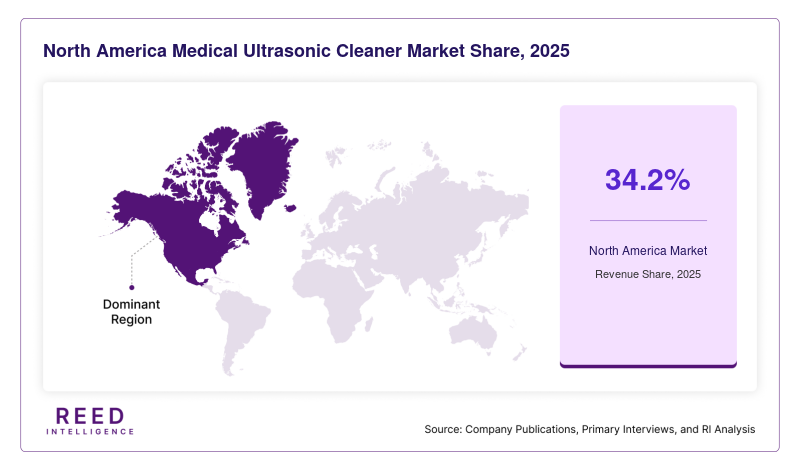
- North America dominated the market with a 34.2% share in 2025.
- Asia Pacific is expected to grow at the fastest CAGR of 11.6% during 2026–2034.
- By product type, bench-top ultrasonic cleaners accounted for the largest share of 39.4%.
- while portable ultrasonic cleaners are projected to grow at a CAGR of 12.1%.
- By application, surgical instrument cleaning led with a 44.8% share.
- whereas dental instrument cleaning is expected to expand at a CAGR of 11.9%.
- The United States remained the dominant country, with market values of USD 420 million in 2024 and USD 462 million in 2025.
Market Trends
Integration of Smart Automation and Digital Monitoring Systems
Healthcare facilities are increasingly adopting smart ultrasonic cleaning systems equipped with automated controls and digital monitoring technologies. Modern medical ultrasonic cleaners now include programmable cleaning cycles, temperature management systems, touchscreen interfaces, and automated frequency adjustment features that improve cleaning consistency and reduce manual intervention. Hospitals and large surgical centers prefer automated systems because they help maintain standard cleaning protocols across departments while minimizing the risk of human error. Digital monitoring also enables healthcare providers to track cleaning performance and maintain compliance with sterilization standards established by healthcare authorities.
Manufacturers are introducing systems integrated with data logging and cloud-based monitoring capabilities that allow hospitals to maintain cleaning records for audit and quality assurance purposes. These technological developments are particularly important for large healthcare institutions managing high instrument volumes daily. Compact smart cleaners are also gaining popularity in dental clinics and outpatient centers due to their ease of use and lower maintenance requirements. As healthcare facilities continue investing in digital transformation and operational efficiency, demand for intelligent ultrasonic cleaning systems is expected to rise steadily throughout the forecast period.
Rising Preference for Compact and Portable Cleaning Equipment
The demand for portable and space-efficient medical ultrasonic cleaners is increasing across small healthcare facilities and specialty clinics. Compact systems are becoming more common in dental practices, ophthalmic clinics, veterinary facilities, and ambulatory surgical centers where space availability is limited. Portable cleaners provide flexibility, faster installation, and lower operational costs while still delivering efficient cleaning performance for delicate medical instruments. Their mobility also allows healthcare professionals to use them across multiple departments without requiring permanent installation infrastructure.
Manufacturers are responding to this demand by introducing lightweight cleaners with improved energy efficiency and enhanced ultrasonic frequency control. Portable units with stainless steel chambers, low water consumption, and shorter cleaning cycles are becoming widely available in the market. In emerging economies, smaller clinics and regional healthcare centers are adopting compact ultrasonic cleaners as a cost-effective solution for maintaining hygiene standards. The increasing establishment of outpatient care centers and independent diagnostic facilities is expected to further support demand for portable ultrasonic cleaning systems during the coming years.
Market Drivers
Growing Volume of Surgical Procedures and Reusable Instruments
The increasing number of surgical procedures worldwide is a major factor driving the growth of the Medical Ultrasonic Cleaner Market. Hospitals and surgical centers perform a high volume of orthopedic, cardiovascular, neurological, cosmetic, and minimally invasive procedures every year, creating strong demand for reliable cleaning systems capable of maintaining instrument hygiene. Reusable surgical instruments require effective cleaning before sterilization to remove blood residues, tissue particles, and microbial contaminants. Ultrasonic cleaning technology provides deep cleaning for complex instrument surfaces that are difficult to clean manually.
Healthcare providers are emphasizing efficient reprocessing workflows to improve patient safety and reduce infection risks associated with contaminated equipment. The growing use of precision surgical instruments and robotic-assisted surgical tools has further increased the need for advanced cleaning systems with controlled cavitation and temperature regulation. As surgical admissions continue rising due to aging populations and chronic disease prevalence, healthcare institutions are expected to invest more heavily in automated cleaning and sterilization infrastructure, supporting long-term market expansion.
Increasing Focus on Infection Prevention and Sterilization Standards
Healthcare-associated infections remain a major concern for hospitals and regulatory authorities worldwide. Medical facilities are strengthening infection control procedures and investing in advanced disinfection technologies to maintain patient safety and regulatory compliance. Medical ultrasonic cleaners play an important role in instrument reprocessing because they can remove microscopic contaminants more effectively than manual cleaning methods. This has increased their adoption across hospitals, dental clinics, and diagnostic laboratories.
Regulatory organizations in developed economies have introduced strict sterilization guidelines that require healthcare providers to maintain standardized cleaning protocols for reusable instruments. Ultrasonic cleaning systems help healthcare facilities achieve these standards while improving workflow efficiency and reducing labor requirements. In addition, rising awareness regarding cross-contamination risks in outpatient and ambulatory care settings has encouraged smaller clinics to adopt ultrasonic cleaning equipment. Growing healthcare investments in emerging economies and the expansion of private hospital networks are expected to further strengthen demand for medical ultrasonic cleaning systems over the forecast period.
Market Restraint
High Initial Equipment Costs and Maintenance Challenges
The relatively high acquisition and maintenance costs associated with advanced medical ultrasonic cleaners continue to restrain market growth in price-sensitive healthcare environments. Large-capacity automated systems equipped with digital monitoring technologies and high-frequency cleaning capabilities require substantial capital investment, making adoption difficult for small clinics and regional healthcare facilities with limited budgets. In developing countries, many healthcare providers still rely on traditional manual cleaning processes because they involve lower upfront expenses.
Maintenance requirements also present operational challenges for healthcare institutions. Ultrasonic cleaning systems require periodic calibration, cleaning solution replacement, tank maintenance, and component servicing to ensure optimal performance. Improper maintenance can reduce cavitation efficiency and compromise cleaning effectiveness, increasing the risk of contamination. In addition, healthcare workers must receive training to operate sophisticated cleaning systems correctly and follow standardized cleaning procedures. These factors can increase operational costs and create barriers for facilities lacking technical expertise or dedicated sterilization departments. Although technological advancements are gradually improving system durability and efficiency, cost-related concerns remain a significant limitation for wider market penetration in low-income healthcare settings.
Market Opportunities
Expansion of Healthcare Infrastructure in Emerging Economies
Rapid healthcare infrastructure development across emerging economies is creating strong growth opportunities for the Medical Ultrasonic Cleaner Market. Governments in countries across Asia Pacific, Latin America, and the Middle East are increasing investments in hospitals, specialty clinics, and diagnostic laboratories to improve healthcare accessibility. Newly established healthcare facilities are adopting modern sterilization and instrument cleaning systems to comply with international hygiene standards and improve patient safety outcomes.
Private healthcare providers are also contributing to market growth by expanding multi-specialty hospitals and ambulatory surgical centers equipped with advanced medical technologies. Rising healthcare spending, medical tourism, and increasing awareness regarding infection prevention are encouraging healthcare institutions to modernize their sterilization infrastructure. Ultrasonic cleaning systems are becoming an attractive solution because they improve cleaning efficiency while reducing manual labor requirements. As healthcare capacity expansion continues in developing regions, manufacturers are expected to benefit from increasing demand for cost-effective and technologically advanced cleaning equipment.
Increasing Adoption in Dental and Specialized Medical Practices
The growing use of ultrasonic cleaners in dental clinics and specialized medical practices presents another major opportunity for market participants. Dental instruments contain small crevices and delicate surfaces that require precise cleaning before sterilization. Ultrasonic cleaning systems offer efficient removal of debris and contaminants without damaging sensitive instruments, making them increasingly popular in dental and orthodontic practices. Rising dental procedure volumes and growing awareness regarding oral hygiene are contributing to higher product demand.
Specialized healthcare facilities such as ophthalmic centers, dermatology clinics, and cosmetic surgery centers are also adopting ultrasonic cleaning technologies to maintain high sterilization standards. Compact and portable ultrasonic cleaners are particularly attractive for these facilities because they occupy less space and offer easy operation. Manufacturers are developing smaller systems with advanced cleaning frequencies and energy-efficient features tailored for specialty medical applications. As outpatient and specialty healthcare services continue expanding globally, the adoption of ultrasonic cleaning equipment is expected to accelerate significantly
Segmental Analysis
By Product Type
Bench-top ultrasonic cleaners accounted for the largest market share of 39.4% in 2024 due to their widespread use across hospitals, dental clinics, and diagnostic laboratories. These systems are preferred because they offer efficient cleaning performance while remaining compact enough for routine medical applications. Bench-top units are widely used for cleaning surgical instruments, forceps, scalpels, dental tools, and laboratory equipment. Healthcare providers favor these systems because they provide consistent cleaning results and support faster sterilization workflows. The availability of different tank capacities and programmable cleaning functions has also increased adoption across healthcare facilities of varying sizes. In addition, bench-top cleaners require relatively lower installation space compared to industrial-scale systems, making them suitable for urban hospitals and specialty clinics with limited operating space.
Portable ultrasonic cleaners are expected to witness the fastest CAGR of 12.1% during the forecast period. The growth of this subsegment is largely driven by increasing demand from ambulatory surgical centers, dental practices, and outpatient healthcare facilities seeking cost-effective and flexible cleaning solutions. Portable systems are easy to transport and install, allowing healthcare providers to use them in multiple departments without requiring dedicated infrastructure. Manufacturers are developing lightweight models with improved cavitation efficiency, lower power consumption, and digital control panels to improve usability. The rising number of independent healthcare facilities and mobile healthcare units in emerging economies is also contributing to market growth. Furthermore, increasing preference for compact sterilization equipment among specialty clinics is expected to sustain strong demand for portable ultrasonic cleaning systems over the coming years.
By Application
Surgical instrument cleaning held the dominant share of 44.8% in 2024 due to the growing number of surgical procedures performed globally. Surgical instruments often contain narrow joints, crevices, and delicate surfaces that require precise cleaning to remove biological contaminants before sterilization. Ultrasonic cleaning systems are highly effective for this purpose because they use high-frequency sound waves to remove microscopic debris without damaging instruments. Hospitals and surgical centers rely heavily on these systems to maintain hygiene standards and reduce infection risks associated with reusable devices. Increasing use of minimally invasive surgical procedures and robotic-assisted instruments has further strengthened the need for advanced cleaning technologies. In addition, rising healthcare regulations regarding instrument reprocessing are encouraging healthcare providers to adopt automated ultrasonic cleaning systems to improve compliance and operational consistency.
Dental instrument cleaning is projected to expand at the fastest CAGR of 11.9% during the forecast period. Dental clinics increasingly use ultrasonic cleaning systems to clean scalers, probes, mirrors, extraction tools, and orthodontic instruments. The growing number of dental procedures and rising awareness regarding oral hygiene are major factors supporting market growth. Dental professionals prefer ultrasonic cleaners because they improve cleaning efficiency while minimizing instrument wear compared to manual scrubbing methods. Compact ultrasonic systems designed specifically for dental applications are becoming more common due to their ease of operation and affordability. The rapid expansion of private dental practices and cosmetic dentistry services in developing economies is also contributing to rising product demand. Furthermore, stricter sterilization guidelines for dental facilities are expected to accelerate adoption of ultrasonic cleaning technologies across the global dental care sector.
By End Use
Hospitals represented the largest end-use segment in 2024 due to their high patient volumes and extensive use of reusable surgical instruments. Large hospitals perform a broad range of medical procedures daily, creating significant demand for efficient cleaning and sterilization equipment. Medical ultrasonic cleaners help hospitals streamline instrument reprocessing workflows while improving infection prevention practices. The presence of centralized sterilization departments in major healthcare institutions further supports the widespread use of ultrasonic cleaning systems. Hospitals are also increasingly adopting automated cleaning technologies with digital monitoring features to improve operational efficiency and maintain compliance with healthcare standards. Rising investments in hospital infrastructure modernization and increasing healthcare spending across developed and developing economies continue to strengthen this segment’s market position.
Ambulatory surgical centers are anticipated to register the fastest CAGR of 11.4% during the forecast period due to the growing shift toward outpatient surgical procedures. These facilities require compact and efficient cleaning systems capable of handling frequent instrument sterilization while maintaining lower operational costs. Ultrasonic cleaners are becoming essential in ambulatory centers because they support faster turnaround times and improve infection control practices. The increasing popularity of minimally invasive surgeries and same-day medical procedures has accelerated the establishment of outpatient care facilities worldwide. Manufacturers are responding by introducing smaller and energy-efficient ultrasonic cleaning units tailored for ambulatory healthcare environments. Additionally, rising patient preference for cost-effective outpatient treatments and shorter hospital stays is expected to continue driving demand for ultrasonic cleaning equipment within ambulatory surgical centers.
Regional Analysis
North America
North America accounted for 34.2% of the global Medical Ultrasonic Cleaner Market share in 2025 and maintained its position as the leading regional market. The region is projected to expand at a CAGR of 9.4% during the forecast period due to strong healthcare infrastructure and widespread adoption of advanced sterilization technologies. Hospitals and ambulatory surgical centers across the United States and Canada continue investing in automated cleaning equipment to improve infection prevention standards and regulatory compliance. The presence of established healthcare device manufacturers and strict sterilization protocols also contributes to sustained market demand.
The United States remained the dominant country in the regional market due to the large number of surgical procedures performed annually and the strong presence of advanced healthcare institutions. Increasing demand for minimally invasive surgeries and robotic-assisted procedures has created additional need for high-precision instrument cleaning systems. Healthcare providers are also emphasizing workflow automation and digital sterilization tracking, which is encouraging adoption of smart ultrasonic cleaning equipment across major hospital networks.
Europe
Europe represented a significant share of the Medical Ultrasonic Cleaner Market in 2025 and is expected to grow at a CAGR of 8.9% through 2034. The market is supported by stringent healthcare regulations related to infection control and reusable instrument sterilization. Countries across Western Europe have implemented standardized cleaning procedures for hospitals and surgical centers, increasing demand for reliable ultrasonic cleaning systems. Rising healthcare expenditure and growing focus on patient safety are also strengthening market expansion in the region.
Germany emerged as the dominant country within the European market because of its advanced healthcare manufacturing sector and strong hospital infrastructure. The country has witnessed increasing investments in automated sterilization technologies to support high surgical procedure volumes and aging population healthcare needs. In addition, the expansion of private specialty clinics and dental care facilities has accelerated demand for compact ultrasonic cleaning units designed for specialized medical applications.
Asia Pacific
Asia Pacific is anticipated to register the fastest CAGR of 11.6% during the forecast period due to rapid healthcare infrastructure expansion and increasing healthcare expenditure. Countries such as China, India, Japan, and South Korea are investing heavily in hospital modernization and advanced sterilization systems. Rising awareness regarding hospital-acquired infections and improved healthcare access are contributing to greater adoption of medical ultrasonic cleaners. The region is also benefiting from increasing medical tourism and the rapid establishment of private healthcare facilities.
China dominated the Asia Pacific market owing to its large patient population and expanding healthcare manufacturing industry. The country has experienced strong demand for cost-effective sterilization equipment across public and private hospitals. Government healthcare reforms aimed at improving infection prevention standards and expanding healthcare access have further accelerated product adoption. Local manufacturers are also introducing affordable ultrasonic cleaning systems to address growing domestic demand and support regional market expansion.
Middle East & Africa
The Middle East & Africa Medical Ultrasonic Cleaner Market is expected to grow steadily during the forecast period with increasing investments in healthcare modernization projects. Governments in Gulf Cooperation Council countries are expanding hospital capacity and upgrading sterilization infrastructure to support rising healthcare demand. Healthcare providers are increasingly adopting ultrasonic cleaning systems to improve patient safety standards and maintain compliance with international sterilization guidelines. Growth in private healthcare investments is also supporting regional market development.
Saudi Arabia remained the leading country in the regional market due to ongoing healthcare infrastructure expansion and rising demand for advanced medical technologies. The country’s healthcare transformation initiatives have encouraged hospitals and specialty clinics to adopt modern instrument cleaning systems. Growing medical tourism activities and increasing surgical procedure volumes have also contributed to stronger demand for ultrasonic cleaning equipment across major urban healthcare centers.
Latin America
Latin America continues to present growth opportunities for the Medical Ultrasonic Cleaner Market due to improving healthcare accessibility and increasing healthcare investments. The market is projected to grow at a healthy pace as hospitals and diagnostic centers strengthen infection prevention measures. Rising awareness regarding reusable instrument sterilization and patient safety has encouraged healthcare institutions to modernize cleaning and disinfection practices. Public healthcare reforms in several countries are also supporting the adoption of advanced medical equipment.
Brazil accounted for the largest share within the regional market owing to its extensive hospital network and growing healthcare expenditure. The country has experienced rising demand for advanced sterilization technologies as healthcare providers seek to reduce contamination risks and improve operational efficiency. Increasing expansion of dental clinics and outpatient surgical centers has further strengthened the need for compact ultrasonic cleaning systems suitable for smaller healthcare environments.
Competitive Landscape
The Medical Ultrasonic Cleaner Market remains moderately competitive with the presence of international medical equipment manufacturers and regional sterilization technology providers. Companies are focusing on product innovation, automation technologies, and strategic partnerships to strengthen their market presence. Many manufacturers are introducing energy-efficient systems with digital interfaces, automated frequency adjustment, and compact designs to address the changing requirements of hospitals and specialty clinics.
Steelco S.p.A. emerged as one of the leading participants in the market due to its strong portfolio of medical cleaning and sterilization equipment. The company has focused on expanding automated ultrasonic cleaning solutions designed for high-volume hospital applications. Recent developments in the market include the launch of smart ultrasonic cleaners integrated with real-time monitoring systems and programmable cleaning cycles to improve compliance and workflow management.
Other major companies are increasing investments in research and development activities to improve cavitation efficiency, reduce noise levels, and enhance cleaning precision for delicate medical instruments. Market participants are also expanding distribution networks in emerging economies to capture rising healthcare infrastructure investments. Strategic collaborations with hospitals and healthcare distributors continue to play a major role in competitive positioning across the global market.
Key Players
- Steelco S.p.A.
- Getinge AB
- Crest Ultrasonics Corporation
- Elma Schmidbauer GmbH
- Blue Wave Ultrasonics
- SharperTek
- Branson Ultrasonics Corporation
- L&R Manufacturing Company
- Kaijo Corporation
- Mettler Electronics Corp.
- Ultrawave Ltd.
- Cole-Parmer Instrument Company
- Kemet International Ltd.
- GT Sonic
- Bandelin Electronic GmbH & Co. KG
Recent Developments
- In February 2025, Getinge AB introduced an automated ultrasonic cleaning platform featuring digital cycle monitoring and integrated temperature control for hospital sterilization departments.
- In September 2024, Steelco S.p.A. expanded its ultrasonic cleaner production capacity in Europe to address rising demand from healthcare institutions and surgical centers.
- In June 2025, Elma Schmidbauer GmbH launched a compact ultrasonic cleaning unit designed specifically for dental and ophthalmic instrument cleaning applications.
Medical Ultrasonic Cleaner Market Segments
Product Type
- Bench-top Ultrasonic Cleaners
- Portable Ultrasonic Cleaners
- Industrial Ultrasonic Cleaners
Application
- Surgical Instrument Cleaning
- Dental Instrument Cleaning
- Laboratory Equipment Cleaning
- Endoscope Cleaning
End Use
- Hospitals
- Dental Clinics
- Ambulatory Surgical Centers
- Diagnostic Laboratories
- Specialty Clinics
By Region
- North America
- Europe
- APAC
- Middle East and Africa
- LATAM