Medicare Billing Software Market Size, Share & Demand Report By Deployment Mode (Cloud-Based, On-Premise, Hybrid), By Application (Claims Management, Revenue Cycle Management, Insurance Eligibility Verification, Payment Processing, Coding and Documentation), By End Use (Hospitals, Physician Practices, Ambulatory Surgical Centers, Diagnostic Laboratories, Specialty Clinics), By Region & Segment Forecasts, 2026–2034
USD 3950
Market Overview
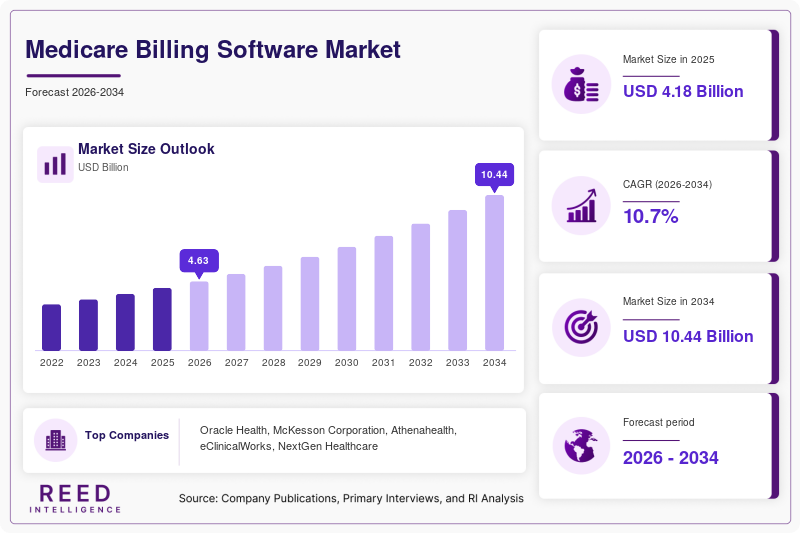
The global Medicare Billing Software Market size was valued at USD 4.18 billion in 2026 and is projected to reach USD 9.42 billion by 2034, expanding at a CAGR of 10.7% during the forecast period from 2026 to 2034. The market is experiencing consistent growth due to the increasing digitization of healthcare administration, rising Medicare enrollment, and growing pressure on healthcare providers to improve reimbursement accuracy. Healthcare facilities are adopting advanced billing software solutions to reduce claim denials, streamline coding procedures, and maintain compliance with evolving Medicare regulations. The transition toward automated healthcare revenue cycle management systems has further accelerated demand for integrated billing platforms across hospitals, clinics, ambulatory centers, and physician practices.
One of the major global factors supporting market growth is the expansion of aging populations and government-funded healthcare reimbursement programs. Countries with rapidly growing elderly populations are witnessing a rise in chronic disease management and long-term care services, increasing the volume of Medicare-related claims processing. Healthcare organizations are investing in cloud-based billing systems equipped with AI-enabled coding assistance, predictive claim analytics, and interoperability features to improve operational efficiency. Additionally, regulatory mandates encouraging electronic health records integration and standardized digital healthcare infrastructure are contributing to wider software adoption across developed and emerging healthcare markets.
Key Highlights
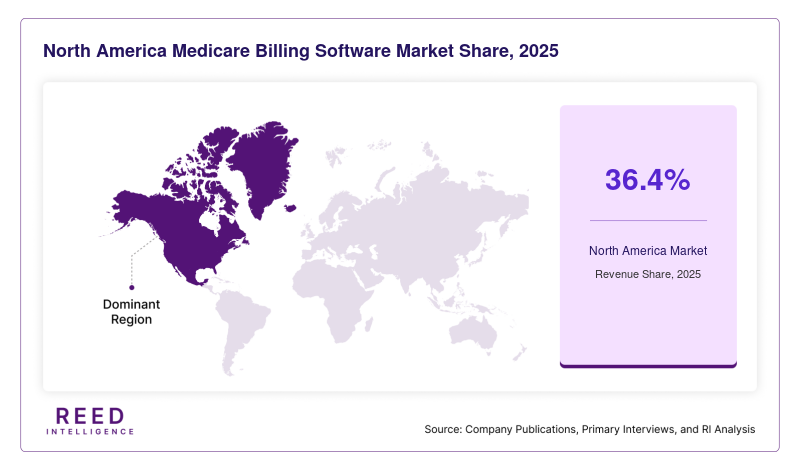
- North America dominated the market with a 36.4% share in 2025.
- Asia Pacific is expected to grow at the fastest CAGR of 12.1% during 2026–2034.
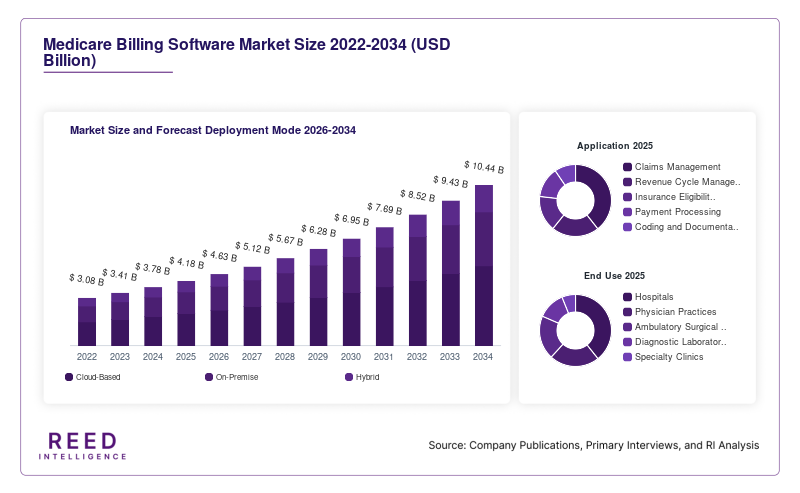
- By deployment mode, cloud-based software accounted for the largest share of 61.8%, while AI-enabled billing platforms are projected to grow at a CAGR of 13.4%.
- By application, claims management led with a 39.7% share, whereas revenue cycle management is expected to expand at a CAGR of 12.6%. By end use, hospitals represented the dominant segment with a 44.1% share, while ambulatory surgical centers are forecast to grow at a CAGR of 11.9%.
- The United States remained the dominant country, with market values of USD 1.42 billion in 2024 and USD 1.58 billion in 2025.
Market Trends
Rising Integration of Artificial Intelligence in Billing Workflows
Healthcare providers are increasingly integrating artificial intelligence technologies into Medicare billing software platforms to improve coding precision and reduce administrative workload. AI-enabled billing systems can analyze patient records, automate claims generation, detect coding inconsistencies, and predict reimbursement outcomes with greater efficiency than traditional manual systems. These solutions are helping hospitals and physician groups reduce denied claims and improve cash flow management. AI-driven automation also supports real-time compliance monitoring, ensuring that providers adhere to changing Medicare regulations and documentation requirements. As healthcare reimbursement structures become more complex, organizations are prioritizing intelligent software capable of minimizing human error and improving claim acceptance rates. Vendors are responding by introducing machine learning algorithms, robotic process automation, and predictive analytics capabilities into next-generation billing software solutions.
Expansion of Cloud-Based Healthcare Revenue Management Platforms
Cloud-based Medicare billing software solutions are witnessing strong adoption due to their scalability, cost efficiency, and remote accessibility. Healthcare organizations are transitioning away from on-premise systems to centralized cloud infrastructure that enables seamless updates, secure data storage, and interoperability with electronic health records. Cloud deployment models also reduce hardware maintenance costs and simplify software upgrades, making them attractive for small and medium-sized healthcare providers. The growing use of telehealth services and distributed healthcare networks has further accelerated cloud adoption across billing operations. Vendors are increasingly offering subscription-based software models with integrated cybersecurity features, analytics dashboards, and mobile accessibility. This trend is supporting digital transformation initiatives across the healthcare sector and encouraging broader software implementation in emerging economies where healthcare infrastructure modernization is expanding rapidly.
Market Drivers
Increasing Medicare Enrollment and Aging Population Growth
The rising global elderly population is significantly contributing to the growth of the Medicare Billing Software Market. Older populations require continuous healthcare services, including chronic disease management, outpatient treatments, and long-term medical care, leading to higher claim processing volumes. Healthcare providers are facing increased administrative burdens associated with Medicare reimbursement management, encouraging investments in automated billing systems. Government healthcare programs are also expanding coverage for aging populations, further increasing the complexity of billing procedures and regulatory compliance requirements. Billing software platforms enable providers to streamline coding, claims submission, reimbursement tracking, and documentation management. As healthcare systems seek to improve operational efficiency while handling growing patient volumes, demand for intelligent Medicare billing software solutions continues to rise across hospitals, specialty clinics, and physician networks worldwide.
Growing Demand for Revenue Cycle Optimization in Healthcare Facilities
Healthcare organizations are increasingly focusing on revenue cycle optimization to improve profitability and reduce claim denials. Medicare billing software plays a central role in automating financial workflows, reducing billing errors, and accelerating reimbursement timelines. Hospitals and healthcare providers are adopting integrated software solutions that combine billing management, patient records, coding assistance, and analytics capabilities into unified platforms. Rising operational costs and declining reimbursement margins are encouraging healthcare institutions to modernize their administrative infrastructure. Advanced billing software solutions help providers improve financial transparency, monitor payer performance, and identify inefficiencies in reimbursement processes. The demand for software platforms capable of supporting accurate coding and compliance management is expected to remain strong as healthcare regulations continue evolving across multiple regional markets.
Market Restraint
Concerns Related to Data Security and Regulatory Compliance
Data security concerns and strict healthcare compliance requirements remain major restraints affecting the Medicare Billing Software Market. Billing software systems process large volumes of sensitive patient information, including medical histories, insurance details, financial records, and identification data. Cybersecurity threats such as ransomware attacks, unauthorized data access, and cloud security vulnerabilities are creating operational risks for healthcare organizations. Providers must comply with strict healthcare data protection regulations, increasing implementation complexity and operational expenses. Small healthcare facilities often face challenges in maintaining secure IT infrastructure and ensuring continuous software compliance updates. Additionally, integration issues between legacy healthcare systems and modern billing platforms may lead to workflow disruptions and data migration complications. These challenges can slow software adoption among cost-sensitive healthcare providers, particularly in developing markets where digital infrastructure and cybersecurity capabilities remain limited.
Market Opportunities
Expansion of Telehealth Services and Remote Healthcare Administration
The rapid expansion of telehealth services is creating new growth opportunities for the Medicare Billing Software Market. Virtual healthcare consultations, remote diagnostics, and digital patient engagement platforms have increased the complexity of reimbursement management for healthcare providers. Billing software vendors are developing solutions capable of supporting telehealth-specific coding, automated reimbursement verification, and multi-channel claims processing. As remote healthcare delivery becomes more common, providers require integrated billing systems that can manage both physical and virtual patient interactions. Governments and healthcare payers are also expanding reimbursement support for telemedicine services, increasing the volume of digitally processed claims. This shift is encouraging software developers to introduce flexible cloud-based platforms designed for hybrid healthcare environments and decentralized medical networks.
Rising Adoption of Healthcare IT Infrastructure in Emerging Economies
Emerging economies are investing heavily in healthcare digitalization, creating favorable opportunities for Medicare billing software providers. Governments across Asia Pacific, Latin America, and the Middle East are implementing healthcare modernization programs focused on electronic health records, insurance management, and digital reimbursement systems. Expanding private healthcare infrastructure and increasing health insurance penetration are driving demand for advanced billing technologies. Small and medium-sized healthcare providers in developing markets are adopting cloud-based billing software due to lower upfront costs and simplified deployment models. International software vendors are also forming partnerships with regional healthcare organizations to improve market penetration. The growing need for operational efficiency, accurate reimbursement management, and compliance monitoring is expected to support long-term software adoption across emerging healthcare ecosystems.
Segmental Analysis
By Deployment Mode
Cloud-based deployment emerged as the dominant subsegment in the Medicare Billing Software Market, accounting for 61.8% of global revenue in 2024. Healthcare organizations are increasingly adopting cloud-based platforms due to their lower infrastructure costs, remote accessibility, and scalable architecture. These systems allow providers to access billing data across multiple healthcare facilities while maintaining centralized administrative control. Cloud deployment also simplifies software updates and integration with electronic health records, enabling healthcare institutions to improve workflow efficiency. Hospitals and physician groups are prioritizing cloud-based solutions because they support flexible subscription pricing models and reduce the need for extensive on-site IT infrastructure. The growing demand for telehealth integration and remote administrative management has further strengthened adoption across large healthcare networks and smaller outpatient facilities.
AI-enabled billing software is projected to witness the fastest growth within the deployment segment, expanding at a CAGR of 13.4% during the forecast period. Healthcare providers are adopting intelligent billing platforms capable of automating coding procedures, identifying reimbursement errors, and predicting claim outcomes. AI technologies improve operational accuracy and reduce manual administrative workload, enabling healthcare institutions to optimize revenue cycle performance. Vendors are increasingly introducing advanced analytics capabilities, machine learning algorithms, and robotic process automation into billing systems to enhance financial efficiency. The demand for AI-driven platforms is also rising because healthcare organizations seek faster reimbursement approvals and improved compliance management. Growing investments in healthcare analytics and automation technologies are expected to accelerate adoption of intelligent billing software solutions across developed and emerging markets.
By Application
Claims management represented the leading application segment in the Medicare Billing Software Market and accounted for 39.7% of total revenue in 2024. Healthcare organizations rely heavily on claims management software to streamline reimbursement processing, minimize billing errors, and improve financial performance. These platforms help providers automate claim generation, track payment status, and reduce denial rates through real-time validation features. Rising patient volumes and increasingly complex reimbursement structures are encouraging healthcare institutions to implement advanced claims management systems. Integrated claims processing solutions also improve coordination between hospitals, insurance providers, and government reimbursement agencies. The increasing emphasis on operational efficiency and regulatory compliance has strengthened adoption of automated claims management software across hospitals, specialty clinics, and ambulatory care centers worldwide.
Revenue cycle management is expected to emerge as the fastest-growing application segment, registering a CAGR of 12.6% during the forecast period. Healthcare providers are increasingly focusing on end-to-end financial workflow optimization to improve profitability and reduce administrative delays. Revenue cycle management software integrates billing, coding, reimbursement tracking, patient data management, and analytics capabilities into centralized platforms. These systems help providers identify inefficiencies, improve payment collection rates, and strengthen financial transparency. Growing pressure on healthcare institutions to maintain sustainable revenue streams is encouraging investment in comprehensive administrative automation solutions. Vendors are also introducing AI-driven predictive analytics and reporting tools that help healthcare organizations monitor payer performance and improve reimbursement forecasting accuracy, further supporting segment growth.
By End Use
Hospitals accounted for the largest share of the Medicare Billing Software Market in 2024, representing 44.1% of total revenue. Large hospitals manage substantial patient volumes and complex reimbursement structures, making advanced billing software essential for operational efficiency. These institutions require integrated systems capable of supporting claims processing, coding management, patient records integration, and financial reporting. Hospitals are also prioritizing software solutions that can reduce administrative costs and improve reimbursement timelines. The growing adoption of electronic health records and centralized healthcare management platforms has strengthened billing software implementation across public and private hospital networks. Additionally, increasing regulatory compliance requirements and pressure to reduce claim denials are encouraging hospitals to invest in automated revenue cycle management systems.
Ambulatory surgical centers are projected to witness the fastest growth within the end-use segment, expanding at a CAGR of 11.9% through 2034. These facilities are increasingly adopting digital billing systems to manage rising outpatient procedure volumes and improve reimbursement accuracy. Ambulatory surgical centers require cost-effective and scalable software platforms capable of streamlining administrative workflows and supporting rapid patient turnover. The shift toward outpatient care and minimally invasive procedures is contributing to higher demand for efficient billing management solutions. Vendors are developing cloud-based platforms specifically designed for smaller healthcare facilities with simplified deployment and subscription pricing models. The growing preference for outpatient treatment services and expanding private healthcare infrastructure are expected to support long-term segment growth.
Regional Analysis
North America
North America accounted for the largest share of the Medicare Billing Software Market in 2025, representing 36.4% of global revenue. The region is projected to expand at a CAGR of 10.1% during the forecast period due to strong healthcare IT infrastructure and widespread adoption of digital healthcare administration systems. Healthcare providers across the United States and Canada are increasingly implementing automated billing software to improve reimbursement efficiency and reduce administrative complexity. Favorable government initiatives supporting electronic health records integration and healthcare interoperability continue to strengthen market expansion across hospitals and physician practices.
The United States remained the dominant country within North America due to high Medicare enrollment and advanced healthcare digitization. A key growth factor supporting the market is the increasing adoption of AI-enabled revenue cycle management platforms among large healthcare networks. Healthcare organizations are investing in predictive analytics and automated coding technologies to improve claim approval rates and minimize operational costs. Additionally, rising healthcare expenditure and the presence of major software vendors are contributing to continuous market innovation across the country.
Europe
Europe represented a substantial share of the Medicare Billing Software Market in 2025 and is forecast to register a CAGR of 9.4% between 2026 and 2034. The region is experiencing increasing adoption of digital billing systems due to healthcare modernization initiatives and expanding insurance-based reimbursement models. Public and private healthcare providers are implementing billing automation platforms to improve administrative transparency and manage increasing patient volumes efficiently. Countries across Western Europe are emphasizing digital healthcare transformation programs, supporting broader adoption of integrated healthcare management software solutions.
Germany emerged as the dominant country within the European market due to its strong healthcare infrastructure and advanced digital health investments. A major growth factor in the country is the expansion of integrated electronic healthcare systems that support automated reimbursement management. Healthcare facilities are prioritizing interoperable billing solutions capable of reducing coding errors and ensuring compliance with evolving healthcare regulations. The increasing focus on healthcare cost management and operational efficiency is also driving demand for advanced Medicare billing software platforms across the region.
Asia Pacific
Asia Pacific is expected to witness the fastest growth in the Medicare Billing Software Market, with a projected CAGR of 12.1% during the forecast period. The region is benefiting from rapid healthcare digitalization, expanding healthcare insurance coverage, and increasing investments in hospital infrastructure. Healthcare providers are adopting cloud-based billing software to improve patient data management and streamline reimbursement procedures. Growing awareness regarding revenue cycle optimization and administrative automation is encouraging healthcare institutions to modernize traditional billing processes across emerging economies in the region.
China remained the leading country in the Asia Pacific market due to expanding healthcare infrastructure and strong government investments in digital healthcare systems. A key growth factor supporting the market is the rapid adoption of cloud-based healthcare management platforms among urban hospitals and specialty clinics. Healthcare providers are increasingly seeking scalable billing systems that can manage rising patient volumes and insurance claims efficiently. The growing middle-class population and rising healthcare spending are also contributing to sustained software demand across the country.
Middle East & Africa
The Middle East & Africa region is gradually expanding within the Medicare Billing Software Market and is projected to grow at a CAGR of 8.8% through 2034. Governments across the region are implementing healthcare digitalization initiatives to improve patient management and administrative efficiency. Hospitals and healthcare providers are increasingly adopting billing software systems to reduce paperwork, improve reimbursement processing, and strengthen healthcare data management. The development of smart hospitals and expanding healthcare infrastructure projects are supporting technology adoption across major urban healthcare centers.
Saudi Arabia dominated the regional market due to significant investments in healthcare modernization and digital transformation initiatives. A major growth factor driving software adoption is the expansion of government-supported healthcare digitization programs under national development strategies. Healthcare facilities are implementing cloud-based administrative systems to improve operational performance and patient service quality. Additionally, increasing private sector participation in healthcare delivery is encouraging demand for scalable and interoperable billing software platforms across the country.
Latin America
Latin America accounted for a moderate share of the global Medicare Billing Software Market in 2025 and is expected to register a CAGR of 9.1% during the forecast period. Healthcare providers across the region are increasingly adopting digital billing platforms to improve reimbursement management and reduce administrative inefficiencies. The growth of private healthcare facilities and expanding health insurance programs are contributing to higher demand for automated billing solutions. Governments are also investing in healthcare IT infrastructure modernization to strengthen digital healthcare delivery systems.
Brazil remained the dominant country within the Latin American market due to its large healthcare sector and growing healthcare technology investments. A significant growth factor supporting the market is the increasing adoption of cloud-based healthcare software among private hospitals and diagnostic centers. Healthcare providers are focusing on improving billing transparency and minimizing claim processing delays through digital workflow automation. The rising prevalence of chronic diseases and increasing patient volumes are also contributing to greater demand for efficient billing management systems across the country.
Competitive Landscape
The Medicare Billing Software Market is moderately competitive, with global and regional software vendors focusing on innovation, cloud integration, and AI-enabled revenue cycle management solutions. Companies are investing in product development, strategic acquisitions, and partnerships with healthcare providers to strengthen their market presence. Competition is primarily driven by software interoperability, automation capabilities, cybersecurity features, and compliance management functionality. Vendors are also emphasizing user-friendly interfaces and scalable deployment models to attract small and medium-sized healthcare organizations.
Oracle Health remained one of the leading companies in the market due to its comprehensive healthcare administration portfolio and strong global customer base. The company recently expanded its AI-driven billing analytics capabilities to improve reimbursement accuracy and financial workflow automation for hospitals and integrated healthcare systems. Other major companies are also introducing cloud-native billing solutions with predictive analytics and interoperability support to strengthen competitive positioning. Market participants are expected to continue investing in advanced healthcare automation technologies to address rising demand for efficient reimbursement management solutions.
Key Players
- Oracle Health
- McKesson Corporation
- Athenahealth
- eClinicalWorks
- Veradigm
- AdvancedMD
- Kareo
- CureMD Healthcare
- NextGen Healthcare
- Epic Systems Corporation
- Greenway Health
- DrChrono
- Practice Fusion
- CareCloud
- R1 RCM Inc.
Recent Developments
- In February 2026, Oracle Health introduced an AI-powered claims validation module designed to reduce Medicare claim denials and improve reimbursement accuracy for large healthcare systems.
- In September 2025, Athenahealth expanded its cloud-based revenue cycle management platform with enhanced telehealth billing support and predictive payment analytics capabilities.
- In January 2026, NextGen Healthcare launched an integrated billing automation solution focused on outpatient clinics and ambulatory surgical centers to improve financial workflow efficiency.
- In November 2025, CareCloud announced a strategic partnership with regional healthcare providers in Asia Pacific to expand adoption of cloud-native Medicare billing platforms.
- In March 2026, AdvancedMD upgraded its cybersecurity infrastructure and compliance monitoring features to strengthen patient data protection within its billing software portfolio.
Medicare Billing Software Market Segments
Deployment Mode
- Cloud-Based
- On-Premise
- Hybrid
Application
- Claims Management
- Revenue Cycle Management
- Insurance Eligibility Verification
- Payment Processing
- Coding and Documentation
End Use
- Hospitals
- Physician Practices
- Ambulatory Surgical Centers
- Diagnostic Laboratories
- Specialty Clinics
By Region
- North America
- Europe
- APAC
- Middle East and Africa
- LATAM