Medicine Box Timer Market Size, Share & Demand Report By Product Type (Electronic Medicine Box Timers, Smart Connected Medicine Box Timers, Mechanical Medicine Box Timers, Voice-Assisted Medicine Box Timers), By Application (Homecare Medication Management, Elderly Care Monitoring, Hospital Medication Administration, Rehabilitation and Recovery Care), By Distribution Channel (Offline Retail, Online Retail, Hospital Pharmacies, Direct Sales) By Region & Segment Forecasts, 2026–2034
USD 3950
Market Overview
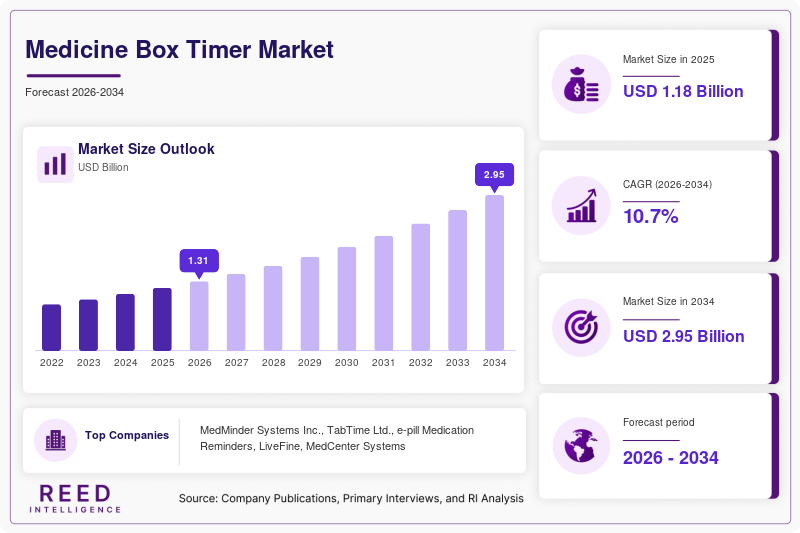
The global Medicine Box Timer Market size was valued at USD 1.18 billion in 2026 and is projected to reach USD 2.67 billion by 2034, expanding at a CAGR of 10.7% during the forecast period from 2026 to 2034. The market is witnessing stable growth due to the rising need for medication adherence solutions among aging populations and patients with chronic diseases. Medicine box timers are increasingly used in homes, hospitals, assisted living facilities, and rehabilitation centers to improve medication management and reduce missed doses. These products combine compartment-based storage systems with digital reminders, alarms, and connected health functions that support patient compliance.
One major global factor supporting market growth is the increasing burden of chronic illnesses such as diabetes, cardiovascular disorders, hypertension, and neurological conditions. Patients suffering from long-term diseases often require multiple medications at different times of the day, creating demand for organized and technology-enabled medicine management systems. Healthcare providers and caregivers are adopting medicine box timers to reduce medication errors, improve treatment outcomes, and support independent living among elderly patients. The integration of Bluetooth connectivity, smartphone synchronization, and voice reminder systems is also expanding the commercial appeal of these devices.
Key Highlights
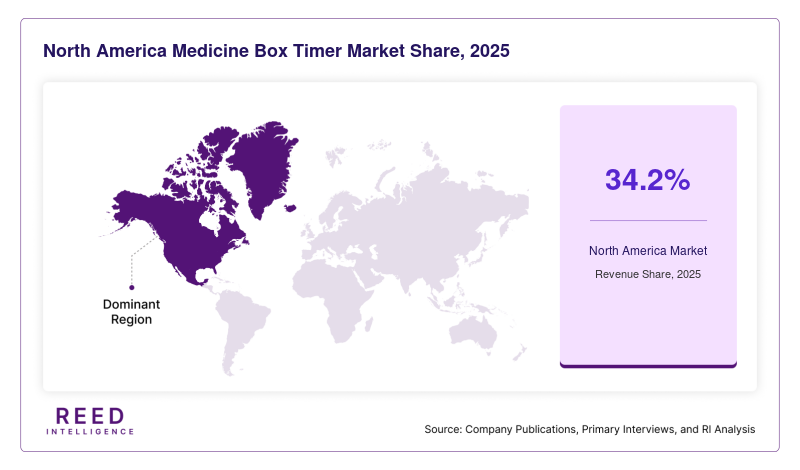
- North America dominated the market with a 34.2% share in 2025, while Asia Pacific is expected to grow at the fastest CAGR of 11.9% during 2026–2034.
- By product type, electronic medicine box timers accounted for the largest share of 46.8%, while smart connected medicine box timers are projected to grow at a CAGR of 12.8%.
- By application, homecare medication management led with a 43.6% share, whereas elderly care monitoring is expected to expand at a CAGR of 12.1%.
- The United States remained the dominant country, with market values of USD 312 million in 2024 and USD 348 million in 2025.
Market Trends
Integration of Smart Connectivity and Mobile Health Features
The Medicine Box Timer Market is experiencing a strong shift toward connected healthcare technologies. Manufacturers are integrating Bluetooth, Wi-Fi, and mobile application synchronization into medicine box timers to improve medication tracking and patient monitoring. Smart medicine organizers now allow caregivers and healthcare professionals to receive notifications when patients miss scheduled doses. This trend is particularly important in elderly care and chronic disease management, where medication adherence directly affects treatment success. Mobile applications linked to medicine box timers can generate adherence reports, send refill reminders, and provide real-time alerts. These connected systems are becoming increasingly attractive for hospitals, home healthcare providers, and insurance companies that aim to reduce avoidable hospital admissions caused by medication noncompliance.
The expansion of telehealth services has further accelerated demand for connected medicine box timers. Remote patient monitoring programs are increasingly including medication reminder devices as part of digital healthcare packages. Technology companies are also collaborating with healthcare providers to introduce cloud-enabled adherence tracking systems. Consumers are showing greater interest in multifunctional products that combine reminders, storage compartments, and caregiver communication tools within a single platform. As digital health adoption rises across developed and emerging economies, connected medicine box timers are expected to become an important component of home-based healthcare infrastructure.
Growing Demand for Elderly-Friendly and Portable Designs
The rising elderly population is influencing product innovation across the Medicine Box Timer Market. Older adults often face challenges related to memory loss, reduced vision, and complex medication schedules. As a result, companies are introducing user-friendly medicine box timers with larger displays, voice-guided instructions, color-coded compartments, and simplified operating systems. Easy-open compartments and ergonomic designs are also becoming important purchasing factors for elderly consumers. Manufacturers are focusing on improving convenience and accessibility to support independent living among senior citizens.
Portable medicine box timers are also gaining traction among working professionals, travelers, and patients requiring frequent medication schedules. Compact devices with rechargeable batteries and lightweight construction are increasingly preferred in urban healthcare settings. Several companies are developing travel-friendly products that include vibration reminders, silent alarm modes, and water-resistant structures. The growing awareness regarding preventive healthcare and medication discipline is contributing to consumer interest in portable reminder devices. This trend is expected to create long-term growth opportunities for companies that can deliver practical and technologically advanced medicine management solutions.
Market Drivers
Rising Prevalence of Chronic Diseases and Complex Medication Schedules
The increasing prevalence of chronic diseases is one of the primary factors driving the Medicine Box Timer Market. Conditions such as diabetes, arthritis, cardiovascular disorders, asthma, and neurological diseases require patients to follow strict medication routines over long periods. Many patients, especially older adults, struggle to manage multiple prescriptions taken at different times throughout the day. Medicine box timers help reduce medication errors by providing structured storage compartments and scheduled reminders that improve adherence.
Healthcare providers are recognizing the importance of medication compliance in reducing treatment complications and hospital readmissions. Poor adherence often results in worsening health conditions, higher healthcare costs, and increased emergency care visits. Medicine box timers are increasingly being recommended by physicians, pharmacists, and caregivers to support treatment consistency. Demand is also rising among family caregivers who need practical solutions to monitor elderly relatives living independently. As the global burden of chronic disease continues to increase, the need for reliable medication management tools is expected to support long-term market growth.
Expansion of Home Healthcare and Assisted Living Services
The rapid expansion of home healthcare services is significantly contributing to the growth of the Medicine Box Timer Market. Healthcare systems worldwide are encouraging home-based treatment to reduce hospital overcrowding and lower medical expenses. Medicine box timers are becoming essential devices in homecare settings because they support patient independence while improving medication accuracy. Home healthcare agencies increasingly include medication reminder systems as part of patient support programs for elderly individuals and patients recovering from surgeries or chronic illnesses.
Assisted living facilities and nursing homes are also adopting medicine box timers to improve operational efficiency and reduce caregiver workload. Automated reminders and organized storage systems simplify medication administration processes and help reduce dispensing mistakes. Government healthcare initiatives promoting elderly care and independent living are creating favorable conditions for market expansion. In addition, growing consumer awareness regarding preventive healthcare and medication discipline is supporting higher adoption rates among middle-income households. The combination of aging populations and rising homecare investment is expected to sustain strong demand across both developed and emerging economies.
Market Restraint
High Product Costs and Limited Technology Awareness in Developing Regions
The Medicine Box Timer Market faces challenges related to high product costs and limited consumer awareness in several developing countries. Advanced medicine box timers equipped with smartphone connectivity, cloud synchronization, and automated monitoring features are often priced beyond the affordability range of low-income consumers. Many patients in emerging economies continue to rely on traditional pill organizers due to cost sensitivity and limited healthcare reimbursement support. This pricing gap can slow the penetration of technologically advanced medication reminder solutions in price-sensitive markets.
Limited digital literacy among elderly populations also creates adoption barriers for smart medicine box timers. Some users find app-based medication systems difficult to configure and operate, reducing the effectiveness of advanced features. In rural healthcare environments, lack of internet connectivity and limited access to digital healthcare infrastructure can further restrict product adoption. Small healthcare providers and local pharmacies may also hesitate to invest in connected medication management systems due to budget limitations. These factors collectively impact market expansion in developing regions and encourage manufacturers to balance affordability with technological innovation. Companies operating in the market are therefore focusing on simplified user interfaces and lower-cost product models to improve accessibility and increase adoption across broader consumer groups.
Market Opportunities
Rising Adoption of AI-Enabled Medication Monitoring Systems
Artificial intelligence integration is creating new growth opportunities in the Medicine Box Timer Market. AI-enabled systems can analyze patient medication habits, detect missed doses, and generate predictive adherence insights for caregivers and healthcare providers. These advanced systems help identify patients at risk of noncompliance and support personalized medication management strategies. Companies are increasingly investing in intelligent reminder technologies that adapt alarm frequencies and notification methods according to patient behavior patterns.
Healthcare institutions are exploring AI-powered medicine box timers as part of broader remote patient monitoring ecosystems. These solutions can improve clinical decision-making by providing healthcare professionals with real-time medication adherence data. Pharmaceutical companies are also showing interest in digital adherence tools that support treatment effectiveness and patient engagement. As artificial intelligence becomes more accessible in consumer healthcare products, manufacturers have opportunities to differentiate their offerings through predictive analytics and personalized medication support features. This technological evolution is expected to strengthen premium product demand and improve long-term market competitiveness.
Expansion Potential Across Emerging Healthcare Markets
Emerging economies present significant expansion opportunities for the Medicine Box Timer Market due to improving healthcare infrastructure and increasing awareness regarding medication safety. Countries across Asia Pacific, Latin America, and the Middle East are experiencing growth in elderly populations and chronic disease prevalence. Governments in these regions are increasing investments in digital healthcare systems, homecare programs, and patient safety initiatives, creating favorable conditions for medicine management technologies.
The rapid penetration of smartphones and internet connectivity in emerging regions is also supporting adoption of app-connected medicine box timers. Local distributors and healthcare retailers are expanding the availability of affordable electronic medication reminder devices through pharmacies and online platforms. Growing urbanization and changing lifestyles are encouraging consumers to adopt convenient healthcare products that simplify daily routines. Companies entering emerging markets with cost-effective and multilingual products can gain competitive advantages and access large underserved patient populations. Partnerships with hospitals, pharmacies, and telehealth providers are expected to create additional growth channels over the forecast period.
Segmental Analysis
By Product Type
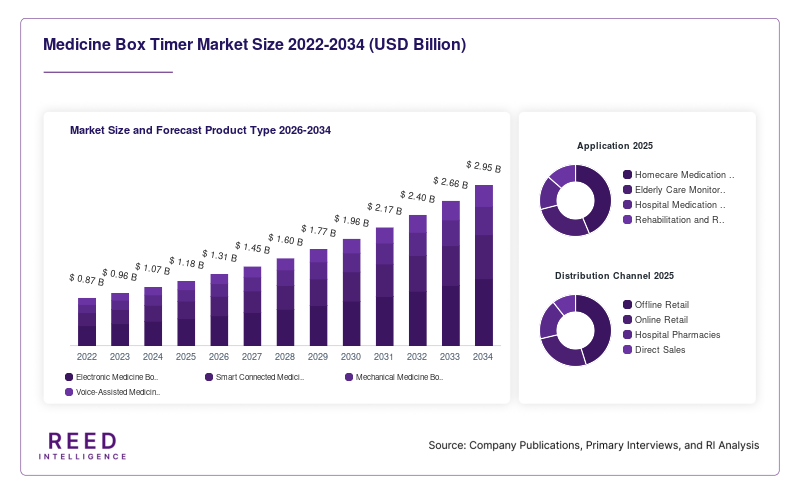
Electronic medicine box timers dominated the Medicine Box Timer Market and accounted for 46.8% of the global market share in 2024. These products are widely preferred because they provide reliable alarm systems, multiple storage compartments, and simple digital interfaces suitable for elderly patients and homecare users. Electronic medicine box timers are extensively used in hospitals, rehabilitation centers, and residential care facilities to reduce medication errors and improve adherence rates. Their affordability compared to advanced connected devices has also contributed to broad adoption across middle-income households. Manufacturers continue to introduce products with improved battery life, larger digital displays, and customizable reminder settings to strengthen user convenience.
The smart connected medicine box timer segment is projected to grow at the fastest CAGR of 12.8% during the forecast period. Growth is driven by increasing demand for remote patient monitoring and smartphone-integrated healthcare solutions. Smart connected devices enable caregivers and healthcare professionals to track medication adherence in real time through mobile applications and cloud-based systems. Consumers are increasingly attracted to products that provide refill alerts, voice reminders, and adherence reporting functions. The growing adoption of telehealth services and digital healthcare ecosystems is accelerating demand for connected medicine management solutions. Manufacturers are also integrating artificial intelligence and data analytics capabilities to create more personalized medication reminder systems.
By Application
Homecare medication management represented the leading application segment and held 43.6% of the global market share in 2024. The growing preference for home-based treatment and independent living among elderly individuals has significantly increased demand for medicine box timers in residential settings. Patients managing chronic illnesses often require structured medication schedules, making reminder-enabled medicine organizers highly valuable for daily healthcare routines. Homecare providers and family caregivers are increasingly using these devices to reduce missed doses and improve patient safety. The affordability and convenience of electronic reminder systems have also contributed to higher consumer adoption across urban and suburban households.
Elderly care monitoring is expected to witness the fastest CAGR of 12.1% during 2026–2034 due to the rising aging population worldwide. Elderly individuals often face memory-related challenges and complex medication regimens, increasing the importance of automated reminder systems. Assisted living facilities and senior care centers are investing in smart medicine box timers to improve operational efficiency and medication accuracy. The integration of voice assistance, caregiver notifications, and remote monitoring features is further strengthening demand within this segment. Government initiatives supporting aging-in-place strategies and independent elderly care are also contributing to rapid growth across developed healthcare markets.
By Distribution Channel
Offline retail channels accounted for the largest share of the Medicine Box Timer Market in 2024, contributing 58.3% of total revenue. Pharmacies, medical equipment stores, and hospital-based retail outlets remain important sales channels because consumers often prefer direct product demonstrations before purchasing healthcare devices. Pharmacists and healthcare professionals also play a significant role in recommending medicine box timers to patients requiring long-term medication management. Offline retail channels provide opportunities for personalized guidance, especially for elderly users who may require assistance in understanding product functionality. The presence of established healthcare retail networks across developed countries continues to support strong sales performance within this segment.
Online retail distribution is projected to expand at the fastest CAGR of 13.4% over the forecast period. The increasing popularity of e-commerce platforms and digital healthcare shopping is driving rapid growth in online sales of medicine box timers. Consumers are benefiting from wider product availability, competitive pricing, and access to customer reviews that simplify purchasing decisions. Manufacturers are increasingly partnering with online marketplaces and direct-to-consumer platforms to expand market reach and strengthen brand visibility. The convenience of home delivery and growing smartphone penetration are particularly supporting online sales growth in emerging economies. Subscription-based refill and replacement services are also emerging as additional revenue opportunities within the digital retail segment.
Regional Analysis
North America
North America accounted for 34.2% of the global Medicine Box Timer Market in 2025 and is expected to maintain a stable growth trajectory with a forecast CAGR of 9.8% during 2026–2034. The region benefits from advanced healthcare infrastructure, high healthcare spending, and widespread awareness regarding medication adherence. Strong adoption of connected healthcare technologies has accelerated the use of smart medicine box timers among hospitals, homecare providers, and elderly care facilities. Consumers in the region increasingly prefer digital medication management solutions that integrate with smartphones and remote monitoring platforms.
The United States remains the dominant country in the regional market due to its large elderly population and growing burden of chronic diseases. One unique growth factor supporting market expansion is the increasing collaboration between healthcare providers and insurance companies to reduce hospital readmissions caused by medication noncompliance. Many healthcare organizations are integrating medication adherence tools into patient care programs. Rising investment in telehealth services and remote patient monitoring technologies is also strengthening demand for connected medicine box timers across the country.
Europe
Europe represented 27.6% of the global Medicine Box Timer Market in 2025 and is projected to grow at a CAGR of 9.4% through 2034. The regional market is supported by strong healthcare systems, increasing elderly populations, and rising awareness regarding patient safety. Governments across several European countries are encouraging the use of digital healthcare devices to improve treatment efficiency and reduce long-term healthcare costs. Smart medication organizers with reminder alarms and mobile connectivity are gaining popularity among consumers seeking convenient homecare solutions.
Germany emerged as the dominant country within the European market due to its advanced healthcare technology adoption and aging demographic structure. A unique factor supporting growth in Germany is the strong integration of pharmacy-led medication management services. Pharmacists increasingly recommend electronic medicine box timers to patients with complex prescriptions and chronic illnesses. The growing focus on independent living among elderly individuals and increasing investments in healthcare digitization programs are also contributing to market growth across the country.
Asia Pacific
Asia Pacific held 22.4% of the global Medicine Box Timer Market in 2025 and is expected to record the fastest CAGR of 11.9% during the forecast period. The region is experiencing rapid healthcare modernization, expanding middle-class populations, and increasing demand for affordable digital healthcare products. Countries across the region are witnessing a steady rise in chronic disease cases and elderly populations, creating strong demand for medication adherence solutions. The increasing penetration of smartphones and online healthcare platforms is further accelerating product awareness and accessibility.
China remains the leading country in the Asia Pacific market due to its large patient population and expanding healthcare manufacturing sector. One distinct growth factor driving the Chinese market is the rapid development of domestic consumer electronics companies entering the healthcare device segment. Local manufacturers are introducing affordable smart medicine box timers equipped with mobile applications and voice reminders. Government efforts to strengthen elderly healthcare services and improve home-based medical support systems are also supporting strong regional market expansion.
Middle East & Africa
The Middle East & Africa region accounted for 7.1% of the global Medicine Box Timer Market in 2025 and is projected to grow at a CAGR of 8.6% during 2026–2034. Market growth is supported by increasing healthcare investments, rising awareness regarding chronic disease management, and gradual expansion of digital healthcare infrastructure. Urban healthcare facilities and private hospitals are increasingly adopting medication management solutions to improve patient adherence and reduce treatment complications. Demand for portable and easy-to-use medicine box timers is also increasing among aging populations in urban centers.
Saudi Arabia emerged as the dominant country in the regional market due to its healthcare modernization initiatives and expanding elderly care services. A unique growth factor in the country is the government’s focus on smart healthcare transformation programs under national healthcare development strategies. Investments in digital patient monitoring systems and homecare services are encouraging healthcare providers to adopt medication reminder technologies. The growing presence of international medical device companies is also improving product availability across the country.
Latin America
Latin America captured 8.7% of the global Medicine Box Timer Market in 2025 and is anticipated to grow at a CAGR of 8.9% through 2034. The region is benefiting from gradual improvements in healthcare accessibility and increasing consumer awareness regarding medication adherence. Urban populations are increasingly adopting electronic healthcare products that support preventive care and chronic disease management. The growth of online retail platforms and pharmacy chains is helping improve the distribution of medicine box timers across major regional markets.
Brazil remains the dominant country in Latin America due to its large healthcare consumer base and expanding elderly population. One unique factor supporting market growth is the increasing role of community healthcare programs focused on chronic disease monitoring. Healthcare providers and local clinics are promoting medication adherence solutions to improve treatment outcomes among patients with diabetes and cardiovascular disorders. Rising investments in healthcare technology and growing smartphone usage are also encouraging adoption of connected medicine management devices.
Competitive Landscape
The Medicine Box Timer Market is moderately fragmented, with several international and regional manufacturers competing through product innovation, pricing strategies, and digital healthcare integration. Companies are focusing on smart reminder technologies, portable designs, and connectivity features to strengthen their market presence. Strategic partnerships with healthcare providers, pharmacies, and telehealth companies are becoming increasingly common as firms seek to expand distribution networks and improve customer engagement.
MedMinder Systems Inc. is considered one of the leading companies in the market due to its strong portfolio of connected medication adherence solutions and remote monitoring services. The company has expanded its cloud-enabled medication management platform to support healthcare providers and homecare agencies. Other major participants are investing in artificial intelligence integration, multilingual mobile applications, and advanced adherence analytics to differentiate their offerings.
Key Players
- MedMinder Systems Inc.
- TabTime Ltd.
- e-pill Medication Reminders
- LiveFine
- MedCenter Systems
- Philips Healthcare
- Hero Health Inc.
- CompuMed Inc.
- Pivotell Ltd.
- AdhereTech Inc.
- PillDrill Inc.
- Careousel Ltd.
- MedReady Inc.
- Reminder Rosie
- Shenzhen Pango Medical Electronics
Recent Developments
- In March 2026, MedMinder Systems Inc. launched an upgraded AI-enabled medicine box timer featuring real-time adherence tracking and caregiver alert notifications for chronic care patients.
- In October 2025, Philips Healthcare expanded its digital medication management ecosystem across Europe, integrating smart medicine box timers with hospital and pharmacy networks.
- In July 2025, Hero Health Inc. enhanced its cloud-based medication adherence platform with predictive analytics to improve treatment compliance in homecare settings.
Medicine Box Timer Market Segments
Product Type
- Electronic Medicine Box Timers
- Smart Connected Medicine Box Timers
- Mechanical Medicine Box Timers
- Voice-Assisted Medicine Box Timers
Application
- Homecare Medication Management
- Elderly Care Monitoring
- Hospital Medication Administration
- Rehabilitation and Recovery Care
Distribution Channel
- Offline Retail
- Online Retail
- Hospital Pharmacies
- Direct Sales
By Region
- North America
- Europe
- APAC
- Middle East and Africa
- LATAM