Medium Entropy Alloys Market Size, Share Demand Report By Type (Transition Metal-Based MEAs, Refractory MEAs, Lightweight MEAs), By Application (Aerospace Components, Energy Systems, Industrial Equipment, Automotive Components), By End-Use (Aerospace & Defense, Automotive, Energy & Power, Industrial Manufacturing) By Region & Segment Forecasts, 2026–2034
USD 3950
Market Overview
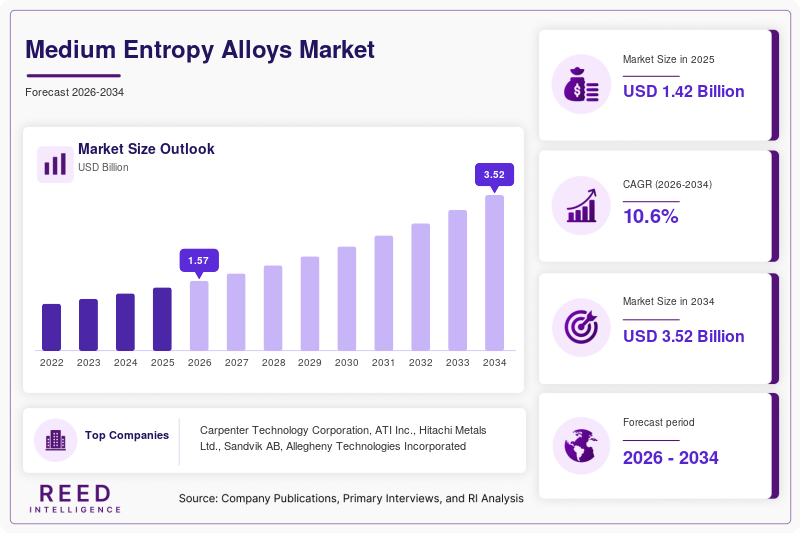
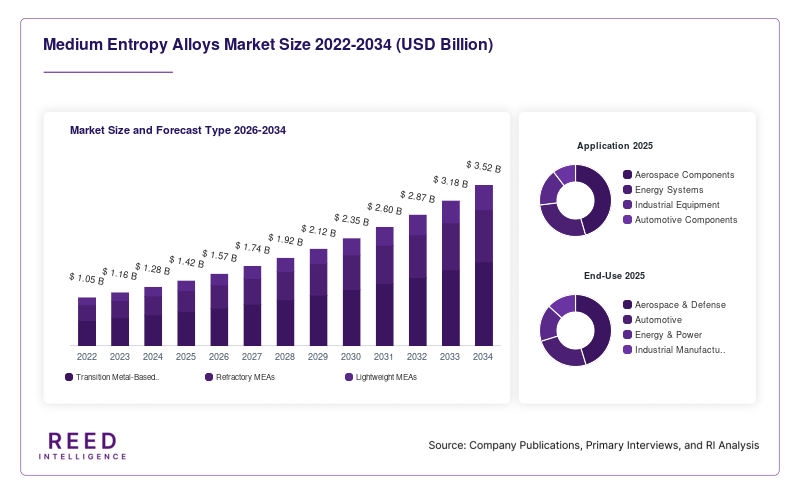
The global Medium Entropy Alloys Market was valued at approximately USD 1.42 billion in 2026 and is projected to reach USD 3.18 billion by 2034, expanding at a CAGR of 10.6% during 2026–2034. Medium entropy alloys (MEAs), characterized by a balanced composition of three to four principal elements, are gaining traction due to their favorable mechanical strength, corrosion resistance, and thermal stability. These materials are increasingly used in aerospace, automotive, and energy sectors where high-performance materials are required.
A key global factor supporting market growth is the increasing demand for lightweight yet durable materials across advanced manufacturing industries. The transition toward fuel-efficient transportation and high-performance industrial equipment has accelerated the adoption of MEAs. These alloys provide an optimal balance between cost and performance compared to high entropy alloys, making them more commercially viable for large-scale industrial applications.
Key Highlights
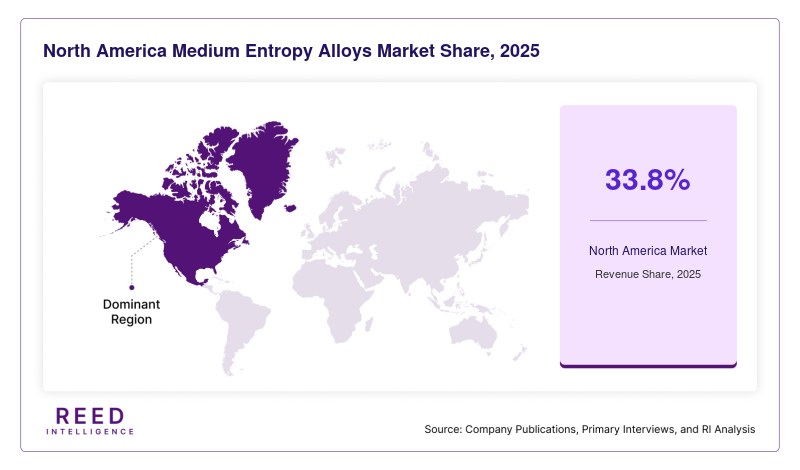
- North America dominated the market with a 33.8% share in 2025.
- Asia Pacific is expected to grow at the fastest CAGR of 11.4% during 2026–2034.
- By type, transition metal-based alloys accounted for the largest share of 42.6%, while refractory MEAs are projected to grow at a CAGR of 12.1%.
- By application, aerospace components led with a 39.2% share, whereas energy systems are expected to expand at a CAGR of 11.7%.
- The United States remained the dominant country, with market values of USD 480 million in 2024 and USD 525 million in 2025.
Market Trends
Increasing Integration of MEAs in Additive Manufacturing
The integration of medium entropy alloys into additive manufacturing processes is emerging as a notable trend in the market. Additive manufacturing enables precise control over material composition and microstructure, which is essential for optimizing the performance of MEAs. Industries such as aerospace and defense are increasingly adopting 3D printing technologies to produce complex components with enhanced mechanical properties. MEAs are particularly suited for this approach due to their adaptability in composition and resistance to high-temperature deformation. Furthermore, additive manufacturing reduces material waste and production time, making MEAs more economically viable. This trend is expected to accelerate as more manufacturers invest in advanced production technologies and customized material solutions.
Growing Focus on Sustainable and Recyclable Materials
Sustainability has become a critical focus area across industries, and the medium entropy alloys market is no exception. Manufacturers are increasingly developing MEAs that incorporate recyclable elements and minimize environmental impact. Compared to traditional alloys, MEAs can be engineered to reduce dependency on scarce or hazardous materials, aligning with global sustainability goals. Additionally, the durability and corrosion resistance of MEAs contribute to longer product lifecycles, reducing the need for frequent replacements. This trend is further supported by regulatory frameworks encouraging the use of environmentally friendly materials. As industries prioritize sustainability, the demand for MEAs with improved recyclability and reduced carbon footprint is expected to rise significantly.
Market Drivers
Rising Demand from Aerospace and Defense Sectors
The aerospace and defense sectors are major drivers of the medium entropy alloys market. These industries require materials that can withstand extreme temperatures, mechanical stress, and corrosive environments. MEAs offer a unique combination of strength, ductility, and thermal stability, making them suitable for critical applications such as turbine blades, structural components, and protective coatings. The increasing number of aircraft production programs and defense modernization initiatives globally is boosting the demand for advanced materials. Additionally, the need for lightweight components to improve fuel efficiency is encouraging the adoption of MEAs. As aerospace manufacturers continue to focus on performance optimization, the demand for medium entropy alloys is expected to grow steadily.
Advancements in Materials Science and Metallurgical Research
Continuous advancements in materials science and metallurgical research are significantly driving the growth of the medium entropy alloys market. Research institutions and industrial laboratories are investing in the development of new alloy compositions with enhanced properties. These advancements have led to improved understanding of phase stability, microstructural evolution, and mechanical behavior of MEAs. As a result, manufacturers can design alloys tailored for specific applications, increasing their adoption across industries. Furthermore, collaborations between academia and industry are accelerating the commercialization of innovative materials. The availability of advanced simulation tools and experimental techniques is also enabling faster development cycles, supporting market expansion.
Market Restraint
High Production Costs and Limited Commercial Scalability
One of the primary restraints affecting the medium entropy alloys market is the high cost associated with production and limited scalability. The manufacturing of MEAs often involves complex processes, including precise control of composition and advanced processing techniques such as vacuum melting and powder metallurgy. These processes require significant capital investment and specialized equipment, which increases overall production costs. Additionally, the use of multiple high-purity elements further adds to the expense, making MEAs less competitive compared to conventional alloys in cost-sensitive applications.
The lack of standardized production methods also poses challenges for large-scale commercialization. Variability in alloy composition and processing conditions can lead to inconsistencies in material properties, limiting their adoption in critical industries. For example, automotive manufacturers may hesitate to integrate MEAs into mass production due to concerns about cost efficiency and supply chain reliability. This restraint impacts market growth by restricting the widespread adoption of MEAs, particularly in emerging economies where cost considerations are a major factor. Addressing these challenges will require advancements in manufacturing technologies and cost optimization strategies.
Market Opportunities
Expansion in Energy and Power Generation Applications
The growing demand for efficient energy systems presents a significant opportunity for the medium entropy alloys market. MEAs are increasingly being explored for use in power generation equipment, including gas turbines, nuclear reactors, and renewable energy systems. Their ability to withstand high temperatures and corrosive environments makes them suitable for improving the efficiency and durability of energy infrastructure. As global energy demand continues to rise, the need for advanced materials that enhance performance and reduce maintenance costs is becoming more critical. This trend is expected to drive the adoption of MEAs in energy applications, creating new growth avenues for market players.
Increasing Adoption in Automotive Lightweighting Initiatives
The automotive industry’s focus on lightweighting is creating new opportunities for medium entropy alloys. Automakers are seeking materials that reduce vehicle weight without compromising strength and safety. MEAs offer a promising solution due to their high strength-to-weight ratio and resistance to wear and corrosion. As electric vehicles gain popularity, the demand for lightweight materials is expected to increase further to enhance battery efficiency and driving range. Additionally, regulatory requirements aimed at reducing emissions are encouraging the adoption of advanced materials. This opportunity is likely to drive innovation and investment in the development of cost-effective MEAs for automotive applications.
Segmental Analysis
By Type
Transition metal-based medium entropy alloys dominated the market in 2024, accounting for a share of approximately 42.6%. These alloys are widely used due to their excellent mechanical properties, including high strength, ductility, and corrosion resistance. Industries such as aerospace and automotive rely on these materials for critical applications where performance and reliability are essential. The ability to tailor the composition of transition metal-based MEAs further enhances their versatility. Additionally, advancements in alloy design have improved their manufacturability, supporting their widespread adoption across various industries.
Refractory medium entropy alloys are expected to be the fastest-growing subsegment, with a projected CAGR of 12.1% during 2026–2034. These alloys are characterized by their exceptional high-temperature stability and resistance to oxidation, making them suitable for applications in extreme environments. The growing demand for high-performance materials in energy and aerospace sectors is driving the adoption of refractory MEAs. Furthermore, ongoing research efforts aimed at improving their ductility and reducing production costs are expected to enhance their commercial viability. This growth is supported by increasing investments in advanced materials research and development.
By Application
Aerospace components represented the largest application segment in 2024, with a share of 39.2%. The demand for lightweight and high-strength materials in aircraft manufacturing is a key factor driving this segment. MEAs are used in turbine blades, structural components, and protective coatings due to their ability to withstand extreme conditions. The increasing production of commercial and military aircraft is further supporting the growth of this segment. Additionally, the focus on improving fuel efficiency and reducing emissions is encouraging the adoption of advanced materials such as MEAs.
Energy systems are expected to be the fastest-growing application segment, with a CAGR of 11.7% during the forecast period. The demand for durable materials in power generation equipment is driving the adoption of MEAs. These alloys are used in gas turbines, nuclear reactors, and renewable energy systems due to their high-temperature stability and corrosion resistance. The increasing focus on energy efficiency and sustainability is further supporting the growth of this segment. As global energy demand continues to rise, the adoption of MEAs in energy applications is expected to increase significantly.
By End-Use
The aerospace and defense sector dominated the market in 2024, accounting for a significant share. The demand for high-performance materials in critical applications is a key factor driving this segment. MEAs are used in various components, including engine parts and structural elements, due to their superior mechanical properties. The increasing investments in defense modernization and aerospace innovation are supporting the growth of this segment. Additionally, the need for materials that can withstand extreme conditions is driving the adoption of MEAs in this sector.
The automotive sector is expected to be the fastest-growing end-use segment, with a CAGR of 11.3% during 2026–2034. The focus on lightweighting and fuel efficiency is driving the adoption of MEAs in automotive applications. These alloys offer a high strength-to-weight ratio, making them suitable for use in vehicle components. The growing demand for electric vehicles is further supporting the adoption of advanced materials. As automakers continue to innovate, the use of MEAs is expected to increase, contributing to market growth.
Regional Analysis
North America
North America held a dominant share of 33.8% in 2025 and is expected to maintain steady growth with a CAGR of approximately 10.2% during 2026–2034. The region’s strong industrial base, coupled with significant investments in research and development, has contributed to the adoption of medium entropy alloys. The presence of advanced manufacturing industries and defense programs further supports market growth. Additionally, increasing demand for high-performance materials in aerospace applications continues to drive the market.
The United States dominates the regional market due to its well-established aerospace and defense sectors. A key growth factor is the increasing government funding for advanced materials research. Programs aimed at enhancing national defense capabilities are encouraging the development and adoption of MEAs. This focus on innovation is expected to sustain market growth in the region.
Europe
Europe accounted for a significant share of the medium entropy alloys market in 2025 and is projected to grow at a CAGR of 9.8% during the forecast period. The region’s emphasis on sustainability and advanced manufacturing technologies is driving the adoption of MEAs. Industries such as automotive and energy are increasingly utilizing these materials to meet performance and environmental standards.
Germany leads the European market, supported by its strong automotive and engineering sectors. A unique growth factor is the region’s focus on green technologies and energy efficiency. The adoption of MEAs in renewable energy systems and electric vehicles is contributing to market expansion. This trend is expected to continue as Europe strengthens its sustainability initiatives.
Asia Pacific
Asia Pacific is expected to be the fastest-growing region, with a CAGR of 11.4% during 2026–2034. The region’s rapid industrialization and expanding manufacturing sector are key drivers of market growth. Countries such as China, Japan, and South Korea are investing heavily in advanced materials research, supporting the development of MEAs.
China dominates the regional market due to its large-scale manufacturing capabilities and government support for innovation. A key growth factor is the increasing demand for high-performance materials in infrastructure and energy projects. The country’s focus on technological advancement is expected to drive significant growth in the medium entropy alloys market.
Middle East & Africa
The Middle East & Africa region is witnessing moderate growth, with a CAGR of 8.7% during the forecast period. The demand for advanced materials in oil and gas and energy sectors is driving market growth. MEAs are increasingly being used to enhance the durability and efficiency of equipment operating in harsh environments.
Saudi Arabia is the dominant country in the region, supported by its strong oil and gas industry. A unique growth factor is the increasing investment in energy infrastructure and diversification initiatives. The adoption of MEAs in energy applications is expected to support market expansion in the region.
Latin America
Latin America is expected to grow at a CAGR of 8.9% during 2026–2034, supported by increasing industrialization and infrastructure development. The adoption of advanced materials in manufacturing and energy sectors is driving market growth in the region.
Brazil leads the market due to its growing industrial base and investments in energy projects. A key growth factor is the increasing demand for durable materials in infrastructure development. The adoption of MEAs is expected to rise as industries seek to improve performance and reduce maintenance costs.
Competitive Landscape
The medium entropy alloys market is characterized by the presence of several key players focusing on research and development to gain a competitive edge. Companies are investing in advanced manufacturing technologies and strategic collaborations to enhance their product offerings. The market is moderately consolidated, with a few major players holding significant market share.
A leading company in the market is Carpenter Technology Corporation, which has established a strong presence through its extensive portfolio of advanced materials. The company focuses on innovation and has recently expanded its research capabilities to develop new alloy compositions. Other players are also adopting strategies such as mergers, acquisitions, and partnerships to strengthen their market position. The increasing emphasis on sustainability and performance is driving competition among market participants. As the market continues to evolve, companies are expected to focus on cost optimization and scalability to enhance their competitiveness.
Key Players
- Carpenter Technology Corporation
- ATI Inc.
- Hitachi Metals Ltd.
- Sandvik AB
- Allegheny Technologies Incorporated
- VDM Metals GmbH
- Nippon Steel Corporation
- ArcelorMittal
- Haynes International Inc.
- Aperam S.A.
- Eramet Group
- Outokumpu Oyj
- POSCO Holdings
- Thyssenkrupp AG
- CRS Holdings LLC
Recent Developments
- In 2025, Carpenter Technology Corporation announced the expansion of its advanced materials research facility to accelerate the development of next-generation medium entropy alloys.
- In 2024, ATI Inc. introduced a new range of high-temperature resistant MEAs designed for aerospace and energy applications, enhancing its product portfolio.
- In 2025, Sandvik AB collaborated with a leading research institute to develop cost-effective manufacturing processes for medium entropy alloys, aiming to improve scalability and adoption.
Medium Entropy Alloys Market Segments
Type
- Transition Metal-Based MEAs
- Refractory MEAs
- Lightweight MEAs
Application
- Aerospace Components
- Energy Systems
- Industrial Equipment
- Automotive Components
End-Use
- Aerospace & Defense
- Automotive
- Energy & Power
- Industrial Manufacturing
By Region
- North America
- Europe
- APAC
- Middle East and Africa
- LATAM