Meeting Room Booking System Software Market Size, Share & Demand Report By Deployment Type (Cloud-Based, On-Premise), By Organization Size (Large Enterprises, Small & Medium Enterprises), By End-Use Industry (IT & Telecommunications, Healthcare, BFSI, Education, Others), By Region & Segment Forecasts, 2026–2034
USD 3950
Market Overview
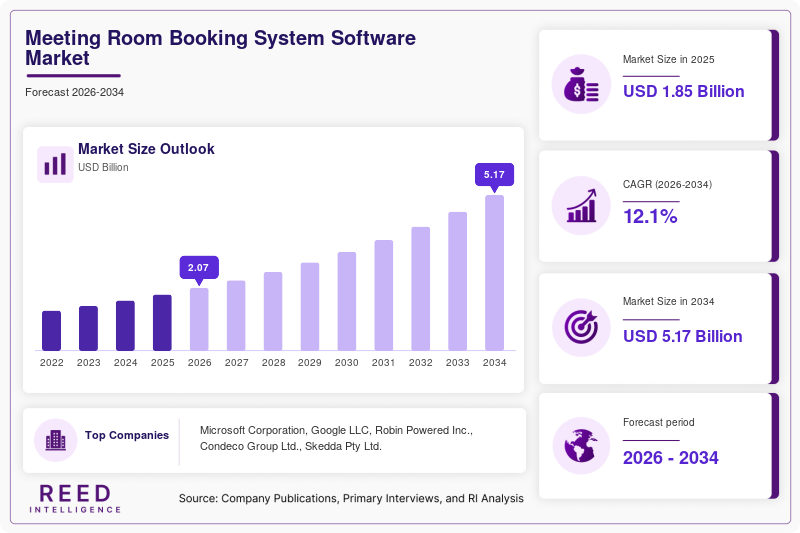
The Meeting Room Booking System Software Market size was valued at approximately USD 1.85 billion in 2026 and is projected to reach USD 4.62 billion by 2034, expanding at a CAGR of 12.1% during 2026–2034. The market reflects steady expansion driven by the increasing adoption of hybrid work models and the growing need for efficient workspace utilization across enterprises. Organizations are prioritizing digital tools that streamline room reservations, reduce scheduling conflicts, and improve operational efficiency.
A major global factor supporting market growth is the rapid digital transformation of workplaces. Enterprises are investing in smart office solutions to enhance productivity and employee experience. Meeting room booking software integrates with calendars, IoT devices, and analytics platforms, enabling organizations to optimize space utilization and monitor usage trends in real time. This transformation is particularly visible in large enterprises and co-working spaces where efficient resource management is critical.
Key Highlights
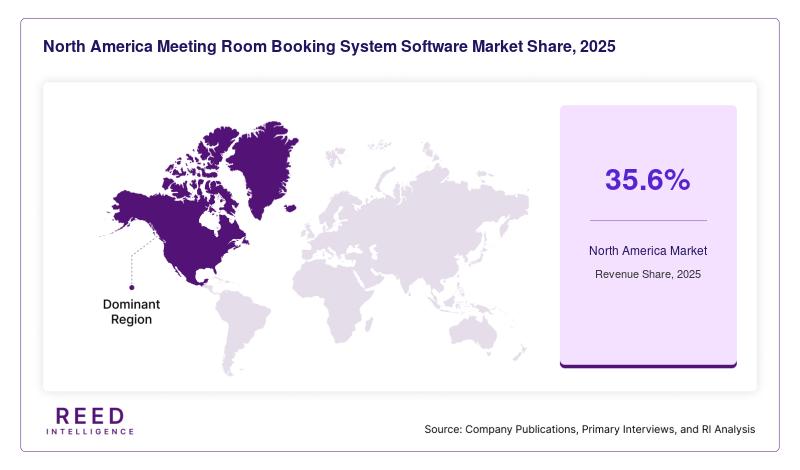
- North America dominated the market with a 35.6% share in 2025.
- Asia Pacific is expected to grow at the fastest CAGR of 13.4% during 2026–2034.
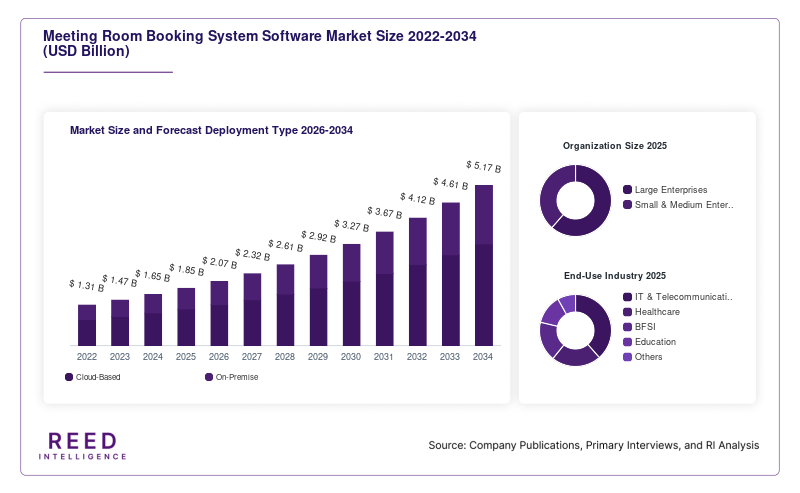
- By deployment, cloud-based solutions accounted for the largest share of 62.8%, while on-premise systems are projected to grow at a CAGR of 9.1%.
- By end-use, large enterprises led with a 54.3% share, whereas SMEs are expected to expand at a CAGR of 13.7%.
- The United States remained the dominant country, with market values of USD 520 million in 2024 and USD 575 million in 2025.
Market Trends
Integration with Smart Office Ecosystems
Meeting room booking systems are increasingly being integrated into broader smart office ecosystems. These systems now connect with IoT-enabled sensors, digital signage, and occupancy analytics tools to provide real-time data on room availability and usage patterns. This integration allows organizations to reduce idle meeting spaces and improve operational efficiency. Businesses are also leveraging AI-driven insights to forecast demand and optimize meeting schedules. As companies adopt workplace automation technologies, the role of booking software is evolving from a simple scheduling tool to a core component of intelligent workspace management. This trend is particularly evident in technologically advanced regions where enterprises seek seamless interoperability between multiple workplace systems.
Rising Adoption of Mobile and Cloud-Based Solutions
The shift toward mobile-first and cloud-based platforms is shaping the Meeting Room Booking System Software Market. Employees increasingly prefer booking meeting rooms via mobile apps or web interfaces that provide flexibility and remote access. Cloud-based systems eliminate the need for complex installations and enable real-time synchronization across devices and locations. This trend is driving adoption among small and medium-sized enterprises due to lower upfront costs and ease of deployment. Additionally, cloud solutions support scalability, allowing organizations to expand their operations without significant infrastructure changes. As remote and hybrid work models continue to grow, mobile-enabled booking solutions are becoming a standard requirement across industries.
Market Drivers
Growth of Hybrid Work Models
The expansion of hybrid work environments is a primary driver of the Meeting Room Booking System Software Market. Organizations are restructuring their office spaces to accommodate both in-office and remote employees, leading to fluctuating demand for meeting rooms. Booking software helps manage this dynamic environment by providing real-time visibility into room availability and enabling advance reservations. This ensures efficient utilization of office space and minimizes scheduling conflicts. Companies are also adopting hot-desking and shared workspace models, further increasing the need for centralized booking systems. As hybrid work becomes a long-term strategy, the demand for flexible and scalable booking solutions is expected to grow significantly.
Increasing Focus on Workplace Efficiency and Cost Optimization
Organizations are under pressure to optimize operational costs while maintaining productivity. Meeting room booking software enables companies to analyze usage patterns and identify underutilized spaces. This data-driven approach helps reduce unnecessary real estate expenses and improve resource allocation. Businesses can reconfigure office layouts based on actual usage, leading to more efficient workspace management. Additionally, automated booking systems reduce administrative workload and enhance employee experience. As companies continue to prioritize efficiency and cost control, the adoption of advanced booking solutions is likely to accelerate across various sectors.
Market Restraint
Data Security and Integration Challenges
One of the key restraints in the Meeting Room Booking System Software Market is the concern over data security and system integration. Many organizations handle sensitive corporate information within their scheduling systems, including meeting details, participant data, and internal communications. Cloud-based solutions, while offering scalability and convenience, raise concerns regarding data privacy and cybersecurity risks. Companies operating in regulated industries such as finance and healthcare are particularly cautious about adopting these systems without robust security measures.
Integration challenges also pose a significant barrier. Organizations often use multiple software platforms, including enterprise resource planning (ERP) systems, communication tools, and calendar applications. Ensuring seamless integration between these systems and meeting room booking software can be complex and time-consuming. Incompatibility issues may lead to inefficiencies and hinder user adoption. For example, if a booking system fails to synchronize properly with widely used calendar platforms, employees may face scheduling conflicts and reduced productivity. These challenges can slow down market growth, especially among organizations with legacy IT infrastructure. Addressing security concerns and improving interoperability will be critical for vendors to expand their market presence.
Market Opportunities
Expansion in Emerging Markets
Emerging economies present significant growth opportunities for the Meeting Room Booking System Software Market. Rapid urbanization and the expansion of corporate sectors in regions such as Asia Pacific, Latin America, and the Middle East are driving demand for modern office solutions. As businesses in these regions adopt digital tools to improve efficiency, the need for meeting room booking systems is increasing. Governments are also promoting digital transformation initiatives, further supporting market growth. Vendors can capitalize on this opportunity by offering cost-effective and scalable solutions tailored to the needs of small and medium-sized enterprises in these regions.
Integration of AI and Advanced Analytics
The integration of artificial intelligence and advanced analytics into meeting room booking systems offers substantial growth potential. AI-powered features can analyze historical data to predict room demand, suggest optimal meeting times, and automate scheduling processes. These capabilities enhance user experience and improve resource utilization. Advanced analytics also provide actionable insights that help organizations make informed decisions بشأن workspace management. As businesses increasingly rely on data-driven strategies, the demand for intelligent booking systems is expected to rise. Vendors that invest in AI-driven innovations can differentiate themselves and capture a larger share of the market.
Segmental Analysis
By Deployment Type
Cloud-based deployment dominated the Meeting Room Booking System Software Market in 2024, accounting for approximately 62.8% of total revenue. The widespread adoption of cloud solutions is driven by their flexibility, scalability, and cost-effectiveness. Organizations prefer cloud-based systems because they eliminate the need for complex infrastructure and enable real-time access from multiple locations. These systems also support seamless integration with existing enterprise tools, enhancing overall efficiency. Large enterprises, in particular, benefit from centralized management and data analytics capabilities offered by cloud platforms. The ability to update software automatically and ensure data accessibility further strengthens the adoption of this deployment model across industries.
On-premise deployment is expected to grow at a CAGR of 9.1% during the forecast period. Despite the dominance of cloud solutions, some organizations continue to prefer on-premise systems due to security concerns and regulatory requirements. Industries such as finance and healthcare require strict control over data, making on-premise deployment a viable option. Additionally, organizations with existing IT infrastructure may opt for on-premise solutions to avoid migration challenges. As vendors enhance security features and offer hybrid deployment options, the adoption of on-premise systems is expected to remain steady.
By Organization Size
Large enterprises accounted for the largest share of the Meeting Room Booking System Software Market in 2024, with a share of 54.3%. These organizations have complex operational structures and require efficient resource management solutions. Meeting room booking systems help large enterprises optimize space utilization, reduce scheduling conflicts, and improve employee productivity. The integration of advanced features such as analytics and reporting further enhances decision-making processes. Large enterprises also have the financial resources to invest in advanced technologies, which supports the adoption of sophisticated booking systems.
Small and medium-sized enterprises (SMEs) are expected to grow at a CAGR of 13.7% during the forecast period. The increasing availability of cost-effective cloud-based solutions is driving adoption among SMEs. These businesses are recognizing the benefits of digital tools in improving operational efficiency and reducing administrative workload. Additionally, the scalability of cloud solutions allows SMEs to expand their operations without significant investment in infrastructure. As digital transformation initiatives gain momentum, SMEs are expected to become a key growth segment in the market.
By End-Use Industry
The IT and telecommunications sector dominated the Meeting Room Booking System Software Market in 2024, accounting for a significant share. This sector relies heavily on collaboration and communication, making efficient meeting room management essential. Booking systems help streamline scheduling processes and ensure optimal utilization of resources. The integration of these systems with communication tools further enhances productivity.
The healthcare sector is expected to grow at a CAGR of 12.9% during the forecast period. Healthcare organizations are increasingly adopting digital solutions to improve operational efficiency and patient care. Meeting room booking systems help manage conference rooms, training spaces, and administrative meetings effectively. The growing focus on digital transformation in healthcare is expected to drive the adoption of these systems.
Regional Analysis
North America
North America held the largest share of the Meeting Room Booking System Software Market in 2025, accounting for approximately 35.6% of global revenue. The region is expected to maintain steady growth with a CAGR of 11.5% during the forecast period. The high adoption of advanced workplace technologies and the presence of major market players contribute to regional dominance. Organizations in this region prioritize digital transformation and invest heavily in smart office solutions to enhance productivity and employee experience.
The United States is the dominant country in North America, driven by widespread adoption of hybrid work models and advanced IT infrastructure. A unique growth factor in this region is the strong presence of co-working spaces and flexible office providers, which rely heavily on booking systems to manage shared resources efficiently. This trend continues to support market expansion across various industries.
Europe
Europe accounted for a significant share of the market in 2025, driven by increasing adoption of digital workplace solutions across enterprises. The region is expected to grow at a CAGR of 10.8% during the forecast period. Countries in Europe are focusing on optimizing office spaces and reducing operational costs, which supports the adoption of meeting room booking systems.
Germany is the leading country in this region, supported by its strong industrial base and focus on workplace efficiency. A unique growth factor is the increasing emphasis on sustainability and efficient resource utilization, prompting organizations to adopt solutions that minimize energy consumption and optimize space usage.
Asia Pacific
Asia Pacific is the fastest-growing region in the Meeting Room Booking System Software Market, with a projected CAGR of 13.4% during 2026–2034. The region accounted for a growing share in 2025 due to rapid urbanization and increasing adoption of digital technologies. Enterprises are investing in modern office infrastructure to support business expansion.
China leads the market in Asia Pacific, driven by rapid economic growth and large-scale corporate expansion. A unique growth factor is the increasing number of smart city initiatives, which promote the adoption of advanced workplace technologies, including meeting room booking systems.
Middle East & Africa
The Middle East & Africa region is witnessing steady growth, with a CAGR of 10.2% during the forecast period. The market is supported by increasing investments in commercial infrastructure and the adoption of digital solutions in corporate environments. Organizations are focusing on improving operational efficiency through automation.
The United Arab Emirates is the dominant country in this region, driven by its rapidly growing corporate sector. A unique growth factor is the expansion of co-working spaces and business hubs, which require efficient room booking systems to manage shared resources effectively.
Latin America
Latin America is experiencing moderate growth in the Meeting Room Booking System Software Market, with a CAGR of 9.8% during the forecast period. The region accounted for a smaller share in 2025 but is gradually adopting digital workplace solutions. Economic development and increasing business activities are contributing to market growth.
Brazil is the leading country in Latin America, supported by its expanding corporate sector. A unique growth factor is the rising adoption of cloud-based solutions, which provide cost-effective and scalable options for businesses looking to modernize their operations
Competitive Landscape
The Meeting Room Booking System Software Market is characterized by moderate competition, with several global and regional players offering diverse solutions. Companies are focusing on innovation, product development, and strategic partnerships to strengthen their market position. The competitive landscape is shaped by the increasing demand for cloud-based and AI-driven solutions.
One of the leading players in the market is Microsoft Corporation, which offers integrated booking solutions within its productivity suite. The company has strengthened its position through continuous product enhancements and integration capabilities. A recent development includes the expansion of its workplace analytics features, enabling organizations to gain deeper insights into space utilization.
Other major players are focusing on expanding their product portfolios and enhancing user experience. Strategic collaborations with technology providers and co-working space operators are also common strategies. As competition intensifies, companies are expected to invest in advanced technologies to differentiate their offerings and capture a larger market share.
Key Players List
- Microsoft Corporation
- Google LLC
- Robin Powered Inc.
- Condeco Group Ltd.
- Skedda Pty Ltd.
- Teem Technologies Inc.
- EMS Software LLC
- Roomzilla Ltd.
- Envoy Inc.
- OfficeSpace Software Inc.
- Joan Workplace Solutions
- Nexudus Ltd.
- SpaceIQ LLC
- Yarooms International
- MeetingRoomApp
Recent Developments
- In 2025, a major software provider introduced AI-powered scheduling features to enhance meeting room utilization and automate booking processes.
- In 2024, a leading vendor launched a mobile-first platform designed to support hybrid work environments and remote access.
- In 2025, a global technology company partnered with co-working space providers to integrate booking systems with shared workspace platforms.
Meeting Room Booking System Software Market Segments
Deployment Type
- Cloud-Based
- On-Premise
Organization Size
- Large Enterprises
- Small & Medium Enterprises
End-Use Industry
- IT & Telecommunications
- Healthcare
- BFSI
- Education
- Others
By Region
- North America
- Europe
- APAC
- Middle East and Africa
- LATAM