Melamine Fiber Market Size, Share Demand Report By Type (Staple Fiber, Nonwoven Fiber), By Application (Protective Apparel, Insulation Materials, Acoustic Panels, Filtration), By End-Use Industry (Construction, Automotive, Industrial Manufacturing, Aerospace), By Distribution Channel (B2B, B2C) By Region & Segment Forecasts, 2026–2034
USD 3950
Market Overview
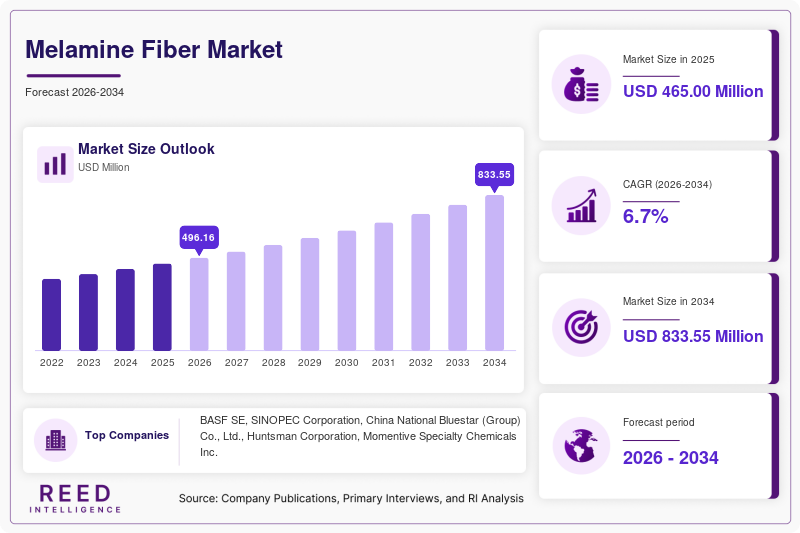
The global Melamine Fiber Market size was valued at approximately USD 465 million in 2026 and is projected to reach USD 782 million by 2034, expanding at a CAGR of 6.7% during the forecast period (2026–2034). The market is witnessing steady growth due to the increasing demand for flame-resistant and heat-stable materials across multiple industries, including construction, automotive, and industrial manufacturing. Melamine fiber, known for its high thermal stability and low flammability, is increasingly used in protective clothing, insulation materials, and acoustic panels.
A key global factor supporting the Melamine Fiber Market growth is the tightening of fire safety regulations across developed and emerging economies. Governments and regulatory bodies are enforcing stricter standards for fire-resistant materials in buildings, transportation, and industrial applications, which has accelerated the adoption of melamine fiber-based products.
Key Highlights
- Europe dominated the market with 33.9% share in 2025, while Asia Pacific is projected to grow at the fastest CAGR of 7.5%
- Staple fiber segment led with 58.4% share, while nonwoven fiber is expected to grow at a CAGR of 7.2%
- Protective apparel application held 36.7% share, while insulation materials are forecasted to grow at a CAGR of 7.6%
- Germany market was valued at USD 95 million in 2024 and reached USD 101 million in 2025
Market Trends
Growing Demand for Flame-Resistant Materials
The increasing emphasis on workplace safety and fire protection has driven the demand for flame-resistant materials. Melamine fiber is widely used in protective clothing for firefighters, military personnel, and industrial workers, shaping key Melamine Fiber Market trends.
Expansion in Acoustic and Insulation Applications
The use of melamine fiber in acoustic panels and thermal insulation materials is expanding due to its lightweight structure and sound-absorbing properties. This trend is particularly prominent in the construction and automotive sectors, where energy efficiency and noise reduction are key considerations.
Market Drivers
Stringent Fire Safety Regulations
Governments across various regions are implementing strict fire safety norms, particularly in construction and transportation sectors. This has increased the demand for fire-resistant materials such as melamine fiber, supporting overall market growth.
Rising Demand in Automotive and Construction Industries
The growth of the automotive and construction sectors has led to increased usage of advanced materials for insulation and safety applications. Melamine fiber’s properties make it suitable for these industries, contributing to the expansion of the Melamine Fiber Market.
Market Restraint
High Production Costs
The production of melamine fiber involves complex manufacturing processes and specialized raw materials, resulting in higher costs compared to conventional fibers. This can limit adoption, particularly in cost-sensitive markets.
Market Opportunities
Development of Eco-Friendly Fiber Solutions
The increasing focus on sustainability is creating opportunities for eco-friendly melamine fiber products. Manufacturers are exploring recyclable and low-emission production processes to align with environmental standards.
Growth in Emerging Economies
Rapid industrialization and urbanization in emerging markets are driving demand for fire-resistant and insulation materials. These regions present significant growth opportunities for the Melamine Fiber Market forecast.
Segmental Analysis
By Type
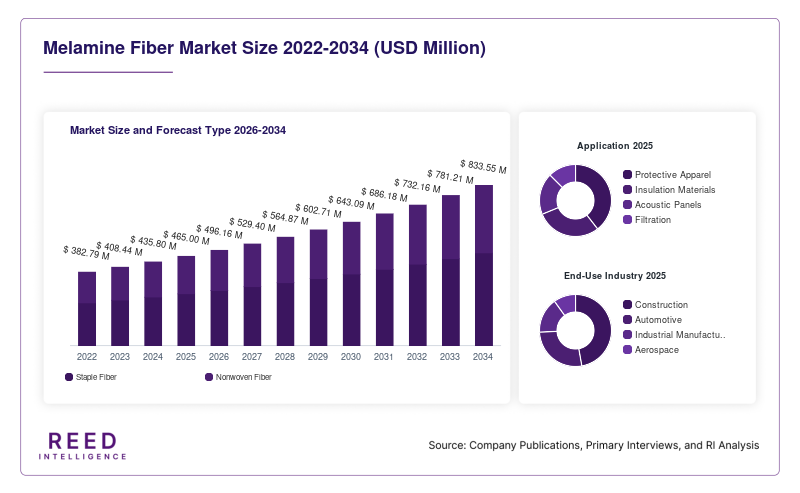
The staple fiber segment dominated the Melamine Fiber Market with 58.4% share in 2025 due to its widespread use in textiles and industrial applications. The nonwoven fiber segment is expected to grow at the fastest CAGR of 7.2%, driven by increasing demand for insulation and filtration materials.
By Application
The protective apparel segment held the largest share of 36.7% in 2025, supported by demand from firefighting, military, and industrial sectors. The insulation materials segment is projected to grow at a CAGR of 7.6%, driven by increasing construction activities and energy efficiency requirements.
By End-Use Industry
The construction segment dominated with 34.1% share in 2025 due to extensive use in insulation and acoustic panels. The automotive segment is expected to grow at a CAGR of 7.0%, supported by demand for lightweight and heat-resistant materials.
By Distribution Channel
The B2B segment accounted for 63.5% share in 2025, as industrial buyers are the primary consumers of melamine fiber. The B2C segment is projected to grow at a CAGR of 6.5%, driven by increasing availability of specialized products for individual use.
Regional Analysis
Europe
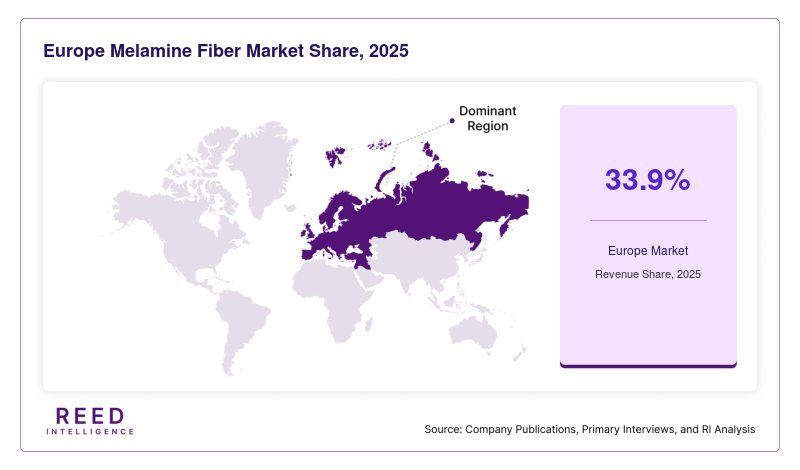
Europe accounted for 33.9% of the Melamine Fiber Market share in 2025 and is expected to grow at a CAGR of 6.2% through 2034. Germany dominated the region due to strong industrial infrastructure and strict fire safety regulations.
North America
North America held 27.8% share in 2025 and is projected to expand at a CAGR of 6.0%. The United States led the market, supported by high demand for protective apparel and advanced construction materials.
Asia Pacific
Asia Pacific captured 24.6% share in 2025 and is expected to grow at the fastest CAGR of 7.5%. China dominated the region due to rapid industrial growth and increasing investments in infrastructure development.
Middle East & Africa
The Middle East & Africa region held 7.2% share in 2025 and is projected to grow at a CAGR of 6.4%. The UAE led the market due to rising construction activities and focus on fire safety standards.
Latin America
Latin America accounted for 6.5% share in 2025 and is expected to grow at a CAGR of 6.3%. Brazil dominated the region, supported by growth in construction and industrial sectors.
Competitive Landscape
The Melamine Fiber Market is characterized by a mix of global and regional players focusing on product innovation and expansion strategies. Key companies are investing in research and development to improve fiber performance and reduce production costs. One leading player has recently expanded its manufacturing capacity in Asia to meet growing regional demand and enhance supply chain efficiency.
Other companies are adopting strategies such as partnerships, mergers, and acquisitions to strengthen their market position. The focus on sustainability and compliance with regulatory standards is also influencing competitive dynamics. As demand for fire-resistant materials increases, manufacturers are emphasizing innovation and diversification to remain competitive.
Key Players List
- BASF SE
- SINOPEC Corporation
- China National Bluestar (Group) Co., Ltd.
- Huntsman Corporation
- Momentive Specialty Chemicals Inc.
- Allnex Group
- Georgia-Pacific Chemicals LLC
- OCI Nitrogen
- Cornerstone Chemical Company
- Balaji Amines Ltd.
- Shandong Hualu-Hengsheng Chemical Co., Ltd.
- Hexza Corporation Berhad
- Mitsui Chemicals, Inc.
- Arkema S.A.
- Evonik Industries AG
Recent Developments
- In 2025, a leading manufacturer expanded production facilities in Asia to meet rising demand for melamine fiber
- In 2024, companies introduced new flame-resistant fiber products for protective apparel applications
- In 2025, partnerships were formed to enhance supply chain efficiency and distribution networks
- In 2024, advancements in fiber processing technology improved product performance and durability
- In 2025, increased investment in sustainable manufacturing practices supported eco-friendly product development
Melamine Fiber Market Segments
Type
- Staple Fiber
- Nonwoven Fiber
Application
- Protective Apparel
- Insulation Materials
- Acoustic Panels
- Filtration
End-Use Industry
- Construction
- Automotive
- Industrial Manufacturing
- Aerospace
Distribution Channel
- B2B
- B2C
By Region
- North America
- Europe
- APAC
- Middle East and Africa
- LATAM