Melanoma Diagnostic Radiopharmaceuticals Market Size, Share & Demand Report By Type (PET Radiopharmaceuticals, SPECT Radiopharmaceuticals), By Application (Diagnosis, Treatment Monitoring), By End-Use (Hospitals, Diagnostic Imaging Centers, Ambulatory Imaging Centers), By Isotope Type (Fluorine-18, Gallium-68, Technetium-99m), By Region & Segment Forecasts, 2026–2034
USD 3950
Market Overview
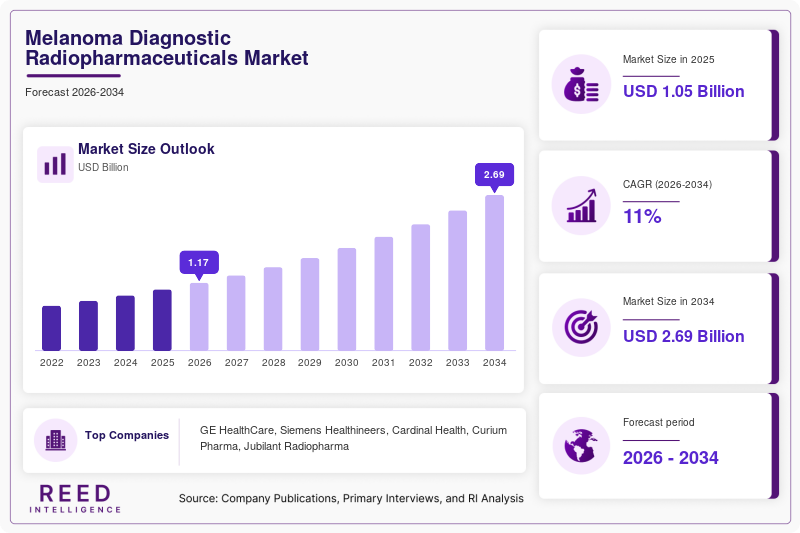
The Melanoma Diagnostic Radiopharmaceuticals Market was valued at approximately USD 1.05 billion in 2026 and is projected to reach USD 2.42 billion by 2034, expanding at a CAGR of 11.0% during 2026–2034. The market is experiencing steady expansion due to the growing need for early and precise melanoma detection, supported by advancements in nuclear imaging technologies.
A major global factor contributing to the growth of the melanoma diagnostic radiopharmaceuticals market is the increasing adoption of precision oncology. Healthcare providers are prioritizing targeted diagnostic approaches that improve detection accuracy and support personalized treatment strategies. Radiopharmaceuticals used in PET and SPECT imaging enable clinicians to identify melanoma lesions with higher sensitivity, facilitating timely intervention and improved clinical outcomes.
The melanoma diagnostic radiopharmaceuticals market is also benefiting from expanding healthcare infrastructure and rising investments in oncology diagnostics. As awareness regarding skin cancer increases globally, demand for advanced imaging techniques continues to grow across both developed and emerging regions.
Key Highlights
- North America accounted for 42% market share, while Asia Pacific is projected to grow at a CAGR of 12.8%
- PET radiopharmaceuticals led with 58% share, while targeted radiotracers are expected to expand at a CAGR of 12.5%
- Hospitals dominated with 46% share, while ambulatory imaging centers are projected to grow at a CAGR of 11.9%
- The United States recorded USD 420 million in 2024 and USD 460 million in 2025
Market Trends
Increasing Adoption of Targeted Radiotracers
The melanoma diagnostic radiopharmaceuticals market is undergoing a transition toward the use of targeted radiotracers that are designed to bind specifically to melanoma-associated biomarkers. These advanced agents offer improved imaging precision, enabling clinicians to detect even small or early-stage lesions. The shift toward molecular imaging is enhancing diagnostic confidence and supporting more accurate staging of melanoma cases.
This trend reflects the broader movement toward personalized medicine, where diagnostics play a critical role in tailoring treatment plans. As research continues to identify new biomarkers, the development of highly selective radiopharmaceuticals is expected to accelerate, strengthening their role in melanoma diagnostics.
Integration of Hybrid Imaging Technologies
Hybrid imaging systems such as PET/CT and PET/MRI are becoming integral to melanoma diagnostics. These technologies combine functional imaging with anatomical detail, providing a comprehensive view of tumor activity and spread. The melanoma diagnostic radiopharmaceuticals market is benefiting from the increasing installation of such systems in hospitals and diagnostic centers.
The ability of hybrid imaging to detect metastases with higher accuracy is particularly valuable in melanoma cases, where early identification of disease progression is critical. As healthcare providers invest in advanced imaging infrastructure, the demand for compatible radiopharmaceuticals continues to rise, supporting overall market growth.
Market Drivers
Rising Global Burden of Melanoma
The increasing incidence of melanoma across the globe is a key factor driving the melanoma diagnostic radiopharmaceuticals market. Factors such as prolonged UV exposure, changing lifestyle patterns, and improved screening programs have contributed to higher diagnosis rates. As the patient population grows, the need for accurate and early diagnostic tools becomes more pronounced.
Radiopharmaceutical-based imaging plays a crucial role in detecting melanoma and assessing its progression. The growing emphasis on early diagnosis to improve survival rates is encouraging healthcare providers to adopt advanced imaging techniques, thereby supporting market expansion.
Advancements in Nuclear Medicine Technologies
Technological progress in nuclear medicine is significantly influencing the melanoma diagnostic radiopharmaceuticals market. Continuous innovation in radiotracer design, imaging equipment, and data processing has improved the efficiency and accuracy of diagnostic procedures. Modern radiopharmaceuticals are being developed with enhanced targeting capabilities and optimized pharmacokinetics.
Automation in radiopharmaceutical production and improved distribution networks are also enhancing accessibility. These advancements are making it easier for healthcare facilities to adopt advanced diagnostic solutions, contributing to the steady growth of the market.
Market Restraints
Regulatory Complexities and Safety Concerns
The melanoma diagnostic radiopharmaceuticals market faces challenges due to stringent regulatory frameworks governing the development and use of radioactive substances. Radiopharmaceuticals must undergo extensive clinical testing and approval processes, which can increase development timelines and costs.
Safety concerns related to radiation exposure also influence adoption rates. Healthcare providers must adhere to strict handling and storage protocols, which may limit usage in smaller or resource-constrained facilities. In addition, the need for specialized infrastructure and trained personnel adds to operational complexity. These factors collectively create barriers to widespread adoption, particularly in regions with limited healthcare resources.
Market Opportunities
Expansion Across Emerging Healthcare Markets
Emerging economies are creating favorable conditions for the growth of the melanoma diagnostic radiopharmaceuticals market. Increasing investments in healthcare infrastructure, rising awareness about cancer detection, and expanding access to diagnostic services are driving demand.
Governments and private organizations are focusing on enhancing nuclear medicine capabilities, which is expected to improve the availability of advanced imaging solutions. As these regions continue to modernize their healthcare systems, the adoption of radiopharmaceutical-based diagnostics is likely to increase significantly.
Development of Next-Generation Radiopharmaceuticals
Ongoing research and innovation are opening new avenues in the melanoma diagnostic radiopharmaceuticals market. The development of next-generation radiopharmaceuticals with higher specificity and improved imaging characteristics is gaining momentum.
Theranostic approaches, which combine diagnostic and therapeutic capabilities, are attracting attention for their potential to transform melanoma management. These innovations are expected to create new growth opportunities by expanding the scope of radiopharmaceutical applications and improving patient outcomes.
Segmental Analysis
By Type
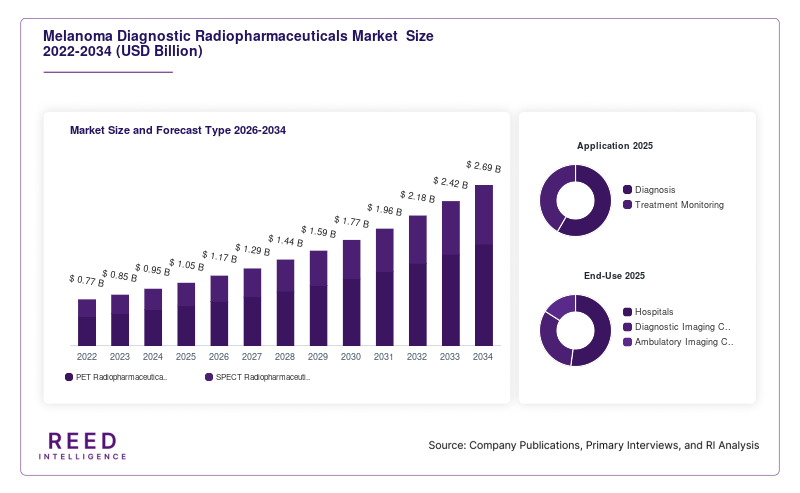
PET radiopharmaceuticals dominated the melanoma diagnostic radiopharmaceuticals market with a 58% share in 2025. Their high sensitivity and ability to detect metastatic melanoma lesions make them widely preferred in clinical practice. These radiopharmaceuticals are extensively used in combination with advanced imaging systems to enhance diagnostic accuracy.
Targeted radiotracers are expected to witness the fastest growth, with a projected CAGR of 12.5% during the forecast period. Their ability to bind selectively to melanoma-specific biomarkers will drive adoption. This specificity allows for improved detection of early-stage tumors and more accurate disease characterization.
By Application
Diagnostic applications accounted for the largest share of the melanoma diagnostic radiopharmaceuticals market at 64% in 2025. Radiopharmaceuticals play a crucial role in initial detection, staging, and assessment of melanoma progression.
Treatment monitoring is anticipated to grow at a CAGR of 11.7%, supported by the increasing need for evaluating therapeutic response. Advanced imaging technologies enable clinicians to track disease progression and adjust treatment strategies accordingly, enhancing patient management.
By End-Use
Hospitals held the dominant share of the melanoma diagnostic radiopharmaceuticals market at 46% in 2025. Their access to advanced imaging equipment and skilled professionals makes them primary centers for melanoma diagnosis.
Ambulatory imaging centers are projected to grow at a CAGR of 11.9%, driven by the rising demand for outpatient diagnostic services. These centers offer cost-effective and convenient imaging solutions, which are attracting a growing number of patients.
By Isotope Type
Fluorine-18-based radiopharmaceuticals accounted for the largest share at 52% in 2025 due to their widespread use in PET imaging and favorable imaging properties. Their reliability and availability have made them a standard choice in melanoma diagnostics.
Gallium-68-based radiopharmaceuticals are expected to grow at a CAGR of 12.2%, supported by their suitability for targeted imaging applications. Their shorter half-life and compatibility with emerging diagnostic techniques are key factors driving their adoption.
Regional Analysis
North America
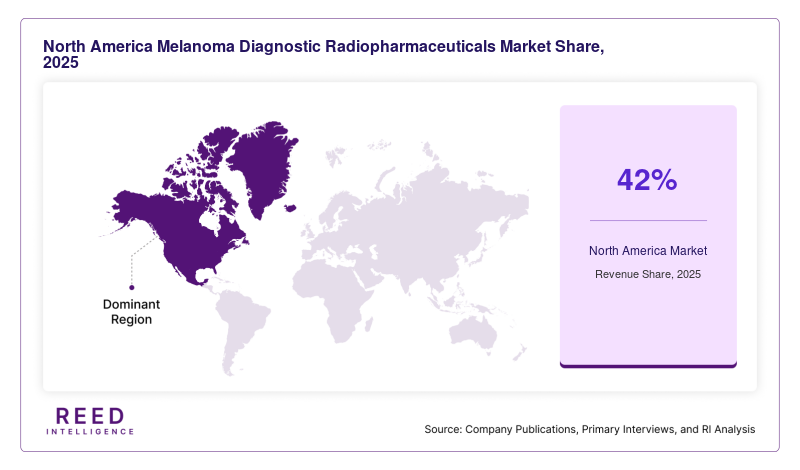
North America accounted for approximately 42% of the melanoma diagnostic radiopharmaceuticals market share in 2025 and is expected to grow at a CAGR of 10.8% during 2026–2034. The region has a mature healthcare ecosystem with widespread access to advanced diagnostic technologies and well-established nuclear medicine infrastructure.
The United States dominated the regional market, supported by strong investment in oncology research and a high adoption rate of advanced imaging systems. The presence of leading market players and continuous innovation in diagnostic radiopharmaceuticals further strengthens the country’s position. The integration of advanced imaging protocols into routine clinical practice has significantly improved early melanoma detection and disease monitoring.
Europe
Europe held around 26% share of the melanoma diagnostic radiopharmaceuticals market in 2025 and is projected to expand at a CAGR of 10.5% over the forecast period. The region benefits from comprehensive healthcare systems and a strong focus on preventive care and cancer screening programs.
Germany emerged as the leading country in this region due to its advanced diagnostic infrastructure and emphasis on technological adoption. The country’s healthcare system supports early diagnosis initiatives, which encourages the use of radiopharmaceutical imaging. Continuous investments in nuclear medicine facilities and supportive regulatory frameworks are expected to sustain market growth.
Asia Pacific
Asia Pacific represented nearly 18% of the melanoma diagnostic radiopharmaceuticals market share in 2025 and is anticipated to register the fastest growth at a CAGR of 12.8%. Rapid urbanization, increasing healthcare expenditure, and improving diagnostic capabilities are contributing to regional expansion.
China led the market within the region, driven by significant investments in healthcare infrastructure and growing adoption of advanced imaging technologies. Government initiatives aimed at improving cancer care and expanding access to diagnostic services are key growth factors. The increasing prevalence of cancer and rising awareness about early detection are further supporting market development.
Middle East & Africa
The Middle East & Africa accounted for about 8% share of the melanoma diagnostic radiopharmaceuticals market in 2025 and is expected to grow at a CAGR of 9.6%. The region is gradually enhancing its healthcare capabilities and focusing on specialized diagnostic services.
Saudi Arabia dominated the regional market, supported by government-led initiatives to modernize healthcare infrastructure. The expansion of oncology centers and increasing investment in advanced diagnostic technologies are contributing to market growth. Efforts to improve healthcare accessibility are expected to further boost demand for radiopharmaceutical diagnostics.
Latin America
Latin America held approximately 6% share of the melanoma diagnostic radiopharmaceuticals market in 2025 and is projected to grow at a CAGR of 9.9%. The region is witnessing gradual improvements in healthcare infrastructure and diagnostic capabilities.
Brazil emerged as the leading country due to its expanding healthcare system and growing awareness of cancer screening. Investments in nuclear medicine facilities and the adoption of advanced imaging technologies are supporting the growth of the melanoma diagnostic radiopharmaceuticals market in the region.
Competitive Landscape
The melanoma diagnostic radiopharmaceuticals market is characterized by the presence of several established players focusing on product innovation and strategic partnerships. Companies are investing in research and development to enhance the specificity and efficiency of radiopharmaceuticals used in melanoma diagnostics.
GE HealthCare remains a leading player, supported by its extensive portfolio of imaging solutions and radiopharmaceutical products. The company has recently expanded its capabilities in PET imaging agents, strengthening its position in the market. Other key participants are also focusing on expanding their geographic presence and developing advanced diagnostic solutions to remain competitive.
Key Players List
- GE HealthCare
- Siemens Healthineers
- Cardinal Health
- Curium Pharma
- Jubilant Radiopharma
- Lantheus Holdings
- Bayer AG
- Bracco Imaging
- Eckert & Ziegler
- Nordion Inc.
- Advanced Accelerator Applications
- Telix Pharmaceuticals
- ITM Isotope Technologies Munich
- Navidea Biopharmaceuticals
- Spectrum Pharmaceuticals
Recent Developments
- GE HealthCare introduced a melanoma-focused PET imaging agent to improve diagnostic accuracy
- Telix Pharmaceuticals expanded its oncology diagnostic radiopharmaceutical pipeline
- Curium Pharma increased production capacity for PET radiopharmaceuticals
- Siemens Healthineers collaborated with research institutions on advanced imaging technologies
- Lantheus Holdings launched a new radiotracer for melanoma detection
Melanoma Diagnostic Radiopharmaceuticals Market Segments
Type
- PET Radiopharmaceuticals
- SPECT Radiopharmaceuticals
Application
- Diagnosis
- Treatment Monitoring
End-Use
- Hospitals
- Diagnostic Imaging Centers
- Ambulatory Imaging Centers
Isotope Type
- Fluorine-18
- Gallium-68
- Technetium-99m
By Region
- North America
- Europe
- APAC
- Middle East and Africa
- LATAM