Membrane Pressure Vessel Market Size, Share & Trends Analysis Report By Material Type (Fiberglass, Stainless Steel, Composite Materials), By Application (Water & Wastewater Treatment, Desalination, Industrial Processing, Others), By End User (Municipal, Industrial, Commercial, Residential) Forecasts, 2026–2034
USD 3950
Membrane Pressure Vessel Market Size
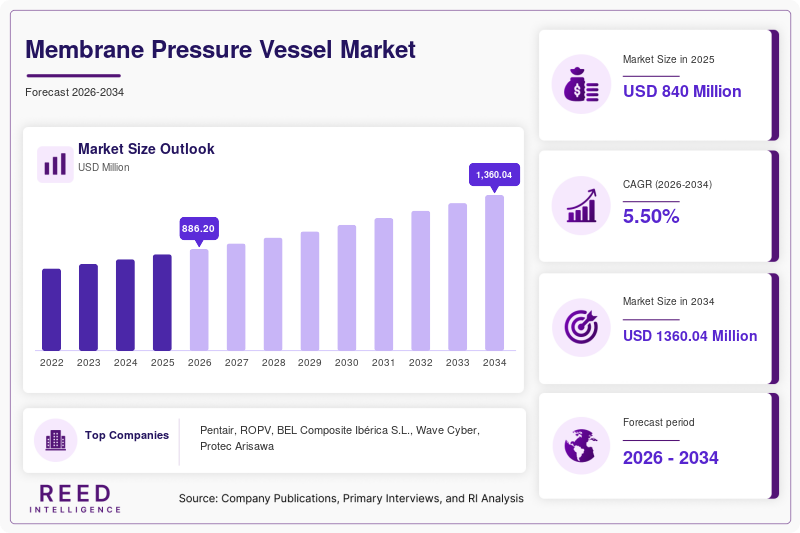
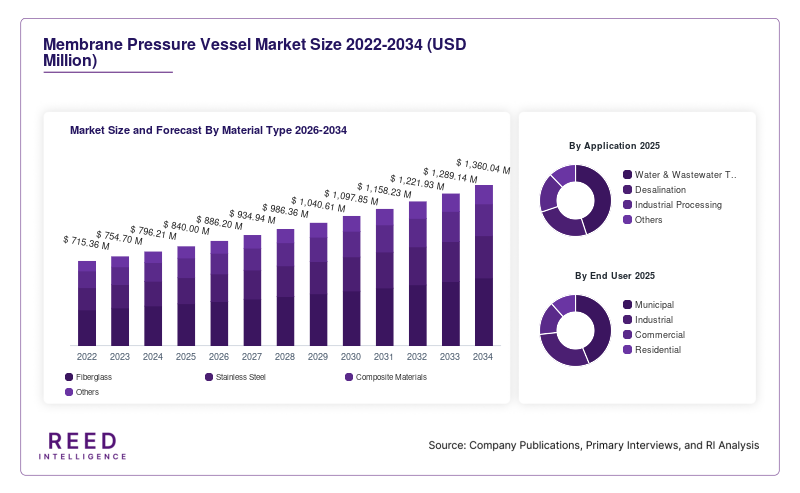
The global Membrane Pressure Vessel Market size was valued at USD 840 million in 2025 and is projected to grow from USD 886 million in 2026 to USD 1,360.04 million by 2034, registering a CAGR of 5.50% during the forecast period from 2026 to 2034.
The Membrane Pressure Vessel Market forms a specialized equipment layer within membrane filtration infrastructure. The vessel does not perform the separation itself; instead, it provides the pressure-resistant enclosure that allows membrane elements to operate safely and efficiently. This makes vessel reliability directly relevant to membrane loading, sealing, pressure management, maintenance intervals and overall plant availability.
Fiberglass-reinforced plastic (FRP) remains the principal material configuration because its corrosion resistance and relatively low weight are well suited to saline, brackish and chemically treated water. Industry sources estimate fiberglass vessels at roughly 55–60% of installations, although reported shares vary by methodology and market definition.
Membrane Pressure Vessel Market Drivers
Expansion of Water and Wastewater Treatment Infrastructure
Water scarcity, urbanization and industrial discharge requirements are increasing the deployment of membrane-based treatment systems. Reverse osmosis and other pressure-driven membrane technologies provide modular treatment capabilities for potable water production, wastewater reuse and industrial process-water recovery. Because membrane elements require pressure-resistant housings, each new membrane train creates corresponding demand for membrane pressure vessels.
Municipal and industrial projects also favor standardized vessel configurations because standardized diameters, membrane lengths and port arrangements simplify procurement, installation and replacement. Industry data indicates that water and wastewater treatment represents the largest application category in the market, while sewage treatment and desalination together constitute a substantial portion of installed demand.
Increasing Desalination Deployment
Desalination is an important demand source because seawater reverse osmosis operates under high-pressure conditions that require engineered membrane housings capable of maintaining structural integrity over extended operating cycles. Codeline pressure vessels, for example, are available in configurations reaching 1,200 psi and are specifically designed for brackish- and seawater applications.
Investment in desalination is particularly relevant across water-stressed regions in the Middle East, Asia Pacific and other coastal markets. The resulting equipment requirement extends beyond membrane elements to pumps, energy-recovery systems, pretreatment equipment, valves and pressure vessels, creating a broader procurement ecosystem around membrane desalination projects.
Shift Toward Durable Composite Vessel Designs
FRP and other composite pressure vessels offer a combination of lower weight, corrosion resistance and pressure capability that can reduce handling complexity and improve suitability for aggressive water-treatment environments. Industry analysis places fiberglass at around 60% of installed units in some market definitions, reflecting its widespread use in desalination and wastewater applications.
Manufacturers are consequently focusing on structural consistency, fatigue resistance, improved sealing systems and longer design lives. Pentair's 80K series, for example, uses advanced epoxy-glass composite construction, offers operating pressures up to 1,200 psi and is designed for a service life exceeding 25 years.
Membrane Pressure Vessel Market Restraints
High Capital and Maintenance Requirements
Membrane systems require multiple integrated components, including high-pressure pumps, pretreatment systems, membranes, vessels, valves and instrumentation. Pressure-vessel procurement therefore forms part of a larger capital commitment, particularly in large desalination and industrial water-treatment projects. Higher-specification vessels can carry additional costs because of pressure ratings, certifications, materials and customization requirements.
Maintenance requirements also influence lifecycle economics. Seals, ports, heads and connections must maintain pressure integrity throughout repeated membrane replacement cycles. Vessel manufacturers are responding with tool-free access, replaceable seals and improved head-retention systems, but these engineering requirements increase manufacturing and qualification complexity.
Material and Certification Requirements
Membrane pressure vessels operate under demanding pressure and chemical conditions, making certification and testing important procurement requirements. Manufacturers may need to comply with standards such as ASME, NSF, CE and other regional requirements depending on application and geography. Pentair states that its Codeline vessels undergo quality inspection and hydro-testing, while its FRP vessels comply with ASME Section X and relevant certifications.
Qualification requirements can lengthen supplier approval cycles, particularly for municipal drinking-water projects and large industrial installations. Smaller manufacturers must therefore balance product customization with consistent manufacturing quality and certification costs.
Membrane Pressure Vessel Market Opportunities
Growth of Water Reuse and Industrial Process-Water Treatment
Industrial facilities increasingly require reliable process-water treatment and wastewater recovery systems. Electronics, pharmaceuticals, food and beverage, mining, chemicals and power generation all require water-quality management at different stages of production. Membrane systems can provide modular treatment and recovery capabilities, creating recurring demand for vessels as plants expand or retrofit existing treatment lines.
The opportunity is particularly relevant where industrial users need higher water recovery rates and greater process-water consistency. Pressure-vessel manufacturers can address this demand through customized port configurations, membrane-element compatibility, corrosion-resistant components and designs suited to higher operating pressures.
Longer-Life and Lifecycle-Optimized Pressure Vessels
Lifecycle performance is becoming a stronger purchasing consideration as operators evaluate equipment beyond initial acquisition cost. ROPV reported an independently verified life-cycle assessment indicating lower environmental impact for engineered FRP vessels over a 30-year operating horizon compared with conventional alternatives, alongside a reported 30–33-year service-life range for its engineered designs.
This creates opportunities for manufacturers to differentiate through fatigue resistance, service life, maintenance accessibility, material efficiency and documented lifecycle performance. Such positioning can be particularly relevant for large desalination and municipal infrastructure projects where replacement downtime carries operational consequences.
Membrane Pressure Vessel Market Segmental Analysis
By Material Type
Fiberglass is the dominant material type, accounting for approximately 55–60% of global installations. FRP vessels combine corrosion resistance, relatively low weight and pressure-handling capability, making them suitable for seawater desalination, municipal wastewater treatment and industrial water systems. Their lower handling burden compared with metallic vessels also supports deployment in large membrane arrays.
Composite and advanced fiberglass configurations represent the faster-developing material direction, as manufacturers improve fatigue resistance, chemical compatibility, sealing and lifecycle performance. Stainless steel remains important for applications requiring high mechanical durability and particular material specifications, but its higher material and fabrication costs can limit adoption in cost-sensitive installations.
By Application
Water & wastewater treatment is the dominant application segment. Municipal treatment, wastewater reuse and industrial water purification require large numbers of membrane elements, creating corresponding demand for pressure vessels. Industry analyses consistently identify water and wastewater treatment as the largest application category because of sustained investment in clean-water infrastructure and wastewater management.
Desalination is the fastest-expanding strategic application, particularly in water-stressed coastal markets. Seawater reverse osmosis requires high-pressure membrane systems and therefore specialized vessels capable of operating reliably under demanding conditions. Middle Eastern desalination projects, together with growing Asian water infrastructure investment, provide important demand channels.
By End User
Municipal users represent the dominant end-user group, reflecting demand from drinking-water treatment, wastewater treatment and water-reuse infrastructure. Municipal projects generally require standardized, certified equipment capable of continuous operation, creating demand for established pressure-vessel designs and long-term serviceability.
Industrial end users represent the fastest-growing end-user category, supported by expanding requirements for process water and wastewater recovery in electronics, pharmaceuticals, food and beverage, chemicals, mining and power generation. Industrial operators also tend to require customized pressure ratings, port configurations and membrane compatibility, increasing opportunities for engineered vessel suppliers.
Membrane Pressure Vessel Market Regional Analysis
North America Membrane Pressure Vessel Market
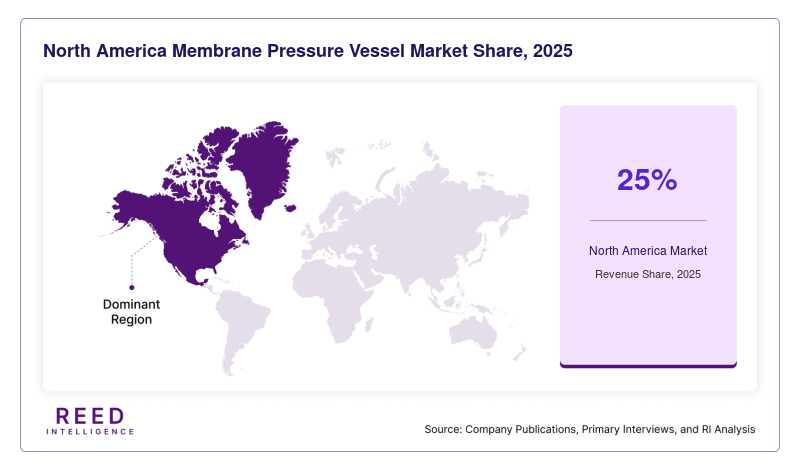
North America represents approximately 25% of the global market in leading 2025 industry estimates, making it one of the largest regional markets. Mature water-treatment infrastructure, replacement demand and industrial requirements for high-purity water support membrane pressure vessel procurement. The region also has established engineering and manufacturing capabilities for certified membrane-treatment components.
The United States remains the primary regional market, supported by municipal water infrastructure upgrades, industrial water treatment and desalination projects in water-stressed states. Canada contributes through municipal and industrial water-treatment requirements, while Mexico adds demand through industrial and municipal treatment investment.
Europe Membrane Pressure Vessel Market
Europe accounts for approximately 20–23% of the market in available regional estimates. The mature European water-treatment industry is supported by wastewater reuse, environmental regulation and upgrades to existing treatment infrastructure. Germany, France, Italy, Spain and the United Kingdom represent important markets for membrane-based filtration systems.
Demand is shaped by wastewater-treatment requirements, industrial water reuse and sustainability-focused infrastructure investment. European operators also place strong emphasis on certification, lifecycle performance and material compliance, supporting demand for certified FRP and stainless-steel pressure-vessel designs.
Asia Pacific Membrane Pressure Vessel Market
Asia Pacific is the dominant regional market, with approximately 35–39% market share in available 2025 estimates. China and India are major demand centers because of urbanization, industrialization, water infrastructure development and increasing requirements for wastewater treatment and water reuse.
China has a large membrane-equipment manufacturing ecosystem and extensive municipal and industrial treatment requirements, while India is expanding water infrastructure and industrial treatment capacity. Japan, South Korea and Southeast Asia contribute through advanced industrial filtration, electronics manufacturing, municipal treatment and desalination projects.
Latin America Membrane Pressure Vessel Market
Latin America represents a smaller but developing market, with Brazil and Mexico serving as important demand centers. Industrial water treatment, mining, municipal wastewater management and potable-water infrastructure contribute to pressure-vessel demand. The region's large industrial and agricultural base also creates requirements for process-water treatment and water reuse.
Brazil's pulp and paper, mining, food-processing and municipal water sectors provide multiple application channels. Mexico's industrial manufacturing base supports demand for membrane-based process-water systems, while other Latin American markets remain influenced by infrastructure investment, financing availability and equipment-import costs.
Middle East & Africa Membrane Pressure Vessel Market
Middle East & Africa is identified as the fastest-growing regional market, with an estimated CAGR of approximately 6.5% during the forecast period in one 2026 regional analysis. Water scarcity and extensive desalination investment are the principal mechanisms supporting demand, particularly across the Gulf Cooperation Council markets.
Saudi Arabia, the UAE and other GCC countries are investing heavily in desalination and water-reuse infrastructure, creating demand for high-pressure membrane systems and durable FRP pressure vessels. Africa provides additional opportunities through municipal water-treatment and industrial projects, although financing, infrastructure maturity and equipment availability remain important market constraints.
Membrane Pressure Vessel Market Competitive Landscape
The competitive landscape is characterized by specialized pressure-vessel manufacturers competing on material engineering, pressure ratings, certification, membrane compatibility, customization and lifecycle reliability. Pentair's Codeline has a broad installed base and product portfolio spanning RO and ultrafiltration applications. Its 80K series provides 8-inch membrane housing configurations with operating pressures up to 1,200 psi, multiporting options, replaceable seals and ASME, NSF and CE certifications.
ROPV is another major specialized FRP pressure-vessel manufacturer, with products designed for water treatment, desalination and industrial processing. The company states that more than 1.5 million vessels have been installed worldwide and offers configurations reaching 2,000 psi. Its engineering approach emphasizes customization, fatigue resistance, manufacturing consistency and long operating life.
Wave Cyber adds vertical integration across membranes, modules and pressure vessels. Its portfolio includes reverse-osmosis and nanofiltration membranes, membrane modules and pressure vessels, allowing it to participate across multiple layers of the membrane-treatment equipment ecosystem.
Other participants include BEL Composite Ibérica, Protec Arisawa, Pure Aqua, AMI, First Line, Fivebro, Changzhou Kangpu, Frotec, Hebei Chengda Huamo Technology and Brother. Competition is increasingly influenced by pressure certification, customization, lifecycle performance, global distribution and the ability to integrate vessels with broader membrane-treatment systems.
Membrane Pressure Vessel Market Competitive Landscape
The competitive landscape is characterized by specialized pressure-vessel manufacturers competing on material engineering, pressure ratings, certification, membrane compatibility, customization and lifecycle reliability. Pentair's Codeline has a broad installed base and product portfolio spanning RO and ultrafiltration applications. Its 80K series provides 8-inch membrane housing configurations with operating pressures up to 1,200 psi, multiporting options, replaceable seals and ASME, NSF and CE certifications.
ROPV is another major specialized FRP pressure-vessel manufacturer, with products designed for water treatment, desalination and industrial processing. The company states that more than 1.5 million vessels have been installed worldwide and offers configurations reaching 2,000 psi. Its engineering approach emphasizes customization, fatigue resistance, manufacturing consistency and long operating life.
Key Market Players
- Pentair
- ROPV
- BEL Composite Ibérica S.L.
- Wave Cyber
- Protec Arisawa
- Pure Aqua
- AMI
- First Line
- Fivebro
- Changzhou Kangpu
- Frotec
- Hebei Chengda Huamo Technology
- Brother
Membrane Pressure Vessel Market Recent Developments
-
May 2026 Pentair: At IFAT Munich 2026, Pentair showcased its integrated membrane filtration and pressure-vessel portfolio, including the Codeline 80K Series, designed for municipal, industrial, desalination and wastewater applications with up to 25-year design life.
-
July 2026 ROPV: ROPV announced an EcoVadis Silver sustainability rating, with an overall score of 77/100 and a position in the 92nd percentile of companies assessed by EcoVadis. The company manufactures FRP pressure vessels for reverse osmosis, desalination and industrial water treatment.
Membrane Pressure Vessel Market Segments
By Material Type
- Fiberglass
- Stainless Steel
- Composite Materials
- Others
By Application
- Water & Wastewater Treatment
- Desalination
- Industrial Processing
- Others
By End User
- Municipal
- Industrial
- Commercial
- Residential
By Region
- North America
- Europe
- APAC
- Middle East and Africa
- LATAM