Membrane Switch Market Size, Share & Demand Report By Type (Tactile Membrane Switch, Non-Tactile Membrane Switch, Capacitive Membrane Switch), By Application (Consumer Electronics, Medical Devices, Industrial Equipment, Automotive, Others), By End-Use (Industrial, Healthcare, Automotive, Consumer Electronics, Others), By Region & Segment Forecasts, 2026–2034
USD 3950
Market Overview
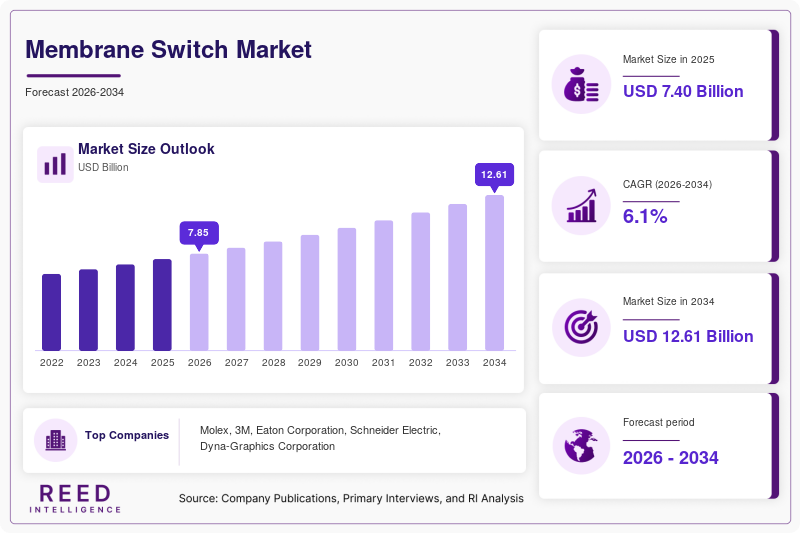
The global Membrane Switch Market size was valued at approximately USD 7.4 billion in 2026 and is projected to reach around USD 11.8 billion by 2034, expanding at a CAGR of 6.1% during the forecast period (2026–2034). The market continues to witness steady growth due to the rising demand for durable, cost-efficient, and user-friendly human-machine interface solutions across industries such as consumer electronics, medical devices, industrial equipment, and automotive systems. Membrane switches are increasingly preferred over traditional mechanical switches because of their compact design, resistance to moisture and contaminants, and customizable interface layouts.
A significant global factor supporting market expansion is the rapid growth in electronics manufacturing and automation adoption. As industries transition toward smarter and more integrated systems, the need for reliable input interfaces has increased. Membrane switches provide enhanced lifecycle performance and aesthetic flexibility, making them suitable for modern electronic products. Additionally, increasing investments in healthcare infrastructure and diagnostic equipment have boosted the demand for hygienic and sealed interface solutions, further supporting market growth.
Key Highlights
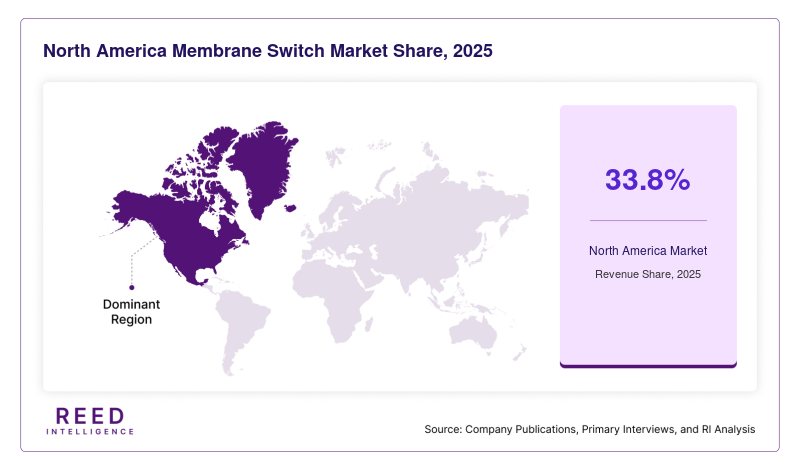
- North America dominated the market with a 33.8% share in 2025.
- Asia Pacific is expected to grow at the fastest CAGR of 7.4% during 2026–2034.
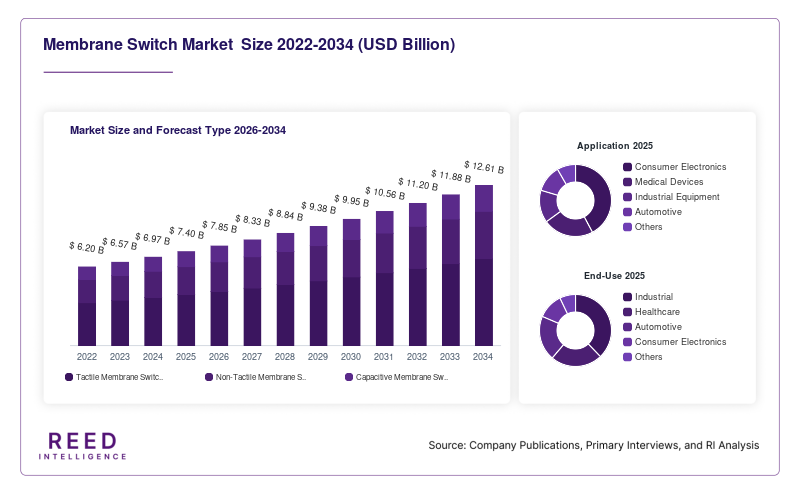
- By type, tactile membrane switches accounted for the largest share of 42.6%, while capacitive membrane switches are projected to grow at a CAGR of 7.9%.
- By application, consumer electronics led with a 36.9% share, whereas medical devices are expected to expand at a CAGR of 7.2%.
- The United States remained the dominant country, with market values of USD 1.6 billion in 2024 and USD 1.7 billion in 2025.
Market Trends
Increasing integration of advanced materials and printing technologies
The Membrane Switch Market is experiencing a notable shift toward the adoption of advanced materials and printing technologies. Manufacturers are increasingly utilizing high-performance polymers such as polyester and polycarbonate to enhance durability and flexibility. These materials provide improved resistance to environmental stress, chemicals, and repeated use, making them suitable for demanding industrial and medical applications. Additionally, advancements in screen printing and digital printing technologies have enabled the development of more intricate designs, improved graphic overlays, and enhanced backlighting features.
This trend is also driven by the need for customization and branding in consumer electronics and industrial equipment. Companies are focusing on integrating LED backlighting, embossing, and tactile feedback into membrane switches to improve user experience. The incorporation of conductive inks and flexible circuits further enhances functionality while maintaining a slim form factor. As industries move toward more sophisticated interface solutions, the demand for technologically advanced membrane switches is expected to continue growing steadily.
Rising demand for compact and sealed interface solutions
Another prominent trend shaping the Membrane Switch Market is the growing preference for compact and sealed interface solutions. Industries such as healthcare, food processing, and automotive are prioritizing equipment that minimizes contamination risks and ensures ease of cleaning. Membrane switches, with their sealed surfaces and resistance to dust and liquids, are increasingly being adopted in these environments. Their ability to maintain functionality under harsh conditions makes them a practical choice for applications requiring high reliability.
The trend is also influenced by the miniaturization of electronic devices. As manufacturers design smaller and more portable products, the need for low-profile input interfaces becomes critical. Membrane switches offer a space-efficient alternative without compromising performance. Furthermore, the increasing use of touch-based and hybrid interfaces is encouraging manufacturers to integrate membrane switches with capacitive technologies. This evolution reflects the market’s shift toward more user-centric and durable interface solutions across multiple sectors.
Market Drivers
Growing adoption of automation and industrial equipment
The expansion of industrial automation is a major driver for the Membrane Switch Market. As manufacturing facilities adopt automated systems to improve productivity and reduce operational costs, the demand for reliable control interfaces has increased significantly. Membrane switches are widely used in control panels, machinery interfaces, and industrial equipment due to their durability and resistance to harsh operating conditions. Their ability to function reliably in environments exposed to dust, moisture, and temperature fluctuations makes them highly suitable for industrial applications.
In addition, the rise of Industry 4.0 initiatives has further accelerated the demand for advanced human-machine interfaces. Membrane switches play a crucial role in enabling efficient interaction between operators and automated systems. Their customizable design allows integration with various control functions, enhancing usability and operational efficiency. As industries continue to modernize their infrastructure, the adoption of membrane switches is expected to remain strong, supporting overall market growth.
Increasing demand in medical devices and healthcare equipment
The healthcare sector is another significant driver of the Membrane Switch Market. The growing demand for medical devices such as diagnostic equipment, patient monitoring systems, and portable healthcare devices has led to increased adoption of membrane switches. These switches are preferred in medical applications due to their hygienic design, ease of cleaning, and resistance to contamination. Their sealed structure helps prevent the ingress of bacteria and fluids, making them suitable for use in sterile environments.
Furthermore, the rising focus on home healthcare and portable medical devices has increased the need for user-friendly and durable interfaces. Membrane switches offer a cost-effective solution with high reliability and long operational life. Their ability to support backlighting and clear visual indicators enhances usability in critical medical applications. As healthcare systems continue to expand and adopt advanced technologies, the demand for membrane switches is expected to grow steadily.
Market Restraint
Limited tactile feedback and competition from alternative technologies
One of the primary challenges facing the Membrane Switch Market is the limited tactile feedback compared to mechanical switches and emerging touch-based technologies. While tactile membrane switches provide some level of feedback, they may not match the responsiveness and precision offered by mechanical alternatives. This limitation can affect user experience in applications requiring high accuracy and frequent interaction, such as gaming devices or advanced industrial controls.
Additionally, the increasing adoption of capacitive touchscreens and advanced human-machine interface technologies poses a competitive threat to membrane switches. These alternatives offer enhanced functionality, multi-touch capabilities, and modern aesthetics, making them attractive for consumer electronics and high-end applications. As a result, some manufacturers are shifting toward touchscreen-based solutions, which may limit the growth potential of traditional membrane switches. Despite these challenges, ongoing innovations in hybrid technologies and improved tactile designs are expected to mitigate the impact to some extent.
Market Opportunities
Expansion in emerging economies and electronics manufacturing hubs
The growth of electronics manufacturing in emerging economies presents a significant opportunity for the Membrane Switch Market. Countries in Asia Pacific and Latin America are witnessing increased investments in manufacturing infrastructure, driven by favorable government policies and lower production costs. This expansion has created a strong demand for components such as membrane switches, which are essential for various electronic devices and industrial equipment.
Moreover, the rising consumer demand for affordable and durable electronic products in these regions is further supporting market growth. Local manufacturers are increasingly adopting membrane switches due to their cost-effectiveness and design flexibility. As global companies continue to expand their production facilities in emerging markets, the demand for membrane switches is expected to increase, creating new growth avenues for industry players.
Integration with smart technologies and IoT-enabled devices
The integration of membrane switches with smart technologies and Internet of Things (IoT) devices offers another promising opportunity. As IoT adoption increases across industries, there is a growing need for intuitive and reliable user interfaces that can support connected systems. Membrane switches can be customized to include indicators, sensors, and connectivity features, making them suitable for smart applications.
This opportunity is particularly relevant in sectors such as home automation, automotive electronics, and industrial monitoring systems. The ability to combine membrane switches with advanced electronics enables the development of multifunctional interfaces that enhance user interaction. As the demand for smart and connected devices continues to grow, manufacturers are expected to invest in innovative membrane switch designs, further expanding market potential.
Segmental Analysis
By Type
Tactile membrane switches dominated the Membrane Switch Market in 2024, accounting for approximately 42.6% of the total share. These switches are widely preferred due to their ability to provide physical feedback to users, enhancing usability and accuracy. Industries such as consumer electronics and industrial equipment rely heavily on tactile switches for applications requiring precise input. Their durability and resistance to environmental factors further contribute to their widespread adoption. Additionally, advancements in design and materials have improved the performance and lifespan of tactile membrane switches, making them a reliable choice for various applications.
Capacitive membrane switches are emerging as the fastest-growing subsegment, with a projected CAGR of 7.9% during the forecast period. The growth of this segment is driven by the increasing demand for touch-based interfaces in modern electronic devices. Capacitive switches offer a sleek design, improved sensitivity, and enhanced user experience. They are particularly popular in applications such as home appliances and automotive systems. The integration of advanced technologies and the growing preference for touch-enabled interfaces are expected to drive the growth of this segment.
By Application
Consumer electronics represented the largest application segment in 2024, accounting for a share of 36.9%. The widespread use of membrane switches in devices such as remote controls, appliances, and handheld electronics has contributed to this dominance. The demand for compact and user-friendly interfaces in consumer products has further supported the adoption of membrane switches. Their cost-effectiveness and design flexibility make them an ideal choice for manufacturers seeking to enhance product functionality and aesthetics.
The medical devices segment is projected to be the fastest-growing application, with a CAGR of 7.2% during the forecast period. The increasing demand for advanced healthcare equipment and portable medical devices is a key growth factor. Membrane switches are widely used in medical applications due to their hygienic design and reliability. The growing focus on patient safety and infection control is also driving the adoption of membrane switches in this segment.
By End-Use
The industrial sector held the largest share of the Membrane Switch Market in 2024, driven by the extensive use of membrane switches in machinery and control systems. These switches are preferred in industrial applications due to their durability and ability to withstand harsh conditions. The increasing adoption of automation and advanced manufacturing technologies has further boosted demand in this segment. Membrane switches play a crucial role in enabling efficient operation and control of industrial equipment.
The automotive sector is expected to be the fastest-growing end-use segment, with a CAGR of 6.8% during the forecast period. The growth is driven by the increasing integration of advanced electronic systems in vehicles. Membrane switches are used in applications such as dashboard controls and infotainment systems. The rising demand for smart and connected vehicles is further supporting the adoption of membrane switches in the automotive sector.
Regional Analysis
North America
North America held a significant share of the Membrane Switch Market in 2025, accounting for approximately 33.8% of global revenue. The region is expected to grow at a steady CAGR of 5.6% during the forecast period. The presence of established electronics manufacturers and a strong focus on technological innovation have contributed to market dominance. Additionally, the widespread adoption of advanced medical devices and industrial automation systems has further supported the demand for membrane switches across the region.
The United States remains the dominant country in North America, driven by its well-developed healthcare infrastructure and strong industrial base. A unique growth factor in the country is the increasing demand for advanced diagnostic equipment and portable medical devices. This trend has led to higher adoption of membrane switches, particularly in applications requiring hygienic and durable interfaces. Continuous investments in research and development are also supporting market expansion.
Europe
Europe accounted for a notable share of the Membrane Switch Market in 2025, supported by the region’s strong manufacturing and automotive sectors. The market is projected to grow at a CAGR of 5.3% during the forecast period. The demand for high-quality and durable interface solutions in industrial and automotive applications has been a key factor driving growth in the region.
Germany stands out as the dominant country in Europe due to its advanced industrial ecosystem and focus on automation. A unique growth factor in the country is the increasing adoption of smart manufacturing technologies. This has led to a higher demand for reliable control interfaces, including membrane switches, in industrial equipment. The emphasis on precision engineering and quality standards continues to support market growth.
Asia Pacific
Asia Pacific is the fastest-growing region in the Membrane Switch Market, with a projected CAGR of 7.4% from 2026 to 2034. The region accounted for a substantial share in 2025, driven by rapid industrialization and the expansion of electronics manufacturing. Countries such as China, Japan, and South Korea are major contributors to market growth, supported by strong production capabilities and technological advancements.
China is the dominant country in the region, benefiting from its large-scale manufacturing sector. A unique growth factor is the government’s focus on strengthening domestic electronics production. This has led to increased demand for components such as membrane switches. The growing consumer electronics market and rising adoption of smart devices are also contributing to regional growth.
Middle East & Africa
The Middle East & Africa region is experiencing moderate growth in the Membrane Switch Market, with a CAGR of 4.8% during the forecast period. The market share in 2025 was relatively smaller compared to other regions, but increasing investments in infrastructure and industrial development are supporting growth. The demand for durable and cost-effective interface solutions in industrial and energy sectors is a key driver.
Saudi Arabia is a leading country in the region, supported by ongoing industrial diversification initiatives. A unique growth factor is the expansion of the oil and gas sector, which requires reliable control systems and equipment. Membrane switches are widely used in such applications due to their durability and resistance to harsh environments, contributing to market growth.
Latin America
Latin America accounted for a modest share of the Membrane Switch Market in 2025 and is expected to grow at a CAGR of 5.1% during the forecast period. The region’s growth is driven by increasing industrial activities and the expansion of the consumer electronics sector. The demand for cost-effective and durable interface solutions is supporting the adoption of membrane switches.
Brazil is the dominant country in Latin America, benefiting from its growing manufacturing sector. A unique growth factor is the rising demand for locally produced electronic devices. This has encouraged manufacturers to adopt membrane switches as a reliable and affordable solution. Government initiatives to promote domestic production are also contributing to market growth.
Competitive Landscape
The Membrane Switch Market is characterized by the presence of several established players focusing on product innovation and strategic partnerships. Companies are investing in research and development to enhance product performance and expand their application areas. The competitive environment is shaped by technological advancements and the ability to meet evolving customer requirements.
One of the leading players in the market is Molex, known for its extensive product portfolio and strong global presence. The company has recently introduced advanced membrane switch solutions with improved durability and customization options. Other key players are also focusing on expanding their manufacturing capabilities and entering new markets to strengthen their position. The emphasis on innovation and quality continues to drive competition in the market.
Key Players
- Molex
- 3M
- Eaton Corporation
- Schneider Electric
- Dyna-Graphics Corporation
- Xymox Technologies
- Butler Technologies
- Nelson-Miller Inc.
- Epec LLC
- GGI International
- GOT Interface
- Design Mark Industries
- Eastprint Incorporated
- Melford Technologies
- Lustre-Cal Corporation
Recent Developments
- A leading manufacturer introduced a new range of capacitive membrane switches designed for smart home applications, enhancing touch sensitivity and durability.
- Several companies expanded their production facilities in Asia Pacific to meet the growing demand for electronic components and improve supply chain efficiency.
- A key player launched advanced membrane switches with integrated LED backlighting, targeting the automotive and industrial sectors for improved user interface design.
Membrane Switch Market Segments
Type
- Tactile Membrane Switch
- Non-Tactile Membrane Switch
- Capacitive Membrane Switch
Application
- Consumer Electronics
- Medical Devices
- Industrial Equipment
- Automotive
- Others
End-Use
- Industrial
- Healthcare
- Automotive
- Consumer Electronics
- Others
By Region
- North America
- Europe
- APAC
- Middle East and Africa
- LATAM