Mems Mirror Market Size, Share, Demand Report By Product Type (Digital Micromirror Devices, Analog MEMS Mirrors, Hybrid MEMS Optical Systems), By Application (Optical Communication Systems, LiDAR & Sensing, Medical Imaging, Industrial Automation, Projection Systems), By End-Use Industry (Telecommunications, Automotive, Healthcare, Aerospace & Defense, Consumer Electronics) By Region & Segment Forecasts, 2026–2034
USD 3950
Market Overview
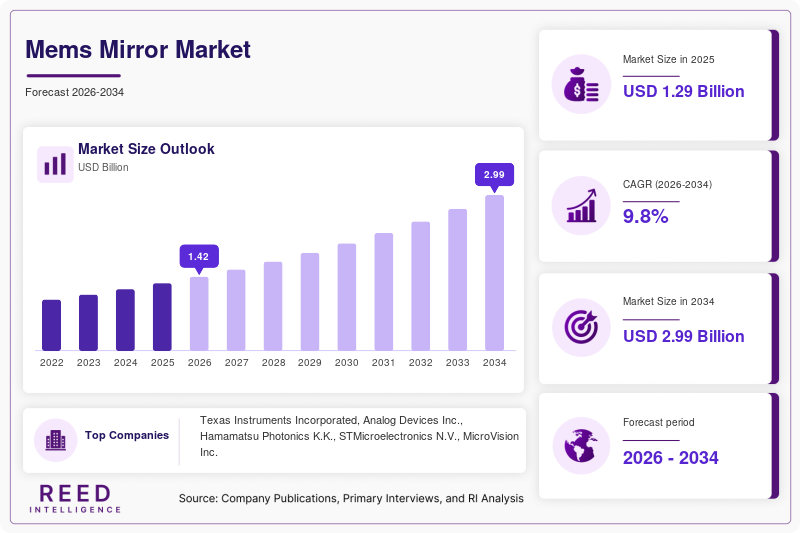
The Mems Mirror Market size is projected to reach approximately USD 1.42 billion in 2026 and is expected to attain a value of USD 3.05 billion by 2034, expanding at a compound annual growth rate (CAGR) of 9.8% (2026–2034). The market is witnessing steady expansion driven by increasing integration of micro-electro-mechanical systems (MEMS)-based mirrors in optical communication, automotive LiDAR, medical imaging, and augmented reality applications. The demand for compact, energy-efficient, and high-speed beam steering components has significantly increased as industries shift toward miniaturized and high-performance optical systems.
A key global factor supporting market growth is the rapid expansion of high-speed data networks and 5G infrastructure, which has increased the demand for optical switching and beam steering technologies. MEMS mirrors play a critical role in enabling precise light manipulation in fiber-optic communication systems and advanced sensing applications. Additionally, the rising adoption of autonomous vehicles and industrial automation has further strengthened the demand for MEMS-based optical components.
Key Highlights
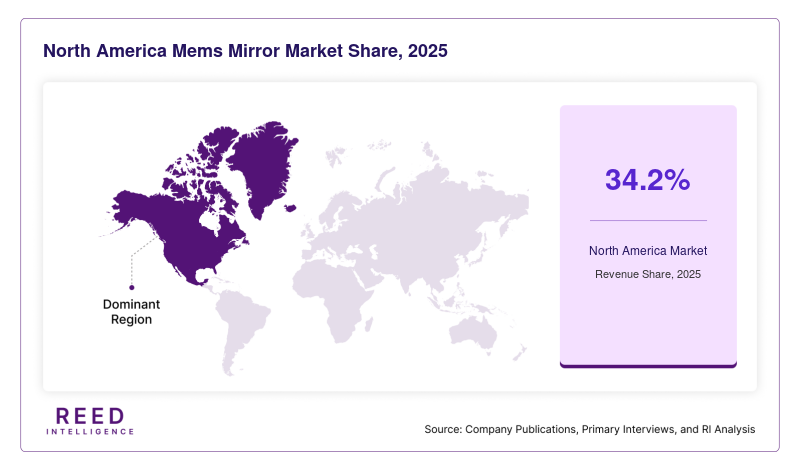
- North America dominated the market with a 34.2% share in 2025.
- Asia Pacific is expected to grow at the fastest CAGR of 11.2% during 2026–2034.
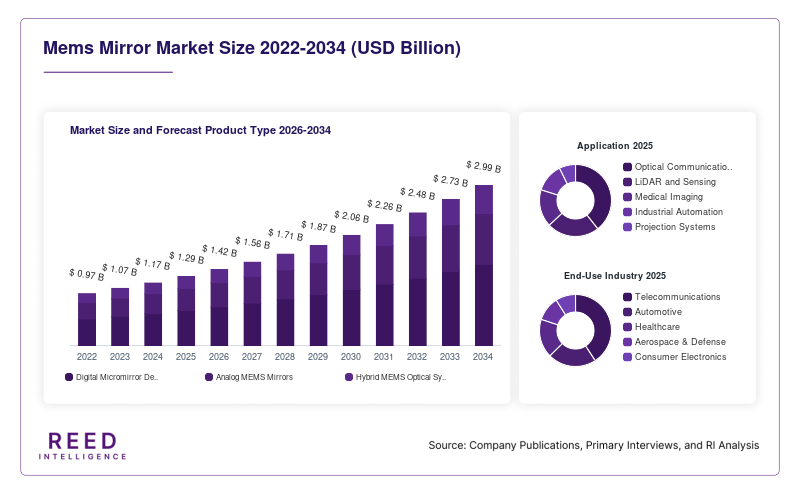
- By application, optical communication systems accounted for the largest share of 38.5%, while LiDAR-based sensing solutions are projected to grow at a CAGR of 12.4%.
- By end-use industry, telecommunications led with a 41.7% share, whereas automotive sensing applications are expected to expand at a CAGR of 11.8%.
- The United States remained the dominant country, with market values of USD 510 million in 2024 and USD 560 million in 2025.
Market Trends
Rising Adoption of MEMS Mirrors in LiDAR and Autonomous Systems
The increasing deployment of autonomous vehicles and advanced driver-assistance systems (ADAS) is significantly influencing the Mems Mirror Market. MEMS mirrors are being widely used in LiDAR systems due to their ability to provide fast scanning, low power consumption, and compact design. Automotive manufacturers are integrating solid-state LiDAR systems that rely on MEMS-based beam steering to improve object detection and navigation accuracy. The shift toward electric and autonomous mobility is further accelerating the use of MEMS mirrors in real-time 3D mapping, obstacle detection, and environmental sensing. Additionally, investments in smart transportation infrastructure are expanding the use of these mirrors beyond vehicles into traffic monitoring and smart city applications.
Expansion of Optical Communication and Data Centers
Another key trend in the Mems Mirror Market is the rapid expansion of optical communication networks and hyperscale data centers. MEMS mirrors are increasingly used in optical switching systems to enhance bandwidth management and reduce signal latency. As global data traffic continues to rise due to cloud computing, video streaming, and IoT applications, network operators are adopting MEMS-based optical switching technologies to improve scalability and efficiency. Furthermore, the transition toward reconfigurable optical networks is driving innovation in micro-mirror-based devices that enable dynamic routing of optical signals, reducing dependence on traditional electronic switching systems.
Market Drivers
Growth in 5G Infrastructure and High-Speed Connectivity Demand
The expansion of 5G networks is a major driver for the Mems Mirror Market, as next-generation communication systems require high-speed, low-latency optical switching solutions. MEMS mirrors are widely used in optical cross-connects and wavelength-selective switches, enabling efficient data transmission across fiber networks. With increasing mobile data consumption and cloud service adoption, telecom operators are investing heavily in advanced optical infrastructure. The ability of MEMS mirrors to support scalable and reconfigurable optical architectures makes them essential in managing the growing complexity of global communication networks. This demand is further reinforced by the deployment of edge computing systems and distributed data centers.
Increasing Adoption in Medical Imaging and Industrial Automation
The use of MEMS mirrors in medical imaging systems, such as optical coherence tomography (OCT), is contributing significantly to market expansion. These devices enable high-resolution imaging with compact form factors, making them suitable for minimally invasive diagnostic procedures. In industrial automation, MEMS mirrors are being integrated into laser scanning systems for precision manufacturing, quality inspection, and robotics guidance. The growing focus on automation and precision engineering across industries is driving demand for advanced optical control systems. Additionally, the need for non-contact measurement techniques in manufacturing environments further supports the adoption of MEMS mirror technologies.
Market Restraint
High Manufacturing Complexity and Cost Sensitivity
A key restraint in the Mems Mirror Market is the high complexity associated with fabrication and integration processes. MEMS mirrors require advanced microfabrication techniques, precise alignment, and stringent quality control, which increase production costs. Small design variations can significantly affect performance, making mass production challenging. This cost sensitivity limits adoption in price-sensitive markets, particularly in developing economies. Additionally, the need for specialized cleanroom facilities and skilled labor further adds to operational expenses. These factors collectively restrict scalability and slow down commercialization in certain application areas despite growing demand across industries.
Market Opportunities
Expansion in Augmented Reality and Virtual Reality Applications
The growing adoption of augmented reality (AR) and virtual reality (VR) technologies presents a significant opportunity for the Mems Mirror Market. MEMS mirrors are used in laser beam scanning systems that enable high-resolution display projection in compact devices. As consumer electronics companies invest in lightweight AR glasses and immersive VR headsets, demand for efficient optical scanning components is expected to rise. The ability of MEMS mirrors to deliver fast response times and low power consumption makes them ideal for wearable display systems. Continued innovation in human-machine interaction technologies further expands their potential applications.
Increasing Deployment in Aerospace and Defense Systems
Aerospace and defense industries are increasingly adopting MEMS mirror technologies for applications such as target tracking, satellite communication, and laser-based defense systems. These mirrors provide precise beam steering capabilities essential for secure communication and high-resolution imaging in challenging environments. The growing focus on space exploration and defense modernization programs is driving investments in advanced optical systems. MEMS mirrors are also being integrated into UAV surveillance systems and missile guidance technologies, offering enhanced accuracy and operational efficiency. This expanding application scope creates long-term growth opportunities for market participants.
Segmental Analysis
By Product Type
The Digital Micromirror Devices (DMDs) segment dominated the Mems Mirror Market in 2024, accounting for approximately 36.9% market share. This dominance is primarily attributed to their extensive use in projection systems, optical switching applications, and advanced imaging devices. DMDs are widely integrated into telecommunications and consumer electronics due to their high precision, reliability, and fast switching capabilities. Their ability to modulate light efficiently has made them a core component in optical communication networks and display technologies, thereby reinforcing their leading position in the global market.
The fastest-growing subsegment is Analog MEMS Mirrors, projected to expand at a CAGR of around 10.6% during 2026–2034. Growth in this segment is driven by increasing adoption in laser beam steering systems, medical imaging devices such as optical coherence tomography, and industrial scanning applications. Analog MEMS mirrors offer continuous motion control, making them suitable for applications requiring smooth and high-resolution scanning. Rising demand for compact optical systems in AR/VR devices and LiDAR-based sensing technologies further strengthens this segment’s growth trajectory across multiple end-use industries.
By Application
Within the application segment, Optical Communication Systems held the largest share of approximately 38.5% in 2024, driven by rapid expansion of global fiber-optic networks and increasing demand for high-speed data transmission. MEMS mirrors play a crucial role in optical switching and beam steering, enabling efficient bandwidth management and reduced latency in telecom infrastructure. Their integration into reconfigurable optical networks and data center interconnects has significantly improved network flexibility and scalability, reinforcing their dominance in this application segment.
The fastest-growing application segment is LiDAR and Sensing, projected to grow at a CAGR of around 12.4% during 2026–2034. This growth is supported by increasing adoption in autonomous vehicles, robotics, and industrial automation systems. MEMS mirrors enable precise laser scanning and real-time 3D mapping, which are essential for navigation, obstacle detection, and environment recognition. The expansion of smart mobility solutions and advancements in driver-assistance systems are further accelerating demand for MEMS-based LiDAR technologies across automotive and defense sectors.
By End-Use Industry
The Telecommunications segment accounted for the highest share of approximately 41.7% in 2024, supported by growing investments in 5G infrastructure and high-capacity data networks. MEMS mirrors are widely used in optical cross-connects, wavelength switching systems, and network routing devices. The rising demand for cloud computing, video streaming, and IoT connectivity has increased pressure on telecom operators to deploy advanced optical systems, thereby sustaining strong growth in this segment.
The fastest-growing end-use industry is Automotive, expected to expand at a CAGR of 11.8% during 2026–2034. Growth is primarily driven by increasing integration of MEMS mirrors in LiDAR systems for autonomous driving and ADAS technologies. Automotive manufacturers are increasingly adopting solid-state LiDAR solutions that rely on MEMS-based beam steering for improved accuracy and compact design. Rising investments in electric vehicles and smart mobility infrastructure further enhance the adoption of MEMS mirror technologies in this segment.
Regional Analysis
North America
North America accounted for approximately 34.2% share of the Mems Mirror Market in 2025, with a projected CAGR of around 9.1% during 2026–2034. The region’s dominance is driven by strong technological infrastructure, early adoption of optical MEMS devices, and high investments in R&D activities. The presence of major semiconductor and photonics companies further strengthens market growth across telecommunications and defense applications.
The United States leads the regional market, supported by rapid expansion of 5G networks and increasing deployment of LiDAR in autonomous vehicles. Additionally, strong government funding for aerospace and defense communication systems continues to drive demand for high-precision MEMS optical components.
Europe
Europe held approximately 25.6% market share in 2025, with an estimated CAGR of 8.7% during 2026–2034. The region benefits from a strong automotive manufacturing base and increasing adoption of optical sensing technologies in industrial automation and healthcare applications. Regulatory support for energy-efficient and advanced mobility systems also contributes to market expansion.
Germany dominates the European market due to its leadership in automotive innovation and industrial engineering. The growing focus on autonomous driving systems and precision manufacturing technologies is significantly boosting demand for MEMS mirrors in the region.
Asia Pacific
Asia Pacific is projected to grow at the fastest CAGR of 11.2% during 2026–2034, accounting for approximately 28.1% share in 2025. The region’s growth is driven by rapid industrialization, large-scale semiconductor production, and increasing adoption of advanced optical technologies across multiple industries.
China is the leading country in the region, supported by massive investments in 5G infrastructure, consumer electronics manufacturing, and electric vehicle development. The rising integration of LiDAR systems in smart mobility solutions is further accelerating MEMS mirror adoption across automotive and industrial sectors.
Middle East & Africa
Middle East & Africa accounted for around 6.3% market share in 2025, with a projected CAGR of 8.9% during 2026–2034. Growth in the region is supported by smart city initiatives, telecom expansion, and increasing investment in defense modernization programs. Adoption of advanced optical systems is gradually increasing across infrastructure and security applications.
The United Arab Emirates leads the regional market due to strong investments in digital transformation, aerospace technologies, and smart surveillance systems. Government-led innovation programs are further supporting the integration of MEMS-based optical solutions.
Latin America
Latin America held approximately 5.8% market share in 2025, with a forecast CAGR of 8.4% during 2026–2034. Market growth is supported by increasing digital infrastructure development and expansion of automotive manufacturing capabilities across the region.
Brazil is the dominant country in Latin America, driven by growing investments in telecommunications networks and industrial automation. The rising adoption of smart technologies in urban infrastructure is further supporting demand for MEMS mirror systems.
Competitive Landscape
The Mems Mirror Market is moderately consolidated, with key players focusing on innovation, miniaturization, and integration of MEMS technologies into advanced optical systems. Companies such as Texas Instruments, Analog Devices, and Hamamatsu Photonics maintain strong positions due to extensive product portfolios and global distribution networks. Emerging players are focusing on niche applications such as LiDAR and AR/VR systems.
Recent developments include increased investment in wafer-level manufacturing and integration of AI-based optical control systems. Companies are also expanding partnerships with automotive and telecom firms to strengthen application-specific product development.
Key Players
- Texas Instruments Incorporated
- Analog Devices Inc.
- Hamamatsu Photonics K.K.
- STMicroelectronics N.V.
- MicroVision Inc.
- Thorlabs Inc.
- Canon Inc.
- OPOTEK Inc.
- Mirrorcle Technologies Inc.
- Sercalo Microtechnology Ltd.
- VarioOptic Systems
- InvenSense Inc.
- MEMS Optical Inc.
- Boston Micromachines Corporation
- JENOPTIK AG
Recent Developments
- A leading semiconductor company expanded its MEMS fabrication facility to increase production capacity for optical switching devices used in telecom infrastructure.
- An automotive technology firm introduced a next-generation solid-state LiDAR system integrated with MEMS mirror scanning technology for enhanced autonomous driving capabilities.
- A photonics manufacturer announced collaboration with a cloud computing provider to develop high-speed optical interconnect solutions using MEMS-based beam steering systems.
Mems Mirror Market Segments
Product Type
- Digital Micromirror Devices
- Analog MEMS Mirrors
- Hybrid MEMS Optical Systems
Application
- Optical Communication Systems
- LiDAR and Sensing
- Medical Imaging
- Industrial Automation
- Projection Systems
End-Use Industry
- Telecommunications
- Automotive
- Healthcare
- Aerospace & Defense
- Consumer Electronics
By Region
- North America
- Europe
- APAC
- Middle East and Africa
- LATAM