Mentoring Software Market Size, Share & Trends Analysis Report By Deployment (Cloud-Based, On-Premise), By Organization Size (Large Enterprises, Small & Medium Enterprises), By Application (Career & Leadership Development, New-Hire Onboarding, Skills & Peer Mentoring, Diversity & Inclusion & Employee Communities, Education & Alumni Mentoring) and By Region (North America, Europe, APAC, Middle East and Africa, LATAM) Forecasts, 2026–2034
USD 3950
Mentoring Software Market Size
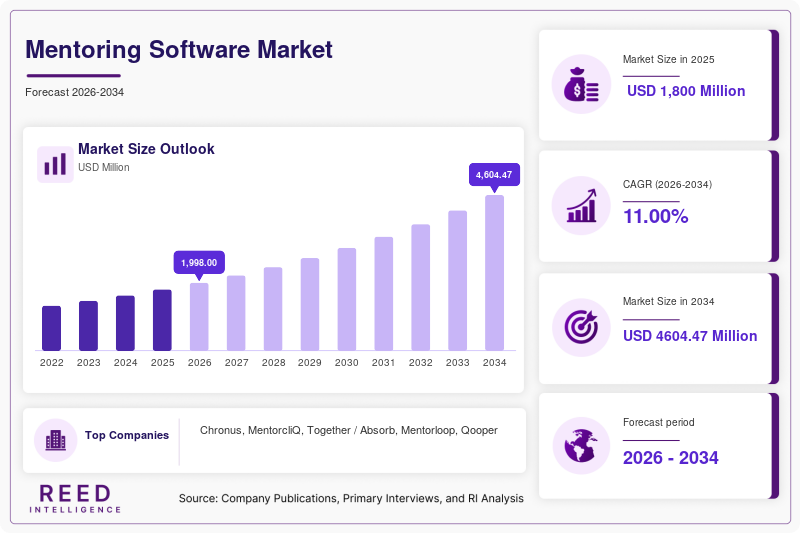
The global mentoring software market is valued at USD 1,800 Million in 2025 and USD 2,000 Million in 2026. The market is projected to reach USD 4,604.47 Million by 2034, registering a 11.00% CAGR during the forecast period.
The mentoring software market is expanding as organizations move from manually managed mentoring programs toward structured digital platforms that automate participant enrollment, mentor-mentee matching, communication, scheduling, progress tracking and outcome measurement.
Modern mentoring platforms increasingly function as broader employee-development systems. Chronus, MentorcliQ, Together, Mentorloop and Qooper position their platforms around structured mentoring, employee development, career progression, onboarding, leadership development, communities and analytics rather than simple mentor-directory functionality. Chronus, for example, combines AI-assisted matching, guided conversations, reporting and employee-community management in a single platform.
Mentoring Software Market Drivers
Skills gaps and changing job requirements are expanding demand for structured mentoring
The global workforce is facing continuous skill disruption. The World Economic Forum estimates that 39% of workers' current skill sets will change or become outdated by 2030, while 63% of employers identify skill gaps as a leading barrier to business transformation.
Mentoring provides organizations with a way to transfer knowledge from experienced employees to people developing new capabilities. Software makes this process scalable by identifying potential matches, structuring interactions and measuring participation.
MentorcliQ explicitly positions mentoring around AI upskilling, leadership development, onboarding and skills programs, while Qooper supports AI-adoption mentoring and structured employee-development programs.
The commercial mechanism is particularly strong where organizations already possess relevant expertise internally but lack efficient systems to identify, connect and manage that knowledge.
Employee retention and internal mobility are making mentoring a strategic talent-management tool
Career development has become increasingly connected with retention. LinkedIn's Workplace Learning Report states that 88% of organizations are concerned about employee retention and identifies learning opportunities as the most commonly cited retention strategy. The report also links mature career-development programs with greater confidence in talent attraction and retention.
Mentoring software supports this requirement by connecting employees with experienced colleagues, providing career-development pathways and creating visibility into participation and outcomes.
MentorcliQ reports capabilities spanning employee retention, career development and promotion pathways, while Qooper's current platform includes org-wide mentoring, new-hire onboarding, leadership development and succession-related programs.
As internal mobility becomes more important, mentoring platforms are increasingly being evaluated alongside learning-management systems, HRIS platforms and talent-management tools.
Automation is replacing manual mentoring administration
Manual mentoring programs require administrators to collect participant data, evaluate applications, create matches, send reminders, monitor milestones and compile outcome reports.
As programs scale across thousands of employees or multiple countries, this administrative burden becomes a significant constraint. MentorcliQ's 2026 analysis specifically identifies manual mentoring administration as a major source of wasted HR and L&D time and highlights automation as necessary for larger programs.
Modern platforms automate much of this lifecycle. Qooper supports automated workflows and HRIS integrations, MentorcliQ provides AI-assisted program design and rapid enrollment, while Mentorloop combines matching, milestones, analytics and AI-supported program coordination.
Automation therefore expands the addressable market from small pilot programs to enterprise-wide, multi-program mentoring ecosystems.
Mentoring Software Market Restraints
Weak matches and participant drop-off can reduce perceived software value
The success of mentoring software depends heavily on the quality and continuity of mentoring relationships. Chronus's September 2026 State of Mentoring survey found that 47% of HR leaders considered their current matches generic or shallow, while 39% reported that matched participants never scheduled a first meeting and 54% said participants often met once and failed to continue.
These problems can undermine return on investment even when the software itself is functioning correctly.
Vendors are therefore investing in more sophisticated matching, guided conversations, milestones, nudges and relationship-health analytics. Mentorloop's AI platform combines structured matching with free-text interpretation and personalized nudges, while Chronus uses guided conversations and AI-assisted matching.
Privacy, governance and employee-data concerns limit uncontrolled AI adoption
Mentoring platforms process sensitive employee information such as career goals, skills, professional relationships, feedback and organizational attributes. As AI becomes more deeply embedded, customers must assess how the data is stored, processed and used.
Chronus's September 2026 survey found that 67% of respondents identified human oversight as the most frequently selected vendor requirement for AI-enabled mentoring. The survey also found that 60% were unlikely to allow AI to act autonomously on HR decisions and 50% were unlikely to allow session recording.
Mentorloop has similarly emphasized human-in-the-loop controls, explainable matching and restrictions on using customer data to train models for other customers.
This increases procurement requirements around security, privacy, governance, role-based access, data retention and AI explainability.
Mentoring Software Market Opportunities
AI-enabled mentoring can expand personalized development beyond human capacity
AI can extend mentoring support between live human interactions through personalized prompts, goal-setting assistance, meeting preparation, conversation guidance and development recommendations.
Chronus launched Rumi in May 2026 as an AI mentor designed to complement human mentoring, while Mentorloop's Intelligence platform combines AI-generated agendas, survey summaries, smart nudges, matching intelligence and its Coco coordinator.
Qooper is also positioning AI around matching, personalized agendas, mentorship training and identification of retention and engagement signals.
The opportunity is to turn mentoring from a scheduled event into an always-available development layer integrated into everyday employee workflows.
Integration with HRIS, collaboration and learning platforms can make mentoring part of the broader talent ecosystem
Enterprise buyers increasingly want mentoring to operate as part of their existing HR technology rather than as an isolated application.
MentorcliQ integrates employee profiles through HRIS systems and supports collaboration tools, while Qooper supports integrations with Workday, SAP SuccessFactors, Oracle, ADP, UKG and other enterprise systems. Mentorloop also supports HRIS, SSO and collaboration integrations in its enterprise offering.
Together's acquisition by Absorb in 2024 also illustrates the strategic logic of integrating mentorship with formal learning systems, bringing Together into an AI-powered learning-management ecosystem.
This creates opportunities for vendors to expand beyond mentoring administration into unified learning, career development and employee-experience platforms.
Deployment Analysis
Cloud-Based platforms hold the dominant deployment share
Cloud-based mentoring software dominates because it allows organizations to deploy programs without maintaining dedicated infrastructure and enables remote participants to access the platform through web and mobile interfaces.
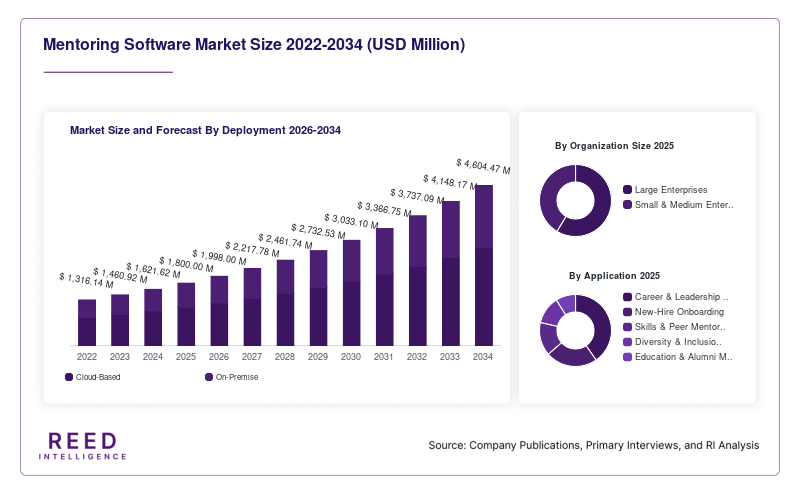
The Cloud-Based segment accounts for 82% of the global market in 2026 and is projected to register a 11.80% CAGR.
Cloud deployment is also well suited to distributed workforces because administrators can launch programs across geographies while maintaining a centralized management and reporting environment.
On-Premise deployment serves organizations with specialized security requirements
On-premise systems remain relevant for organizations with strict internal infrastructure, data-residency or security requirements.
The segment is projected to register a 6.20% CAGR, with demand concentrated among organizations with specialized IT-governance requirements.
Organization Size Analysis
Large Enterprises hold the dominant organization-size share
Large enterprises represent the largest user group because they are more likely to run multiple mentoring programs across business units, geographies and employee populations.
The Large Enterprises segment accounts for 71% of the global market in 2026 and is projected to register a 10.30% CAGR.
Chronus, MentorcliQ, Qooper and Mentorloop all emphasize enterprise-scale deployment, multi-program management, HRIS integrations and reporting. Chronus's September 2026 survey also demonstrates that organizations are increasingly expanding mentoring beyond small high-potential groups toward workforce-wide programs.
Regional Analysis
North America Mentoring Software Market
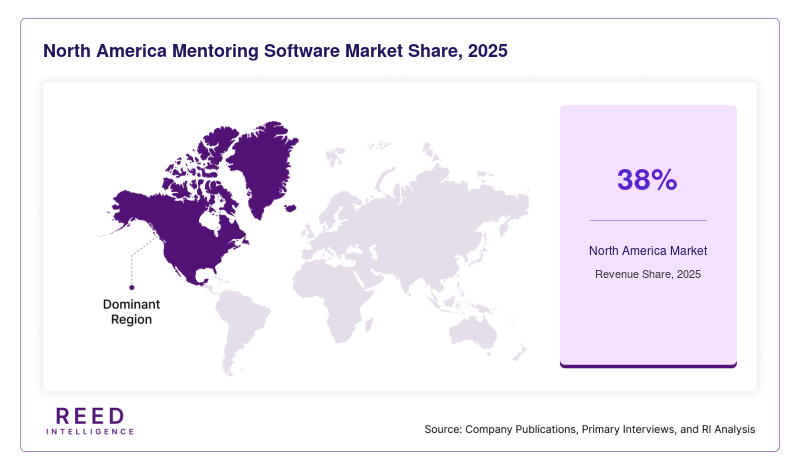
North America remains the dominant regional market because of high enterprise-software adoption, mature HR technology infrastructure, large professional-services ecosystems and strong investment in employee development.
The North America region accounts for 38% of the global market in 2026 and is projected to register a 10.20% CAGR.
The region also contains many of the market's leading vendors, including Chronus, MentorcliQ, Qooper and Together, while large employers increasingly integrate mentoring with HRIS, learning and employee-experience platforms.
APAC Mentoring Software Market
APAC is the fastest-growing regional market as organizations across India, China, Southeast Asia, Japan, Australia and other markets expand digital HR infrastructure and structured employee-development programs.
The APAC region accounts for 24% of the global market in 2026 and is projected to register a 13.20% CAGR, making it the fastest-growing region.
The region benefits from large employee populations, growing technology-sector employment, increasing demand for leadership development and expansion of cloud-based HR technology.
Mentorloop's 2026 activity illustrates the importance of APAC as a growth region: the company reported recognition across APAC, Asia and EMEA and continued investment in AI-powered mentoring capabilities.
Europe Mentoring Software Market
Europe is an established market with strong adoption of enterprise HR software, learning technologies and structured career-development initiatives.
The region is projected to register a 10.00% CAGR, supported by demand for multilingual mentoring, GDPR-aware platforms, cross-border employee development and internal mobility.
Mentorloop and Qooper both emphasize multilingual capabilities and privacy or security controls relevant to European enterprise buyers.
Middle East and Africa Mentoring Software Market
The Middle East and Africa market is developing through enterprise digitalization, workforce localization, leadership development and growing investments in employee experience.
The region is projected to register a 11.50% CAGR, with demand increasingly coming from large corporations, universities and professional communities.
LATAM Mentoring Software Market
LATAM is expanding through cloud-HR adoption, employee-development initiatives, professional associations and university-alumni programs.
The region is projected to register a 10.90% CAGR, supported by greater use of digital mentoring infrastructure and cross-border professional networks.
Competitive Landscape
The mentoring software market is competitive across enterprise mentoring platforms, employee-community systems, education-focused platforms and broader learning-and-development technology providers.
Chronus is positioning itself as an enterprise platform for mentoring, career development, employee communities and change adoption. Its MatchIQ AI capabilities, guided mentoring, ROI reporting and Rumi AI mentor show the company's transition from traditional mentoring administration toward AI-supported employee development.
Key Market Players
- Chronus
- MentorcliQ
- Together / Absorb
- Mentorloop
- Qooper
- Guider
- PushFar
- MentorCity
- Ten Thousand Coffees
- Mentor Collective
- People360
- Growthspace
- ADPList
- MentorCruise
- Insala / People360
Recent Developments
September 2026 – Chronus released its inaugural State of Mentoring survey. The survey of 94 senior HR and talent leaders found that 62% expected their number of mentoring programs to increase over the next 12–24 months, while 52% expected mentoring budgets to grow. The research also showed that 86% expected to evaluate or deploy AI-enabled mentoring within two years.
September 2026 – Qooper expanded its AI positioning around personalized mentoring and retention-risk identification. Qooper described AI capabilities that use engagement, relationship-health and career-movement signals to surface potential retention risks and support targeted mentor matching. The development expands mentoring software from program administration toward continuous talent intelligence.
Mentoring Software Market Segments
By Deployment
- Cloud-Based
- On-Premise
By Organization Size
- Large Enterprises
- Small & Medium Enterprises
By Application
- Career & Leadership Development
- New-Hire Onboarding
- Skills & Peer Mentoring
- Diversity & Inclusion & Employee Communities
- Education & Alumni Mentoring
By Region
- North America
- Europe
- APAC
- Middle East and Africa
- LATAM