Mesoporous Silica Market Size, Share & Demand Report By Type (SBA-15, MCM-41, KIT-6, Others), By Application (Drug Delivery, Catalysis, Energy Storage, Adsorption & Filtration, Others), By End-Use (Pharmaceutical, Chemical, Electronics, Energy, Environmental) By Region & Segment Forecasts, 2026–2034
USD 3950
Market Overview
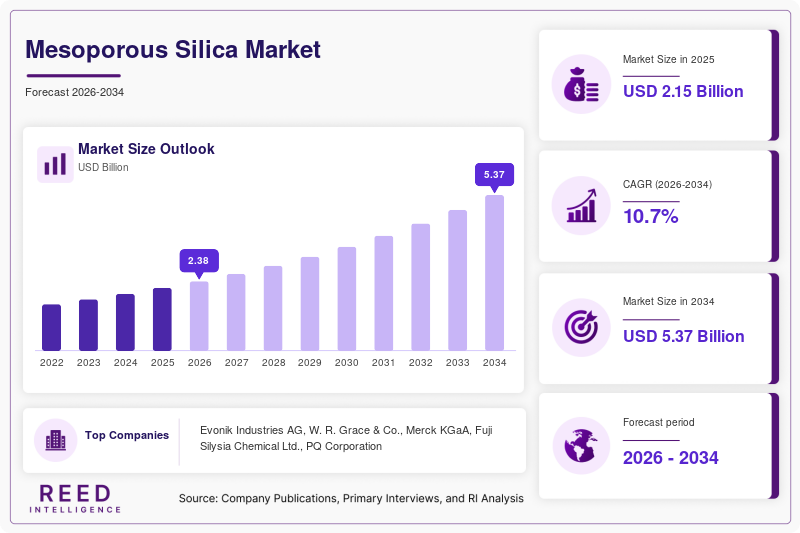
The global Mesoporous Silica Market size was valued at approximately USD 2.15 billion in 2026 and is projected to reach USD 4.85 billion by 2034, expanding at a CAGR of 10.7% during the forecast period from 2026 to 2034. The market continues to demonstrate steady expansion due to the rising demand for advanced materials with high surface area, tunable pore structures, and functional versatility across industries such as pharmaceuticals, electronics, energy storage, and catalysis. Increasing investments in nanotechnology research and material science innovation have further contributed to the growing adoption of mesoporous silica in high-performance applications.
A key global factor supporting market growth is the expanding pharmaceutical and drug delivery sector, where mesoporous silica is widely utilized for controlled drug release systems. Its ability to enhance bioavailability and improve therapeutic efficiency has made it a preferred material in advanced drug formulations. Additionally, growing environmental concerns have driven the use of mesoporous silica in water treatment and adsorption technologies, further strengthening market demand.
Key Highlights
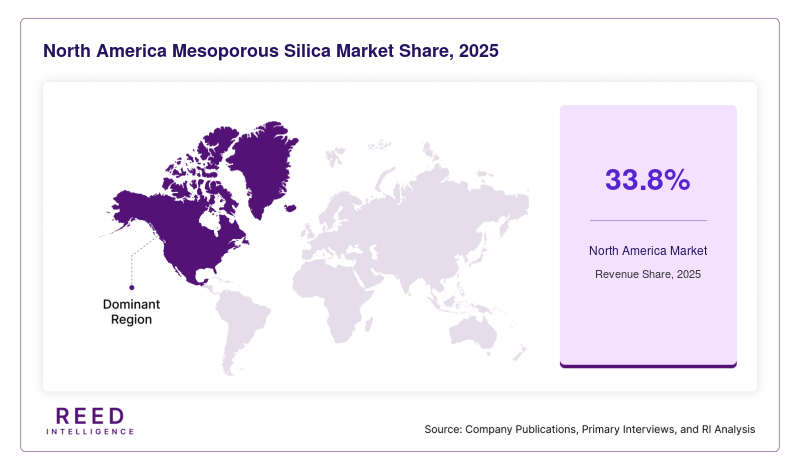
- North America dominated the market with a 33.8% share in 2025.
- Asia Pacific is expected to grow at the fastest CAGR of 11.5% during 2026–2034.
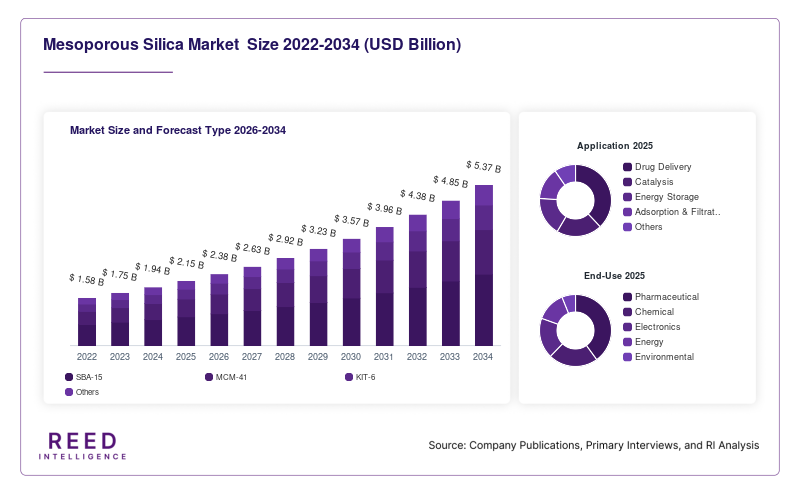
- By type, SBA-15 accounted for the largest share of 36.2%, while MCM-41 is projected to grow at a CAGR of 12.1%.
- By application, drug delivery led with a 39.4% share, whereas energy storage applications are expected to expand at a CAGR of 11.9%.
- The United States remained the dominant country, with market values of USD 480 million in 2024 and USD 525 million in 2025.
Market Trends
Growing adoption in nanomedicine and targeted drug delivery
The integration of mesoporous silica in nanomedicine has emerged as a notable trend shaping the Mesoporous Silica Market. The material’s highly ordered pore structure and biocompatibility allow for precise drug loading and controlled release mechanisms. Pharmaceutical companies are increasingly focusing on developing targeted therapies for chronic diseases, including cancer and neurological disorders. Mesoporous silica nanoparticles enable site-specific drug delivery, reducing side effects and improving treatment outcomes. This trend is supported by rising research collaborations between academic institutions and pharmaceutical manufacturers. Additionally, advancements in surface modification techniques are enabling customization of mesoporous silica particles, further expanding their application scope. The increasing prevalence of chronic diseases worldwide continues to support sustained demand for such innovative drug delivery systems.
Expanding use in sustainable catalysis and environmental applications
Another prominent trend is the increasing use of mesoporous silica in sustainable catalysis and environmental remediation processes. Industries are shifting toward cleaner production methods, and mesoporous silica is gaining traction as a catalyst support due to its large surface area and thermal stability. It is widely used in petrochemical refining, green chemistry processes, and emission control systems. Furthermore, its application in water purification systems, including adsorption of heavy metals and organic pollutants, is expanding rapidly. Governments across various regions are implementing stringent environmental regulations, encouraging industries to adopt efficient filtration and catalytic technologies. As a result, the demand for mesoporous silica in eco-friendly applications is expected to rise steadily, reinforcing its role in sustainable industrial development.
Market Drivers
Rising demand from pharmaceutical and healthcare industries
The growing demand from the pharmaceutical and healthcare sectors is a major factor driving the Mesoporous Silica Market. Mesoporous silica materials are increasingly used in drug formulation due to their ability to enhance solubility and stability of poorly water-soluble drugs. This property is particularly important for improving the effectiveness of modern therapeutics. The expansion of personalized medicine and biologics has further increased the need for advanced drug delivery carriers. In addition, the rise in global healthcare expenditure and increasing focus on innovative treatment methods are encouraging pharmaceutical companies to adopt mesoporous silica-based solutions. Continuous advancements in material engineering are also enabling the development of multifunctional carriers, thereby supporting market growth.
Increasing applications in energy storage and electronics
The growing adoption of mesoporous silica in energy storage and electronics applications is another key driver of market growth. The material is used in lithium-ion batteries, supercapacitors, and fuel cells due to its structural stability and high surface area, which enhance energy efficiency and performance. As the demand for renewable energy solutions and electric vehicles increases, the need for advanced energy storage systems is rising significantly. Mesoporous silica plays a crucial role in improving battery lifespan and charge capacity. Additionally, its use in electronic components, including sensors and semiconductors, is expanding due to its unique physical and chemical properties. This trend is expected to drive consistent demand across the forecast period.
Market Restraint
High production costs and complex synthesis processes
One of the key challenges limiting the growth of the Mesoporous Silica Market is the high production cost associated with its synthesis. The manufacturing process involves precise control of chemical reactions, temperature conditions, and templating methods, which increases operational complexity. This leads to higher costs compared to conventional silica materials, restricting its adoption among small- and medium-scale industries. Additionally, scalability remains a concern, as large-scale production often requires significant capital investment and advanced technological infrastructure. These factors can hinder widespread commercialization, particularly in price-sensitive markets. For example, in developing regions, industries may prefer cost-effective alternatives despite the superior performance of mesoporous silica. Addressing these challenges through process optimization and cost reduction strategies will be critical for sustained market growth.
Market Opportunities
Advancements in biomedical research and diagnostics
The expanding scope of biomedical research and diagnostics presents significant opportunities for the Mesoporous Silica Market. Researchers are exploring the use of mesoporous silica nanoparticles in imaging, biosensing, and disease detection. Their ability to carry fluorescent markers and functional molecules makes them suitable for advanced diagnostic applications. As healthcare systems increasingly emphasize early disease detection and precision medicine, the demand for innovative diagnostic tools is growing. Mesoporous silica offers a promising platform for developing next-generation diagnostic technologies. Furthermore, increased funding for research and development activities in the life sciences sector is expected to accelerate innovation and create new growth avenues for market participants.
Growing demand in emerging economies
Emerging economies present strong growth opportunities for the Mesoporous Silica Market due to rapid industrialization and increasing investments in advanced materials. Countries in Asia Pacific, Latin America, and the Middle East are witnessing significant expansion in sectors such as pharmaceuticals, energy, and water treatment. Government initiatives aimed at improving infrastructure and promoting sustainable development are further supporting market growth. Additionally, rising awareness about environmental protection is driving the adoption of advanced filtration and adsorption materials. As these regions continue to develop, the demand for high-performance materials like mesoporous silica is expected to increase, offering lucrative opportunities for global manufacturers to expand their presence.
Segmental Analysis
By Type
SBA-15 emerged as the dominant subsegment in 2024, accounting for approximately 36.2% of the Mesoporous Silica Market share. Its well-ordered pore structure, large surface area, and thermal stability make it suitable for a wide range of applications, including catalysis, drug delivery, and adsorption processes. Industries prefer SBA-15 due to its ability to support high loading capacity and enhance reaction efficiency in catalytic systems. Additionally, its compatibility with various functionalization techniques enables customization for specific industrial requirements. The increasing use of SBA-15 in pharmaceutical formulations and environmental applications continues to support its leading position in the market.
MCM-41 is projected to be the fastest-growing subsegment, expanding at a CAGR of 12.1% during the forecast period. Its uniform pore size distribution and ease of synthesis make it attractive for applications in drug delivery and nanotechnology. The growing demand for advanced materials in biomedical research and electronics is driving the adoption of MCM-41. Furthermore, ongoing research focused on improving its structural properties and functional capabilities is expected to enhance its application scope. The increasing focus on innovation and material performance optimization continues to drive growth in this segment.
By Application
Drug delivery accounted for the largest share of the Mesoporous Silica Market in 2024, with a share of approximately 39.4%. The growing demand for advanced drug delivery systems and targeted therapies has significantly contributed to the dominance of this segment. Mesoporous silica’s ability to improve drug solubility and provide controlled release mechanisms makes it highly suitable for pharmaceutical applications. Additionally, the increasing prevalence of chronic diseases and the need for effective treatment solutions are driving demand in this segment. Continuous advancements in nanomedicine further strengthen the adoption of mesoporous silica in drug delivery applications.
Energy storage applications are expected to grow at the fastest CAGR of 11.9% during the forecast period. The increasing demand for efficient energy storage solutions, particularly in renewable energy systems and electric vehicles, is driving this growth. Mesoporous silica is used to enhance the performance and stability of batteries and supercapacitors. Its structural properties enable improved charge capacity and longer lifespan of energy storage devices. As the global shift toward sustainable energy continues, the demand for advanced materials in energy storage applications is expected to rise significantly.
By End-Use
The pharmaceutical industry dominated the Mesoporous Silica Market in 2024, accounting for a significant share of around 34.8%. The widespread use of mesoporous silica in drug formulation, delivery systems, and biomedical research has contributed to its dominance. Pharmaceutical companies are increasingly focusing on developing innovative therapies that require advanced materials with high efficiency and reliability. Mesoporous silica’s unique properties, such as high surface area and tunable pore structure, make it an ideal choice for these applications. The continuous growth of the global pharmaceutical industry further supports demand in this segment.
The electronics industry is expected to be the fastest-growing end-use segment, with a CAGR of 11.3% during the forecast period. The increasing use of mesoporous silica in sensors, semiconductors, and electronic components is driving growth in this segment. Its excellent thermal stability and electrical properties make it suitable for high-performance electronic applications. Additionally, the growing demand for consumer electronics and advancements in technology are contributing to the expansion of this segment. As innovation in electronics continues, the demand for advanced materials like mesoporous silica is expected to increase.
Regional Analysis
North America
North America accounted for a significant share of the Mesoporous Silica Market, holding approximately 33.8% in 2025, with a steady CAGR of 9.8% projected through 2034. The region’s strong market presence is attributed to advanced research infrastructure and high adoption of nanotechnology-based materials. The presence of established pharmaceutical and chemical industries further supports demand. Additionally, continuous investments in innovation and product development contribute to sustained growth in this region.
The United States dominates the North American market due to its robust healthcare sector and strong focus on research and development. A key growth factor is the increasing use of mesoporous silica in drug delivery systems, supported by favorable regulatory frameworks. The country’s emphasis on technological advancements and collaboration between research institutions and industries continues to drive market expansion.
Europe
Europe held a considerable share of the Mesoporous Silica Market in 2025, accounting for around 26.5%, with a projected CAGR of 9.5% during the forecast period. The region benefits from stringent environmental regulations that promote the use of advanced materials in sustainable applications. The presence of leading chemical manufacturers and research organizations further supports market growth.
Germany is the leading country in Europe, driven by its strong industrial base and focus on innovation. A unique growth factor is the increasing adoption of mesoporous silica in catalytic applications within the automotive and chemical sectors. The country’s commitment to sustainability and green technologies continues to create opportunities for market expansion.
Asia Pacific
Asia Pacific is expected to be the fastest-growing region in the Mesoporous Silica Market, with a CAGR of 11.5% from 2026 to 2034, and held a share of approximately 24.3% in 2025. Rapid industrialization and growing investments in advanced materials are key factors driving regional growth. The expansion of pharmaceutical and electronics industries further contributes to increasing demand.
China dominates the Asia Pacific market due to its large manufacturing base and increasing investments in research and development. A significant growth factor is the rising demand for energy storage solutions, where mesoporous silica is used in battery technologies. Government support for industrial development and innovation further accelerates market growth.
Middle East & Africa
The Middle East & Africa region accounted for around 8.1% of the Mesoporous Silica Market in 2025, with a projected CAGR of 8.9% during the forecast period. The region is gradually adopting advanced materials in various industries, including oil and gas, water treatment, and construction. Increasing awareness of sustainable practices is also contributing to market growth.
Saudi Arabia leads the market in this region, driven by its strong oil and gas sector. A unique growth factor is the use of mesoporous silica in catalytic processes for refining and petrochemical production. The country’s focus on diversifying its economy and investing in advanced technologies supports market expansion.
Latin America
Latin America held a market share of approximately 7.3% in 2025 and is expected to grow at a CAGR of 9.1% through 2034. The region’s growth is supported by increasing industrial activities and rising demand for advanced materials in environmental applications. Expanding infrastructure projects also contribute to market development.
Brazil is the dominant country in Latin America, driven by its growing industrial and pharmaceutical sectors. A key growth factor is the increasing adoption of mesoporous silica in water treatment applications. Government initiatives aimed at improving environmental sustainability further support market growth.
Competitive Landscape
The Mesoporous Silica Market is characterized by the presence of several established players focusing on research and development, product innovation, and strategic collaborations. Companies are investing in advanced manufacturing technologies to improve product quality and reduce production costs. The market is moderately competitive, with key players aiming to strengthen their global presence through expansion and partnerships.
Evonik Industries AG is recognized as a leading player in the market, leveraging its strong product portfolio and technological expertise. The company recently expanded its production capacity for advanced silica materials to meet growing demand from pharmaceutical and industrial applications. Other major players are also focusing on developing customized solutions to cater to specific industry requirements, enhancing their competitive positioning.
Key Players
- Evonik Industries AG
- W. R. Grace & Co.
- Merck KGaA
- Fuji Silysia Chemical Ltd.
- PQ Corporation
- Cabot Corporation
- AGC Inc.
- Solvay S.A.
- Mitsubishi Chemical Corporation
- Thermo Fisher Scientific Inc.
- Sigma-Aldrich Corporation
- NanoPore Incorporated
- ACS Material LLC
- SkySpring Nanomaterials Inc.
- Strem Chemicals Inc.
Recent Developments
- Evonik Industries AG expanded its silica production facility to enhance supply capacity for pharmaceutical-grade materials.
- Merck KGaA introduced a new range of mesoporous silica products designed for advanced drug delivery applications.
- W. R. Grace & Co. developed innovative catalyst support materials using mesoporous silica for improved industrial performance.
Mesoporous Silica Market Segments
Type
- SBA-15
- MCM-41
- KIT-6
- Others
Application
- Drug Delivery
- Catalysis
- Energy Storage
- Adsorption & Filtration
- Others
End-Use
- Pharmaceutical
- Chemical
- Electronics
- Energy
- Environmental
By Region
- North America
- Europe
- APAC
- Middle East and Africa
- LATAM