Metal & Metal Manufactured Products Market Size, Share & Demand Report By Metal Type (Steel Products, Aluminum Products), By Manufacturing Process (Casting, Forging, Fabrication & Forming), By Product Category (Structural Metal Products, Pipes & Tubes, Fasteners & Hardware), By End-Use Industry (Construction & Infrastructure, Automotive & Transportation), By Distribution Channel (Direct Sales, Distributors, Industrial Wholesalers), By Region & Segment Forecasts, 2026–2034
USD 3950
Market Overview
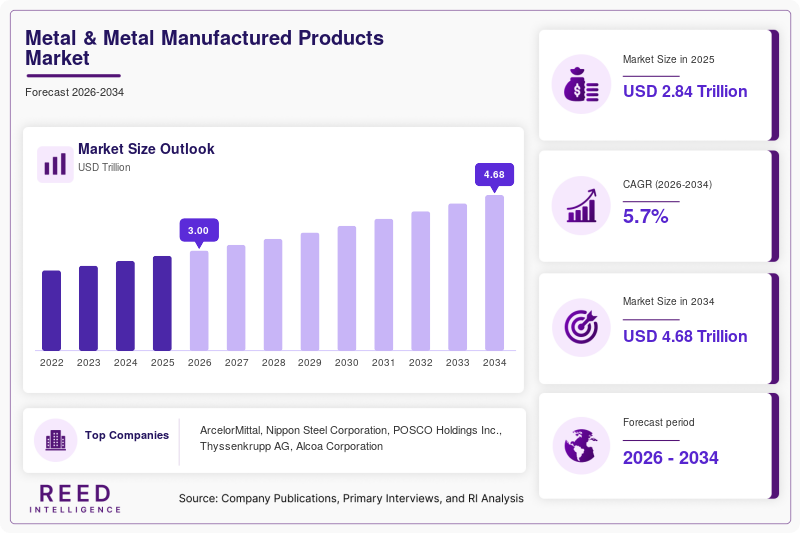
The Metal & Metal Manufactured Products Market was valued at USD 2.84 trillion in 2026 and is projected to reach USD 4.41 trillion by 2034, expanding at a CAGR of 5.7% during 2026–2034. The market continues to play a fundamental role in global industrial development, supporting sectors such as construction, transportation, energy, machinery, consumer goods, aerospace, electronics, and infrastructure. Rising investments in manufacturing modernization, industrial automation, and large-scale infrastructure projects are contributing to steady market expansion worldwide.
One of the major global factors supporting market growth is the continued increase in public and private investments in infrastructure development. Governments across developed and emerging economies are allocating significant budgets toward transportation networks, renewable energy facilities, smart cities, industrial parks, and urban housing projects. These initiatives require substantial quantities of steel, aluminum, copper, fabricated metal products, structural components, and engineered metal solutions, creating sustained demand across the value chain.
Key Highlights
- Asia Pacific dominated the market with 42.8% share in 2025, while Middle East & Africa is projected to register the fastest CAGR of 6.9% during 2026–2034.
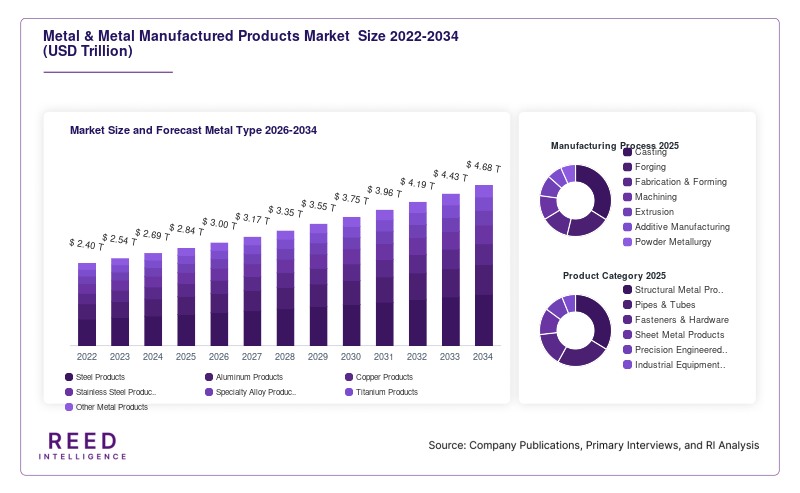
- By Metal Type, Steel Products accounted for the largest share of 46.5% in 2025, while Aluminum Products are forecast to grow at 6.8% CAGR.
- By Manufacturing Process, Fabrication & Forming held 39.4% market share in 2025, while Additive Manufacturing is expected to expand at 8.2% CAGR.
- By End-Use Industry, Construction & Infrastructure represented 34.7% share in 2025, while Renewable Energy Equipment is projected to grow at 8.6% CAGR.
- By Product Category, Structural Metal Products captured 31.2% share in 2025, whereas Precision Engineered Components are expected to register 7.8% CAGR.
- China, the dominant country, recorded market values of USD 682.4 billion in 2024 and USD 714.6 billion in 2025.
Market Trends
Increasing Adoption of Lightweight Metal Solutions
Manufacturers across transportation, aerospace, and industrial equipment sectors are increasingly adopting lightweight metal solutions to improve fuel efficiency, operational performance, and sustainability. Aluminum alloys, advanced steel grades, magnesium-based products, and engineered metal composites are gaining wider acceptance. These materials offer superior strength-to-weight ratios and support evolving product design requirements, making lightweight metals an important trend shaping the market outlook.
Growing Integration of Smart Manufacturing Technologies
Digital transformation is becoming a defining trend within metal manufacturing facilities. Producers are deploying industrial Internet of Things (IIoT) platforms, artificial intelligence, robotics, digital twins, and automated quality control systems to improve productivity and reduce downtime. Smart manufacturing technologies are enabling real-time process optimization, predictive maintenance, and enhanced resource utilization, supporting improved profitability and operational efficiency.
Market Drivers
Rising Infrastructure Development Projects Worldwide
Large-scale investments in transportation corridors, commercial buildings, industrial facilities, public utilities, and urban development projects are driving demand for metal products globally. Structural steel, fabricated metal components, pipes, tubes, reinforcement products, and industrial hardware remain essential inputs for modern infrastructure construction. Increasing urbanization and population growth continue to support long-term consumption across developed and emerging economies.
Expansion of Electric Vehicle Manufacturing
The rapid growth of electric vehicle production is creating substantial demand for specialized metal products and components. Battery enclosures, lightweight body structures, electric motor assemblies, thermal management systems, and charging infrastructure all require advanced metal materials. Automakers are increasing procurement of aluminum, copper, specialty steel, and precision-engineered components, supporting market expansion across multiple product categories.
Market Restraint
Volatility in Raw Material Prices
Fluctuations in prices of iron ore, coking coal, aluminum, copper, nickel, and energy resources remain a major challenge for manufacturers. Unpredictable input costs can affect production planning, profit margins, and investment decisions. Price volatility may also increase procurement risks and create uncertainty throughout the metal manufacturing supply chain.
Market Opportunities
Growth of Renewable Energy Infrastructure
Renewable energy installations require significant volumes of metal products for wind turbines, solar mounting structures, transmission systems, battery storage facilities, and grid modernization projects. Increasing renewable energy deployment worldwide is expected to create substantial opportunities for manufacturers of fabricated and engineered metal products.
Expansion of Advanced Manufacturing Applications
Industries including aerospace, medical devices, semiconductor equipment, robotics, and precision machinery are demanding increasingly sophisticated metal components. Advanced manufacturing techniques such as precision machining, additive manufacturing, and high-performance metallurgy are expected to open new growth avenues for specialized manufacturers throughout the forecast period.
Segmental Analysis
By Metal Type
Steel Products
Steel products accounted for the largest market share of 46.5% in 2025. Their extensive utilization across construction, industrial machinery, transportation equipment, and infrastructure applications supported dominant market positioning.
Aluminum Products
Aluminum products are projected to grow at a CAGR of 6.8% through 2034. Growing demand for lightweight engineering solutions and energy-efficient product designs will support expansion across transportation and industrial applications.
Other Segments
- Copper Products
- Stainless Steel Products
- Specialty Alloy Products
- Titanium Products
- Other Metal Products
By Manufacturing Process
Fabrication & Forming
Fabrication and forming operations represented 39.4% market share in 2025 due to broad utilization in industrial production and construction applications.
Additive Manufacturing
Additive manufacturing is expected to expand at 8.2% CAGR during the forecast period. Increasing customization requirements and complex component production capabilities will accelerate adoption.
Other Segments
- Casting
- Forging
- Machining
- Extrusion
- Powder Metallurgy
By Product Category
Structural Metal Products
Structural metal products captured 31.2% of market revenue in 2025. Strong demand from industrial construction and infrastructure projects supported segment leadership.
Precision Engineered Components
Precision engineered components are anticipated to register 7.8% CAGR through 2034. Growing requirements from aerospace, electronics, medical technology, and advanced manufacturing industries will support future growth.
Other Segments
- Pipes & Tubes
- Fasteners & Hardware
- Metal Containers
- Sheet Metal Products
- Industrial Equipment Components
By End-Use Industry
Construction & Infrastructure
Construction and infrastructure represented 34.7% share in 2025. Continuous demand for structural systems, reinforcement materials, and fabricated components sustained segment dominance.
Renewable Energy Equipment
Renewable energy equipment is forecast to grow at 8.6% CAGR during 2026–2034. Expanding deployment of solar farms, wind energy projects, and grid infrastructure will stimulate demand for specialized metal products.
Other Segments
- Automotive & Transportation
- Industrial Machinery
- Aerospace & Defense
- Consumer Goods
- Energy & Utilities
By Distribution Channel
Direct Sales
Direct sales accounted for 61.8% market share in 2025. Large industrial buyers typically engage directly with manufacturers to secure customized specifications and long-term supply agreements.
Digital Procurement Platforms
Digital procurement platforms are projected to grow at 7.4% CAGR during the forecast period. Greater adoption of online sourcing systems and integrated supply-chain management solutions will encourage market expansion.
Other Segments
- Distributors
- Industrial Wholesalers
- Value-Added Resellers
Regional Analysis
North America
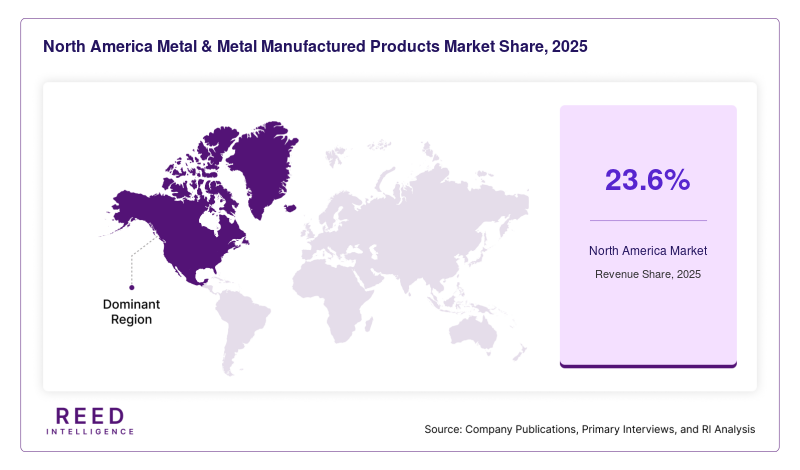
North America accounted for 23.6% of the global market share in 2025. The region will likely expand at a CAGR of 5.1% during 2026–2034. Strong industrial production capabilities, modernization of manufacturing facilities, and substantial investments in transportation equipment production contribute to market growth.
The United States remained the dominant country within the region. Growing reshoring initiatives and increasing domestic industrial investments are supporting higher demand for fabricated and precision-manufactured metal products.
Europe
Europe represented 21.4% market share in 2025 and is anticipated to grow at a CAGR of 4.9% through 2034. Demand remains supported by industrial equipment manufacturing, automotive production, machinery exports, and energy transition projects.
Germany dominated the European market. The country's advanced engineering sector, industrial automation leadership, and strong machinery manufacturing base continue to generate significant demand for metal products and components.
Asia Pacific
Asia Pacific held the largest market share of 42.8% in 2025 and is forecast to grow at a CAGR of 6.3% during 2026–2034. Rapid industrialization, urban expansion, manufacturing investments, and infrastructure development continue to drive regional demand.
China remained the largest contributor to regional revenues. Extensive manufacturing capacity, large-scale infrastructure investments, and significant production of industrial equipment support sustained consumption of metals and fabricated products.
Middle East & Africa
Middle East & Africa accounted for 6.3% share in 2025 and is projected to register the fastest regional CAGR of 6.9% through 2034. Increasing industrial diversification programs, logistics infrastructure development, and energy sector investments are supporting market growth.
Saudi Arabia emerged as the leading country within the region. Industrial development initiatives and large-scale construction projects are generating rising demand for structural metals and manufactured products.
Latin America
Latin America captured 5.9% market share in 2025 and is expected to expand at a CAGR of 5.4% during the forecast period. Manufacturing sector development, mining-related investments, and urban infrastructure projects are supporting market expansion.
Brazil dominated the regional market. Growth is supported by increasing industrial output and expanding investments in manufacturing modernization and transportation infrastructure.
Competitive Landscape
The Metal & Metal Manufactured Products Market remains moderately fragmented, with global and regional manufacturers competing through production efficiency, product quality, technological innovation, and strategic capacity expansion.
ArcelorMittal continues to maintain a leading position through extensive global production capacity, diversified product offerings, and investments in sustainable steelmaking technologies. The company recently expanded its low-carbon steel production initiatives to support evolving sustainability requirements.
Nippon Steel Corporation focuses on advanced steel solutions and specialty materials serving automotive, construction, and industrial sectors.
POSCO Holdings continues investing in smart manufacturing technologies and high-performance steel products to strengthen competitiveness.
Thyssenkrupp AG emphasizes engineering-intensive metal solutions and industrial processing capabilities across multiple end-use industries.
Alcoa Corporation remains a significant participant in aluminum production and value-added metal manufacturing, serving transportation, packaging, and industrial applications worldwide.
Key Players List
- ArcelorMittal
- Nippon Steel Corporation
- POSCO Holdings Inc.
- Thyssenkrupp AG
- Alcoa Corporation
- Nucor Corporation
- United States Steel Corporation
- Tata Steel Limited
- JSW Steel Limited
- JFE Holdings Inc.
- China Baowu Steel Group Corporation
- HBIS Group
- Novelis Inc.
- Rio Tinto Metal Products Division
- Kaiser Aluminum Corporation
Recent Developments
- Major steel producers announced investments in low-carbon manufacturing facilities to improve sustainability performance.
- Several aluminum manufacturers expanded recycling operations to strengthen circular economy initiatives.
- Industrial metal processors introduced AI-powered production monitoring systems to improve operational efficiency and product quality.
- Manufacturers increased investments in advanced machining and precision engineering facilities to address demand from aerospace and automation industries.
- Digital procurement platforms were expanded to streamline sourcing, inventory management, and customer engagement activities.
- Multiple companies adopted robotics and automated fabrication technologies to enhance production capacity and reduce operational costs.
- Strategic partnerships were established between metal producers and renewable energy developers to support infrastructure expansion projects.
Metal & Metal Manufactured Products Market Segments
Metal Type
- Steel Products
- Aluminum Products
- Copper Products
- Stainless Steel Products
- Specialty Alloy Products
- Titanium Products
- Other Metal Products
Manufacturing Process
- Casting
- Forging
- Fabrication & Forming
- Machining
- Extrusion
- Additive Manufacturing
- Powder Metallurgy
Product Category
- Structural Metal Products
- Pipes & Tubes
- Fasteners & Hardware
- Sheet Metal Products
- Precision Engineered Components
- Industrial Equipment Components
End-Use Industry
- Construction & Infrastructure
- Automotive & Transportation
- Industrial Machinery
- Aerospace & Defense
- Consumer Goods
- Energy & Utilities
- Renewable Energy Equipment
Distribution Channel
- Direct Sales
- Distributors
- Industrial Wholesalers
- Digital Procurement Platforms
- Value-Added Resellers
By Region
- North America
- Europe
- APAC
- Middle East and Africa
- LATAM