Metal And Metal Ore Market Size, Share, Growth & Industry Forecast Report By Type (Ferrous Metals, Non-Ferrous Metals, Precious Metals, Rare Earth Metals), By Application (Construction, Automotive, Electronics, Renewable Energy, Industrial Machinery), By End-Use Industry (Manufacturing, Energy & Power, Infrastructure, Transportation, Electronics & Semiconductor) and Regional Analysis, 2026–2034
USD 3950
Market Overview
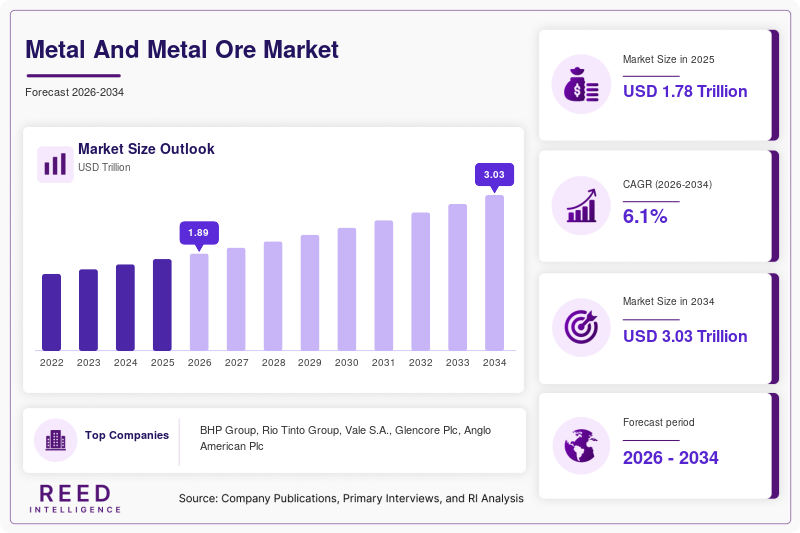
The Metal And Metal Ore Market was valued at approximately USD 1.78 trillion in 2026 and is projected to reach USD 2.86 trillion by 2034, expanding at a CAGR of 6.1% during the forecast period (2026–2034). The market growth is supported by increasing industrialization, rising infrastructure investments, and expanding manufacturing activities across emerging economies. Metals and metal ores play a foundational role in construction, transportation, electronics, and energy sectors, making them essential to global economic development.
A key global factor supporting market expansion is the accelerating transition toward renewable energy and electrification. The growing adoption of electric vehicles, wind turbines, and solar installations has significantly increased the demand for metals such as copper, aluminum, lithium, and rare earth elements. These materials are critical for energy storage systems and transmission networks, thereby boosting mining activities and metal processing operations worldwide.
Key Highlights
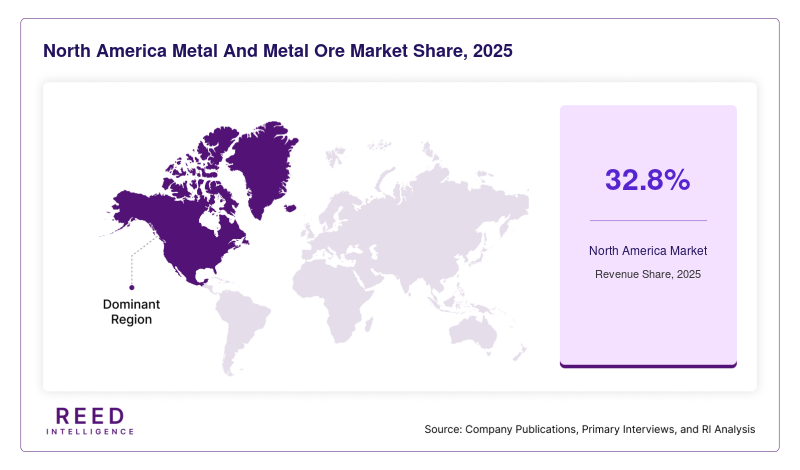
- North America dominated the market with a 32.8% share in 2025.
- Asia Pacific is expected to grow at the fastest CAGR of 7.4% during 2026–2034.
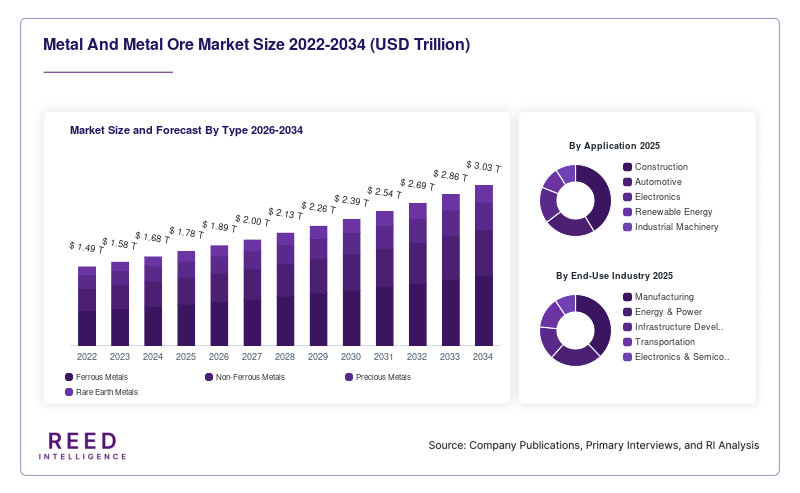
- By type, ferrous metals accounted for the largest share of 54.6%, while rare earth metals are projected to grow at a CAGR of 8.1%.
- By application, construction led with a 36.9% share, whereas renewable energy applications are expected to expand at a CAGR of 7.8%.
- The United States remained the dominant country, with market values of USD 410 billion in 2024 and USD 435 billion in 2025.
Market Trends
Increasing Demand for Critical Minerals in Energy Transition
The shift toward clean energy systems is reshaping the Metal And Metal Ore Market, particularly with rising demand for critical minerals. Metals such as lithium, cobalt, nickel, and copper are essential components in batteries, electric vehicles, and renewable energy infrastructure. Governments across regions are implementing policies to secure supply chains for these materials, which has intensified exploration and mining activities. Additionally, mining companies are investing in sustainable extraction methods to meet environmental regulations. This trend is expected to significantly influence production patterns and trade flows, especially as nations aim to reduce dependency on imports and strengthen domestic capabilities in strategic minerals.
Digitalization and Automation in Mining Operations
The adoption of advanced technologies such as artificial intelligence, automation, and data analytics is transforming mining operations globally. Companies are integrating smart sensors, predictive maintenance systems, and autonomous machinery to enhance productivity and reduce operational risks. These technologies enable real-time monitoring of ore quality, equipment performance, and environmental conditions. As a result, mining firms can optimize resource utilization and minimize downtime. Furthermore, digitalization improves safety standards and supports compliance with regulatory requirements. This trend is particularly prominent in developed regions but is gradually expanding into emerging markets, driving efficiency and competitiveness across the industry.
Market Drivers
Rapid Urbanization and Infrastructure Development
The increasing pace of urbanization, particularly in developing economies, is a major driver of the Metal And Metal Ore Market. Growing populations in urban areas are fueling demand for housing, transportation systems, and public infrastructure. This, in turn, requires large quantities of steel, aluminum, and other construction materials derived from metal ores. Governments are also investing heavily in infrastructure projects such as highways, bridges, and smart cities, which further boosts demand. The construction sector remains a primary consumer of metals, and sustained investment in infrastructure development is expected to support steady market growth over the forecast period.
Expansion of Automotive and Manufacturing Industries
The growth of the automotive and manufacturing sectors is another key factor driving market demand. The increasing production of vehicles, including electric and hybrid models, requires a diverse range of metals such as steel, aluminum, copper, and specialty alloys. Additionally, industrial machinery and equipment manufacturing depend heavily on metal components. As global trade and industrial output expand, the demand for metal ores and processed metals continues to rise. Technological advancements in manufacturing processes are also enabling the use of lightweight and high-strength materials, further increasing the consumption of specific metal types.
Market Restraint
Environmental Regulations and Sustainability Challenges
Environmental concerns and stringent regulations pose a significant restraint to the Metal And Metal Ore Market. Mining and metal extraction processes are associated with environmental degradation, including deforestation, water pollution, and greenhouse gas emissions. Governments and regulatory bodies are imposing stricter guidelines on mining operations to reduce environmental impact. Compliance with these regulations often requires substantial investment in cleaner technologies and waste management systems, which can increase operational costs.
Moreover, public opposition to mining projects has grown due to environmental and social concerns. This has led to delays in project approvals and increased scrutiny of mining activities. For instance, several large-scale mining projects have faced cancellations or postponements due to environmental protests and legal challenges. These factors can limit the expansion of mining operations and disrupt supply chains. Additionally, the pressure to adopt sustainable practices is compelling companies to transition toward circular economy models, including recycling and reuse of metals, which may reduce reliance on primary metal extraction over time.
Market Opportunities
Growth in Recycling and Secondary Metal Production
The increasing emphasis on sustainability is creating opportunities in metal recycling and secondary production. Recycling metals such as aluminum, copper, and steel requires significantly less energy compared to primary extraction, making it an attractive option for reducing environmental impact. Governments and industries are promoting recycling initiatives to conserve natural resources and minimize waste. This trend is expected to drive investment in recycling infrastructure and technologies. As demand for sustainable materials grows, companies focusing on secondary metal production are likely to gain a competitive advantage in the market.
Exploration of Untapped Mineral Reserves
The discovery and development of untapped mineral reserves present a significant growth opportunity for the market. Advances in exploration technologies, including geospatial analysis and remote sensing, are enabling the identification of new mining sites. Regions such as Africa and South America are rich in mineral resources but remain underexplored. Increased investment in these regions can unlock new supply sources and support global demand. Additionally, partnerships between governments and private companies are facilitating resource development and improving infrastructure in mining regions, further enhancing market potential.
Segmental Analysis
By Type
Ferrous metals dominated the Metal And Metal Ore Market in 2024, accounting for a share of 54.6%. This segment includes iron ore and steel, which are widely used in construction, automotive, and industrial applications. The dominance of ferrous metals is attributed to their strength, durability, and cost-effectiveness. The construction sector, in particular, relies heavily on steel for structural applications. Additionally, the availability of large iron ore reserves and established production processes contribute to the segment’s leading position.
Rare earth metals are projected to be the fastest-growing subsegment, expanding at a CAGR of 8.1% during the forecast period. These metals are essential for advanced technologies, including electronics, renewable energy systems, and defense applications. The increasing demand for high-performance materials and the growing adoption of clean energy technologies are driving the growth of this segment. Furthermore, government initiatives to secure supply chains for critical minerals are supporting investment in rare earth metal production.
By Application
The construction segment held the largest share of 36.9% in 2024, driven by extensive infrastructure development and urbanization. Metals such as steel and aluminum are essential for building structures, transportation networks, and industrial facilities. The growth of smart cities and large-scale infrastructure projects in emerging economies is further boosting demand in this segment. Additionally, the durability and recyclability of metals make them preferred materials in construction applications.
Renewable energy applications are expected to be the fastest-growing subsegment, with a CAGR of 7.8%. The increasing adoption of wind, solar, and energy storage systems is driving demand for metals such as copper, aluminum, and rare earth elements. These materials are critical for manufacturing components such as turbines, panels, and batteries. Government incentives and policies promoting clean energy are further accelerating growth in this segment.
By End-Use Industry
The industrial manufacturing sector dominated the market in 2024, accounting for a significant share due to its extensive use of metals in machinery, equipment, and tools. The growth of manufacturing activities across regions, particularly in Asia Pacific, is driving demand for metal products. Additionally, technological advancements in manufacturing processes are increasing the efficiency and quality of metal components, further supporting market growth.
The electronics industry is projected to be the fastest-growing subsegment, with a CAGR of 7.5%. The increasing demand for consumer electronics, communication devices, and advanced technologies is driving the need for metals such as copper, gold, and rare earth elements. The miniaturization of electronic components and the development of new technologies are further boosting demand in this segment. Additionally, the expansion of digital infrastructure and the growing adoption of smart devices are expected to support sustained growth.
Regional Analysis
North America
North America held a market share of 32.8% in 2025 and is expected to grow at a CAGR of 5.8% during the forecast period. The region benefits from well-established mining infrastructure, technological advancements, and strong demand from construction and manufacturing sectors. The presence of major mining companies and continuous investment in exploration activities contribute to stable market growth.
The United States dominates the regional market, driven by extensive infrastructure projects and a strong industrial base. A key growth factor is the increasing focus on domestic sourcing of critical minerals to reduce dependency on imports. Government initiatives supporting mining activities and investments in advanced technologies are expected to enhance production capabilities.
Europe
Europe accounted for approximately 24.5% of the market share in 2025 and is projected to grow at a CAGR of 5.4% through 2034. The region’s growth is supported by strong demand from automotive and renewable energy sectors. Additionally, stringent environmental regulations are encouraging the adoption of sustainable mining practices and recycling initiatives.
Germany leads the European market due to its advanced manufacturing sector and high demand for industrial metals. A unique growth factor is the region’s emphasis on circular economy principles, which promote recycling and efficient resource utilization. This approach is expected to shape market dynamics and drive innovation.
Asia Pacific
Asia Pacific is the fastest-growing region, with a CAGR of 7.4% during the forecast period and a market share of 28.9% in 2025. Rapid industrialization, urbanization, and infrastructure development are key drivers of growth. The region also benefits from abundant mineral resources and cost-effective labor.
China is the dominant country in the region, supported by its large-scale manufacturing and construction activities. A major growth factor is the country’s investment in renewable energy and electric vehicles, which is driving demand for metals such as copper and lithium. Government policies supporting industrial growth further boost the market.
Middle East & Africa
The Middle East & Africa region held a market share of 7.1% in 2025 and is expected to grow at a CAGR of 6.3%. The region’s growth is driven by increasing mining activities and investments in infrastructure development. Rich mineral reserves provide significant opportunities for market expansion.
South Africa is a key contributor to the regional market, owing to its abundant mineral resources and established mining industry. A unique growth factor is the increasing foreign investment in mining projects, which is enhancing production capacity and supporting economic development in the region.
Latin America
Latin America accounted for 6.7% of the market share in 2025 and is projected to grow at a CAGR of 6.6%. The region is rich in mineral resources, including copper, iron ore, and precious metals. Growing demand from global markets is driving mining activities and export opportunities.
Brazil leads the regional market, supported by its large reserves of iron ore and strong mining infrastructure. A key growth factor is the increasing demand for exports, particularly from Asia Pacific countries. Investments in mining technologies and infrastructure are further supporting market growth.
Competitive Landscape
The Metal And Metal Ore Market is characterized by the presence of several global and regional players competing based on production capacity, technological capabilities, and resource availability. Leading companies are focusing on expanding their mining operations, investing in advanced technologies, and strengthening their supply chains to maintain competitive positions.
BHP Group is recognized as a leading player in the market, with a strong presence across multiple regions and a diversified portfolio of metal resources. The company has recently invested in sustainable mining technologies to reduce environmental impact and improve operational efficiency. Other key players are also adopting similar strategies, including mergers, acquisitions, and partnerships, to enhance their market presence.
Additionally, companies are increasingly focusing on sustainability and compliance with environmental regulations. The adoption of digital technologies and automation is becoming a key differentiator in the competitive landscape, enabling companies to optimize production and reduce costs.
Key Players
- BHP Group
- Rio Tinto Group
- Vale S.A.
- Glencore Plc
- Anglo American Plc
- Freeport-McMoRan Inc.
- Teck Resources Limited
- ArcelorMittal
- China Minmetals Corporation
- Aluminum Corporation of China Limited
- Norilsk Nickel
- Vedanta Resources Limited
- South32 Limited
- Fortescue Metals Group
- Hindalco Industries Limited
Recent Developments
- In 2025, a major mining company announced the expansion of its copper production capacity to meet rising demand from the electric vehicle sector.
- In 2024, a leading player invested in digital mining technologies to improve operational efficiency and reduce environmental impact.
- In 2025, a strategic partnership was formed between two global companies to explore new mineral reserves in Africa, enhancing supply chain capabilities.
Metal And Metal Ore Market Segments
By Type
- Ferrous Metals
- Non-Ferrous Metals
- Precious Metals
- Rare Earth Metals
By Application
- Construction
- Automotive
- Electronics
- Renewable Energy
- Industrial Machinery
By End-Use Industry
- Manufacturing
- Energy & Power
- Infrastructure Development
- Transportation
- Electronics & Semiconductor
By Region
- North America
- Europe
- APAC
- Middle East and Africa
- LATAM