Metal Halide Light Tower Market Size, Share & Demand Report By Power Source (Diesel-Powered Light Towers, Hybrid-Powered Light Towers, Solar-Assisted Light Towers), By Application (Infrastructure Development), By End-Use (Equipment Rental Companies, Infrastructure Contractors, Industrial Facilities, Government Agencies, Mining Companies), By Region & Segment Forecasts, 2026–2034
USD 3950
Market Overview
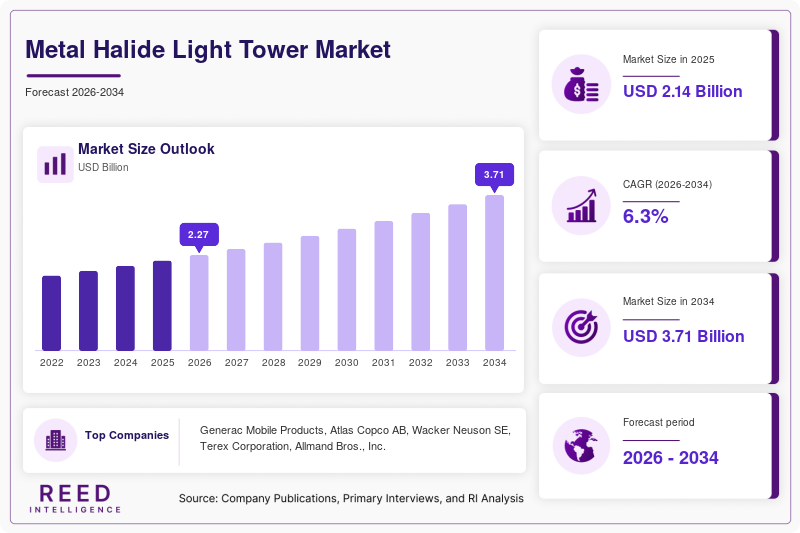
The global Metal Halide Light Tower Market size was valued at approximately USD 2.14 billion in 2026 and is projected to reach USD 3.48 billion by 2034, expanding at a CAGR of 6.3% during 2026–2034. Metal halide light towers remain an important source of temporary illumination across construction sites, mining operations, infrastructure projects, oil and gas facilities, emergency response activities, and outdoor industrial environments. Despite the increasing adoption of LED-based alternatives, metal halide technology continues to maintain relevance in several markets due to its high-intensity illumination, broad area coverage, and established deployment across heavy-duty applications.
A major global factor supporting market growth is the continuous increase in infrastructure development activities. Governments and private sector investors are allocating substantial budgets toward transportation networks, industrial corridors, urban expansion projects, and energy infrastructure. These projects frequently require reliable temporary lighting solutions capable of operating in remote and challenging environments. Metal halide light towers provide strong luminous output and remain widely available through equipment rental fleets, making them a practical choice for contractors and project developers.
Key Highlights
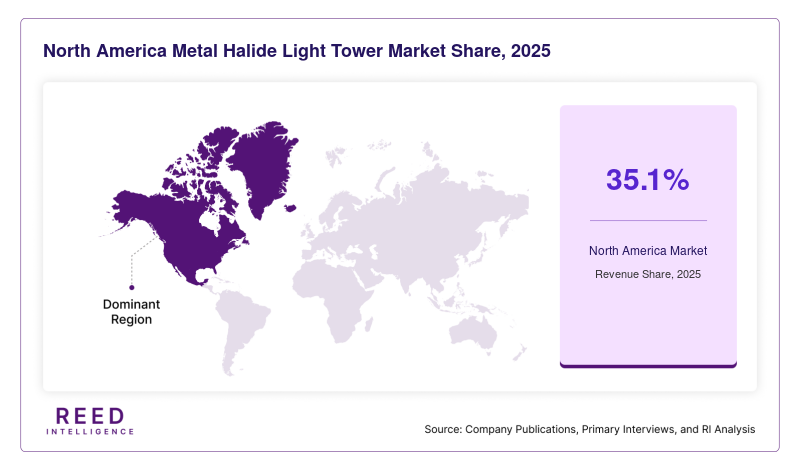
- North America dominated the market with a 35.1% share in 2025.
- Asia Pacific is expected to grow at the fastest CAGR of 7.8% during 2026–2034.
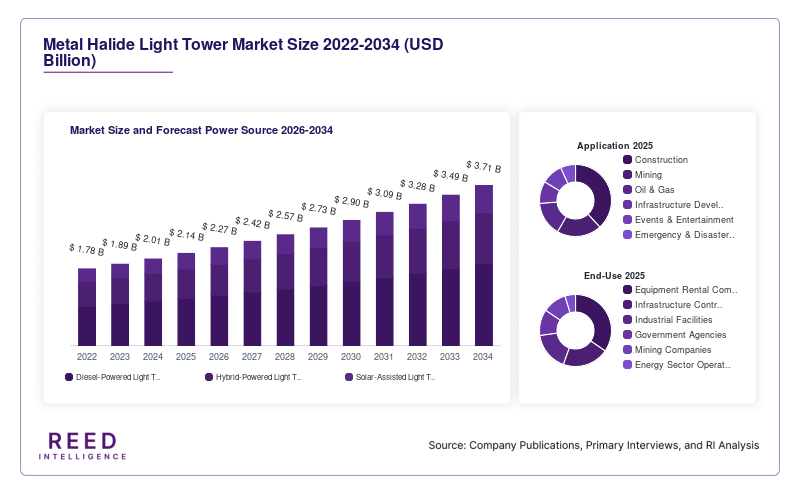
- By power source, diesel-powered light towers accounted for the largest share of 63.8%.
- while hybrid-powered light towers are projected to grow at a CAGR of 8.7%.
- By application, construction activities led with a 42.6% share.
- whereas mining operations are expected to expand at a CAGR of 7.9%.
- By end-use, equipment rental companies held the largest share of 39.4%.
- while infrastructure contractors are projected to grow at a CAGR of 8.1%.
- The United States remained the dominant country, with market values of USD 472 million in 2024 and USD 505 million in 2025.
Market Trends
Expansion of Rental-Based Equipment Utilization
The rental equipment industry has emerged as a significant trend influencing the Metal Halide Light Tower Market. Construction contractors, event organizers, municipal authorities, and industrial operators increasingly prefer renting lighting equipment instead of making capital-intensive purchases. Rental solutions provide flexibility, reduce maintenance obligations, and allow users to access modern equipment without large upfront investments. As project durations vary significantly, rental models help organizations align equipment expenses with operational requirements. Large rental fleets also ensure quick deployment during emergency response activities and temporary infrastructure projects. This trend is particularly visible in North America and Europe, where equipment rental penetration rates continue to increase. Manufacturers are responding by developing durable and service-friendly models specifically designed for rental applications, supporting long-term market demand.
Integration of Hybrid Power Technologies
A growing trend across the industry involves the incorporation of hybrid power configurations within traditional metal halide light tower systems. Manufacturers are combining diesel generators with battery storage and intelligent power management technologies to improve fuel efficiency and reduce operating costs. These systems help users minimize fuel consumption while maintaining the high illumination levels associated with metal halide lamps. Hybrid solutions are gaining traction among contractors seeking to meet sustainability goals without completely replacing existing fleets. The trend is particularly relevant in regions implementing stricter emissions standards and fuel-efficiency requirements. As operational cost reduction becomes a priority for project developers, hybrid metal halide light towers are expected to gain wider acceptance across construction, mining, and infrastructure sectors throughout the forecast period.
Market Drivers
Rising Global Infrastructure Development Activities
Infrastructure investment remains a primary growth driver for the Metal Halide Light Tower Market. Governments across developed and emerging economies continue to invest heavily in highways, airports, railways, ports, bridges, and utility networks. Many of these projects require nighttime operations to accelerate completion timelines and minimize disruptions to public activities. Metal halide light towers provide powerful illumination suitable for large work zones, making them an essential component of construction operations. The expansion of smart city projects and industrial development zones further supports equipment demand. As urbanization accelerates and transportation infrastructure requires modernization, contractors increasingly rely on temporary lighting systems capable of delivering consistent performance in diverse environmental conditions, supporting sustained market expansion.
Growth of Mining and Resource Extraction Operations
The continued expansion of mining activities is another significant factor driving market growth. Demand for minerals, metals, and energy resources has increased due to industrialization, renewable energy projects, and manufacturing expansion worldwide. Mining operations often take place in remote locations where permanent lighting infrastructure is unavailable. Metal halide light towers provide reliable illumination for excavation sites, transportation routes, maintenance areas, and processing facilities. Their ability to operate under harsh environmental conditions makes them suitable for mining environments. Increased exploration activities in regions such as Asia Pacific, Latin America, and Africa are creating additional demand. Mining companies also value the mobility and scalability of light tower systems, allowing rapid deployment as operational requirements evolve.
Market Restraint
Increasing Adoption of LED-Based Lighting Alternatives
The growing shift toward LED lighting technologies represents a significant restraint for the Metal Halide Light Tower Market. LED light towers offer several advantages, including lower energy consumption, reduced maintenance requirements, longer operational lifespans, and faster startup times. Many construction firms and rental companies are gradually transitioning portions of their fleets toward LED systems to achieve operational savings and meet environmental objectives. Regulatory pressure related to emissions reduction and energy efficiency further encourages the adoption of alternative lighting technologies. In mature markets, fleet replacement cycles increasingly favor LED solutions, limiting new investments in traditional metal halide equipment. For example, large infrastructure contractors seeking lower fuel costs may prioritize LED towers with battery support systems. Although metal halide towers remain relevant for high-intensity applications and existing fleets, increasing competition from advanced lighting technologies could slow market expansion and influence long-term purchasing decisions across several end-user industries.
Market Opportunities
Emerging Infrastructure Projects Across Developing Economies
Developing economies present substantial opportunities for market participants. Countries across Asia Pacific, the Middle East, Africa, and Latin America are investing heavily in transportation, energy, and industrial infrastructure. These projects frequently involve construction activities in locations where permanent lighting systems are unavailable during project execution. Metal halide light towers offer dependable temporary illumination solutions that can be deployed rapidly and relocated as needed. Growing urban populations and industrial expansion are creating sustained demand for infrastructure development. Equipment manufacturers can capitalize on these opportunities by expanding distribution networks, establishing local partnerships, and introducing cost-effective products tailored to regional requirements. As project pipelines continue to expand, demand for temporary lighting equipment is expected to rise steadily.
Increasing Demand for Disaster Recovery and Emergency Response Equipment
Natural disasters, extreme weather events, and emergency response operations are creating new opportunities within the market. Emergency management agencies, utility providers, and disaster recovery contractors require portable lighting systems capable of operating independently from damaged electrical infrastructure. Metal halide light towers provide broad illumination coverage for rescue operations, temporary shelters, utility restoration activities, and public safety applications. Governments are increasing investments in emergency preparedness programs, resulting in higher procurement of mobile equipment. The ability of these systems to operate in challenging conditions and provide high-intensity illumination enhances their value during critical situations. As climate-related disruptions become more frequent globally, emergency response applications are expected to contribute additional growth opportunities throughout the forecast period.
Segmental Analysis
By Power Source
Diesel-powered light towers dominated the market, accounting for approximately 63.8% of total revenue in 2024. Their widespread adoption is attributed to high power output, operational reliability, and suitability for remote locations lacking grid connectivity. Construction companies, mining operators, and infrastructure contractors continue to rely on diesel-powered systems due to their ability to provide consistent illumination over extended periods. The availability of fuel distribution networks further supports deployment across diverse project environments. Rental companies also maintain substantial diesel-powered fleets because of their versatility and compatibility with various applications. Despite increasing environmental concerns, diesel-powered models remain a preferred choice for heavy-duty operations requiring dependable performance and strong lighting coverage.
Hybrid-powered light towers represent the fastest-growing subsegment and are anticipated to expand at a CAGR of 8.7% through 2034. Growth is supported by rising demand for fuel efficiency, reduced emissions, and lower operating costs. Hybrid systems combine traditional power generation with battery storage technologies, enabling optimized energy consumption. Contractors increasingly seek solutions that balance performance and sustainability objectives. Regulatory pressure related to emissions standards further encourages adoption. Manufacturers are introducing advanced control systems that automatically manage energy usage and improve operational efficiency. As organizations focus on reducing environmental impact while maintaining productivity, hybrid-powered equipment is expected to experience substantial growth throughout the forecast period.
By Application
Construction activities held the largest share of approximately 42.6% in 2024, making them the dominant application segment within the Metal Halide Light Tower Market. Construction sites frequently operate during evening and nighttime hours to accelerate project schedules and reduce daytime disruptions. Temporary lighting is essential for worker safety, equipment operation, and project efficiency. Metal halide light towers provide strong illumination suitable for large work zones and complex construction environments. Infrastructure expansion, urban development, and commercial building projects continue to drive demand across global markets. Contractors value the mobility and rapid deployment capabilities of these systems, enabling flexible use throughout different project phases and locations.
Mining operations are projected to register the fastest CAGR of 7.9% during the forecast period. Increasing demand for minerals and natural resources is driving exploration and extraction activities worldwide. Mining sites often operate continuously and require reliable lighting systems to ensure safe working conditions. Metal halide light towers are particularly suitable for remote mining environments due to their durability and powerful illumination capabilities. Expanding resource development projects across Asia Pacific, Africa, and Latin America are creating favorable growth conditions. Additionally, rising investments in critical minerals used for renewable energy technologies are expected to further support demand from the mining sector.
By End-Use
Equipment rental companies accounted for the largest share of approximately 39.4% in 2024. The growing preference for rental solutions among contractors and industrial operators has strengthened this segment's position. Renting light towers allows organizations to access equipment without incurring significant capital expenditures or maintenance responsibilities. Rental providers offer flexible deployment options that align with project-specific requirements. The segment also benefits from demand generated by emergency response activities, seasonal construction projects, and temporary industrial operations. Fleet expansion initiatives by major rental companies continue to support market growth and increase equipment availability across diverse geographic regions.
Infrastructure contractors are expected to emerge as the fastest-growing end-use segment, recording a CAGR of 8.1% through 2034. Governments worldwide are increasing investments in transportation, utilities, and public infrastructure projects. Contractors involved in these developments require dependable lighting systems to support extended work schedules and nighttime operations. Large-scale bridge construction, highway expansion, airport upgrades, and utility installations create substantial demand for portable illumination solutions. The growing emphasis on project completion efficiency and worker safety further supports equipment adoption. As infrastructure spending continues to rise globally, infrastructure contractors are expected to become an increasingly important customer group for market participants.
Regional Analysis
North America
North America accounted for approximately 35.1% of the global market share in 2025 and maintained its position as the leading regional market. The region benefits from established construction industries, extensive infrastructure maintenance programs, and a highly developed equipment rental sector. Market growth is expected to continue at a CAGR of 5.8% through 2034. Strong demand from transportation infrastructure projects, commercial construction activities, and energy sector developments supports equipment deployment across multiple end-use industries.
The United States remains the dominant country within the region. A key growth factor is the extensive modernization of aging infrastructure networks, including highways, bridges, and public utilities. Contractors frequently utilize temporary lighting solutions to facilitate nighttime construction schedules and improve project efficiency. Continued federal and state-level investment programs are expected to sustain demand for metal halide light towers over the forecast period.
Europe
Europe represented approximately 26.4% of global revenue in 2025 and continues to demonstrate stable market performance. The region is forecast to expand at a CAGR of 5.6% during the study period. Demand is supported by transportation upgrades, industrial redevelopment projects, and energy infrastructure improvements. Although energy-efficient technologies are gaining traction, metal halide light towers continue to serve applications requiring high-intensity illumination and extensive area coverage.
Germany leads the European market due to its strong industrial base and ongoing infrastructure investments. A unique growth factor is the increasing number of rail modernization and logistics expansion projects across the country. These developments often require temporary nighttime lighting solutions, supporting equipment utilization across construction and maintenance operations. Rental fleet expansion further contributes to regional market stability.
Asia Pacific
Asia Pacific held approximately 22.7% of the market in 2025 and is projected to record the fastest growth at a CAGR of 7.8% through 2034. Rapid urbanization, industrialization, and infrastructure development are generating strong demand for temporary lighting equipment. Large-scale construction projects, mining activities, and energy investments across emerging economies continue to support market expansion throughout the region.
China remains the dominant country in Asia Pacific. A significant growth factor is the country's ongoing investment in transportation networks, industrial parks, and urban development initiatives. Massive construction activity creates continuous demand for portable lighting systems. Additionally, expanding mining and resource extraction operations in various provinces contribute to increased deployment of metal halide light towers.
Middle East & Africa
The Middle East & Africa region accounted for nearly 8.4% of global market revenue in 2025 and is expected to grow at a CAGR of 6.9%. Demand is largely driven by energy sector projects, industrial developments, mining activities, and infrastructure construction. Governments continue to pursue economic diversification initiatives that require extensive investment in transportation and industrial facilities, creating favorable conditions for market growth.
Saudi Arabia represents the largest national market within the region. A unique growth factor is the implementation of large-scale economic diversification projects involving tourism infrastructure, industrial zones, and smart city developments. These projects frequently require temporary lighting during construction phases, generating consistent demand for mobile illumination equipment and supporting regional market expansion.
Latin America
Latin America captured approximately 7.4% of global market share in 2025 and is projected to expand at a CAGR of 6.4% through 2034. The market benefits from increasing mining investments, transportation infrastructure projects, and energy sector developments. Governments and private organizations continue to invest in industrial growth initiatives that require temporary lighting solutions for operational and construction purposes.
Brazil dominates the regional market due to its large construction sector and extensive natural resource industries. A key growth factor is the expansion of mining activities across several states, creating substantial demand for portable lighting systems in remote operational environments. Ongoing infrastructure development projects also contribute to increased equipment utilization throughout the country.
Competitive Landscape
The Metal Halide Light Tower Market is characterized by the presence of global and regional manufacturers competing through product reliability, fleet expansion partnerships, technological improvements, and geographic reach. Companies continue to focus on fuel efficiency, equipment durability, and hybrid technology integration to strengthen their market positions. Strategic collaborations with rental providers remain a common growth strategy, allowing manufacturers to expand market penetration and increase equipment visibility among end users.
Generac Mobile Products is recognized as a leading participant due to its extensive product portfolio and strong presence across construction and industrial applications. The company recently introduced upgraded light tower models featuring enhanced fuel management systems and remote monitoring capabilities to improve operational efficiency.
Other notable participants are investing in product innovation, regional expansion, and aftermarket service capabilities. Competitive intensity is expected to remain moderate as manufacturers pursue opportunities in emerging infrastructure markets while adapting to changing customer requirements and evolving environmental regulations.
Key Players
- Generac Mobile Products
- Atlas Copco AB
- Wacker Neuson SE
- Terex Corporation
- Allmand Bros., Inc.
- Multiquip Inc.
- Doosan Portable Power
- J C Bamford Excavators Ltd. (JCB)
- Trime S.r.l.
- Chicago Pneumatic
- United Rentals Inc.
- Larson Electronics
- Progress Solar Solutions
- Colorado Standby
Recent Developments
- Generac Mobile Products launched a next-generation metal halide light tower featuring advanced remote fleet monitoring and improved fuel efficiency capabilities.
- Atlas Copco expanded its portable lighting equipment portfolio by introducing hybrid-compatible models designed for infrastructure and mining applications.
- Wacker Neuson strengthened its rental equipment partnerships across North America to improve distribution and availability of mobile lighting solutions.
- Trime S.r.l. invested in manufacturing upgrades focused on enhancing product durability and operational performance in challenging environmental conditions.
- Multiquip Inc. introduced new fleet management technologies that enable contractors and rental operators to monitor equipment utilization and maintenance requirements more effectively.
Metal Halide Light Tower Market Segments
Power Source
- Diesel-Powered Light Towers
- Hybrid-Powered Light Towers
- Solar-Assisted Light Towers
Application
- Construction
- Mining
- Oil & Gas
- Infrastructure Development
- Events & Entertainment
- Emergency & Disaster Response
End-Use
- Equipment Rental Companies
- Infrastructure Contractors
- Industrial Facilities
- Government Agencies
- Mining Companies
- Energy Sector Operators
By Region
- North America
- Europe
- APAC
- Middle East and Africa
- LATAM