Metal Spiral Bellows Market Size, Share & Demand Report By Material Type (Nickel Alloy Bellows, Titanium Bellows, Other Specialty Alloy Bellows), By Application (Industrial Piping Systems, Power Generation Systems, Renewable Energy Systems), By End-Use Industry (Aerospace & Defense, Automotive, Industrial Manufacturing, Others), By Region & Segment Forecasts, 2026–2034
USD 3950
Market Overview
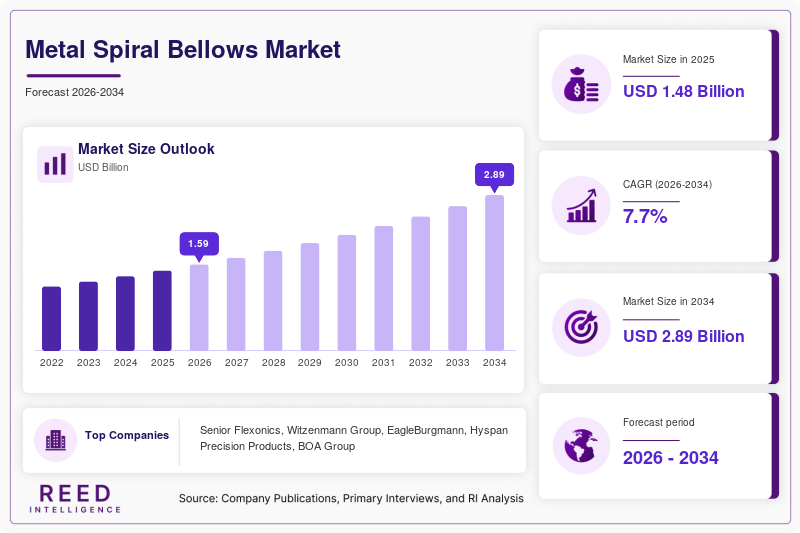
The global Metal Spiral Bellows Market size was valued at USD 1.48 billion in 2026 and is projected to reach USD 2.67 billion by 2034, expanding at a CAGR of 7.7% during 2026–2034. Metal spiral bellows are flexible metallic components designed to absorb vibration, compensate for thermal expansion, manage pressure fluctuations, and provide sealing solutions across industrial systems. These products are widely utilized in oil & gas, power generation, aerospace, automotive, chemical processing, marine, and industrial manufacturing applications.
A major factor supporting market growth is the continued expansion of industrial infrastructure and energy transportation networks worldwide. Governments and private organizations are investing in power plants, refineries, petrochemical facilities, and industrial automation systems that require highly durable and pressure-resistant expansion joints and flexible connectors. Metal spiral bellows have become essential for maintaining operational reliability, reducing maintenance requirements, and improving equipment lifespan in harsh operating environments.
Key Highlights
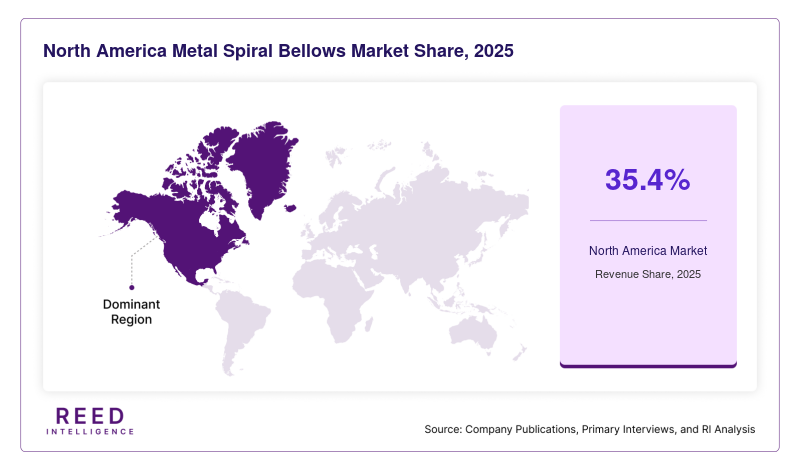
- North America dominated the market with a 35.4% share in 2025.
- Asia Pacific is expected to grow at the fastest CAGR of 9.2% during 2026–2034.
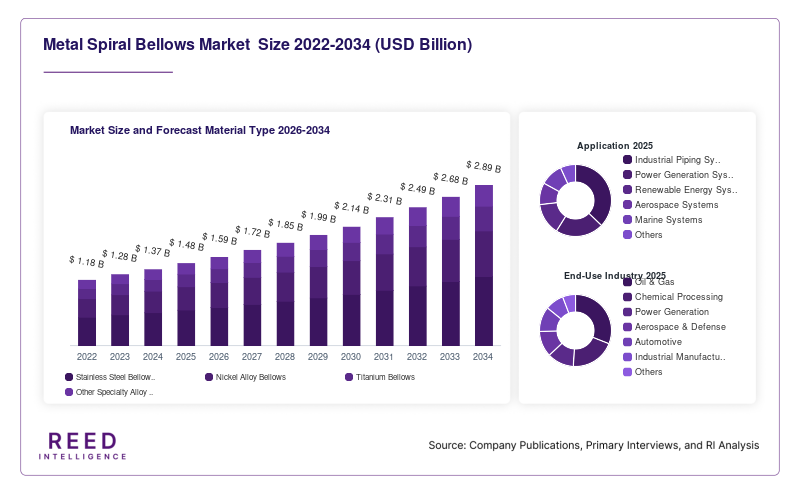
- By material type, stainless steel bellows accounted for the largest share of 46.8%.
- while nickel alloy bellows are projected to grow at a CAGR of 9.8%.
- By application, industrial piping systems led with a 39.7% share.
- whereas renewable energy systems are expected to expand at a CAGR of 10.4%.
- By end-use industry, oil & gas accounted for the largest share of 31.5%.
- while aerospace & defense is projected to grow at a CAGR of 9.9%.
- The United States remained the dominant country, with market values of USD 428 million in 2024 and USD 461 million in 2025.
Market Trends
Integration of Advanced Alloys and High-Performance Materials
One notable trend shaping the Metal Spiral Bellows Market is the increasing adoption of advanced metallic alloys capable of withstanding aggressive operating conditions. Industrial operators are demanding bellows that can function reliably in high-temperature, high-pressure, and corrosive environments. As a result, manufacturers are introducing nickel-based alloys, titanium blends, and specialized stainless steel grades that offer superior fatigue resistance and longer service life. These material advancements are particularly important in chemical processing, offshore energy facilities, and aerospace systems where component failure can result in substantial operational disruption. The trend is encouraging product differentiation and supporting premium pricing strategies across several industrial sectors.
Growing Adoption in Renewable Energy Infrastructure
Renewable energy projects are creating new demand opportunities for metal spiral bellows. Wind power facilities, hydrogen production plants, biomass facilities, and concentrated solar power systems require flexible metallic components to accommodate thermal movement and vibration. As governments accelerate energy transition initiatives, infrastructure developers are investing in durable piping and pressure-management systems. Metal spiral bellows help maintain system integrity while reducing maintenance frequency. The trend is particularly visible in Asia Pacific and Europe, where clean-energy investments continue to increase. Manufacturers are responding by developing specialized bellows designs tailored to renewable energy applications, creating additional revenue streams and expanding the addressable market.
Market Drivers
Expansion of Industrial Processing Facilities
The steady growth of industrial processing facilities worldwide continues to drive demand for metal spiral bellows. Industries such as petrochemicals, power generation, pharmaceuticals, and chemical manufacturing rely on extensive piping networks exposed to thermal expansion and vibration. Metal spiral bellows play a critical role in protecting equipment and maintaining operational efficiency. Emerging economies are witnessing significant investments in industrial infrastructure, resulting in higher installation rates of pressure-management and expansion-compensation components. Increased production capacity across manufacturing sectors is creating sustained demand for reliable bellows solutions that can reduce downtime and improve plant safety. This trend is expected to remain a primary growth contributor throughout the forecast period.
Rising Focus on Operational Safety and Equipment Reliability
Industrial operators are placing greater emphasis on safety compliance and asset reliability. Regulatory authorities across multiple industries are introducing stricter standards for pressure systems and piping infrastructure. Metal spiral bellows help organizations comply with these requirements by minimizing stress on pipelines and reducing leakage risks. Their ability to absorb movement and vibration improves equipment longevity while lowering maintenance costs. Companies are increasingly replacing older expansion joints with advanced bellows systems that offer enhanced durability and monitoring capabilities. The focus on preventive maintenance and risk reduction is supporting long-term market growth, particularly in energy, transportation, and process industries where operational continuity is essential.
Market Restraint
Volatility in Raw Material Prices
Fluctuations in the prices of stainless steel, nickel, titanium, and specialty alloys remain a significant challenge for the Metal Spiral Bellows Market. Manufacturers depend heavily on these materials to produce high-performance products capable of operating in demanding industrial environments. Sudden increases in metal prices can raise production costs, reduce profit margins, and create pricing uncertainty for end users. Smaller manufacturers often face greater challenges in managing procurement expenses, making it difficult to compete with larger organizations that possess stronger supply chain capabilities.
The impact extends beyond production economics. Industrial customers frequently postpone equipment upgrades when component prices rise sharply, leading to delayed purchasing decisions. For example, a petrochemical facility planning a large-scale piping modernization project may reassess capital expenditure budgets when alloy costs increase significantly. Such delays can affect overall market demand in the short term. Although long-term industry fundamentals remain positive, ongoing raw material volatility continues to represent a restraint that manufacturers must address through supply chain optimization, material innovation, and strategic sourcing initiatives.
Market Opportunities
Expansion of Hydrogen and LNG Infrastructure
The rapid development of hydrogen and liquefied natural gas infrastructure presents substantial opportunities for market participants. Hydrogen production, transportation, and storage facilities require specialized components capable of handling pressure variations and temperature fluctuations. Metal spiral bellows are increasingly being incorporated into these systems due to their flexibility and durability. Several countries are investing heavily in hydrogen economy initiatives and LNG export terminals to enhance energy security and support decarbonization goals. As new facilities become operational, demand for advanced bellows solutions is expected to increase significantly. Manufacturers that develop products specifically engineered for hydrogen and cryogenic applications are likely to benefit from expanding procurement activity across global energy markets.
Growth of Aerospace and Defense Manufacturing
The aerospace and defense sector offers another promising opportunity for the Metal Spiral Bellows Market. Aircraft engines, fuel systems, hydraulic assemblies, and defense equipment utilize precision-engineered bellows to manage pressure and thermal expansion. Increasing defense modernization programs and growing commercial aircraft production are creating favorable demand conditions. Manufacturers are focusing on lightweight and high-strength bellows designs that improve performance while meeting stringent safety standards. As air travel recovers and military spending remains robust across several economies, suppliers with specialized aerospace-grade capabilities are expected to secure long-term contracts. This opportunity is encouraging investments in research, advanced manufacturing technologies, and customized product development.
Segmental Analysis
By Material Type
Stainless steel bellows represented the dominant subsegment, accounting for approximately 46.8% of the market share in 2024. Their widespread adoption is attributed to excellent corrosion resistance, cost efficiency, and suitability for a broad range of industrial applications. Stainless steel variants are extensively utilized across oil & gas facilities, chemical plants, power stations, and industrial manufacturing environments. Their ability to withstand temperature fluctuations and moderate pressure conditions makes them a preferred choice for both standard and specialized installations. Manufacturers continue to improve material grades and fabrication techniques, further enhancing performance characteristics and supporting strong demand across developed and emerging markets.
Nickel alloy bellows are projected to be the fastest-growing subsegment, expanding at a CAGR of 9.8% through 2034. These products are increasingly adopted in environments involving extreme temperatures, corrosive chemicals, and demanding operational conditions. Industries such as aerospace, advanced energy systems, and high-performance chemical processing facilities require materials capable of maintaining structural integrity under severe stress. Growing investments in LNG, hydrogen, and defense applications are creating favorable demand conditions. As industrial operators prioritize reliability and lifecycle performance, nickel alloy bellows are expected to gain a larger share of premium application segments worldwide.
By Application
Industrial piping systems held the largest share of approximately 39.7% in 2024, making them the dominant application segment. Metal spiral bellows are essential components in piping networks where thermal expansion, vibration, and pressure fluctuations can affect operational performance. Industrial facilities rely on these products to protect equipment, reduce maintenance requirements, and improve system reliability. Demand remains particularly strong across petrochemical plants, refineries, power generation facilities, and large-scale manufacturing operations. Continued investment in industrial infrastructure and modernization projects supports steady procurement activity. The segment's broad applicability across multiple industries contributes significantly to overall market revenue generation.
Renewable energy systems are anticipated to register the fastest CAGR of 10.4% during the forecast period. Wind farms, hydrogen facilities, biomass plants, and solar thermal systems increasingly require flexible metallic components capable of managing dynamic operating conditions. Governments and private investors continue to allocate substantial resources toward clean-energy infrastructure development. Metal spiral bellows help ensure system integrity and operational efficiency by compensating for thermal movement and vibration. As renewable energy capacity expands globally, manufacturers are introducing specialized designs tailored to sector-specific requirements, creating strong growth opportunities within this application category.
By End-Use Industry
The oil & gas industry accounted for the largest share of approximately 31.5% in 2024. Exploration, production, transportation, refining, and petrochemical activities rely extensively on robust piping infrastructure. Metal spiral bellows are utilized to accommodate thermal expansion, absorb vibration, and maintain operational safety under challenging conditions. The industry's requirement for highly reliable pressure-management solutions supports consistent demand. Ongoing investments in pipeline expansion, refinery modernization, and LNG infrastructure continue to reinforce procurement activity. Despite fluctuations in commodity prices, long-term energy demand and infrastructure development remain important contributors to segment growth and market stability.
Aerospace & defense is projected to emerge as the fastest-growing end-use segment, advancing at a CAGR of 9.9% through 2034. Modern aircraft, defense platforms, propulsion systems, and hydraulic assemblies require precision-engineered bellows capable of operating under demanding conditions. Rising aircraft production, increasing defense budgets, and continued technological innovation are supporting demand. Manufacturers are focusing on lightweight materials, enhanced fatigue resistance, and customized solutions to meet stringent industry specifications. As aerospace and defense organizations prioritize reliability, efficiency, and safety, adoption of advanced metal spiral bellows is expected to accelerate throughout the forecast period.
Regional Analysis
North America
North America accounted for approximately 35.4% of the global market in 2025 and continues to represent the largest regional market. The region is projected to expand at a CAGR of 7.1% through 2034. Strong industrial infrastructure, extensive energy transportation networks, and significant investments in modernization projects support market demand. Industries including oil & gas, power generation, aerospace, and advanced manufacturing remain major consumers of metal spiral bellows across the region.
The United States dominates the regional landscape due to its extensive pipeline systems, refining capacity, and industrial manufacturing base. A unique growth factor is the ongoing modernization of aging energy infrastructure. Operators are replacing older expansion joints and pressure-management components with advanced bellows systems that offer improved durability, reliability, and compliance with evolving safety regulations, creating consistent procurement demand.
Europe
Europe represented approximately 26.8% of global revenue in 2025 and is expected to grow at a CAGR of 6.8% during the forecast period. The region benefits from strong engineering capabilities, established industrial sectors, and increasing investments in sustainable energy infrastructure. Demand is particularly strong in chemical processing, automotive manufacturing, and renewable energy projects requiring flexible metallic components.
Germany remains the dominant country within Europe due to its advanced manufacturing ecosystem and industrial automation leadership. A unique growth factor is the region's emphasis on energy efficiency and emissions reduction. Industrial facilities increasingly deploy advanced piping systems equipped with metal spiral bellows to improve operational performance while meeting stringent environmental and efficiency requirements.
Asia Pacific
Asia Pacific held nearly 24.7% of the market in 2025 and is projected to record the fastest CAGR of 9.2% through 2034. Rapid industrialization, urbanization, and infrastructure development continue to stimulate demand. Expanding manufacturing activities across sectors including chemicals, electronics, energy, and transportation are creating favorable conditions for market growth.
China leads the regional market owing to its extensive industrial base and large-scale infrastructure investments. A unique growth factor is the accelerated expansion of renewable energy and industrial processing facilities. New installations require highly reliable pressure-management solutions, increasing adoption of metal spiral bellows across multiple application areas and supporting sustained regional growth.
Middle East & Africa
The Middle East & Africa accounted for around 7.1% of global revenue in 2025 and is forecast to grow at a CAGR of 7.4% through 2034. The region's market is supported by ongoing investments in oil & gas production, petrochemical processing, and industrial infrastructure projects. Expansion of energy facilities continues to generate demand for durable bellows systems capable of operating in harsh environments.
Saudi Arabia remains the leading country within the region due to its substantial energy infrastructure and industrial diversification initiatives. A unique growth factor is the development of large-scale downstream petrochemical projects. These facilities require extensive piping networks and expansion-management systems, creating strong demand for high-performance metal spiral bellows products.
Latin America
Latin America captured approximately 6.0% of the global market in 2025 and is expected to register a CAGR of 7.0% during the forecast period. Industrial modernization initiatives, mining investments, and energy sector developments are contributing to market expansion. Demand is gradually increasing as companies invest in equipment reliability and operational efficiency improvements.
Brazil dominates the regional market due to its large industrial sector and growing infrastructure investments. A unique growth factor is the expansion of offshore energy projects requiring robust piping and pressure-control systems. Metal spiral bellows play an important role in maintaining operational reliability under challenging environmental conditions, supporting continued adoption across energy-related applications.
Competitive Landscape
The Metal Spiral Bellows Market is moderately consolidated, with established engineering companies competing through product innovation, customization capabilities, and global distribution networks. Market participants are investing in advanced manufacturing technologies, precision forming processes, and high-performance alloy development to strengthen competitive positioning.
Senior Flexonics remains a leading market participant due to its extensive product portfolio and strong presence across energy, industrial, and aerospace applications. The company recently expanded its engineered bellows production capabilities to address growing demand from high-temperature industrial sectors. Other prominent companies continue to pursue strategic partnerships, capacity expansions, and product enhancements. Manufacturers are increasingly focusing on application-specific solutions tailored to renewable energy, LNG, and hydrogen infrastructure projects. Competitive differentiation is also being achieved through improved corrosion resistance, extended lifecycle performance, and enhanced quality assurance processes. As industrial customers seek reliable and customized solutions, innovation and technical expertise are expected to remain important competitive factors throughout the forecast period.
Key Players
- Senior Flexonics
- Witzenmann Group
- EagleBurgmann
- Hyspan Precision Products
- BOA Group
- Flexider Group
- MIRAPRO Co., Ltd.
- Technoflex Corporation
- U.S. Bellows Inc.
- Duraflex Inc.
- Macoga S.A.
- Belman A/S
- Teddington Engineered Solutions
- Stenflex Rudolf Stender GmbH
- Microflex Inc.
Recent Developments
- Senior Flexonics expanded engineered bellows production capacity to support rising industrial and energy-sector demand.
- Witzenmann Group introduced advanced high-temperature metal spiral bellows designed for hydrogen and renewable energy infrastructure applications.
- EagleBurgmann launched enhanced corrosion-resistant bellows solutions targeting chemical processing and offshore industrial environments.
- BOA Group invested in manufacturing automation technologies to improve production efficiency and product consistency.
- Hyspan Precision Products expanded its custom-engineered bellows portfolio for aerospace and defense applications.
Metal Spiral Bellows Market Segments
Material Type
- Stainless Steel Bellows
- Nickel Alloy Bellows
- Titanium Bellows
- Other Specialty Alloy Bellows
Application
- Industrial Piping Systems
- Power Generation Systems
- Renewable Energy Systems
- Aerospace Systems
- Marine Systems
- Others
End-Use Industry
- Oil & Gas
- Chemical Processing
- Power Generation
- Aerospace & Defense
- Automotive
- Industrial Manufacturing
- Others
By Region
- North America
- Europe
- APAC
- Middle East and Africa
- LATAM