Methyl Ethyl Ketone Peroxide Market Size, Share & Demand Report By Type (Standard MEKP, Stabilized MEKP), By Application (Polyester Resin Curing, Vinyl Ester Resin Curing), By End-Use Industry (Construction, Marine, Automotive, Wind Energy, Others), By Formulation (Liquid, Gel), By Region & Segment Forecasts, 2026–2034
USD 3950
Market Overview
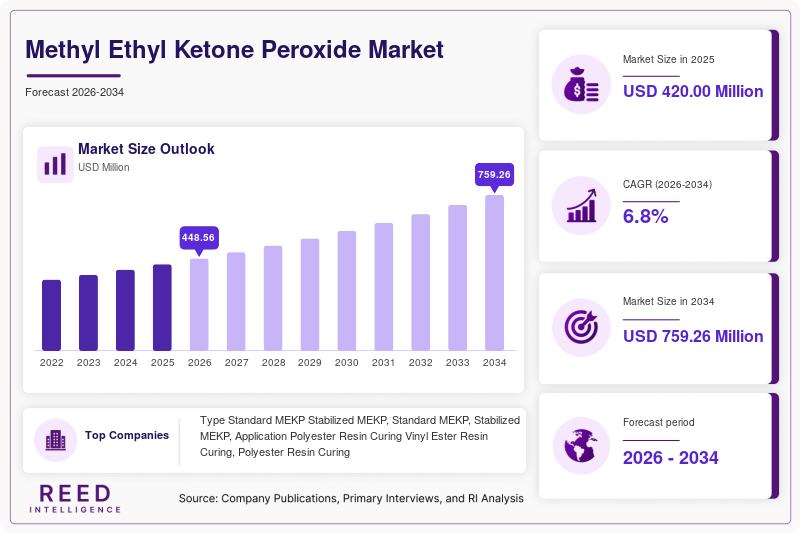
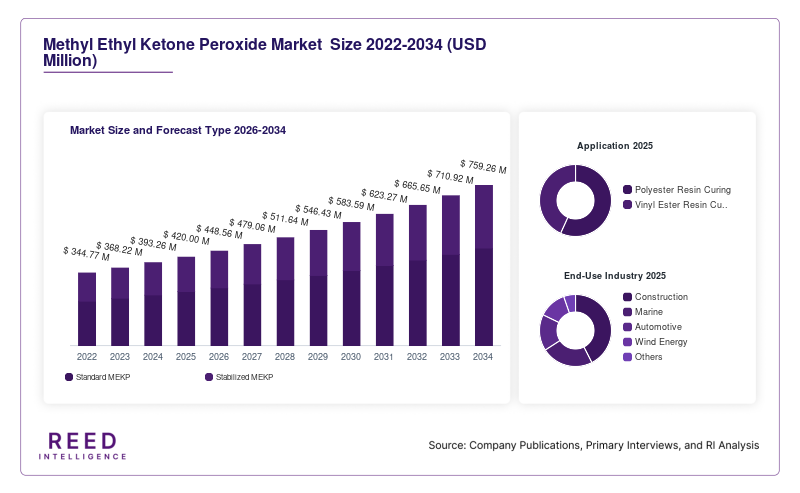
The global Methyl Ethyl Ketone Peroxide Market size was valued at approximately USD 420 million in 2026 and is projected to reach USD 710 million by 2034, expanding at a CAGR of 6.8% during the forecast period (2026–2034). The market growth is supported by the increasing adoption of thermoset composites across construction, marine, and automotive sectors, where methyl ethyl ketone peroxide (MEKP) acts as a critical curing agent.
A key global factor driving the Methyl Ethyl Ketone Peroxide Market is the rapid expansion of fiber-reinforced plastics (FRP) manufacturing. As industries seek lightweight and corrosion-resistant materials, MEKP has gained prominence due to its efficiency in initiating polymerization reactions in unsaturated polyester resins and vinyl ester systems.
Key Highlights:
- Asia Pacific dominated the market with a 42% share in 2025, while the Middle East & Africa is expected to witness the fastest growth at a CAGR of 7.6%.
- By application, polyester resin curing held the largest share at 58%, whereas vinyl ester curing is projected to grow fastest at a CAGR of 7.4%.
- China remained the dominant country, with market values of USD 92 million in 2024 and USD 98 million in 2025.
Market Trends
Increasing Adoption of Advanced Composite Materials
The Methyl Ethyl Ketone Peroxide Market is experiencing a shift toward advanced composite materials, particularly in transportation and infrastructure sectors. Manufacturers are increasingly utilizing high-performance composites that require efficient curing agents like MEKP. These materials offer improved strength-to-weight ratios, corrosion resistance, and durability, making them suitable for automotive panels, wind turbine blades, and marine components. As a result, MEKP demand is closely aligned with innovations in composite technologies.
Furthermore, the trend toward sustainable construction practices is encouraging the use of long-lasting and low-maintenance materials. MEKP-based curing systems are gaining traction due to their compatibility with eco-efficient composite formulations, reinforcing their role in modern manufacturing processes.
Shift Toward Safer and Stabilized Formulations
Safety concerns associated with peroxide-based chemicals have led to increased research into stabilized and safer MEKP formulations. Manufacturers are focusing on improving storage stability, reducing volatility, and enhancing handling safety. This trend is particularly evident in developed markets where regulatory frameworks are stringent.
In addition, the adoption of customized formulations tailored for specific applications is gaining momentum. These innovations are helping end-users achieve better curing efficiency while minimizing operational risks. As industries prioritize worker safety and environmental compliance, demand for improved MEKP formulations is expected to rise steadily.
Market Drivers
Growth in Fiber-Reinforced Plastic (FRP) Production
The rapid expansion of FRP production is a major driver of the Methyl Ethyl Ketone Peroxide Market. FRP materials are widely used in industries such as construction, marine, and transportation due to their lightweight and high-strength properties. MEKP plays a critical role as a curing agent in the manufacturing of these materials, ensuring efficient polymerization and structural integrity.
As demand for durable and corrosion-resistant materials increases, manufacturers are scaling up FRP production capacities. This directly translates into higher consumption of MEKP, supporting sustained market growth.
Expanding Marine and Automotive Applications
The marine and automotive industries are increasingly adopting composite materials to enhance performance and reduce weight. MEKP is essential in producing composite components such as boat hulls, car panels, and structural parts.
In the marine sector, the need for materials that withstand harsh environmental conditions has driven the adoption of MEKP-cured resins. Similarly, automotive manufacturers are leveraging composites to improve fuel efficiency and reduce emissions. This growing application scope continues to strengthen the demand outlook for the Methyl Ethyl Ketone Peroxide Market.
Market Restraint
Safety and Handling Challenges
One of the primary challenges in the Methyl Ethyl Ketone Peroxide Market is the hazardous nature of the chemical. MEKP is a highly reactive organic peroxide that requires careful handling, storage, and transportation. Exposure to heat, contamination, or improper storage conditions can lead to decomposition, posing safety risks.
These challenges have resulted in stringent regulatory requirements across various regions. Compliance with safety standards often increases operational costs for manufacturers and distributors. Additionally, the need for specialized storage facilities and trained personnel adds to the overall cost burden.
Small and medium-sized enterprises may find it difficult to manage these requirements, limiting their participation in the market. Moreover, concerns regarding workplace safety and environmental impact may discourage adoption in certain industries.
Despite these challenges, ongoing advancements in formulation and packaging are helping mitigate risks. However, safety concerns remain a significant restraint that could influence the growth trajectory of the Methyl Ethyl Ketone Peroxide Market.
Market Opportunities
Rising Demand in Emerging Economies
Emerging economies present significant growth opportunities for the Methyl Ethyl Ketone Peroxide Market. Rapid industrialization, urbanization, and infrastructure development are driving the demand for composite materials in regions such as Asia Pacific, Latin America, and the Middle East.
As governments invest in transportation, construction, and energy projects, the need for durable and cost-effective materials continues to rise. MEKP, being a key component in composite manufacturing, is expected to witness increased demand in these regions.
Technological Advancements in Curing Systems
Innovations in curing technologies are opening new avenues for the Methyl Ethyl Ketone Peroxide Market. Advanced curing systems that enhance efficiency, reduce curing time, and improve product quality are gaining traction.
Manufacturers are developing next-generation MEKP formulations that offer better performance and safety. These innovations are particularly relevant in high-value applications such as wind energy and aerospace composites.
As industries continue to adopt advanced manufacturing techniques, the demand for high-performance curing agents is expected to grow, creating lucrative opportunities for market participants.
Segmental Analysis
By Type
The standard MEKP segment dominated the Methyl Ethyl Ketone Peroxide Market with a 65% share in 2025. Its widespread use in general-purpose applications and cost-effectiveness have made it the preferred choice among manufacturers.
The stabilized MEKP segment will grow at a CAGR of 7.1%, driven by increasing demand for safer and more stable formulations. Enhanced storage and handling properties will support its adoption across industries.
By Application
Polyester resin curing accounted for the largest share of 58% in 2025 due to its extensive use in composite manufacturing. MEKP’s efficiency in initiating curing reactions has made it indispensable in this segment.
Vinyl ester resin curing is projected to grow at a CAGR of 7.4%, supported by rising demand for high-performance composites in industrial applications. Its superior chemical resistance will drive increased adoption.
By End-Use Industry
The construction industry dominated with a 34% share in 2025, driven by the use of composites in infrastructure development. MEKP plays a crucial role in ensuring the durability of construction materials.
The wind energy sector will expand at a CAGR of 7.5%, fueled by the growing demand for renewable energy. The use of composite materials in turbine blades will drive MEKP consumption.
By Formulation
Liquid formulations held the largest share of 72% in 2025, owing to their ease of application and compatibility with various resins.
Gel-based formulations are expected to grow at a CAGR of 6.9%, driven by their suitability for specific applications requiring controlled curing processes.
Regional Analysis
North America
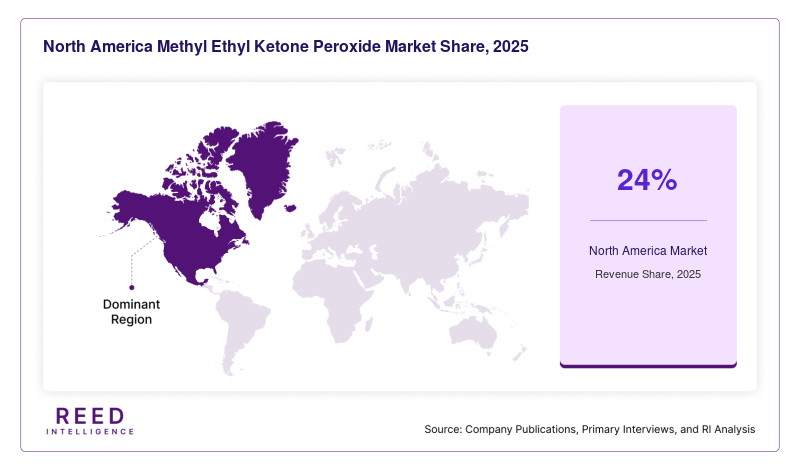
North America accounted for approximately 24% of the Methyl Ethyl Ketone Peroxide Market share in 2025 and will expand at a CAGR of 6.2% during 2026–2034. The region’s mature composites industry has contributed to steady demand for MEKP across various applications.
The United States dominated the regional market due to its well-established marine and automotive sectors. The presence of advanced manufacturing facilities and strong adoption of composite materials has supported consistent demand for MEKP in industrial applications.
Europe
Europe held around 21% market share in 2025 and is expected to grow at a CAGR of 6.0% over the forecast period. The region’s focus on sustainable materials and regulatory compliance has influenced market dynamics.
Germany emerged as the leading country, driven by its strong automotive and engineering industries. The increasing use of lightweight materials in manufacturing has contributed to the demand for MEKP in composite production.
Asia Pacific
Asia Pacific dominated the Methyl Ethyl Ketone Peroxide Market with a 42% share in 2025 and will register a CAGR of 7.2% through 2034. The region’s rapid industrialization and expanding manufacturing base have been key growth factors.
China led the market, supported by its large-scale production of composites and extensive infrastructure projects. The country’s focus on industrial growth and export-oriented manufacturing has significantly boosted MEKP consumption.
Middle East & Africa
The Middle East & Africa region accounted for approximately 7% share in 2025 and is projected to grow at a CAGR of 7.6%, the fastest among all regions. Increasing investments in infrastructure and energy projects are driving market expansion.
Saudi Arabia dominated the region due to its growing construction and industrial sectors. The demand for durable materials in harsh environmental conditions has increased the use of MEKP in composite applications.
Latin America
Latin America held about 6% share in 2025 and will grow at a CAGR of 6.5% during the forecast period. The region’s developing industrial base has created moderate demand for MEKP.
Brazil emerged as the dominant country, supported by its expanding construction and marine industries. The adoption of composite materials in infrastructure projects has contributed to market growth.
Competitive Landscape
The Methyl Ethyl Ketone Peroxide Market is moderately consolidated, with key players focusing on product innovation and regional expansion. Leading companies are investing in research and development to enhance product safety and performance.
Akzo Nobel N.V. is a prominent market leader, known for its extensive product portfolio and strong global presence. The company recently introduced advanced MEKP formulations aimed at improving safety and efficiency in industrial applications.
Other major players are also adopting strategies such as partnerships, capacity expansions, and technological advancements to strengthen their market position. The competitive landscape is characterized by continuous innovation and efforts to meet evolving industry requirements.
Key Players List
- Akzo Nobel N.V.
- Nouryon
- Arkema Group
- United Initiators GmbH
- Pergan GmbH
- MPI Chemie BV
- Kawaguchi Chemical Industry Co., Ltd.
- Novichem Sp. z o.o.
- Luperox (Arkema)
- Ace Chemical Corp.
- Chang Chun Group
- Taicang Plastic Additives Factory
- Hualun Chemical Co., Ltd.
- Jiangsu Yuanyang Pharmaceutical Co., Ltd.
- RheinPerChemie GmbH
Recent Developments
- In 2025, Akzo Nobel N.V. launched a new range of stabilized MEKP products to improve safety and storage stability.
- In 2024, Arkema Group expanded its organic peroxide production capacity to meet rising demand.
- In 2025, Nouryon introduced customized MEKP solutions for high-performance composite applications.
- In 2024, United Initiators GmbH invested in R&D to develop eco-efficient peroxide formulations.
- In 2025, Pergan GmbH strengthened its distribution network in Asia Pacific to enhance market reach.
Methyl Ethyl Ketone Peroxide Market Segments
Type
- Standard MEKP
- Stabilized MEKP
Application
- Polyester Resin Curing
- Vinyl Ester Resin Curing
End-Use Industry
- Construction
- Marine
- Automotive
- Wind Energy
- Others
Formulation
- Liquid
- Gel
By Region
- North America
- Europe
- APAC
- Middle East and Africa
- LATAM