Methyl Heptyl Ketone Market Size, Share, Demand Report by Grade (Industrial Grade, High Purity Grade, Custom Blend Grade), By Application (Coatings & Paints, Adhesives & Sealants, Printing Inks, Cleaning Formulations, Chemical Intermediates), By End Use Industry (Chemical Manufacturing, Automotive, Packaging, Electronics, Construction, Others), and Regional Forecasts, 2026–2034
USD 3950
Market Overview
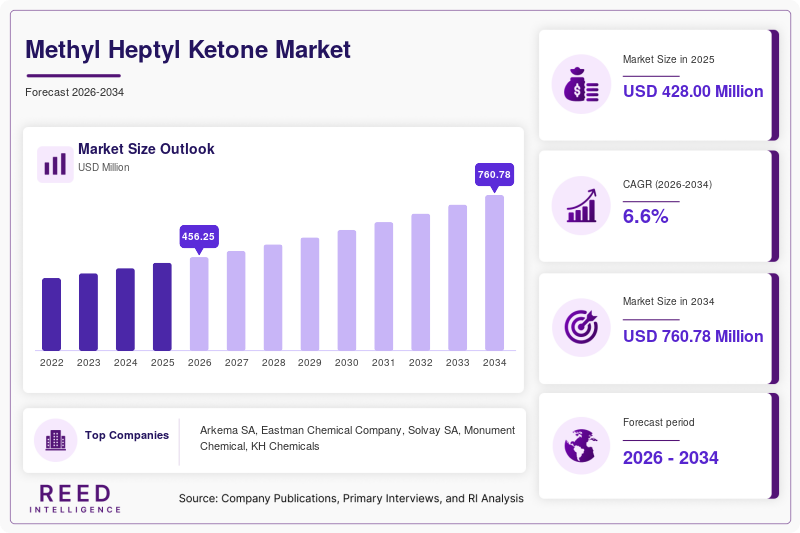
The Methyl Heptyl Ketone Market size was valued at USD 428 million in 2026 and is projected to reach USD 716 million by 2034, expanding at a CAGR of 6.6% during 2026–2034. Methyl heptyl ketone is widely used as a specialty solvent and intermediate in coatings, adhesives, inks, cleaning formulations, and chemical synthesis. Its balanced evaporation rate, solvency strength, and compatibility with resin systems make it valuable in industrial formulations where consistent performance is required. Demand is increasing from manufacturers seeking efficient solvent systems that support higher productivity and stable product quality.
One global factor supporting market growth is the steady expansion of industrial manufacturing output across automotive, packaging, electronics, and construction supply chains. As production volumes rise, demand for specialty chemicals used in coatings, surface treatment, and process cleaning also increases. Many producers are also shifting toward solvents with improved formulation efficiency and lower residue characteristics, which benefits methyl heptyl ketone consumption. Growth in maintenance coatings, industrial printing, and specialty adhesives is further supporting broader adoption in developed and emerging economies.
Key Highlights
- North America dominated the market with a 33.8% share in 2025.
- Asia Pacific is expected to grow at the fastest CAGR of 7.8% during 2026–2034.
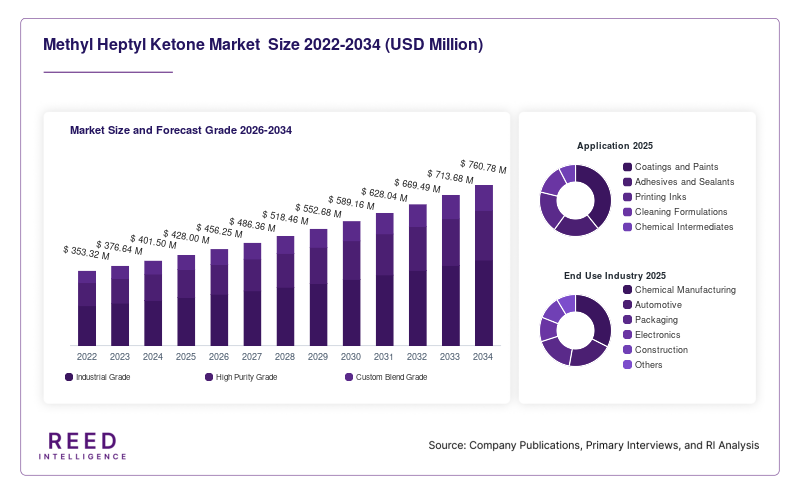
- By grade, industrial grade accounted for the largest share of 61.4%.
- while high purity grade is projected to grow at a CAGR of 7.5%.
- By application, coatings and paints led with a 36.9% share, whereas adhesives and sealants are expected to expand at a CAGR of 7.3%.
- By end use, chemical manufacturing held the largest share of 31.6%, while electronics is forecast to grow at a CAGR of 7.9%.
- The United States remained the dominant country, with market values of USD 128 million in 2024 and USD 136 million in 2025.
Market Trends
Rising Use in Specialty Coatings Formulations
Manufacturers of industrial coatings are increasingly using methyl heptyl ketone in formulations that require controlled drying time, smooth film formation, and strong resin compatibility. Demand is visible in metal coatings, equipment finishes, protective maintenance paints, and packaging inks. Producers are refining solvent blends to improve process efficiency while maintaining surface appearance and durability. As coatings companies move toward higher-value specialty products instead of commodity volumes, demand for performance solvents rises. This trend is especially strong in automotive refinish, machinery coatings, and premium packaging where finish quality directly influences product value.
Expansion of High-Purity Grades for Electronics Processing
The market is witnessing a gradual shift toward higher-purity methyl heptyl ketone grades for electronics cleaning, precision manufacturing, and specialty synthesis. Semiconductor and component producers require solvents with lower impurity content to reduce contamination risk during production. This creates opportunities for suppliers able to provide tighter specifications and reliable batch consistency. Growth in printed circuit boards, sensors, batteries, and advanced assemblies is increasing solvent demand in Asia Pacific and North America. As electronics manufacturing becomes more quality sensitive, premium grades are expected to gain share within the broader market.
Market Drivers
Growth of Adhesives, Sealants, and Flexible Packaging
The expansion of flexible packaging, labels, tapes, and industrial bonding solutions is supporting methyl heptyl ketone demand. Adhesive formulators use specialty solvents to manage viscosity, drying speed, and application behavior across multiple substrates. E-commerce growth has increased packaging consumption, while food and consumer goods producers continue to adopt lightweight packaging formats. This has raised output of laminating adhesives and printing systems where solvent performance matters. The chemical’s ability to support stable formulations makes it attractive for manufacturers seeking dependable production efficiency and consistent bonding results across large-scale operations.
Industrial Maintenance and Refurbishment Spending
Aging infrastructure, industrial plants, marine assets, and transportation fleets require regular maintenance, recoating, and surface preparation. These activities increase demand for solvents used in cleaning systems, protective coatings, and repair materials. Methyl heptyl ketone benefits from this trend because maintenance cycles often prioritize performance and compatibility over lowest cost. Energy facilities, warehouses, rail systems, and manufacturing plants are extending asset life rather than replacing equipment quickly. As capital discipline continues across industries, maintenance expenditure remains a stable source of specialty solvent demand in both mature and developing economies.
Market Restraint
Volatility in Feedstock Costs and Regulatory Pressure
The market faces pressure from fluctuating petrochemical feedstock prices and evolving solvent regulations. Since methyl heptyl ketone production depends on upstream chemical inputs, sudden cost changes can reduce producer margins and create pricing uncertainty for downstream buyers. At the same time, some regions are tightening workplace exposure, emissions, and solvent handling standards. Smaller formulators may switch to alternative chemistries if compliance costs rise. For example, coating producers serving export markets often redesign formulations to meet multiple regional rules, which can delay procurement decisions. These factors may limit faster adoption despite healthy end-use demand.
Market Opportunities
Capacity Expansion in Asia Pacific Chemical Hubs
Asia Pacific continues to add manufacturing capacity for coatings, adhesives, electronics materials, and specialty chemicals. This creates a favorable environment for regional methyl heptyl ketone supply chains, including local production, storage, and distribution networks. Buyers increasingly prefer shorter lead times and regional sourcing to reduce logistics risk. Suppliers that establish blending or purification facilities near industrial clusters can improve service levels and pricing competitiveness. Countries such as China, India, Vietnam, and South Korea are expected to remain attractive due to rising domestic consumption and export-oriented manufacturing growth.
Development of Customized Solvent Blends
There is growing opportunity in tailored solvent systems designed for specific resin families, drying conditions, and application methods. Rather than purchasing single solvents, many industrial customers now seek optimized blends that improve line speed, finish quality, or cleaning performance. Methyl heptyl ketone can be incorporated into customized systems because of its balanced solvency profile. Producers that offer technical support, application testing, and formulation guidance can secure long-term customer relationships. This value-added approach may increase margins while reducing direct price competition in standard commodity solvent categories.
Segmental Analysis
By Grade
Industrial grade held the dominant share of 61.4% in 2024. This segment benefits from broad use in coatings, inks, adhesives, and general manufacturing applications where standard purity specifications are sufficient. Buyers prioritize cost efficiency, reliable supply, and formulation compatibility rather than ultra-low impurity levels. Industrial grade is commonly used in bulk procurement contracts by coating blenders, packaging chemical suppliers, and maintenance product manufacturers. Its wide application base makes it the largest revenue contributor across developed and emerging markets.
High purity grade is the fastest-growing segment and is forecast to expand at a 7.5% CAGR through 2034. Growth is linked to electronics processing, specialty synthesis, precision cleaning, and higher-value chemical formulations that require tighter specifications. Manufacturers of sensors, batteries, and advanced components are increasing demand for consistent solvent quality. Suppliers investing in purification systems, analytical testing, and traceability are expected to gain share as premium applications continue to expand globally.
By Application
Coatings and paints accounted for the largest 36.9% share in 2024. Methyl heptyl ketone is used to improve solvency balance, drying characteristics, and resin handling in industrial coatings systems. Demand comes from metal finishing, protective maintenance coatings, automotive refinishing, and equipment paints. As customers seek better appearance and durability, formulators continue using specialty solvents in performance-oriented products. The segment also benefits from regular repainting cycles in industrial and commercial assets.
Adhesives and sealants are projected to be the fastest-growing application at a 7.3% CAGR during the forecast period. Flexible packaging, tapes, construction bonding, and assembly operations are increasing consumption of advanced adhesive systems. Solvents help manage viscosity, spreadability, and drying speed during manufacturing and end use. The shift toward lightweight packaging and multi-material assemblies in consumer goods and transport sectors is expected to sustain demand for this application category.
By End Use
Chemical manufacturing held the largest 31.6% share in 2024. The segment uses methyl heptyl ketone as an intermediate, processing aid, or solvent within specialty chemical production chains. Demand is supported by resins, additives, treatment chemicals, and formulation blending operations. Large-volume purchasing contracts and repeat industrial consumption make chemical manufacturing a stable end-use category. Producers value predictable quality and supply continuity for uninterrupted plant operations.
Electronics is expected to register the fastest 7.9% CAGR through 2034. Growth is tied to expanding production of semiconductors, printed circuit boards, batteries, displays, and sensors. Precision manufacturing requires solvents with consistent purity and residue control, creating opportunities for premium grades. Asia Pacific capacity additions, along with supply-chain diversification in North America and Europe, are likely to accelerate demand from this end-use segment.
Regional Analysis
North America
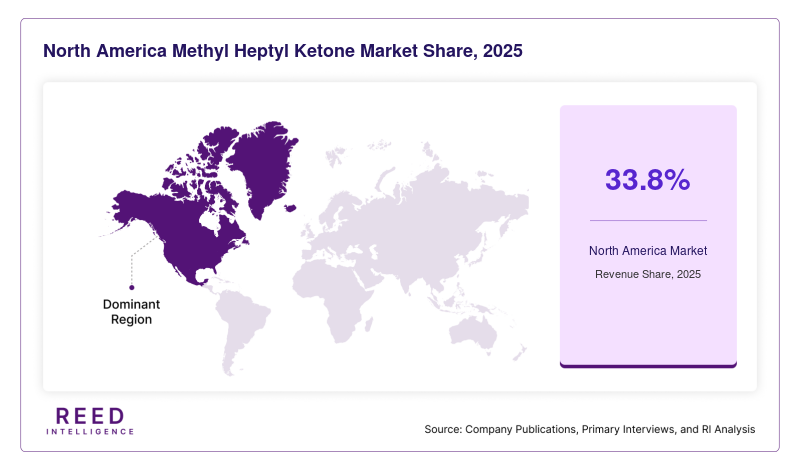
North America accounted for 33.8% of the Methyl Heptyl Ketone Market in 2025 and is projected to grow at a 6.1% CAGR through 2034. Demand is supported by established coatings, adhesives, and industrial maintenance sectors across the United States and Canada. The region also benefits from advanced chemical distribution systems, reliable storage infrastructure, and consistent procurement from manufacturing clients that require specialty solvent grades.
The United States leads regional consumption due to its broad industrial base and strong aftermarket coatings demand. A unique growth factor is the ongoing refurbishment of industrial assets and logistics facilities, which increases use of maintenance coatings and cleaning chemicals. Growth in packaging production and specialty printing further supports stable demand from downstream formulators.
Europe
Europe held 25.6% market share in 2025 and is expected to register a 5.8% CAGR during the forecast period. The region has a mature but resilient specialty chemicals industry with demand concentrated in Germany, France, Italy, and the United Kingdom. Consumption remains linked to automotive coatings, engineered adhesives, and industrial process chemicals requiring consistent solvent performance.
Germany is the dominant country market because of its strong automotive, machinery, and specialty manufacturing sectors. A unique growth factor is the region’s emphasis on high-performance engineered coatings used in exports. Producers often prioritize formulation precision and product reliability, supporting steady procurement of specialty solvents such as methyl heptyl ketone.
Asia Pacific
Asia Pacific represented 24.7% of the market in 2025 and is forecast to expand at the fastest 7.8% CAGR through 2034. Rapid industrialization, rising coatings output, electronics production, and packaging demand are driving consumption. Regional buyers increasingly source solvents locally, encouraging new supply investments and stronger domestic distribution channels.
China remains the largest country market, supported by extensive manufacturing capacity across coatings, electronics, and industrial chemicals. A unique growth factor is the concentration of export manufacturing zones that require large volumes of packaging inks, laminating adhesives, and process chemicals. This broad downstream base creates consistent multi-sector demand.
Middle East & Africa
The Middle East & Africa captured 8.4% share in 2025 and is projected to grow at a 6.4% CAGR by 2034. Demand is emerging from construction materials, infrastructure coatings, petrochemical processing, and industrial cleaning applications. Several countries are investing in local manufacturing diversification beyond raw hydrocarbon exports.
Saudi Arabia leads the region due to its integrated petrochemical ecosystem and industrial expansion programs. A unique growth factor is the development of downstream specialty manufacturing parks that increase regional demand for solvents, coatings intermediates, and packaging materials. This supports gradual market deepening over the forecast period.
Latin America
Latin America held 7.5% of global share in 2025 and is expected to grow at a 6.0% CAGR through 2034. Market demand is tied to construction coatings, automotive refinishing, food packaging, and industrial maintenance. Economic recovery cycles strongly influence purchasing patterns, but long-term fundamentals remain constructive.
Brazil dominates regional demand due to its scale in manufacturing, packaging, and transportation sectors. A unique growth factor is the country’s large aftermarket automotive refinishing industry, which supports recurring solvent consumption in coatings and repair materials. Local packaging expansion also adds stable downstream demand.
Competitive Landscape
The market is moderately consolidated, with global and regional chemical suppliers competing on purity standards, pricing, logistics reliability, and technical support. Leading participants focus on long-term supply agreements with coatings, adhesives, and specialty chemical customers. Many companies are expanding storage terminals and regional warehousing to reduce delivery times and improve responsiveness.
Arkema SA is considered a market leader due to its diversified solvent portfolio and broad industrial customer base. A recent development includes expanded specialty solvent distribution partnerships in Asia to improve access for electronics and coatings customers. Other active participants include Eastman Chemical Company, Solvay, Monument Chemical, and KH Chemicals, all of which continue to optimize product portfolios and supply networks. Competition is increasingly shifting toward customized blends, high-purity grades, and value-added technical service rather than volume pricing alone.
Key Players List
- Arkema SA
- Eastman Chemical Company
- Solvay SA
- Monument Chemical
- KH Chemicals
- Tokyo Chemical Industry
- Merck KGaA
- Thermo Fisher Scientific
- Santa Cruz Biotechnology
- Parchem Fine & Specialty Chemicals
- Alfa Aesar
- Sasol Chemicals
- Chevron Phillips Chemical
- Brenntag SE
- Univar Solutions
Recent Developments
- Several producers expanded solvent storage and drum filling capacity in Southeast Asia to improve regional delivery times in 2025.
- A major specialty chemical supplier introduced tighter-specification methyl heptyl ketone grades for electronics cleaning applications in 2024.
- Multiple distributors in North America signed new warehousing agreements to strengthen supply availability for coatings and adhesives customers in 2025.
Methyl Heptyl Ketone Market Segments
Grade
- Industrial Grade
- High Purity Grade
- Custom Blend Grade
Application
- Coatings and Paints
- Adhesives and Sealants
- Printing Inks
- Cleaning Formulations
- Chemical Intermediates
End Use Industry
- Chemical Manufacturing
- Automotive
- Packaging
- Electronics
- Construction
- Others
By Region
- North America
- Europe
- APAC
- Middle East and Africa
- LATAM