Methyl Isobutyl Carbinol Market Size, Share & Demand Report By Application (Flotation Reagents, Solvent Extraction, Lubricant Additives, Coatings and Paints), By End-Use (Mining, Industrial Chemicals, Automotive, Construction), By Grade (Industrial Grade, High Purity Grade, Specialty Grade), By Region & Segment Forecasts, 2026–2034
USD 3950
Market Overview
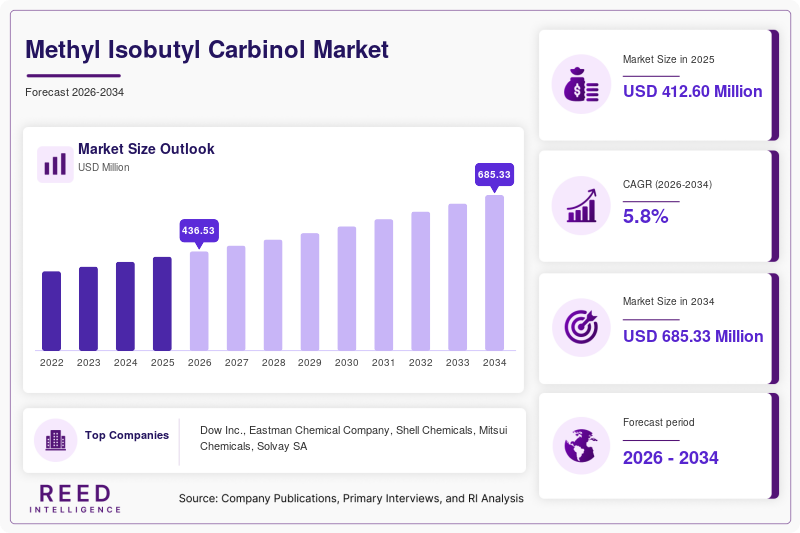
The global Methyl Isobutyl Carbinol Market size was valued at USD 412.6 million in 2026 and is projected to reach USD 648.9 million by 2034, expanding at a CAGR of 5.8% during the forecast period from 2026 to 2034. Methyl isobutyl carbinol (MIBC), a specialty chemical primarily used as a frother in mineral flotation, solvent in coatings, and additive in lubricants, continues to witness stable demand across mining, industrial chemicals, and paints sectors. The market is benefiting from rising investments in global copper, lithium, and rare earth mining activities, particularly as governments and private companies increase exploration to secure raw materials for electrification and renewable energy systems. Expanded metal extraction activities in both developed and emerging economies have strengthened demand for flotation chemicals, directly supporting MIBC consumption. Additionally, its role in industrial formulations, hydraulic fluids, and surface coatings has created broader commercial relevance beyond mining applications.
Supply chain optimization and technological advancements in petrochemical refining have also improved production economics, allowing manufacturers to expand output and improve purity grades for specialized applications. Growing industrialization in Asia Pacific and Latin America has further supported broader market penetration.
Key Highlights
- North America dominated the market with a 36.4% share in 2025.
- Asia Pacific is expected to grow at the fastest CAGR of 7.4% during 2026–2034.
- By application, flotation reagents accounted for the largest share of 46.8%, while solvent extraction applications are projected to grow at a CAGR of 6.9%.
- By end-use, mining led with a 49.3% share, whereas coatings and paints are expected to expand at a CAGR of 6.6%.
- The United States remained the dominant country, with market values of USD 118.4 million in 2024 and USD 125.9 million in 2025.
Market Trends
Rising integration in critical mineral extraction
The increasing global focus on critical minerals such as lithium, cobalt, nickel, and copper has created a structural demand shift for MIBC in flotation processes. As battery manufacturing and clean energy technologies expand, mining companies are investing heavily in advanced ore beneficiation systems, where MIBC serves as an efficient frothing agent. This trend is especially visible in countries expanding domestic mineral security strategies. High-purity MIBC grades are increasingly preferred for selective flotation, reducing reagent waste and improving mineral recovery rates. This industrial shift is not only increasing volume demand but also encouraging product innovation tailored to modern mining conditions, including low-emission chemical processing and ore-specific reagent customization.
Growing use in specialty coatings and industrial solvents
Beyond mining, MIBC is gaining traction in paints, coatings, inks, and industrial solvent applications due to its moderate volatility and compatibility with complex formulations. Manufacturers are increasingly using it in specialty coatings for automotive refinishing, machinery, and industrial infrastructure because of its performance in improving flow and stability. As industrial coatings markets evolve toward durable and performance-based products, MIBC is seeing expanded utility in formulation chemistry. Emerging economies are also increasing domestic paint manufacturing capacity, supporting broader chemical demand. This trend diversifies revenue streams for producers and reduces dependency on mining cycles, creating more balanced long-term market expansion.
Market Drivers
Expansion of global mining and ore processing industries
The primary growth driver for the Methyl Isobutyl Carbinol Market remains the expansion of mining operations worldwide. Copper, zinc, molybdenum, and precious metal extraction activities continue to increase due to infrastructure development, electric vehicle manufacturing, and energy transition goals. MIBC is widely used in froth flotation to separate valuable minerals from ore, making it essential to efficient resource extraction. Large-scale projects in Chile, Australia, Canada, and Africa are increasing flotation reagent demand. Moreover, declining ore grades globally require more advanced beneficiation chemicals, further reinforcing MIBC’s value in maintaining productivity and cost efficiency across mining operations.
Industrial chemical diversification and solvent demand
MIBC demand is also supported by its growing role in industrial solvents, brake fluids, and lubricant additives. As manufacturing sectors expand in automotive, aerospace, and heavy machinery, demand for specialized solvents and additives continues to rise. MIBC’s chemical stability and performance characteristics make it suitable for precision industrial applications. In coatings, it supports texture, consistency, and drying efficiency. This broader industrial use base reduces sector concentration risk and supports demand resilience even during fluctuations in commodity mining. Chemical manufacturers are increasingly investing in diversified production capabilities to serve multiple end-use industries simultaneously.
Market Restraint
Environmental regulations and volatility in petrochemical feedstock pricing
One of the primary restraints affecting the Methyl Isobutyl Carbinol Market is increasing environmental scrutiny surrounding volatile organic compounds and petrochemical-derived specialty chemicals. Regulatory frameworks in Europe and parts of North America are placing greater emphasis on emissions control, workplace safety, and chemical substitution where feasible. While MIBC remains commercially relevant, compliance costs for storage, transport, and industrial handling are increasing. Additionally, fluctuations in raw material costs linked to petrochemical feedstocks can impact pricing stability for manufacturers and downstream users. For example, sudden crude oil price volatility may raise production expenses, limiting profit margins and creating uncertainty for long-term procurement contracts. Smaller manufacturers may face challenges in balancing compliance investment with competitive pricing, potentially slowing capacity expansion.
Market Opportunities
Emerging demand from battery metals and strategic resource projects
The expansion of battery supply chains presents a significant opportunity for MIBC producers. Lithium, nickel, cobalt, and graphite mining projects are increasing worldwide to support electric mobility and energy storage systems. Many of these extraction projects rely on flotation technologies where MIBC can enhance mineral separation performance. Countries prioritizing domestic battery material independence are accelerating mine development, particularly in Asia Pacific and Latin America. This creates a new growth pathway beyond traditional copper and zinc mining. Producers capable of offering tailored formulations for battery mineral flotation may gain stronger margins and strategic partnerships in rapidly expanding industrial ecosystems.
Product innovation in low-emission and specialty-grade formulations
A growing opportunity exists in developing environmentally optimized and application-specific MIBC variants. Manufacturers are increasingly investing in cleaner production methods, reduced-emission solvents, and enhanced-purity grades for specialized industrial applications. These innovations can support regulatory compliance while opening new use cases in pharmaceuticals, coatings, and advanced industrial fluids. Specialty-grade MIBC may command higher pricing due to quality requirements and niche applications. As industries increasingly seek operational efficiency and sustainability, chemical producers that align product development with environmental standards may strengthen market positioning and access premium customer segments.
Segmental Analysis
By Application
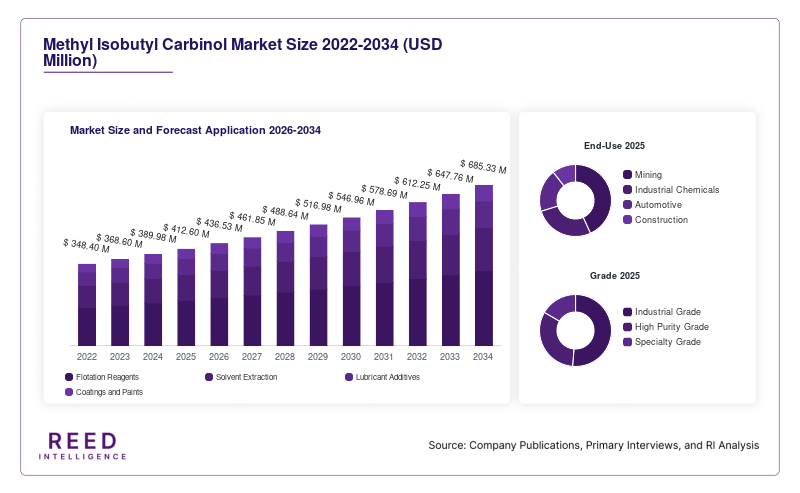
Flotation reagents represented the dominant application segment, accounting for 46.8% of market share in 2024. MIBC’s role as a frothing agent in mineral processing makes it highly important across copper, zinc, gold, and lithium beneficiation. Mining companies prioritize reagent efficiency due to rising ore complexity and declining grades. This has maintained flotation’s leading position. Strong demand from mining-intensive economies such as Chile, Australia, and Canada reinforces this dominance, while process optimization trends support continued chemical utilization.
Solvent extraction is projected to be the fastest-growing application segment, with a CAGR of 6.9% from 2026 to 2034. Industrial solvent demand is increasing across paints, lubricants, and coatings due to expanding manufacturing sectors. MIBC’s compatibility in specialty formulations makes it valuable in precision industrial environments. Emerging industrial economies are also increasing solvent-based manufacturing.
By End-Use
Mining remained the dominant end-use segment in 2024, holding 49.3% of the global market. Mineral flotation demand remains structurally linked to commodity production and strategic resource development. Increased production of battery metals, precious metals, and industrial minerals has strengthened MIBC’s position. The mining industry’s dependence on flotation efficiency has preserved this leadership.
Coatings and paints are expected to be the fastest-growing end-use segment, with a CAGR of 6.6% during the forecast period. Growth is supported by infrastructure development, automotive refinishing, and industrial manufacturing expansion. MIBC contributes to formulation stability and solvent performance, making it relevant for advanced coatings applications.
By Grade
Industrial-grade MIBC accounted for the largest market share in 2024 at 61.5%, driven by broad usage across mining, lubricants, and industrial solvents. Cost efficiency and large-volume applicability support this segment’s scale. Bulk procurement by mining and manufacturing firms reinforces industrial-grade leadership.
High-purity and specialty-grade MIBC is projected to grow at the fastest CAGR of 7.1% through 2034. Demand is rising from specialty coatings, chemical processing, and environmentally optimized industrial applications. Premium formulations may offer stronger margins due to specialized performance requirements.
Regional Analysis
North America
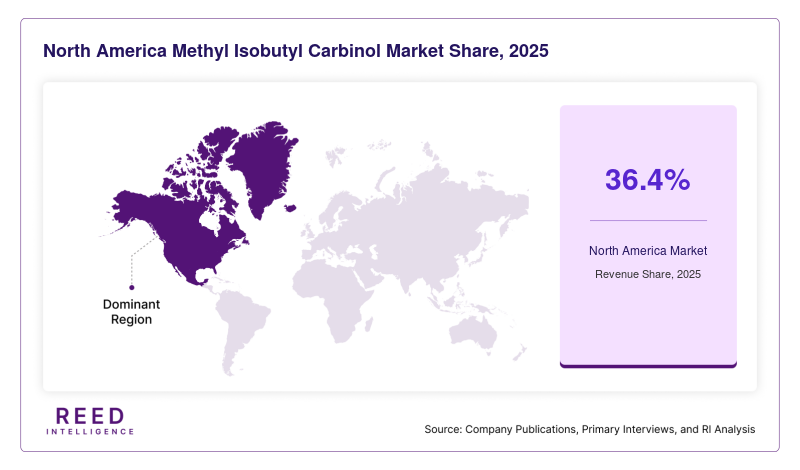
North America held the largest share of the Methyl Isobutyl Carbinol Market in 2025, accounting for 36.4% of global revenue, and is projected to grow at a CAGR of 5.2% through 2034. Strong mining activity in Canada, the United States, and Mexico continues to support demand for flotation reagents. Industrial coatings, lubricants, and solvent applications further strengthen regional consumption. Established petrochemical infrastructure and advanced processing technologies also contribute to supply chain efficiency.
The United States remains the dominant market in North America due to its strong specialty chemical manufacturing ecosystem and large-scale industrial consumption. Domestic demand is reinforced by mining modernization and rising infrastructure coatings applications. Increased investment in domestic critical mineral extraction, particularly copper and lithium exploration, has created additional opportunities for MIBC suppliers.
Europe
Europe represented 24.7% of the global market in 2025 and is forecast to expand at a CAGR of 4.8% during the forecast period. Regional growth is relatively moderate due to stricter environmental regulations, but demand remains stable through coatings, industrial solvents, and selective mining operations. Germany, France, and Eastern Europe continue to support industrial consumption patterns.
Germany leads the European market due to its advanced chemical processing industry and industrial manufacturing base. Demand is driven largely by coatings, machinery fluids, and specialty chemicals. Europe’s emphasis on sustainable chemical innovation is also encouraging higher-value MIBC formulations designed for regulatory compliance and industrial efficiency.
Asia Pacific
Asia Pacific accounted for 21.9% of the global market in 2025 and is projected to register the fastest CAGR of 7.4% through 2034. Industrialization, mining expansion, and manufacturing growth in China, India, and Southeast Asia are major contributors. The region’s growing metals demand and expanding paint industry continue to create strong downstream demand.
China dominates the Asia Pacific market due to large-scale mining, petrochemical production, and manufacturing capacity. Growing domestic production of strategic minerals and industrial coatings has significantly increased MIBC consumption. India is also emerging as a promising market due to infrastructure development and industrial expansion.
Middle East & Africa
The Middle East & Africa region held 9.1% of the global market in 2025 and is expected to grow at a CAGR of 5.9% through 2034. Mining expansion in Africa and petrochemical development in the Gulf region are supporting market progress. Increased exploration of copper, gold, and strategic metals is improving demand prospects.
South Africa leads regional demand due to its extensive mineral processing industry. Gold and platinum extraction continue to drive flotation reagent demand. In the Middle East, petrochemical diversification strategies are creating moderate but growing solvent demand.
Latin America
Latin America captured 7.9% of the global market in 2025 and is projected to grow at a CAGR of 6.3% through 2034. The region benefits from large-scale copper, silver, and lithium mining operations, especially in Chile, Peru, and Argentina. Flotation remains a core application area.
Chile is the dominant country due to its copper mining leadership and expanding lithium extraction activities. Strong investment in mineral beneficiation technologies is supporting MIBC demand. Regional export-focused mining remains a major growth engine.
Competitive Landscape
The Methyl Isobutyl Carbinol Market is moderately consolidated, with major players focusing on capacity optimization, regional expansion, and specialty-grade innovation. Dow continues to lead through broad chemical distribution networks and diversified industrial portfolios. Eastman Chemical Company remains a strong competitor through solvent specialization and industrial application reach. Shell Chemicals supports market positioning through petrochemical integration. Mitsui Chemicals is expanding specialty chemical strategies in Asia, while Solvay maintains relevance through mining chemical expertise. Recent developments include expanded production capacity for mining reagents, sustainability-focused product refinements, and strategic partnerships with metal extraction companies.
Key Players
- Dow Inc.
- Eastman Chemical Company
- Shell Chemicals
- Mitsui Chemicals
- Solvay SA
- BASF SE
- Celanese Corporation
- KH Neochem Co., Ltd.
- Arkema SA
- Monument Chemical
- Sasol Limited
- LCY Chemical Corp.
- Zhejiang Xinhua Chemical Co.
- Carboclor S.A.
- Monument Performance Chemicals
Recent Developments
- Dow expanded specialty solvent production capabilities to strengthen mining chemical supply.
- Eastman Chemical introduced formulation enhancements for industrial solvent applications.
- Mitsui Chemicals increased Asia Pacific distribution capacity to support regional manufacturing demand.
Methyl Isobutyl Carbinol Market Segments
Application
- Flotation Reagents
- Solvent Extraction
- Lubricant Additives
- Coatings and Paints
End-Use
- Mining
- Industrial Chemicals
- Automotive
- Construction
Grade
- Industrial Grade
- High Purity Grade
- Specialty Grade
By Region
- North America
- Europe
- APAC
- Middle East and Africa
- LATAM