Methyl Oleate Market Size, Share & Demand Report By Type (Industrial Grade, Pharmaceutical Grade), By Application (Lubricants, Solvents, Agrochemicals, Personal Care, Others), By End-Use Industry (Chemicals, Pharmaceuticals, Agriculture, Automotive, Personal Care), By Distribution Channel (Direct Sales, Distributors, Online), By Region & Segment Forecasts, 2026–2034
USD 3950
Market Overview
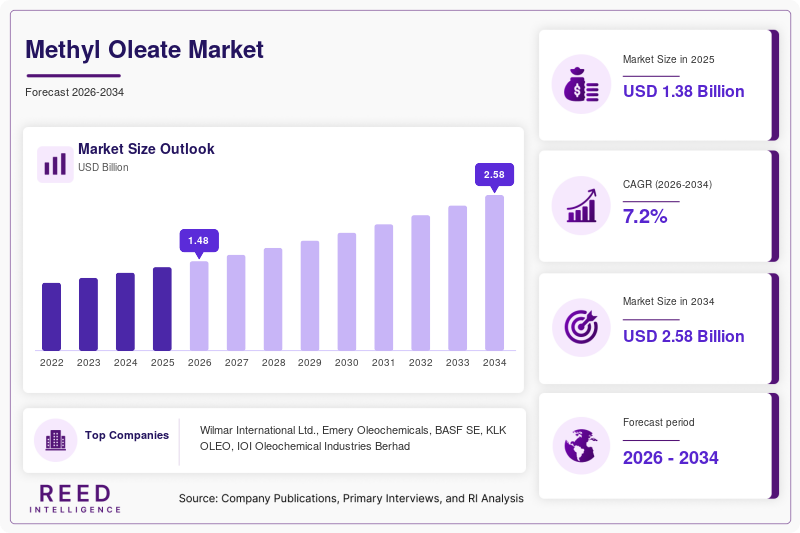
The global Methyl Oleate Market size was valued at USD 1.38 billion in 2026 and is projected to reach USD 2.41 billion by 2034, expanding at a CAGR of 7.2% during 2026–2034. The market reflects steady expansion driven by the increasing use of bio-based chemicals across industrial applications. Methyl oleate, a fatty acid methyl ester derived primarily from vegetable oils, is widely used as a solvent, lubricant, and intermediate in chemical synthesis.
One of the major global factors supporting the growth of the Methyl Oleate Market is the shift toward sustainable and biodegradable chemical solutions. Governments and industries worldwide are transitioning from petroleum-based products to renewable alternatives to meet environmental regulations and reduce carbon footprints. This transition has accelerated the adoption of methyl oleate in coatings, personal care, agriculture, and metalworking fluids.
Key Highlights:
- Asia Pacific dominated the market with 38.5% share, while it is expected to register the fastest CAGR of 8.1%
- Lubricants segment led with 32.4% share, while agrochemicals segment is projected to grow at a CAGR of 8.6%
- Industrial grade accounted for the highest share among types, while pharmaceutical grade is expected to grow fastest at 7.9% CAGR
- The U.S. market was valued at USD 310 million in 2024 and USD 328 million in 2025
Market Trends
Rising Adoption of Bio-Based Lubricants
The increasing demand for environmentally acceptable lubricants has significantly influenced the Methyl Oleate Market. Industries such as automotive, marine, and heavy machinery are gradually replacing mineral oil-based lubricants with bio-based alternatives. Methyl oleate offers superior biodegradability, low toxicity, and effective lubrication properties, making it suitable for environmentally sensitive applications. Regulatory frameworks encouraging the use of green chemicals have further accelerated adoption. This trend is particularly visible in developed economies where environmental compliance standards are stringent.
Expansion in Personal Care and Cosmetics Formulations
Another key trend shaping the Methyl Oleate Market is its growing use in personal care products. Methyl oleate is increasingly utilized as an emollient and carrier oil in skincare and cosmetic formulations due to its skin-friendly properties. The rising demand for natural and organic beauty products has pushed manufacturers to incorporate plant-derived ingredients. As consumer awareness regarding ingredient transparency increases, companies are reformulating products using sustainable components, which is expected to strengthen market demand.
Market Drivers
Increasing Demand for Green Solvents
The shift toward environmentally friendly solvents has emerged as a key driver of the Methyl Oleate Market. Industries such as paints, coatings, and adhesives are seeking alternatives to volatile organic compounds (VOCs). Methyl oleate provides a viable solution due to its low volatility and biodegradability. Regulatory policies limiting VOC emissions have encouraged manufacturers to adopt safer substitutes, thereby boosting market growth.
Growing Use in Agrochemical Formulations
The agricultural sector has also contributed to the growth of the Methyl Oleate Market. It is widely used as an adjuvant in pesticide formulations to enhance spreading and absorption efficiency. Increasing global food demand has led to higher agrochemical usage, indirectly driving methyl oleate consumption. Moreover, its compatibility with bio-based agricultural inputs aligns with the growing trend toward sustainable farming practices.
Market Restraint
Price Volatility of Raw Materials
A major challenge faced by the Methyl Oleate Market is the fluctuating prices of raw materials such as vegetable oils, including soybean and palm oil. These feedstocks are subject to supply-demand imbalances influenced by climatic conditions, geopolitical factors, and trade policies. Price volatility can affect production costs and profit margins for manufacturers.
Additionally, competition with food-grade applications for vegetable oils can create supply constraints, impacting availability for industrial use. This situation is particularly relevant in regions heavily dependent on imports. Manufacturers are increasingly exploring alternative feedstocks and improving supply chain resilience, but raw material dependency continues to limit market stability.
Market Opportunities
Development of High-Purity Grades for Pharmaceuticals
The demand for high-purity methyl oleate in pharmaceutical applications presents a strong growth opportunity. It is used as a solvent and excipient in drug formulations. As pharmaceutical manufacturing expands globally, particularly in emerging economies, the need for high-quality bio-based ingredients is increasing. This trend is expected to create new revenue streams for manufacturers focusing on premium-grade products.
Expansion in Industrial Cleaning Applications
Another emerging opportunity in the Methyl Oleate Market is its use in industrial cleaning formulations. Methyl oleate’s solvency and low toxicity make it suitable for degreasers and cleaners in manufacturing facilities. With increasing emphasis on worker safety and environmental compliance, industries are transitioning toward safer cleaning agents. This shift is likely to boost adoption across sectors such as automotive and heavy engineering.
Segmental Analysis
By Type
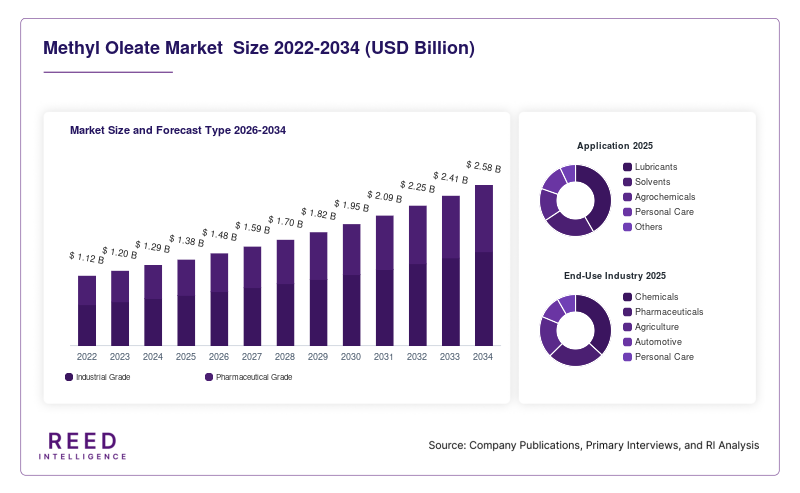
Industrial grade methyl oleate dominated the Methyl Oleate Market with a 61.3% share in 2025. Its widespread use in lubricants, solvents, and industrial applications contributed to its leading position. The cost-effectiveness and availability of industrial-grade variants have made them suitable for large-scale usage.
Pharmaceutical grade methyl oleate is expected to grow at the fastest CAGR of 7.9% during the forecast period. This growth will be driven by increasing demand for high-purity ingredients in drug formulations and medical applications. Stringent quality requirements will further boost demand for premium-grade products.
By Application
Lubricants accounted for the largest share of 32.4% in 2025. The increasing use of biodegradable lubricants in industrial machinery and automotive applications supported this dominance. Methyl oleate’s performance characteristics make it a preferred choice in environmentally sensitive operations.
Agrochemicals are projected to grow at the fastest CAGR of 8.6%. This growth will be driven by rising agricultural productivity requirements and increasing use of adjuvants in pesticide formulations. The shift toward sustainable agriculture will further support segment expansion.
By End-Use Industry
The chemical industry dominated with a 34.1% share in 2025. The extensive use of methyl oleate as an intermediate in chemical synthesis contributed to this dominance. The versatility of the compound in multiple reactions makes it valuable in industrial processes.
The pharmaceutical industry is expected to grow at a CAGR of 7.8%. Growth will be driven by increasing demand for bio-based excipients and solvents in drug manufacturing. Expanding pharmaceutical production capacities globally will further support this segment.
By Distribution Channel
Direct sales accounted for the largest share of 58.2% in 2025. Bulk purchasing by industrial users and long-term supply agreements contributed to this dominance. Direct distribution ensures consistent quality and cost advantages for buyers.
Online distribution channels are expected to grow at a CAGR of 8.3%. The increasing adoption of digital procurement platforms will facilitate easier access to suppliers. This trend will be particularly significant among small and medium enterprises.
Regional Analysis
North America
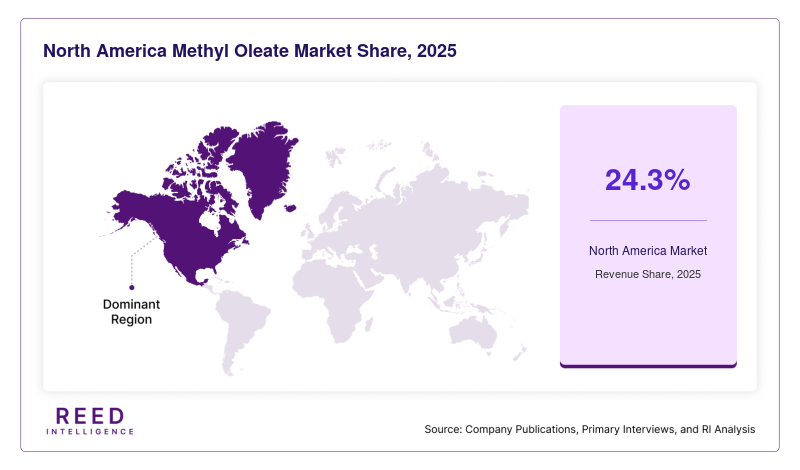
North America accounted for 24.3% of the Methyl Oleate Market share in 2025 and is projected to grow at a CAGR of 6.5% during 2026–2034. The region’s growth trajectory will be supported by strong regulatory frameworks promoting sustainable chemicals and increasing demand across industrial applications. The presence of advanced manufacturing infrastructure and early adoption of bio-based alternatives will further support market expansion.
The United States remained the dominant country in the region due to its robust chemical industry and increasing use of bio-lubricants. The growth factor is linked to rising investments in renewable chemical production technologies, which have enabled manufacturers to scale production efficiently.
Europe
Europe held 22.7% market share in 2025 and is expected to expand at a CAGR of 6.8% over the forecast period. The region’s strict environmental regulations and commitment to reducing carbon emissions will drive demand for bio-based chemicals. Government initiatives supporting green chemistry will play a key role in shaping market growth.
Germany dominated the European market due to its strong industrial base and focus on sustainable manufacturing. The growth factor is attributed to increased demand from the automotive and industrial sectors, where eco-friendly lubricants are gaining traction.
Asia Pacific
Asia Pacific led the Methyl Oleate Market with a 38.5% share in 2025 and is anticipated to grow at the fastest CAGR of 8.1%. Rapid industrialization and expanding agricultural activities will drive market growth. The availability of raw materials and cost-effective production will also contribute to regional expansion.
China emerged as the dominant country due to its large-scale chemical production capabilities. The growth factor is associated with increasing domestic demand and export opportunities for bio-based chemicals.
Middle East & Africa
The Middle East & Africa accounted for 7.4% share in 2025 and is projected to grow at a CAGR of 6.2%. The region’s growth will be driven by gradual industrial development and increasing adoption of sustainable chemical products. Investments in diversification of economies beyond oil will support market expansion.
Saudi Arabia dominated the region due to its expanding industrial base. The growth factor lies in the development of chemical manufacturing hubs and increasing focus on downstream industries.
Latin America
Latin America held 7.1% market share in 2025 and is expected to grow at a CAGR of 6.7%. The region’s growth will be supported by rising agricultural activities and increasing demand for agrochemicals. The availability of raw materials such as soybean oil will also contribute to market expansion.
Brazil was the leading country due to its strong agricultural sector. The growth factor is linked to increasing demand for bio-based inputs in farming and industrial applications.
Competitive Landscape
The Methyl Oleate Market is moderately fragmented, with several global and regional players competing on product quality, pricing, and distribution networks. Key companies are focusing on expanding production capacities and developing high-purity grades to cater to specialized applications.
The market leader, Wilmar International Ltd., has strengthened its position through integrated supply chains and continuous investment in bio-based chemical production. The company recently expanded its oleochemical production capacity to meet rising global demand.
Other players are emphasizing strategic partnerships, technological advancements, and geographic expansion to enhance their market presence. Increasing competition is expected to drive innovation and improve product offerings across the market.
Key Players List
- Wilmar International Ltd.
- Emery Oleochemicals
- BASF SE
- KLK OLEO
- IOI Oleochemical Industries Berhad
- Croda International Plc
- Stepan Company
- Godrej Industries Limited
- VVF Ltd.
- Musim Mas Holdings
- Oleon NV
- Ecogreen Oleochemicals
- Timur Oleochemicals
- AAK AB
- Cargill Incorporated
Recent Developments
- In 2025, major producers increased investments in bio-based chemical facilities to expand methyl oleate production capacity.
- Several companies launched high-purity methyl oleate variants targeting pharmaceutical applications.
- Strategic collaborations were formed between agrochemical manufacturers and oleochemical producers to develop advanced formulations.
- Expansion of distribution networks in emerging markets improved product accessibility.
Methyl Oleate Market Segments
Type
- Industrial Grade
- Pharmaceutical Grade
Application
- Lubricants
- Solvents
- Agrochemicals
- Personal Care
- Others
End-Use Industry
- Chemicals
- Pharmaceuticals
- Agriculture
- Automotive
- Personal Care
Distribution Channel
- Direct Sales
- Distributors
- Online
By Region
- North America
- Europe
- APAC
- Middle East and Africa
- LATAM